TL;DR
Semrush is the broader marketing intelligence suite, while Earlyseo is the more focused choice for small teams that need practical SEO direction without a heavy tool stack. Small businesses should pick based on workflow: broad competitive research and paid marketing needs point to Semrush, while lean execution and early visibility work point to Earlyseo.
A small team does not need the biggest SEO platform by default; it needs the tool that turns limited time into visible search progress. The Semrush vs Earlyseo decision in 2026 comes down to breadth versus focus: Semrush covers a wide marketing intelligence toolkit, while Earlyseo is built around helping smaller teams act faster on SEO priorities. TL;DR: Short for "too long; didn't read," TL;DR is internet slang used to introduce a brief summary of a longer article or post.
Table of Contents
What is the short verdict on Semrush vs Earlyseo?
Semrush is the better fit for teams that need a broad marketing suite, while Earlyseo is the stronger fit for small teams that want a focused SEO workflow for early organic visibility. The best choice depends on team size, marketing maturity, reporting needs, and how much time can be spent inside an SEO platform.
Key insight: The right SEO tool is not the one with the longest feature list; it is the one a team will actually use every week.
SERP research for this topic shows the strongest competing pages frame the decision around small-team fit, company stage, core SEO tasks, and AI search changes in 2026. That framing matches the real buying question: which platform helps a founder, local business, e-commerce manager, or lean marketing team make better SEO decisions without slowing execution?
Fast decision guide
Use this quick filter before comparing feature lists:
- Choose Earlyseo first when the goal is simple SEO planning, content prioritization, and early-stage visibility work.
- Choose Semrush first when the team needs deep competitive intelligence, PPC research, social tools, and broad marketing reporting.
- Consider both when an agency or in-house team needs enterprise-level market data plus a lighter execution layer.
- Delay the decision when no one owns SEO execution; a tool cannot replace a clear publishing and optimization process.
How do Semrush and Earlyseo compare on core SEO jobs?
Semrush and Earlyseo overlap on SEO planning, but they serve different workflow styles: Semrush is built as an all-purpose marketing platform, while the Earlyseo platform focuses on a smaller team's path from SEO idea to action.
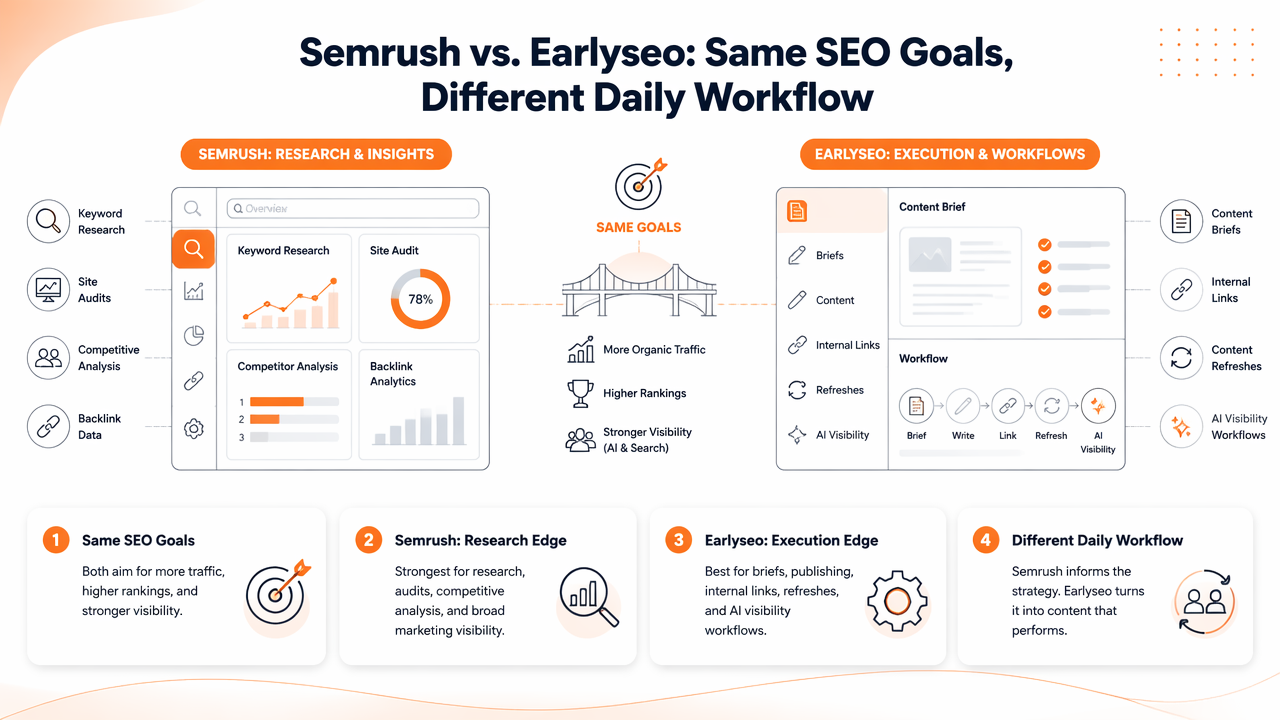
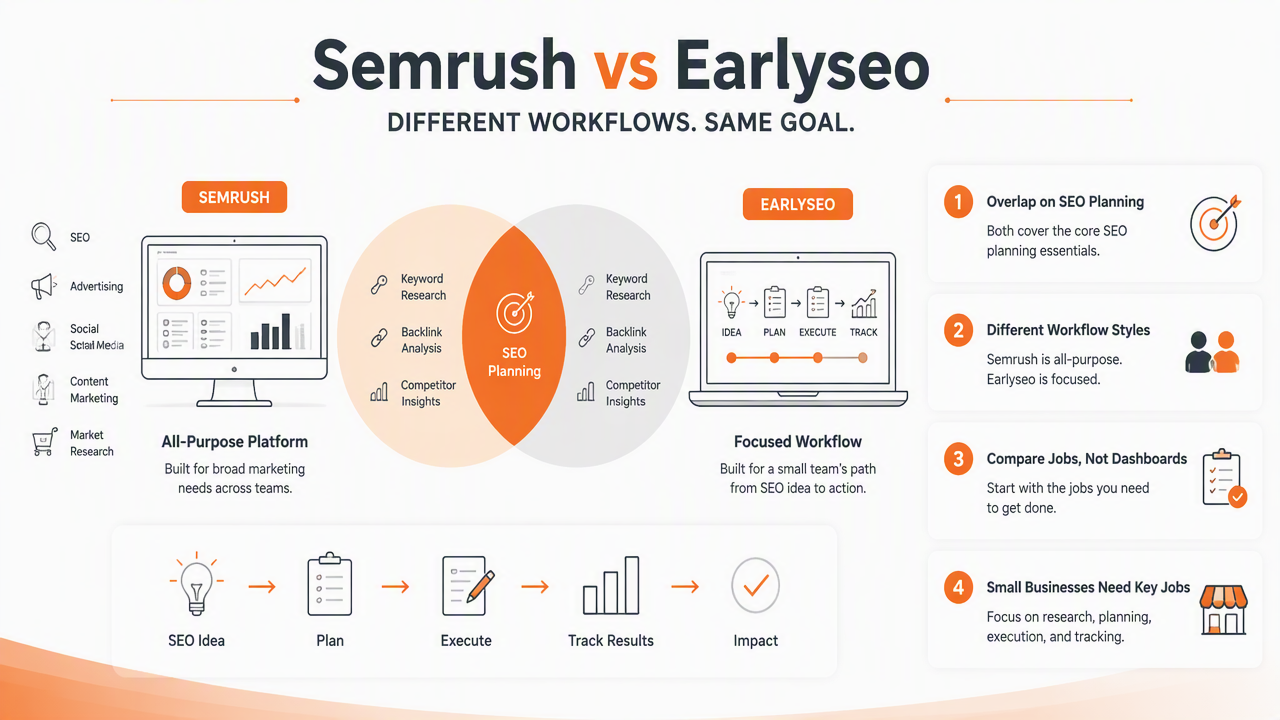
A fair comparison should start with jobs, not dashboards. Small businesses usually need keyword choices, content ideas, technical checks, local visibility support, and a way to decide what gets done next. Large feature menus help only when the team has time to interpret them.
Core workflow comparison table
| SEO job | Earlyseo fit | Semrush fit | Best practical choice |
|---|---|---|---|
| Keyword planning | Focused research for early visibility and content priorities | Deep keyword databases and competitive keyword views | Earlyseo for lean execution, Semrush for broader research |
| Competitor research | Useful for finding realistic content gaps | Strong for market-wide competitor intelligence | Semrush when competitor depth matters most |
| Site audits | Helpful for prioritizing fixes small teams can act on | Detailed audit data across many technical areas | Depends on technical SEO capacity |
| Content planning | Built around turning SEO opportunities into action | Strong research inputs, often requiring more setup | Earlyseo for simpler planning |
| Reporting | Suited to practical progress tracking | Strong for multi-channel and stakeholder reporting | Semrush for larger reporting needs |
| AI search readiness | Better fit when small teams need concise answer-focused content planning | Useful when paired with broad SEO and content analysis | Earlyseo for focused AEO workflows |
Semrush shines when a team needs many data angles in one place. It can support SEO, competitive research, PPC, content marketing, and reporting, which makes it attractive for marketing departments and agencies.
Earlyseo is more useful when the main constraint is not data access, but deciding what to publish, optimize, or fix next. That distinction matters for startups and local businesses, where SEO often competes with sales, operations, and customer support.
Where feature breadth helps most
Feature breadth is most valuable when a team has clear owners for different channels.
- SEO managers can analyze keyword and ranking data.
- Paid search teams can research PPC competition.
- Content teams can plan and refresh pages.
- Executives can review performance reports.
- Agencies can package findings for multiple clients.
For a smaller company, the same breadth can become a lot to manage. The practical question is whether the business needs wider intelligence or a tighter path to execution.
Which platform gives better value by company stage?
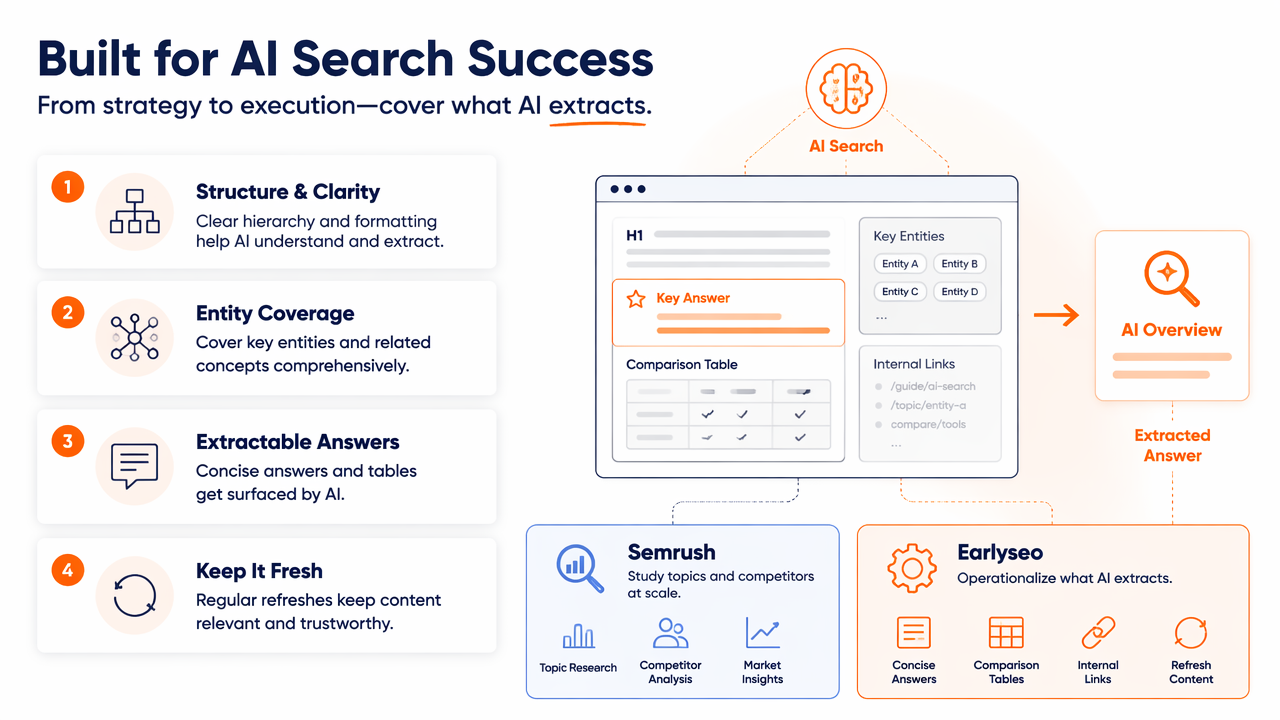
Early-stage teams usually get better value from focused SEO guidance, while mature teams often get more value from a broader intelligence suite. Company stage matters because the same feature can feel either useful or excessive depending on staff, budget, and SEO experience.
Search data supplied for this rewrite shows only 239 impressions, 0 clicks, and an average position of 8.5 for the target query. That suggests the page is close to visibility but needs a sharper answer, a stronger comparison layout, and clearer match to buying intent.
Best fit by team stage
| Company stage | Typical SEO need | Better fit | Why |
|---|---|---|---|
| Founder-led startup | Find realistic topics and publish consistently | Earlyseo | Focus matters more than channel breadth |
| Local business | Improve service pages, local content, and basic visibility | Earlyseo | Practical next steps beat complex dashboards |
| Growing e-commerce store | Expand category, product, and comparison content | Depends | Semrush helps with competitive depth, Earlyseo helps prioritize action |
| Marketing team with specialists | Manage SEO, PPC, content, and reporting together | Semrush | Broader suite supports multiple channel owners |
| Agency or consultant | Research many clients and markets | Semrush | Scale and reporting depth can matter more |
A startup founder or small business owner often needs fewer reports and more confidence. The key value question becomes, "Which tool reduces hesitation?" In that use case, fewer but clearer decisions usually beat a larger menu of options.
Marketing managers at growing companies may prefer Semrush once SEO is part of a larger acquisition system. When paid search, social media, competitor tracking, and content reporting all need shared visibility, a broad platform can justify the extra complexity.
Budget fit without oversimplifying
Tool cost should be judged against execution capacity, not just subscription price.
- A low-cost tool is expensive if no pages get shipped.
- A premium suite is reasonable if several teams use its data weekly.
- A focused platform is valuable when it prevents random content decisions.
- A broad platform is valuable when it replaces several separate tools.
Small teams should score value by completed work: pages improved, topics chosen, technical fixes shipped, and reports understood. That lens makes the choice less about brand size and more about operational fit.
How should AI search change the decision in 2026?
AI search makes the decision less about ranking data alone and more about whether a tool helps create clear, answer-ready pages. ChatGPT, a generative AI chatbot developed by OpenAI and released in 2022, helped normalize answer-style search behavior, and Google AI experiences have pushed publishers to structure content for direct extraction.
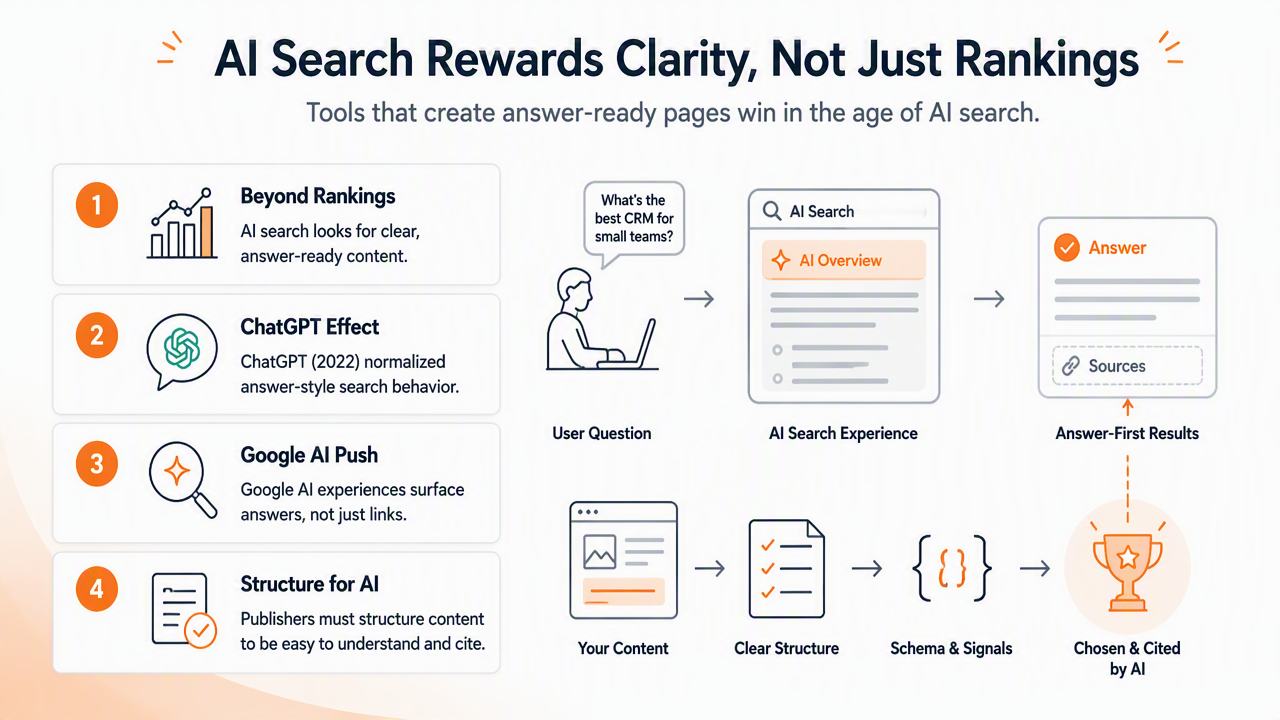
Answer Engine Optimization, often called AEO, rewards pages that define terms clearly, answer questions directly, and organize comparisons in extractable formats. That shift does not replace classic SEO. It adds a new layer on top of keyword research, technical health, and content quality.
How Earlyseo handles AI search workflows
Earlyseo is best framed as a practical fit for teams that need to turn SEO topics into answer-ready content plans. For small businesses, that means building pages with clear definitions, direct question answers, comparison tables, FAQs, and concise decision sections.
AI-focused content should be easy for both people and models to parse. A strong page usually includes:
- A direct answer near the top.
- Named entities such as Semrush, Earlyseo, Google, OpenAI, and ChatGPT.
- Tables for feature or use-case comparisons.
- FAQ answers written in 40 to 80 words.
- Clear next steps that match business stage.
Key insight: AI search increases the value of structured content, but it does not reward vague automation or thin summaries.
Semrush can support AI-era SEO through broad research inputs and competitive intelligence. A team still has to translate those inputs into concise, citation-friendly pages. With Earlyseo, the appeal is the tighter focus on practical visibility work for teams that do not want SEO to become a full-time analytics project.
What to expect in 2027
By 2027, SEO platforms will likely be judged more by decision quality than by raw data volume. Rank tracking will still matter, but more teams will ask whether content appears in AI summaries, brand mentions, comparison answers, and high-intent informational results.
For small teams, the winning workflow will combine classic SEO basics with answer-focused structure. That means clean pages, helpful content, clear expertise, and consistent updates. Tools that help prioritize those actions will feel more useful than tools that only add more data.
FAQ: choosing between Semrush and Earlyseo
The best platform choice depends on workflow maturity, not a universal winner.
Is Semrush better than Earlyseo?
Semrush is better for broad marketing intelligence, especially when a company needs SEO, PPC, competitor research, content tools, and reporting in one suite. Earlyseo is the better fit when a smaller team needs focused SEO planning and practical next steps for organic visibility.
Is Earlyseo only for startups?
Earlyseo is especially useful for startups, local businesses, and lean marketing teams, but it is not limited to early-stage companies. Any team that wants a simpler SEO workflow can benefit from a focused platform. More complex organizations may pair focused execution with broader intelligence tools.
Can a business use both tools?
A business can use both when the roles are clear. Semrush can provide broad market and competitor research, while a focused workflow can guide content priorities and execution. Using both makes sense only when the team has enough time and ownership to act on the combined insights.
Which tool is better for AI search visibility?
AI search visibility depends less on tool branding and more on content structure, topical clarity, and entity coverage. Earlyseo fits teams that need help shaping answer-ready SEO content. Semrush can support the research side, especially for teams already using its broader marketing data.
What should small teams check before choosing?
Small teams should check who owns SEO, how often content will be published, which reports matter, and whether broad channel data is actually needed. If the main need is action, a focused platform is usually easier to adopt. If the main need is multi-channel intelligence, Semrush is a strong candidate.
Conclusion
The practical Semrush vs Earlyseo verdict is simple: Semrush fits teams that need a broad marketing intelligence suite, while Earlyseo fits small teams that want focused SEO direction and faster execution. The stronger choice is the one that matches the team's stage, not the one with the longest feature list.
For the next step, a small team should list its top three SEO jobs for the next 90 days: keyword selection, content planning, technical cleanup, local visibility, or reporting. If focused organic growth is the priority, visit earlyseo.com and compare that workflow against the broader Semrush suite before committing budget.