TL;DR
Google AI Overviews can turn search results into an instant answer, so small businesses need clear pages, trusted local signals, and content that answers real customer questions. The best action is not chasing tricks, but strengthening Google Business Profile data, service pages, FAQs, reviews, and Search Console tracking.
Google AI Overviews for small business now shape the first impression many searchers see before visiting a website. AI Overviews are Google Search summaries generated with artificial intelligence that appear near the top of some results and synthesize information from web pages, business listings, and other signals. Small business: a company, partnership, or sole proprietorship with fewer employees or lower annual revenue than larger enterprises. For lean teams, the practical goal is simple: become clear, useful, and trustworthy enough for Google's AI systems to understand. Earlyseo helps smaller teams connect search performance, keyword opportunities, and content fixes in one workflow, without turning SEO into a full-time job.
Table of Contents
What are Google AI Overviews for small business?
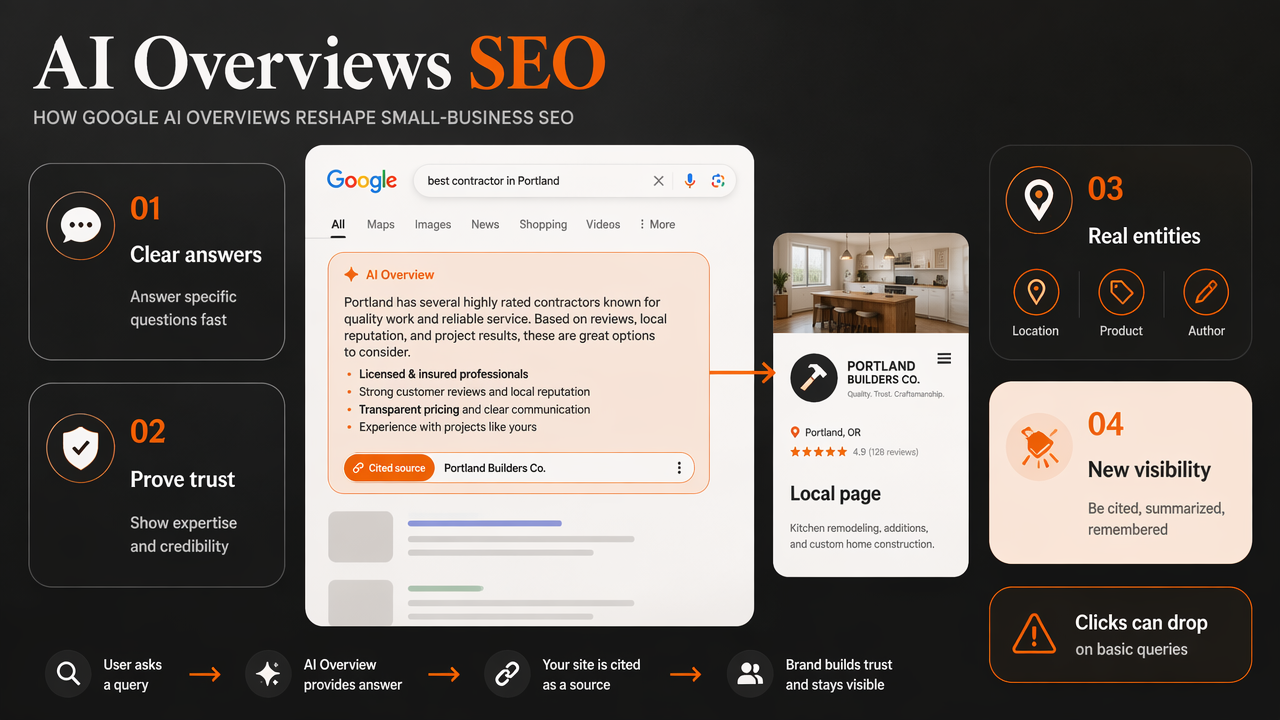
Google AI Overviews for small business are AI-generated search summaries that can answer customer questions, compare options, and surface local or commercial information before a traditional organic click happens. In 2026, they matter because the answer box can influence brand discovery, trust, and traffic from high-intent searches.
Google's AI feature uses large language model technology, associated with the Gemini family, to produce synthesized answers. Research on deep learning by Alzubaidi, Zhang, and Humaidi explains the broader technical field behind modern AI systems, including neural network architectures and real-world applications, in the Journal of Big Data.
For a small business, the concern is not only ranking on page one. The larger issue is whether search engines can confidently describe the business, its services, prices, service area, policies, and proof of credibility.
Key insight: AI Overviews reward pages that make facts easy to extract, verify, and connect to a real business entity.
Core terms small teams should know
- AI Overview: an AI-generated answer shown inside Google Search for selected queries.
- Citation: a source link Google may show inside or near the AI-generated answer.
- Entity: a clearly identifiable business, person, product, location, or topic.
- Local intent: a search where the user likely wants a nearby provider, store, or service area.
- Search Console: Google's reporting tool for impressions, clicks, average position, and query data.
Small business SEO has always depended on clarity, but AI search raises the bar. A thin homepage, vague service descriptions, and outdated local profiles give AI systems less reliable material
Why AI Overviews change small business SEO
AI Overviews change small business SEO by moving part of the buying conversation directly into Google's results page. A searcher may compare providers, read a definition, check common pricing factors, or learn what to ask before clicking a website.
That shift does not make SEO pointless. It makes structured, useful content more valuable. A business that explains services clearly can still win visibility, even when the final click happens later in the buying path. For owners still questioning the channel, this guide on whether small businesses need SEO gives useful context.
AI-generated summaries also create risk. If public information is inconsistent across a website, Google Business Profile, reviews, and local directories, the summary may be incomplete or less favorable. Research by Mehrabi, Morstatter, and Saxena surveys bias and fairness issues in machine learning, showing why data quality and representation matter in AI systems: ACM Computing Surveys paper.
AI Overview impact by business type
| Business type | Searches affected | Best content to build | Local signal to strengthen |
|---|---|---|---|
| Local services | "best plumber near me," "AC repair cost" | Service pages, cost guides, FAQs | Google Business Profile categories and reviews |
| E-commerce stores | "best handmade candles," "product vs product" | Product guides, comparison pages, shipping details | Merchant data and product schema |
| Professional services | "bookkeeper for startup," "estate lawyer fees" | Expertise pages, process explainers, case-style examples | Reviews, credentials, location pages |
| Restaurants and retail | "gluten-free bakery nearby," "gift shop open now" | Menu, inventory, hours, accessibility details | Photos, hours, attributes, recent reviews |
Local businesses should treat Google Business Profile as part of the AI search layer, not a separate listing. A strong profile supports Maps visibility, traditional rankings, and AI confidence. Earlyseo's guide to optimizing a Google Business Profile for rankings is a practical next step for that work.
How can a small business appear in AI Overviews?
A small business can improve its chance of appearing in AI Overviews by publishing specific answers, proving real-world credibility, keeping local data consistent, and monitoring queries in Google Search Console. No business can force inclusion, but clean information gives Google better source material.
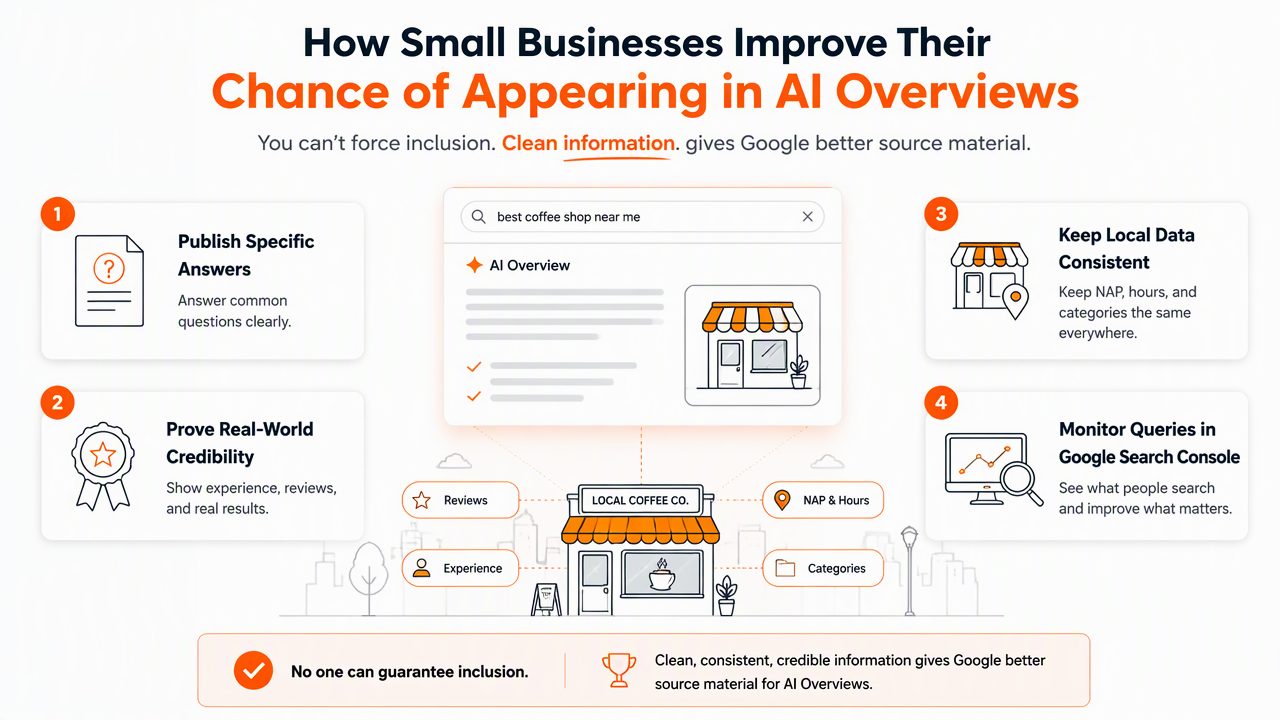
- Write one clear answer for each high-intent customer question.
- Support claims with business details, policies, photos, reviews, and author expertise.
- Keep names, addresses, phone numbers, hours, and services consistent.
- Add structured sections such as FAQs, comparison tables, and definition blocks.
- Track impressions and clicks to see which pages gain or lose visibility.
The Earlyseo platform is useful here because it helps connect query data with page-level SEO tasks. Teams that already use Search Console can also review Earlyseo's Google Search Console feature to spot pages that are close to ranking and worth improving first.
Content format that AI systems can extract
Google's AI answers tend to pull from content that is direct and well organized. Small pages do not need academic length, but they do need clean structure.
- Put the short answer near the top of the page.
- Use descriptive H2 and H3 headings that match real searches.
- Add tables for comparisons, pricing factors, service areas, and eligibility.
- Include examples tied to a location, product, or customer need.
- Avoid vague claims such as "best quality" without proof.
A service business, for example, should not rely on a single "Services" page. Separate pages for emergency repair, installation, maintenance, and pricing factors give search systems more precise information. For service providers, SEO for service-based businesses covers that structure in more depth.
Proof signals that support trust
Machine learning systems classify and rank information using patterns, features, and signals. Sarker's 2021 overview of machine learning explains common algorithms, applications, and research directions in SN Computer Science.
For small businesses, trust signals are often practical rather than technical:
- Real address or service area details
- Staff names, certifications, and experience
- Recent customer reviews
- Original photos of work, products, or premises
- Clear refund, booking, warranty, or delivery policies
- Consistent business information across major platforms
Strong AI visibility usually starts with boring accuracy: names, locations, services, dates, and proof that the business is real.
What should small businesses avoid with AI search?
Small businesses should avoid treating AI Overviews as a loophole or shortcut. The safest strategy is building pages that help customers make decisions, then making those pages easy for Google to understand.
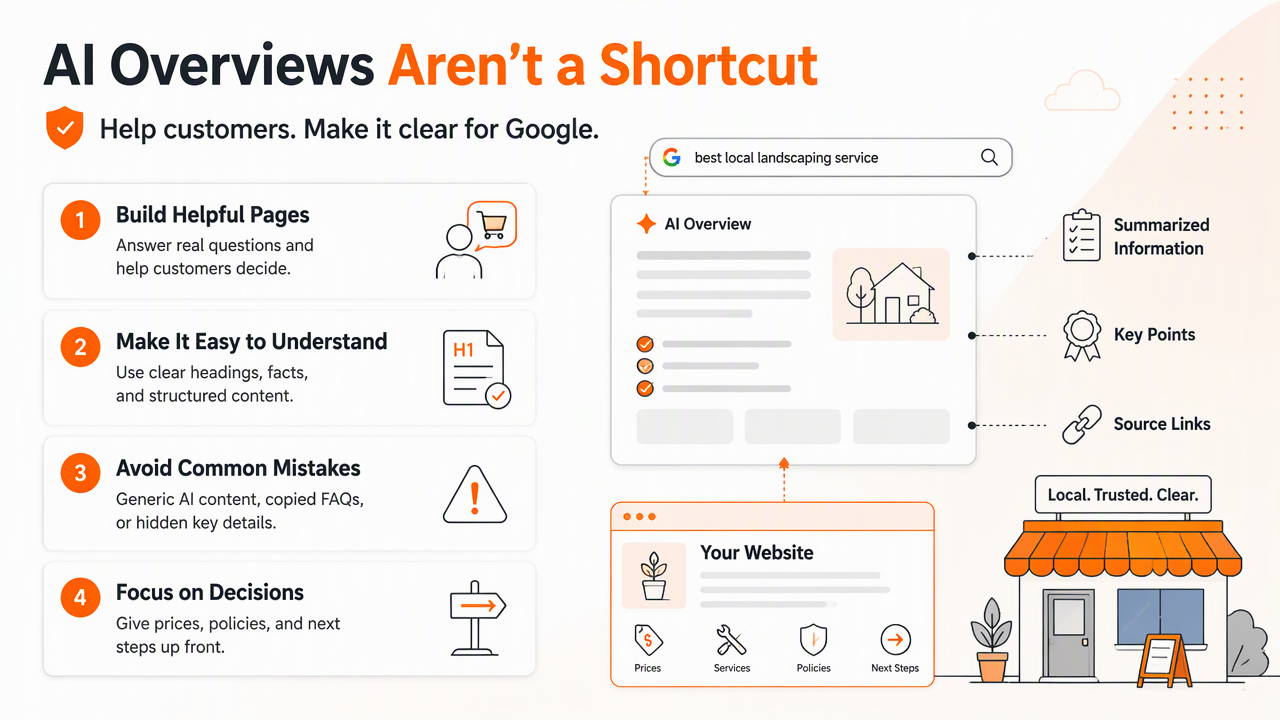
Common mistakes include publishing generic AI-written articles, copying competitor FAQs, hiding key details behind forms, and leaving local listings stale. These issues can weaken trust, even if the site has many pages. A sudden drop after broader search changes should be diagnosed carefully, and this guide to recovering from a Google algorithm update explains that process.
Outdated SEO tactics also create noise. Keyword stuffing, doorway location pages, fake reviews, and thin comparison pages can make a business look less reliable. AI search increases the value of accuracy because summaries depend on source material.
A practical audit checklist
- Homepage: states who the business serves, where it operates, and what it sells.
- Service or product pages: answer pricing, timing, process, qualifications, and objections.
- Google Business Profile: matches website categories, hours, services, and contact details.
- Reviews: recent feedback reflects the services promoted on the site.
- Images: original photos show the team, location, products, or completed work.
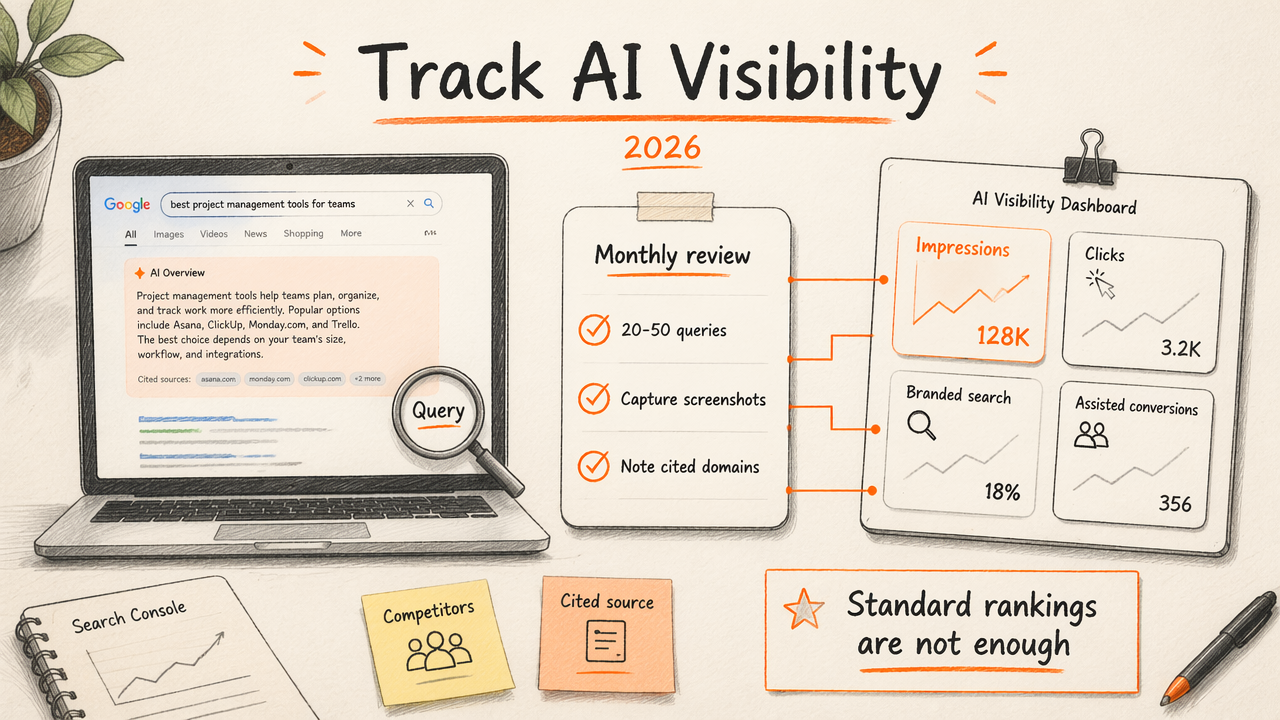
- Search Console: queries are reviewed monthly for rising impressions and low clicks.
Small teams with limited budgets can still make progress by improving one page and one listing at a time. A realistic plan for local SEO without a big budget can pair well with this checklist.
What should small businesses expect next in 2027?
Small businesses should expect AI search to become more blended with local, shopping, and review-based results in 2027. The direction is clear: search engines will keep answering more questions directly while still needing reliable source pages and business data.
In practical terms, visibility may depend less on one blue-link ranking and more on presence across several answer surfaces. A business may appear in an AI Overview, a local pack, a product result, a review snippet, or a traditional organic listing for the same topic.
That means measurement needs to mature. Impressions may rise while clicks flatten. Some visitors may arrive later after repeated exposure. Branded searches may grow after the business appears in non-branded AI answers. With Earlyseo, teams can watch those patterns and prioritize pages that already show demand. More guidance and tools are available at earlyseo.com.
FAQ: Google AI Overviews and small business visibility
Can a business pay to be cited in Google AI Overviews?
No research data provided here shows a direct paid placement option for organic AI Overview citations. Paid search and organic AI citations should be treated as separate visibility channels. The practical focus should be clear content, accurate listings, reviews, and pages that answer high-intent questions better than competing results.
Do AI Overviews reduce website traffic?
AI Overviews can answer some searches before a click, so some informational traffic may become harder to win. Still, commercial and local searches often require action, such as booking, calling, comparing, or buying. Strong pages remain valuable because Google needs sources and customers need proof before choosing a business.
Is Google Business Profile important for AI Overviews?
Google Business Profile is important because it contains structured local information, including categories, hours, reviews, photos, and services. For local businesses, those details help search systems understand what the business does and where it operates. Website content and profile data should match closely.
How often should small businesses update content for AI search?
Important pages should be reviewed at least quarterly, especially service pages, pricing information, hours, product availability, and FAQs. Fast-changing industries may need more frequent updates. Search Console data should guide priorities, because pages with impressions but weak clicks often need clearer titles, answers, or proof.
Does schema markup guarantee AI Overview visibility?
Schema markup does not guarantee inclusion, but it can help search engines understand page content. LocalBusiness, Product, FAQ, Review, and Organization markup may support clarity when used accurately. Schema works best when the visible page content already provides complete, trustworthy information.
Conclusion
Google AI Overviews for small business are not just another search feature; they are a new layer of customer discovery. The best response is a tighter SEO foundation: accurate local data, helpful service pages, proof-rich content, structured answers, and regular Search Console review. A sensible next step is to choose one high-intent page, add a clear 50-word answer, improve the matching Google Business Profile details, and track the query trend for 30 days. For a guided workflow, visit earlyseo.com and use Earlyseo to turn those findings into a focused SEO action plan.