TL;DR
AI brand visibility depends on whether answer engines can identify, verify, and explain a company with confidence. The best path is to clarify the entity, publish comparison-ready content, earn third-party corroboration, and track the prompts where the brand should appear.
AI visibility optimization for brand queries has moved from an SEO side project to a brand risk issue: when ChatGPT, Google AI Overviews, Perplexity, or AI Mode summarizes a company, the answer may become the first impression. Earlyseo helps growing teams treat those answers as measurable search surfaces, not random AI behavior.
AI visibility optimization for brand queries: the practice of making a brand easier for AI answer engines to identify, describe, compare, and cite when people search for the company, its category, or alternatives.
Generative engine optimization, often called GEO, is the broader practice of structuring digital content and managing online presence to improve visibility in generative AI responses. For brand queries, GEO gets more specific: the goal is not just traffic, but accurate naming, category fit, trust signals, and repeatable mentions.
Key insight: AI systems do not only need content. They need consistent evidence that a brand exists, belongs to a category, and deserves to be included in an answer.
Table of Contents
What is AI visibility optimization for brand queries?
AI visibility optimization for brand queries means shaping the public evidence AI systems use to answer searches about a company, product, category, or competitor set. It combines entity SEO, structured content, third-party validation, answer-ready explanations, and prompt tracking so AI tools can mention the brand accurately and confidently.
Traditional SEO usually asks, "Can a page rank?" Brand visibility in AI asks, "Can an answer engine understand and recommend the company?" That shift matters because AI answers often compress many sources into one response.
Core terms AI systems need to resolve
| Term | Plain-English meaning | Brand query example |
|---|---|---|
| Entity | A distinct company, product, person, or place | "Earlyseo" as a named company |
| Category | The market or use case the entity belongs to | "SEO software for new websites" |
| Attribute | A feature, audience, price point, or strength | "helps new domains build visibility" |
| Corroboration | External proof from trusted sources | Reviews, directories, mentions, comparisons |
| Citation path | The source trail an AI answer can reference | Website pages, profiles, articles, documentation |
Brand queries are not limited to exact company names. They include "best tools for X," "Company A vs Company B," "alternatives to Company A," "is Company A good for Y," and "who offers Z near me." Each query type needs a different proof set.
A newer company has a harder job because fewer third-party signals exist. Founders building from zero can pair this work with SEO for a brand new domain so search engines and AI systems learn the entity at the same time.
How do AI systems decide which brands to name?
AI systems tend to name brands when public information makes the entity clear, the category match strong, and the evidence repeatable across multiple sources. They are more likely to include a company when content explains what it does, who it serves, how it compares, and where independent sources confirm those claims.
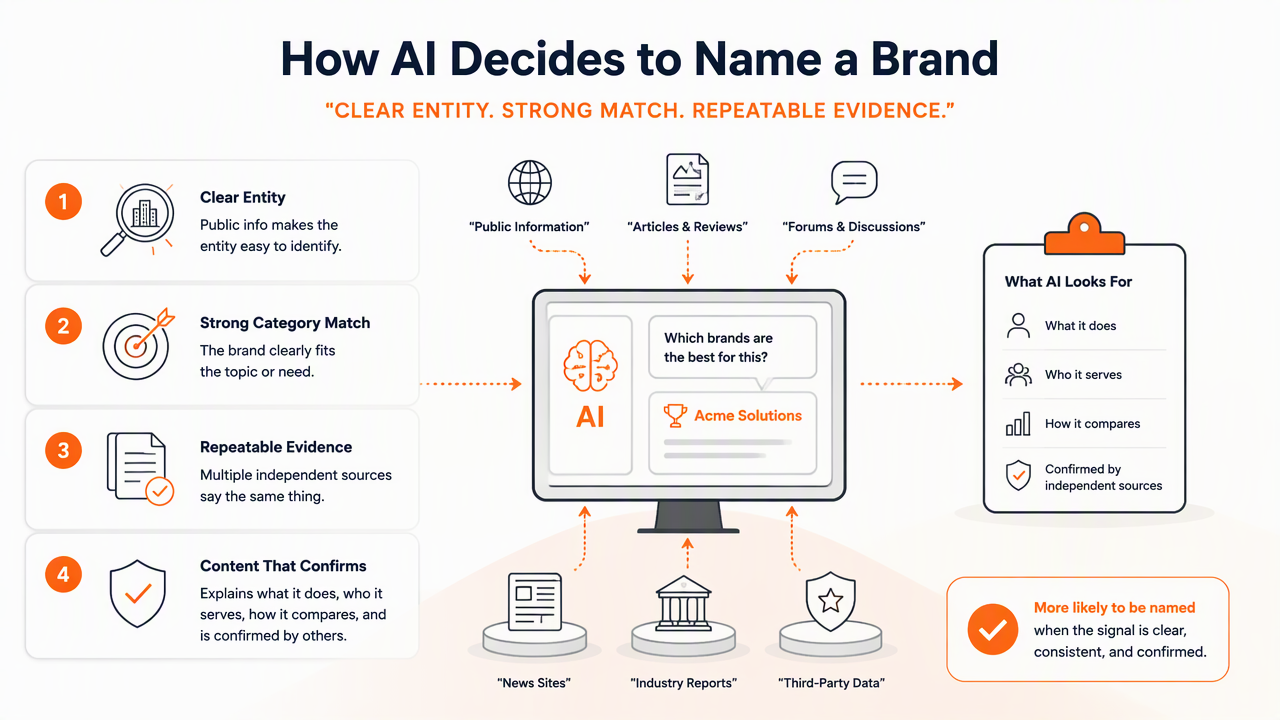
Answer engines are not simple rank trackers. They blend retrieval, summarization, entity recognition, source evaluation, and language generation. That means visibility can change across prompts that look similar to a human but signal different intent to a model.
Research on explainable AI shows why traceable reasoning matters in high-stakes systems. A 2022 paper on explainable artificial intelligence in medical image analysis by Bas H. M. van der Velden, Hugo J. Kuijf, and Kenneth G. A. Gilhuijs examined how AI outputs can be made more interpretable for users (Medical Image Analysis, 2022). Brand search is lower stakes than medicine, but the same practical lesson applies: unclear inputs make explanations weaker.
Brand signals that answer engines can reuse
| Signal | What it helps AI infer | What to publish or earn |
|---|---|---|
| Clear homepage positioning | Company identity and category | One-sentence category definition above the fold |
| Product and use-case pages | Fit for specific problems | Pages for audiences, workflows, and industries |
| Comparison pages | Evaluation context | Fair "X vs Y" and "alternatives" pages |
| FAQ pages | Direct answer snippets | Short answers to buying and support questions |
| Review and directory profiles | Third-party corroboration | Consistent listings on relevant platforms |
| Authoritative mentions | Trust and notability | Partner pages, podcasts, articles, reports |
The Galaxy Community's 2024 update on the Galaxy platform focused on accessible, reproducible, and collaborative data analyses (Nucleic Acids Research, 2024). The brand lesson is straightforward: repeatable information beats scattered claims. If the same category, features, and audience appear across the web, AI systems get a cleaner pattern.
Key insight: A brand does not become AI-visible because one page says the right thing. It becomes visible when many reliable pages say compatible things.
How should a brand make its entity unambiguous?
A brand should make its entity unambiguous by standardizing its name, category, audience, descriptions, structured data, and third-party profiles across every indexable source. AI systems need a stable identity graph before they can describe the company correctly or include it in category-level recommendations.
The cleanest approach starts with an entity brief. This is a short internal document that defines how the brand should appear across the website, social profiles, review sites, press mentions, and partner pages.
Entity clarity checklist for 2026
- Lock the canonical brand name. Use the same capitalization, spacing, and suffix everywhere.
- Write a one-sentence category definition. Name the product type, audience, and main outcome.
- Create an "about" page with facts. Include founding context, location if relevant, leadership, contact details, and product scope.
- Add structured data. Use
Organization,Product,SoftwareApplication,FAQPage, andsameAsproperties where they fit. - Align external profiles. Keep category labels, descriptions, logos, and links consistent across directories and social sites.
- Publish comparison context. Explain which alternatives exist and when each option makes sense.
- Refresh FAQs quarterly. Add questions found in sales calls, support chats, customer reviews, and AI prompt tracking.
Structured data does not guarantee inclusion in an AI answer, but it reduces ambiguity. The point is to help crawlers connect the brand website, profiles, authors, products, and references into one entity.
The star schema concept from data warehousing offers a useful analogy. A star schema has a central fact table connected to related dimension tables. A brand can mirror that idea by making the official website the central source, then connecting supporting pages for products, people, reviews, locations, and use cases.
A simple brand entity model
| Hub or spoke | Brand asset | Purpose |
|---|---|---|
| Hub | Homepage | Canonical identity and category |
| Spoke | Product page | Features, outcomes, pricing fit |
| Spoke | Comparison page | Evaluation and alternatives |
| Spoke | FAQ page | Direct answers for AI snippets |
| Spoke | Review profiles | Independent validation |
| Spoke | Author pages | Expertise and accountability |
Misalignment creates confusion fast. If a website says "AI SEO tool," a directory says "content agency," and a social profile says "marketing analytics," an answer engine may avoid the brand or summarize it poorly.
How Earlyseo handles branded AI visibility
Earlyseo helps teams turn branded and category-level queries into a structured optimization workflow, from entity clarity to answer-ready content and visibility tracking. The strongest use case is for startups, local companies, ecommerce stores, and growing marketing teams that need search systems to understand the brand earlier.
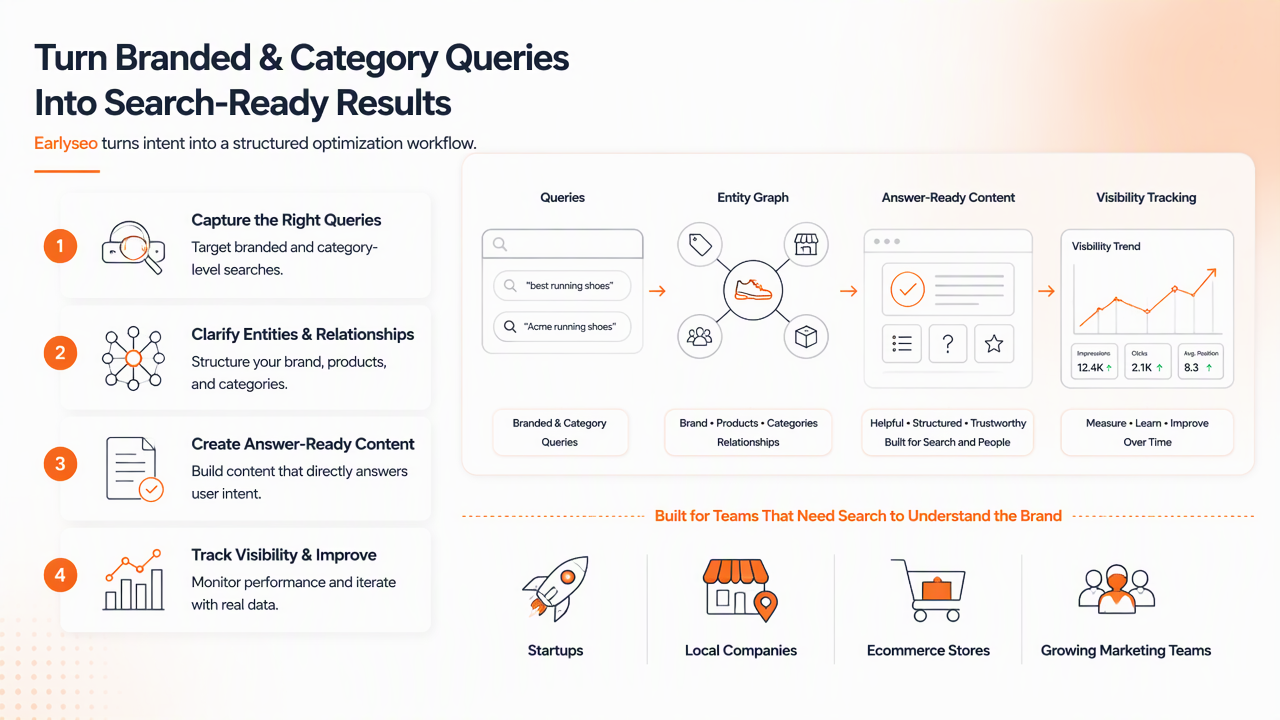
The Earlyseo platform fits this work because AI visibility is not one asset. It is a loop: define the entity, publish clear pages, measure AI answers, spot missing proof, then improve the source material.
AI-ready brand query framework
| Query type | What the AI answer needs | Best content asset |
|---|---|---|
| "What is Brand?" | Accurate definition | Homepage, about page, knowledge panel signals |
| "Brand reviews" | Trust and experience evidence | Review pages, testimonials, third-party profiles |
| "Brand vs Competitor" | Fair comparison | Side-by-side comparison page |
| "Best tools for Category" | Category fit and differentiation | Use-case page, list-style proof, awards if earned |
| "Brand alternatives" | Positioning and buyer fit | Alternatives page with honest tradeoffs |
| "Is Brand good for Audience?" | Audience match | Industry or persona page |
Strong comparison content is often missing from smaller brands. That gap matters because AI systems answer evaluation prompts with named options. A brand that never explains its place in the market gives answer engines less to work with.
A good comparison page should be fair, not defensive. It should define the category, list decision criteria, explain strengths, state limits, and identify who should pick which option. AI systems can reuse that structure because it matches the shape of many recommendation answers.
What to publish first
- One canonical "What is [Brand]?" page section with a plain definition.
- One category page that names the market and audience.
- Three FAQ blocks for pricing, use cases, and comparisons.
- Two comparison pages for the most common competitor or alternative searches.
- One proof page collecting reviews, case studies, customer logos, or public mentions.
For newer companies, this order works better than publishing many broad blog posts. It gives AI systems the facts needed to place the brand before trying to win broad informational demand.
What should teams track in 2026 and 2027?
Teams should track AI visibility by monitoring real prompts, brand mentions, answer sentiment, cited sources, competitor inclusion, and missing proof across AI answer engines. In 2027, measurement will likely move closer to share-of-answer reporting, where brands compare how often they appear across commercial prompts.
Keyword rankings still matter, but they do not show the whole picture. AI systems may answer a brand or category question without sending a click, so visibility measurement needs to capture presence inside the answer itself.
AI visibility metrics that matter
- Brand mention rate: how often the brand appears for target prompts.
- Citation rate: how often the brand's own pages or third-party mentions are cited.
- Category accuracy: whether AI systems describe the company in the right market.
- Competitor overlap: which brands appear beside it.
- Sentiment and framing: whether the answer presents the brand positively, neutrally, or with uncertainty.
- Prompt coverage: how many awareness, comparison, and buying prompts return useful answers.
A 2022 paper by Soumyadeb Chowdhury, Prasanta Kumar Dey, and Sian Joel-Edgar examined AI capability frameworks in human resource management (Human Resource Management Review, 2022). For marketers, the useful takeaway is capability-based thinking: visibility improves when people, process, data, and tools work together.
What changes next
| 2026 focus | 2027 direction |
|---|---|
| Prompt testing by hand | Automated prompt panels by audience and funnel stage |
| Basic AI mention tracking | Share-of-answer dashboards |
| SEO content updates | Entity graph and citation-path management |
| Standalone FAQs | Modular answer blocks reused across pages |
| General comparison pages | More specific "for audience" and "for use case" comparisons |
AI visibility will probably become less mysterious as reporting improves. Still, brands with clean entity data and strong third-party proof will keep an advantage because those signals help both search engines and answer engines.
Earlyseo is especially relevant where teams need a practical system rather than scattered experiments. The goal is not to chase every model update. The goal is to make the brand easier to understand wherever AI answers are generated.
FAQ about AI brand visibility
AI brand visibility questions usually focus on timing, content formats, structured data, and measurement. The short answer is that brands need both owned content and outside validation, because answer engines look for clear claims that can be supported by more than one source.
How long does AI visibility optimization take?
AI visibility improvements can appear in weeks for owned content changes, but stronger brand inclusion usually takes longer because third-party signals need time to be crawled, indexed, and associated with the entity. A practical review cycle is monthly prompt testing plus quarterly content and profile updates.
Does schema markup make a brand appear in AI answers?
Schema markup can help clarify a brand's entity, products, FAQs, and social connections, but it does not force inclusion in AI answers. It works best when paired with clear page copy, consistent external profiles, useful comparisons, and reputable third-party mentions.
Are comparison pages safe for brand reputation?
Comparison pages are safe when they are factual, fair, and specific. The best pages avoid attacking competitors and instead explain buyer fit, product strengths, limits, pricing context, and use cases. That format helps prospects and gives AI systems balanced material ### Should local businesses optimize for AI brand queries?
Local businesses should optimize because AI assistants increasingly answer "near me," service, reputation, and recommendation searches. Location pages, Google Business Profile consistency, reviews, local citations, service FAQs, and clear contact details all help AI systems connect the business to a place and need.
Conclusion
AI visibility optimization for brand queries works best when a company treats the brand as an entity, not just a website. The next step is simple: define the brand clearly, publish answer-ready pages, earn corroboration, and track the prompts that matter most.
Earlyseo gives growing teams a practical way to organize that work and measure progress. For a focused audit of branded and category-level AI visibility, visit earlyseo.com and start with the queries where the brand should already be showing up.