TL;DR
The best small-business SEO consultant should show clear proof, explain the work in plain language, and match the business model: local, ecommerce, service-based, or content-led. Strong options usually combine technical fixes, local visibility, content planning, and monthly reporting, while risky providers lean on vague guarantees or low-priced packages with no strategy.
The best SEO consultants for small businesses are not always the biggest agencies; the strongest fit is usually the provider that can tie search work to calls, bookings, sales, or qualified leads. Search engine optimization: the practice of improving website visibility and performance in search engine results pages so more qualified visitors can find a business. For small teams, that means fewer vanity reports and more practical work: Google Business Profile cleanup, technical fixes, useful content, and conversion tracking. A tool-supported workflow also matters, which is where Earlyseo can help small teams organize SEO tasks, publishing, and optimization without turning the process into agency jargon.
Table of Contents
What should the best SEO consultants for small businesses provide?
The best SEO consultants for small businesses should provide a clear audit, a practical growth plan, local or ecommerce SEO where relevant, measurable reporting, and honest expectations about timelines.
Small businesses are commonly defined as corporations, partnerships, or sole proprietorships with fewer employees or lower revenue than larger companies. That matters because SEO recommendations need to fit limited time, budget, and staff.
A strong consultant usually covers five areas:
- Technical SEO: crawlability, indexation, site speed, redirects, schema, and page structure.
- Local SEO: Google Business Profile, citations, service pages, reviews, and local landing pages.
- Content strategy: keyword mapping, blog topics, product pages, FAQs, and internal links.
- On-page SEO: titles, headings, meta descriptions, image alt text, and conversion-focused copy.
- Measurement: rankings, organic traffic, leads, calls, sales, and page-level performance.
A useful consultant explains which work affects visibility, which work affects conversions, and which work can wait.
SERP research for this topic found 195 results and several ranking pages focused on agency lists, local SEO packages, or service pricing. That leaves a gap for buyers: how to judge consultants before signing anything.
A practical consultant deliverables checklist
A small-business SEO engagement should start with a written scope, not a sales promise.
- Audit the current website, Google Business Profile, analytics, and search visibility.
- Prioritize fixes by business impact, difficulty, and cost.
- Map target pages to buyer intent and location intent.
- Improve important pages before publishing large volumes of new content.
- Report on leads, bookings, revenue signals, and rankings.
- Review progress every month and adjust the plan.
For teams managing content internally, the Earlyseo blog publishing workflow can support consultant-led strategy by keeping optimization and publishing work organized.
Which SEO consultant type fits a small business?
The right consultant type depends on budget, growth target, site complexity, and whether the business needs local leads, ecommerce sales, or broader content visibility.
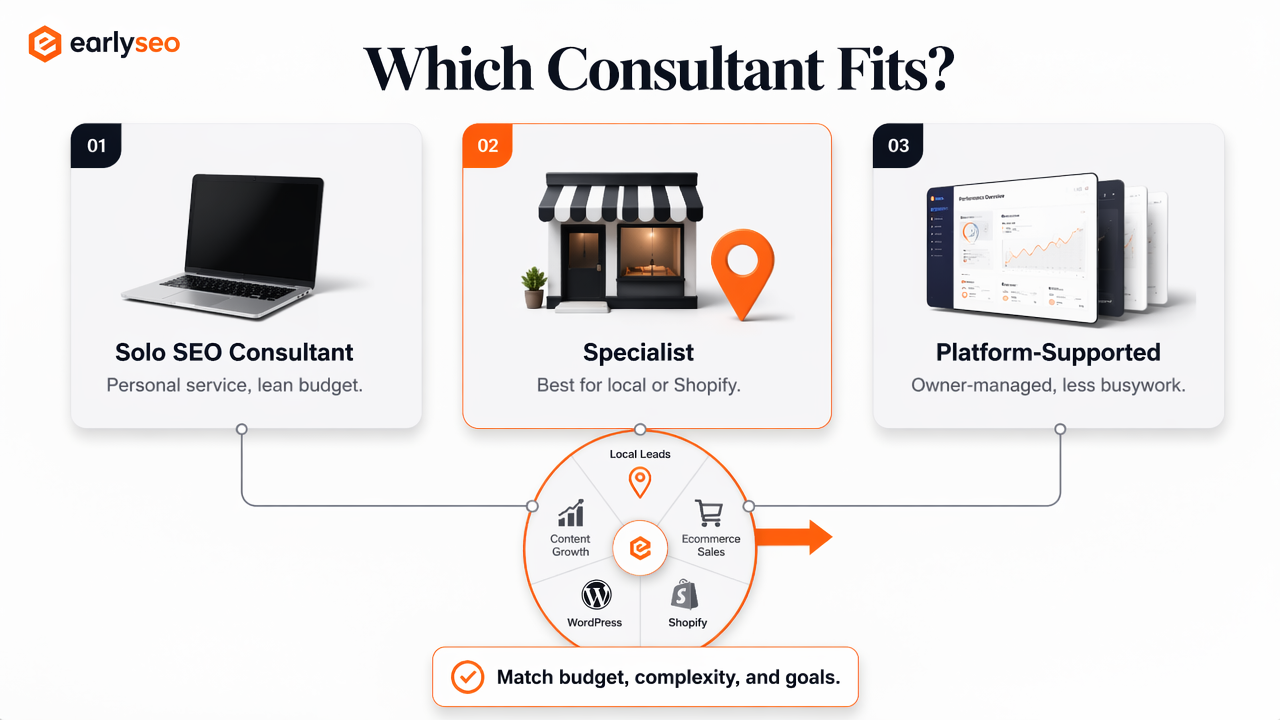
No single provider type wins every case. A solo consultant may beat an agency for personal service. A specialist may beat a generalist for Shopify, WordPress, or local SEO. A platform-supported approach can reduce busywork when an owner or marketing manager handles execution.
Comparison of consultant types, pricing models, and use cases
| Consultant type | Common pricing model | Best fit | Main strength | Watch closely |
|---|---|---|---|---|
| Solo SEO consultant | Monthly retainer or project fee | Local services, startups, lean teams | Direct access and flexible strategy | Limited capacity |
| Boutique SEO agency | Monthly retainer | Growing service businesses | Broader skills across content, tech, and local | Account quality can vary |
| Local SEO specialist | Monthly local package | Dentists, contractors, restaurants, clinics | Google Business Profile and local rankings | May ignore content depth |
| Ecommerce SEO consultant | Retainer plus project work | Shopify or catalog-heavy stores | Product, collection, and technical SEO | Needs platform experience |
| Content SEO strategist | Monthly or per-brief pricing | B2B, SaaS, publishers | Topic clusters and organic lead capture | May lack technical skills |
| SEO software plus advisor | Subscription plus light consulting | Cost-conscious teams | Repeatable workflows and ownership | Requires internal execution |
Third Marble publicly lists local SEO service tiers starting at $499 per month for smaller websites, which gives a useful market reference for packaged local SEO pricing (Third Marble local SEO services). Some providers cost less, but very low budgets often restrict the work to advice, audits, or basic monitoring.
The best fit is rarely the cheapest option; the better question is which provider can remove the biggest growth constraint first.
How should proof and pricing be evaluated before hiring?
Proof should be evaluated by relevance, transparency, and business impact rather than screenshots of rankings with no context.
A consultant does not need famous clients to be credible. Better evidence includes before-and-after examples, a sample audit, page-level recommendations, anonymized reporting, and a clear explanation of how work connects to revenue. For ecommerce stores, proof should include product or collection page wins. For local firms, proof should include map visibility, calls, direction requests, and service-area pages.
Pricing should match the workload. A five-page local website has different needs than a Shopify store with hundreds of products. For ecommerce teams, platform-specific execution matters, so a consultant familiar with Shopify SEO publishing and optimization can reduce delays between strategy and implementation.
Questions that separate serious consultants from sellers
A good evaluation process uses specific questions.
- What pages should be fixed first, and why?
- Which keywords show buying intent rather than research intent?
- How will local visibility be tracked?
- What work is included each month?
- Which tasks require client input, developer time, or content approval?
- How are leads, calls, form fills, or sales attributed?
- What will the first 90 days look like?
Strong answers are specific. Weak answers hide behind "proprietary methods," guaranteed rankings, or unclear monthly activity.
A useful first 90-day plan often includes:
- Month 1: audit, tracking, technical fixes, competitor review, priority page plan.
- Month 2: page rewrites, local profile improvements, internal links, content briefs.
- Month 3: new content, review requests, schema, reporting, and plan refinement.
Contracts should define ownership. The business should retain access to Google Analytics, Google Search Console, Google Business Profile, CMS accounts, landing pages, and content assets.
How do local SEO services change the consultant search?
Local SEO services change the consultant search because the goal is not just website traffic; the goal is visibility in a real service area, map results, and high-intent local searches.
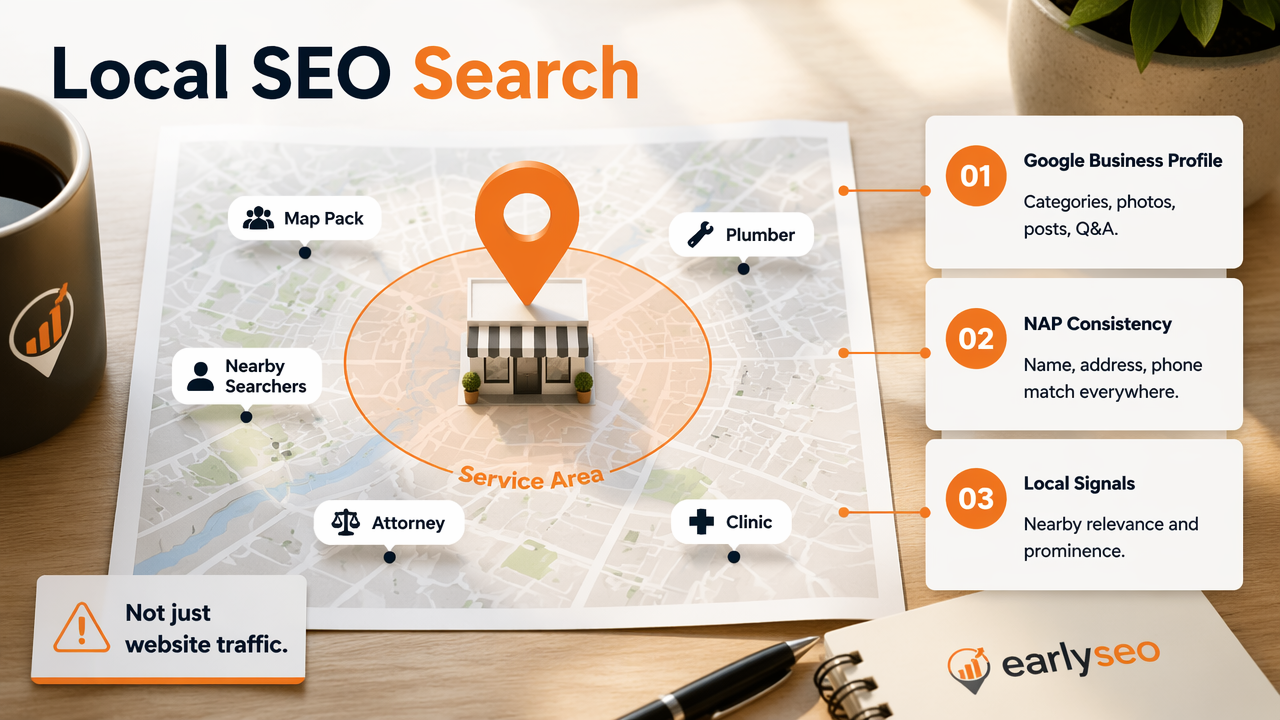
Local businesses need a consultant who understands proximity, relevance, and prominence signals. A generic content-only approach may miss the work that helps a plumber, attorney, clinic, gym, or home services company appear for nearby searchers.
Core local SEO tasks include:
- Google Business Profile category selection, services, photos, posts, and Q&A.
- Consistent business name, address, and phone data across citations.
- Location pages or service-area pages with unique local proof.
- Review generation systems that follow platform policies.
- Local schema and on-page trust signals.
- Internal links from service pages to supporting articles.
Local SEO should make a business easier to choose, not just easier to find.
A consultant should also explain what can and cannot be controlled. Distance from the searcher, competitor density, and review history all affect map visibility. Honest forecasting beats false certainty.
Local SEO red flags to avoid
Some sales pitches sound attractive because they remove uncertainty. Most deserve caution.
- Guaranteed first-place rankings in Google.
- Hundreds of directory submissions with no quality review.
- Duplicate city pages with swapped location names.
- Fake reviews or review gating.
- No access to reporting accounts.
- Link packages with no explanation of source quality.
- Monthly reports that list tasks but not outcomes.
Local SEO also needs clean publishing operations. Teams using WordPress.com can connect strategy to execution through WordPress.com SEO publishing support, while documentation-driven teams can standardize workflows with Earlyseo setup docs.
How does Earlyseo support consultant-led SEO in 2026?
Earlyseo supports consultant-led SEO by helping small teams turn recommendations into repeatable publishing and optimization workflows.
Many small businesses do not need a huge agency forever. They need a clean plan, a reliable way to publish optimized pages, and enough structure to keep SEO moving after the consultant finishes the audit. The Earlyseo platform fits that middle ground by supporting content operations across common website systems.
A consultant can still lead strategy. Earlyseo can help the business maintain momentum through organized page updates, content workflows, and integration-based execution. For small teams, that reduces the common gap between "the SEO report says what to do" and "the work actually went live."
Head to earlyseo.com when a consultant has created a plan but internal publishing still feels slow.
Who should pick which SEO path?
| Business situation | Best path | Why it fits |
|---|---|---|
| Brand-new local business | Local SEO consultant | Fastest focus on maps, reviews, and service pages |
| Growing ecommerce store | Ecommerce SEO specialist plus platform workflow | Product and collection pages need technical accuracy |
| Small team with some marketing skill | Consultant plus Earlyseo | Strategy stays expert-led while execution stays organized |
| Complex website migration | Technical SEO consultant | Redirects, crawl control, and indexation need specialist review |
| Content-led service business | Content SEO strategist | Topic authority and lead capture need consistent publishing |
The practical choice depends on the missing capability. If strategy is missing, hire a consultant. If execution is missing, add workflow support. If both are missing, combine a focused consultant with a platform that keeps implementation moving.
FAQ: hiring small-business SEO consultants
The best hiring decision comes from matching the provider to the business model, budget, and ability to implement recommendations.
How much should a small business spend on SEO consulting?
A small business should spend enough to cover meaningful work, not just reporting. Public local SEO packages in the research set started at $499 per month, while broader consulting often costs more depending on technical needs, content volume, and competition. A smaller budget can still fund an audit, keyword map, or focused local cleanup.
How long does SEO take for a small business?
Most small-business SEO programs need several months before patterns become clear. Technical fixes and local profile updates can show early movement, while content and authority building usually take longer. A consultant should define 30-day implementation goals, 90-day visibility goals, and longer-term traffic or lead expectations without promising exact rankings.
Is a freelancer or agency better for a small business?
A freelancer is often better for direct access, lower overhead, and focused strategy. An agency may fit better when the business needs content, development, analytics, and local SEO handled together. The better choice depends on skill coverage, communication quality, and whether the provider has experience with the exact business type.
Should a consultant guarantee SEO results?
A consultant should guarantee deliverables, communication, and reporting standards, not a specific Google ranking. Search results depend on competitors, location, website history, content quality, and algorithm changes. Strong providers explain controllable work clearly and report progress through visibility, traffic quality, leads, calls, and sales signals.
Conclusion
The best SEO consultants for small businesses combine practical strategy, clean execution, and proof tied to business outcomes. A smart hiring process starts with the business model: local service, ecommerce, content-led, or technical-heavy. Then it checks proof, scope, account ownership, reporting, and the first 90-day plan.
The next step is simple: shortlist three providers, request a sample audit or plan, compare deliverables in writing, and choose the one that explains tradeoffs most clearly. If execution support is the missing piece after the plan is built, Earlyseo and earlyseo.com can help turn SEO recommendations into published, trackable work.