TL;DR
Choose the primary category that matches the main revenue-driving service, then add only secondary categories that reflect real services. Competitor category research helps confirm local search norms, but irrelevant category stuffing can confuse relevance signals and weaken trust.
Google Business Profile categories are one of the strongest local relevance signals because they tell Google what a business is, not just what it sells. A plumber, urgent care clinic, Thai restaurant, and roofing contractor can all share a city, but category choices decide which local searches each profile can realistically match.
Google Business Profile category: a predefined business type selected inside a Google Business Profile to describe the business for Google Search and Google Maps. Google Maps is a mapping platform and consumer application that shows street maps, imagery, reviews, and local business results.
For founders and local operators, category selection belongs in the same early visibility workflow as location pages, reviews, and website SEO. The Earlyseo platform helps teams connect that local intent work with search-friendly content planning, especially when a business needs fast, clean visibility without guessing.
Table of Contents
What are Google Business Profile categories?
Google Business Profile categories are predefined labels that classify a business for local search, Maps discovery, profile features, and relevance matching. In 2026, public category databases report roughly 4,000 available options, including service, retail, medical, restaurant, contractor, education, and professional categories.
A category is not a keyword field. It is closer to a business classification system. A Google Account is required to access and manage many Google services, including business profile administration, so category changes normally happen inside the signed-in profile editing flow.
Public 2026 lists, such as LocalDominator's Google Business Profile categories guide, show how granular the system has become. "Restaurant" is broad, while "Thai Restaurant," "Brunch Restaurant," or "Vegan Restaurant" can better match specific demand.
Key insight: The best category is usually the plain-language business type a customer would expect to see on the storefront, invoice, menu, or appointment page.
Category terms local teams should know
Primary category: the main business type and the strongest category signal for local relevance.
Secondary category: an added business type that supports real services, departments, or offerings without replacing the primary focus.
Local pack: the map-style group of nearby results that often appears for searches with local intent.
Category stuffing: adding weak, unrelated, or aspirational categories only to appear for more searches.
Business feature unlock: a profile function that may appear only for certain categories, such as menus, booking links, hotel attributes, or service options.
Primary vs secondary categories
The primary category defines the core identity of a profile, while secondary categories expand eligible relevance only when they accurately match real offerings. A business should treat the primary field as a positioning decision and secondary fields as supporting evidence.
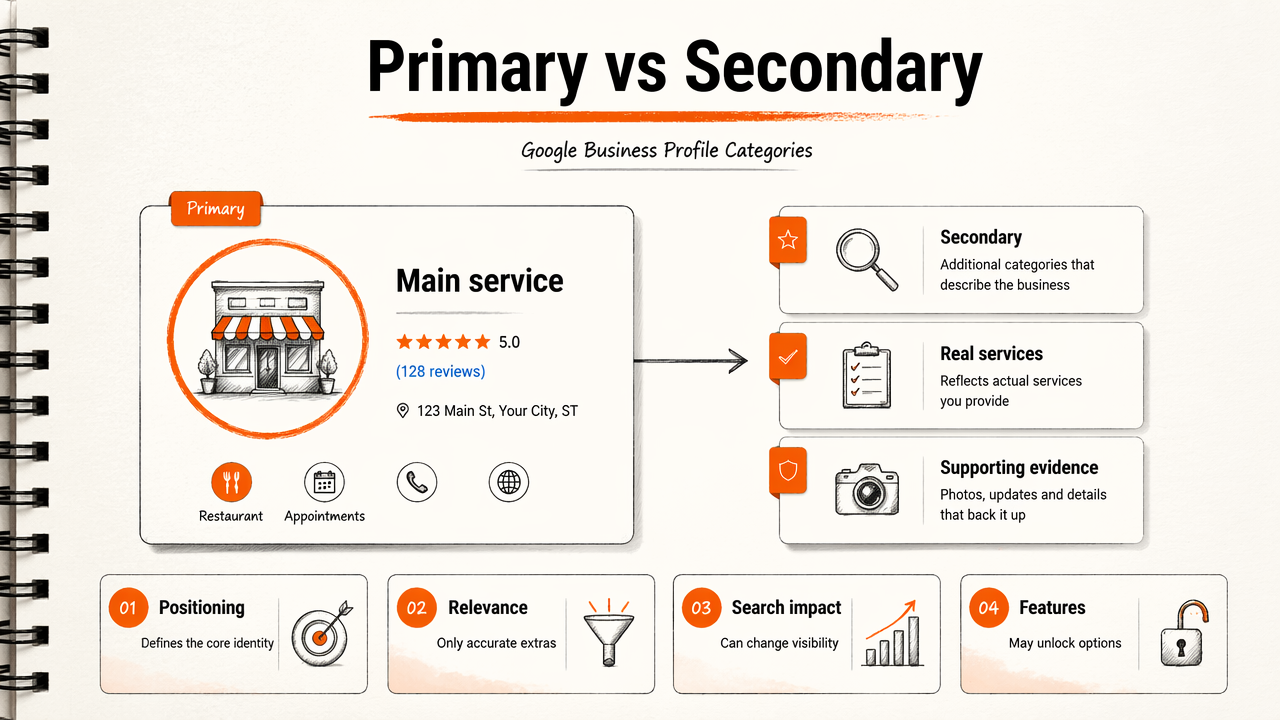
Changing the primary category can alter which searches a profile competes for. It may also affect profile features. For example, a restaurant category can support food-related attributes, while a medical category may surface appointment-related options depending on region and profile settings.
Secondary categories help when a business has multiple legitimate service lines. A dental clinic may use "Dentist" as the primary category and add "Cosmetic Dentist" or "Emergency Dental Service" if those services are actually provided.
Research on digital classification outside local SEO shows why structured labels matter. Sarker's 2021 overview of deep learning taxonomy and applications examined how classification approaches shape machine interpretation of data, a useful parallel for how named business entities must be categorized consistently online (Sarker, 2021).
Category examples by business type
| Business type | Strong primary category | Smart secondary categories | Risky choice |
|---|---|---|---|
| Service business | House Cleaning Service |
Commercial Cleaning Service, Window Cleaning Service |
Cleaning Products Supplier if no products are sold |
| Clinic | Medical Clinic |
Urgent Care Center, Family Practice Physician |
Hospital for a small outpatient office |
| Restaurant | Italian Restaurant |
Pizza Restaurant, Takeout Restaurant |
Caterer if catering is not offered |
| Contractor | Roofing Contractor |
Siding Contractor, Gutter Cleaning Service |
General Contractor when roofing is the only service |
| Ecommerce with showroom | Furniture Store |
Office Furniture Store, Mattress Store |
Warehouse if customers cannot shop there |
The strongest setup reflects what the business wants to rank for and what it can prove on its website, reviews, photos, services, and real-world operations. Earlyseo content planning can support that proof by aligning service pages and local landing pages with the same business focus.
How to choose the right business category
A business should choose the most specific primary category that describes its main service, then add secondary categories only for real, visible, and revenue-relevant offerings. The goal is not maximum coverage; the goal is clear local relevance.
The category decision should start with the business model, not a competitor list. Competitors can reveal common options, but the profile must match the actual business. A clinic that mainly provides physical therapy should not copy a nearby sports medicine clinic unless the services, staffing, and patient experience truly align.
For website support, service pages should reinforce the same language. A business using WordPress can connect publishing workflows through Earlyseo's WordPress integration, while store owners can keep category-led content aligned through the Shopify integration.
A 6-step category selection process
- List the main revenue source. Identify the service or product category that pays the bills, not every possible add-on.
- Search for the closest predefined label. Pick the category that matches the business type most directly.
- Check local competitors. Review top map results for the same high-intent searches.
- Map categories to proof. Confirm the website, services, photos, reviews, and staff support each chosen label.
- Add only relevant secondary options. Include categories that represent real services customers can buy now.
- Review after major business changes. Update categories when a business adds a department, drops a service, or changes its model.
A good test is simple: if a customer asked for that category service today, staff should be able to deliver it without redirecting the customer somewhere else.
How to research competitor categories
Competitor category research shows which classifications Google already associates with winning local results, but it should guide decisions rather than override business reality. The best research compares several top-ranking profiles, not just one visible competitor.
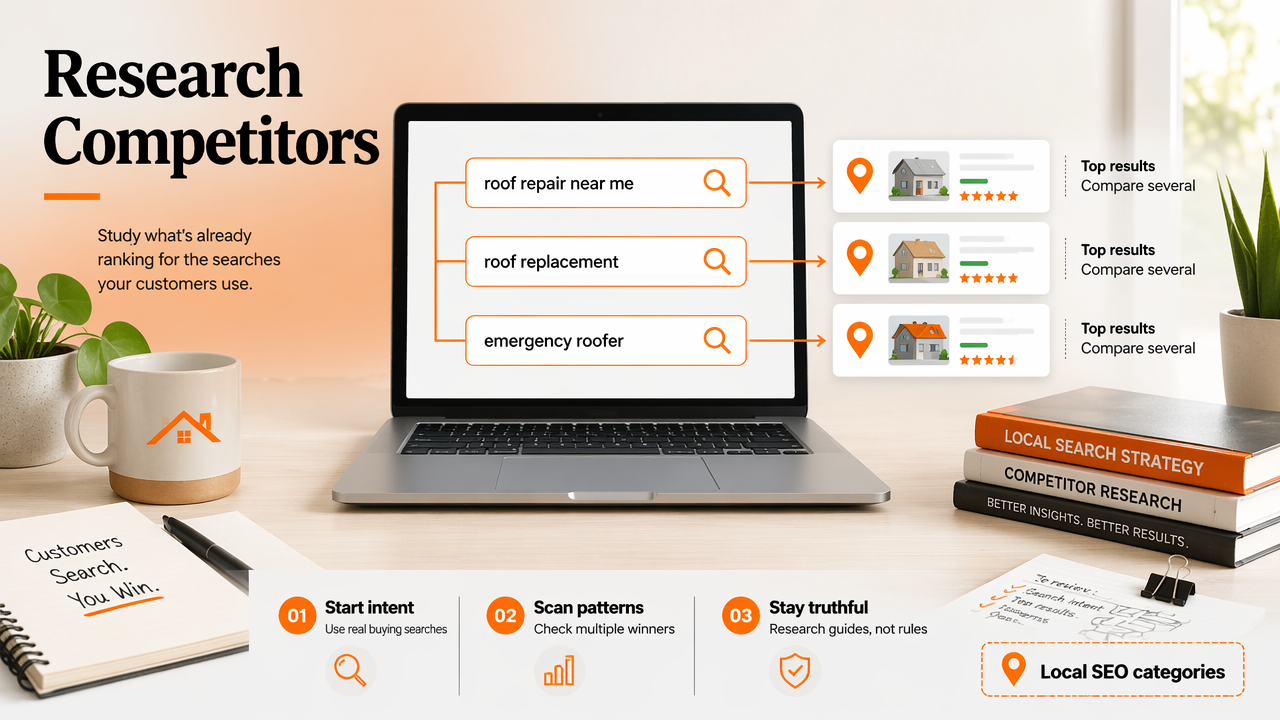
Start with searches that represent actual buying intent. A roofing company might check "roof repair near me," "roof replacement," and "emergency roofer." A restaurant might check cuisine, meal, and occasion queries, such as "Thai lunch," "takeout Thai food," or "best curry near me."
Category research pairs well with broader local content planning. The Earlyseo blog library gives small teams a place to build supporting search knowledge, while the Earlyseo documentation can help operational teams keep publishing workflows consistent.
Competitor category research checklist
- Search from the target city or service area, not from a random location.
- Record the top 5 to 10 map results for each important query.
- Note the visible primary category displayed on each profile.
- Open competitor profiles and look for services, menu items, appointment options, and attributes.
- Compare category choices against competitor websites, not just the profile label.
- Look for repeated patterns across winners, such as "Dentist" versus "Cosmetic Dentist."
- Reject categories that do not match the business's real offering.
Key insight: If three strong competitors use the same specific category and the business truly offers that service, that category deserves serious consideration.
What not to copy from competitors
Some profiles rank despite messy category choices, not because of them. A competitor may have strong proximity, high review volume, old citations, or brand demand that compensates for a weak category setup.
Category stuffing creates three problems. It can dilute the main business identity, create mismatches between profile and website content, and attract poor-fit leads. For example, a contractor that adds "Kitchen Remodeler" without offering remodels may earn irrelevant calls and weaker engagement.
A cleaner profile usually beats a crowded one. Google's systems are built around entity understanding, and vague entity signals make a business harder to classify with confidence.
FAQ about Google Business Profile categories
Google Business Profile categories should be reviewed whenever a business changes its services, location model, or primary revenue focus. Most stable businesses do not need frequent edits, but category choices should not be treated as a one-time setup task.
How many categories should a business choose?
A business should choose one accurate primary category and only the secondary categories that represent real services, departments, or products. There is no advantage in filling every possible category slot. A focused profile gives Google cleaner relevance signals and gives customers a clearer expectation before calling, booking, or visiting.
Can category changes improve rankings quickly?
A category change can affect visibility, especially when the previous primary category was too broad or wrong. Still, rankings also depend on proximity, reviews, website relevance, business information, and competition. Category edits should be measured over time rather than judged after a single day of movement.
Should a multi-location business use the same category everywhere?
A multi-location business should use the same primary category when each location has the same business model. Different categories make sense when locations offer different services, such as one medical office focused on urgent care and another focused on physical therapy. Consistency matters, but accuracy matters more.
Do service-area businesses need different category logic?
Service-area businesses should still choose the category that best describes the main service, even when customers do not visit a storefront. A locksmith, cleaner, roofer, or mobile mechanic needs category alignment across the profile, website, service pages, and reviews so Google can connect the business to local intent.
Conclusion
The smartest approach to Google Business Profile categories in 2026 is simple: pick the clearest primary category, support it with accurate secondary categories, and prove the choice across the profile and website. Service businesses, clinics, restaurants, contractors, and local retailers all benefit from fewer guesses and tighter relevance signals.
Next steps should be practical. Audit the current primary category, compare 5 to 10 local competitors, remove weak secondary labels, and align service pages with the chosen terms. For businesses building that wider search foundation, earlyseo.com offers a practical starting point with Earlyseo for turning local category decisions into publishable SEO work.