TL;DR
SEO operations turn SEO from random tasks into a repeatable system with owners, checklists, publishing cadence, measurement, and refresh cycles. Small teams should start with a clear workflow, one source of truth, weekly execution, and monthly quality reviews before adding more tools or channels.
Most SEO programs don't fail because teams lack ideas; they fail because no one owns the workflow after the idea appears. SEO operations is the practical system that turns keyword research, briefs, content, publishing, internal links, reporting, and updates into steady output. For growing teams, Earlyseo gives that system a clearer shape by connecting strategy, production, and performance tracking in one operating rhythm.
SEO operations: the repeatable process, roles, tools, and quality checks used to plan, produce, publish, measure, and improve organic search work.
Table of Contents
What is SEO operations?
SEO operations is the management layer behind search growth: it defines who does the work, when work ships, how quality is checked, and how results feed the next cycle. Unlike a one-time SEO audit, it runs every week and connects content, technical fixes, internal linking, and reporting into one repeatable process.
Google's Search Engine Optimization Starter Guide describes SEO as helping search engines understand content and helping users find useful pages. Operations takes that broad idea and makes it executable: briefs get written, pages get published, links get added, reports get reviewed, and stale content gets refreshed.
Key insight: strategy says what should happen; operations makes sure it actually happens.
A small company does not need a large department. It needs a shared queue, a few clear standards, and a cadence that survives busy weeks.
Core terms teams should define first
Keyword brief: a short document that defines the target query, search intent, audience, angle, headings, internal links, and quality requirements for a page.
Publishing cadence: the planned rhythm for shipping new or updated pages, such as two articles per week or four product page updates per month.
Content refresh: an update to an existing page based on ranking movement, outdated details, missing sections, weaker competitors, or changed search intent.
SEO backlog: the prioritized list of content, technical, linking, and reporting tasks waiting for execution.
How should a small team run the workflow?
A small team should run the workflow as a simple loop: research, plan, produce, publish, measure, and refresh. Each stage needs one owner, one output, and one quality check so work does not stall between marketing, writing, development, and analytics.
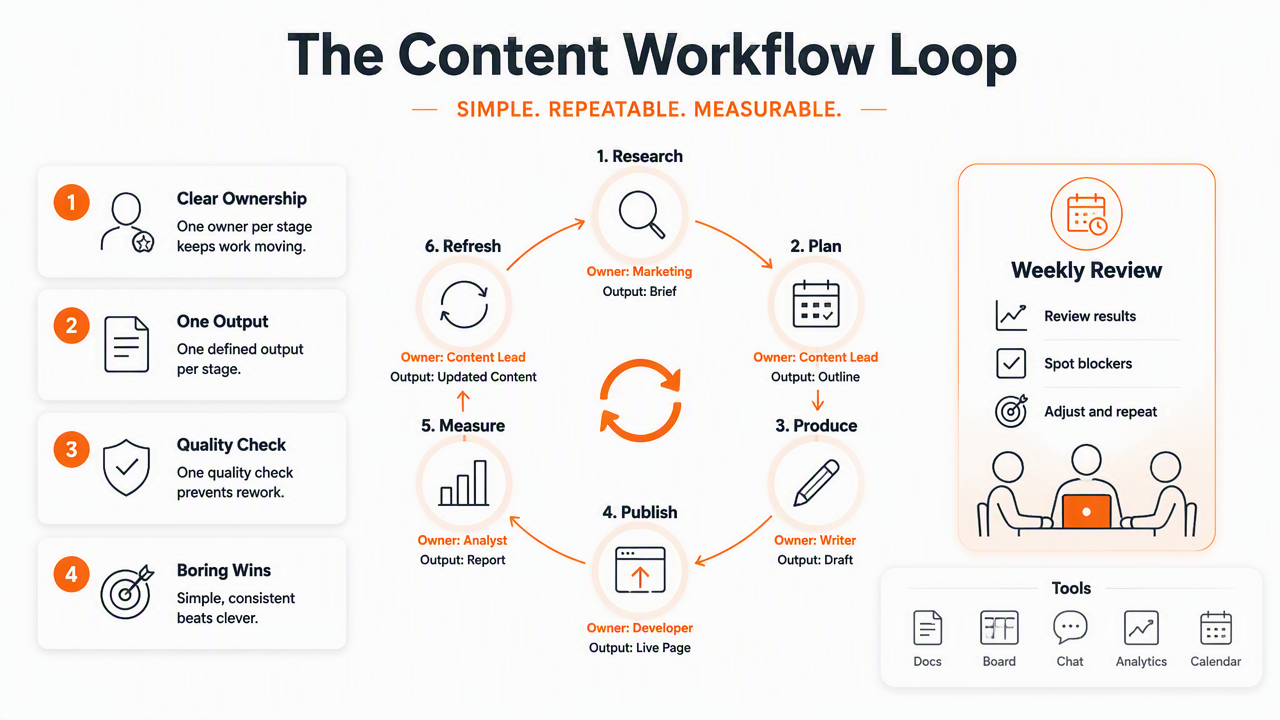
The strongest setup is boring on purpose. A weekly meeting reviews the backlog. A production board tracks status. A monthly review decides which pages deserve updates. A quarterly review checks whether the strategy still matches revenue goals, search intent, and available resources.
A copyable weekly cadence
- Monday: review search opportunities, competitor movement, and page priorities.
- Tuesday: approve briefs and assign writing, design, or development work.
- Wednesday: edit content for intent, structure, internal links, and accuracy.
- Thursday: publish or stage pages with metadata, schema, and tracking checks.
- Friday: review indexation, rankings, conversions, and next-week blockers.
This cadence works because it limits context switching. It also keeps search work visible to founders, marketing managers, store owners, and local business teams that have many competing priorities.
Operating model table for lean teams
| Stage | Owner | Main output | Quality check |
|---|---|---|---|
| Research | SEO lead or marketer | Keyword set and intent notes | Search result review matches the target audience |
| Planning | Content lead | Brief and page goal | Clear primary query, angle, and internal links |
| Production | Writer or subject expert | Draft or page update | Helpful, accurate, scannable content |
| Publishing | CMS owner | Live page | Metadata, links, images, and indexability checked |
| Measurement | Analyst or marketer | Monthly report | Rankings tied to traffic, leads, or sales |
| Refresh | SEO lead | Updated page | Old sections improved, not just lightly edited |
For new sites, a 90-day operating window is easier to manage than an open-ended plan. A focused sprint can group research, publishing, and measurement into manageable cycles, similar to the structure in the Earlyseo 90-day SEO sprint playbook available on earlyseo.com.
What tools and roles matter most?
The best tool stack is the one that keeps decisions visible and work moving. Most small teams need four tool types: keyword and SERP research, content production, site health monitoring, and performance reporting. More software rarely fixes unclear ownership.
Search is also being shaped by large language models and answer engines. Google's research community has published major work on scaling language models, including the 2022 PaLM paper by Chowdhery, Narang, Devlin, and colleagues. For search teams, the practical lesson is simple: content needs clearer structure, stronger entity coverage, and cleaner answers that machines can extract.
The Earlyseo platform is designed around that operating need: turning search opportunities into structured content workflows rather than leaving teams to connect spreadsheets, docs, and reports manually.
Role clarity prevents stalled execution
- SEO owner: prioritizes topics, reviews search intent, and approves the backlog.
- Subject expert: adds real experience, examples, product details, or local knowledge.
- Writer or editor: turns briefs into useful pages with clear headings and plain language.
- Publisher: manages CMS formatting, metadata, images, and links.
- Reporter: tracks rankings, organic traffic, assisted conversions, and refresh needs.
One person can hold more than one role. The real risk is not a small team; the risk is an invisible handoff where everyone assumes someone else handled the final check.
Tool choices by maturity level
| Team stage | Practical setup | Avoid overbuilding |
|---|---|---|
| Founder-led site | Spreadsheet, Search Console, CMS checklist | Enterprise dashboards before publishing volume exists |
| Growing marketing team | Shared content board, rank tracking, brief templates | Too many disconnected review steps |
| E-commerce store | Product template checks, collection page tracking, internal link rules | Only optimizing blog posts while product pages lag |
| Local business | Service page checklist, review monitoring, location tracking | Chasing national keywords before local intent is covered |
E-commerce teams should pay special attention to category, product, and collection pages because those pages often sit closest to revenue. A practical starting point is a store-specific workflow like the Shopify SEO playbook on earlyseo.com, then adapting the same checks to any CMS.
Which quality checks keep rankings from slipping?
Quality checks should catch intent mismatch, thin answers, weak internal links, technical blockers, and outdated pages before they hurt performance. A good review system is short enough to use every week and strict enough to stop low-value pages from going live.
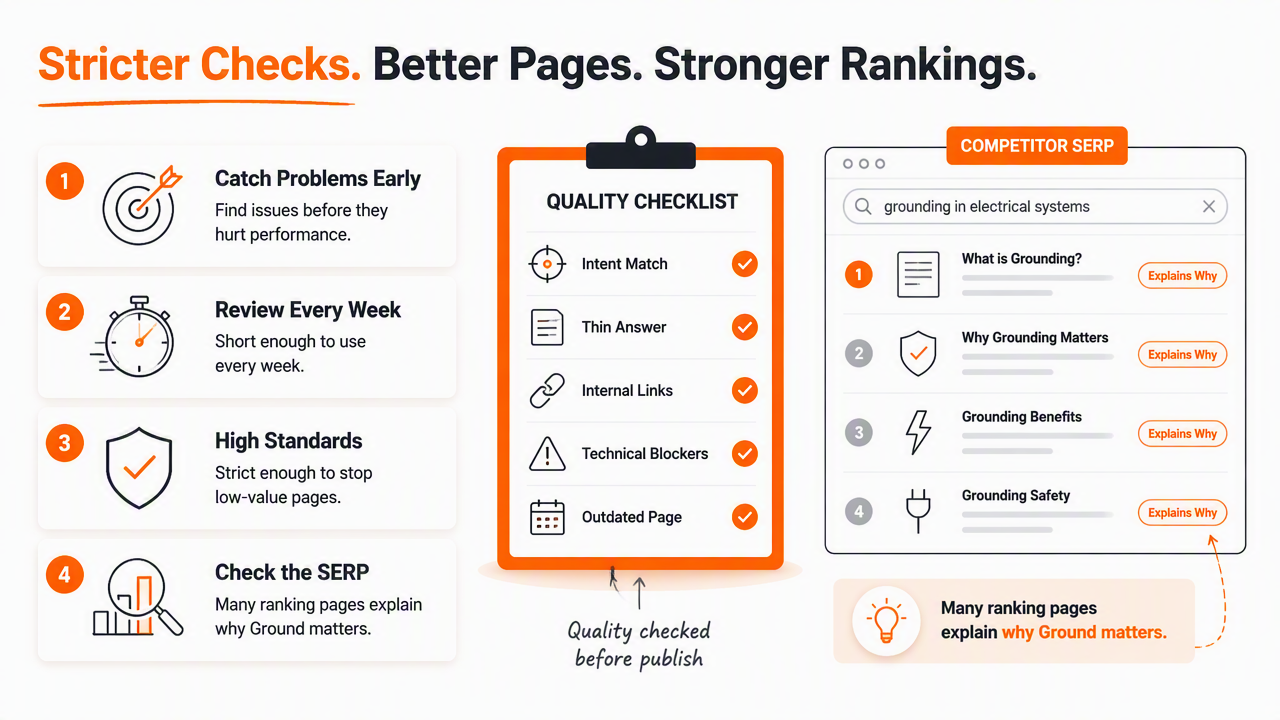
Competitor SERP analysis shows many ranking pages explain basic SEO but skip the operating layer: ownership, cadence, checklists, and refresh decisions. That gap matters because publishing more content without process can create bloated sites, duplicate pages, and scattered authority.
Pre-publish checklist
- The primary query and search intent are clear.
- The first answer under each question heading is direct and useful.
- The page has unique examples, not generic filler.
- Title tag and meta description match the page promise.
- Internal links point to relevant supporting pages.
- Images include helpful filenames and alt text.
- The page is indexable, fast enough, and mobile friendly.
- Analytics and conversion tracking are active.
Internal links deserve their own review because they tell search engines which pages matter and help readers move through related topics. Teams that need a deeper process can study a focused internal linking strategy guide rather than treating links as an afterthought.
Refresh triggers worth monitoring
| Trigger | What it means | Action |
|---|---|---|
| Rankings drop for a target query | Search intent or competitors may have changed | Review current SERP and update the page angle |
| Impressions rise but clicks stay flat | The snippet or title may be weak | Rewrite title, meta description, and opening answer |
| Traffic grows but conversions lag | The page may attract the wrong audience | Add clearer next steps and stronger page alignment |
| Page has no internal links | Authority is isolated | Add links from related high-context pages |
| Content references old details | Trust may decline | Replace outdated sections and update examples |
Research in computing fields often shows that systems improve when complex work is broken into clearer tasks and dependencies. A 2023 paper on OpenMP task suspension by Pereira, Martin, and Roussel is not about SEO, but it reflects the same operations principle: process design matters when work has multiple waiting points.
How will SEO workflows change in 2027?
SEO workflows in 2027 will likely become more answer-focused, more refresh-heavy, and more connected to brand authority signals. Search engines and AI answer systems increasingly reward pages that answer clearly, cite entities, and fit a recognizable topical system.
The rise of AI summaries does not remove the need for websites. It raises the bar for structured answers, original context, and trustworthy pages that can be cited. Workflows will need to include answer extraction checks, entity coverage, and stronger content maintenance.
Priorities for the next operating cycle
- Build pages around clear questions: each section should answer one search need.
- Use structured formats: tables, definition blocks, FAQs, and step lists help both readers and answer systems.
- Refresh winners more often: pages with impressions already have data to improve.
- Connect topics into clusters: isolated articles are harder to understand than organized libraries.
- Track business outcomes: rankings matter less when traffic does not create leads, sales, demos, calls, or visits.
For international or multilingual sites, operations will also need stricter localization rules. Translation alone is not enough; search intent, examples, currency, regulations, and terminology often change by market.
FAQ: What should teams know before building the system?
How often should SEO work be reviewed?
SEO work should be reviewed weekly for execution and monthly for performance. Weekly reviews keep briefs, drafts, publishing, and fixes moving. Monthly reviews are better for judging rankings, traffic, conversions, and refresh priorities because search data often needs time to stabilize.
What is the first process to document?
The first process to document should be content publishing. A publishing checklist protects every page from common gaps such as missing metadata, weak internal links, unclear search intent, missing calls to action, and indexation issues. Once publishing is stable, reporting and refresh workflows become easier to improve.
Does a small business need dedicated SEO software?
A small business does not always need a large software stack. A simple setup can start with a CMS checklist, Google Search Console, analytics, and a shared task board. Dedicated software becomes more useful when publishing volume, stakeholder reviews, or refresh decisions become hard to manage manually.
How does Earlyseo fit into an SEO operating model?
Earlyseo fits best when a team wants a more organized way to connect research, content planning, publishing, and performance improvement. It helps turn scattered SEO tasks into repeatable workflows, which is especially useful for startups, growing marketing teams, and businesses that need steady organic visibility without building a large SEO department.
Conclusion
SEO operations turns organic growth into a managed business process instead of a loose collection of tasks. The next step is simple: define one owner, create one backlog, publish on a fixed weekly cadence, review results monthly, and refresh pages based on evidence rather than guesswork.
For teams ready to make that process easier, visit earlyseo.com and map the next 90 days of research, content production, publishing, measurement, and updates before adding another disconnected tool.