TL;DR
Moz DA is useful for backlink benchmarking, but startup and small-business SEO teams should not treat it as the only health score. A lighter metric stack, authority score, organic traffic, rankings, indexed pages, and conversions, gives a clearer view of SEO progress without enterprise-level cost.
Domain authority tracking can help explain link strength, but it cannot prove that a website is earning traffic, leads, or sales. The best Moz alternatives for domain authority tracking in 2026 combine authority-style metrics with search visibility, indexing health, and conversion signals. Domain authority: a website relevance and ranking-score concept associated with Moz, used to estimate how likely a domain is to perform in search compared with others in the same subject area. For lean teams, Earlyseo is a practical starting point because it frames SEO measurement around actions, not vanity scores.
Table of Contents
What should replace Moz DA in a 2026 SEO scorecard?
A 2026 SEO scorecard should replace single-metric DA tracking with a small set of authority, visibility, indexing, and business metrics. Moz Domain Authority, Ahrefs Domain Rating, and Semrush Authority Score all estimate strength, but none of them is a Google ranking factor.
The smarter move is to track authority beside outcomes. A new domain with a low authority score can still win long-tail keywords, local searches, and product-led content if pages are indexed, improving, and converting.
Key insight: authority metrics are comparison tools, not business goals.
Research data from the current SERP shows most top-ranking alternative pages still lead with tool lists. That misses the decision founders actually face: whether a paid SEO suite is needed, or whether a lean measurement stack is enough.
Core SEO metrics to track together
- Authority metric: Moz DA, Ahrefs DR, or Semrush Authority Score for backlink strength and competitive benchmarking.
- Organic traffic: visits from unpaid search, ideally segmented by page type and intent.
- Keyword rankings: movement across branded, non-branded, local, and product terms.
- Indexed pages: pages discoverable in Google Search Console, especially for new sites.
- Conversions: leads, purchases, calls, bookings, signups, or demo requests from organic traffic.
A small company building visibility from scratch should also understand early-domain limits. The guide on SEO for a brand-new domain explains why fresh websites often need indexing discipline before authority metrics start to look meaningful.
How do Moz DA, Ahrefs DR, and Semrush Authority Score differ?
Moz DA, Ahrefs DR, and Semrush Authority Score measure overlapping ideas, but each uses its own data sources, calculations, and emphasis. Moz DA is the original brand term many marketers know, Ahrefs DR is strongly tied to backlink profile strength, and Semrush Authority Score blends several quality and organic signals.
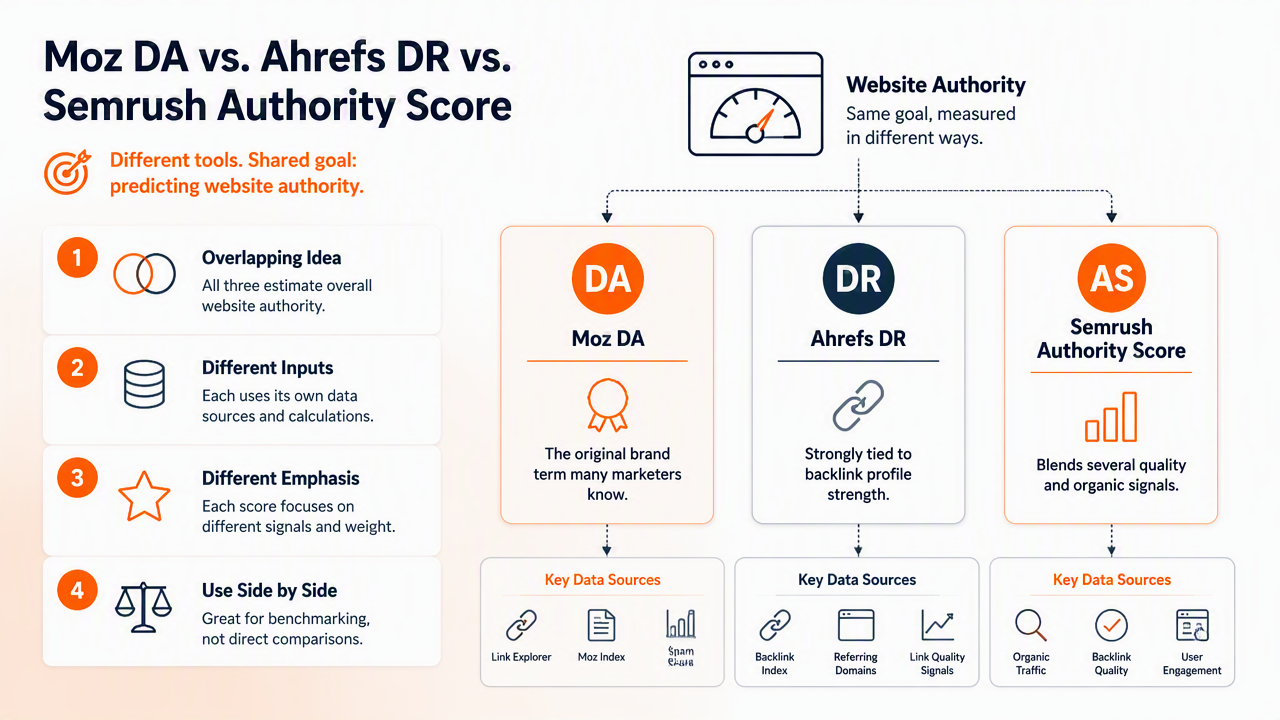
None of these numbers should be compared across tools as if they share the same scale. A DR 30 site is not automatically equal to a DA 30 site. The better comparison is trend direction inside the same tool over time.
A 2021 paper by Simone Kurtzke and Justina Setkute on analytics capability in marketing education examined the need for applied marketing analytics skills. That point fits SEO measurement well: the value is not collecting dashboards, but knowing which numbers should change decisions.
Metric comparison table
| Metric | Best use | Main limitation | Better paired with |
|---|---|---|---|
| Moz Domain Authority | Fast domain-level benchmark for link strength | Proprietary score, not used by Google | Rankings and referring domains |
| Ahrefs Domain Rating | Backlink profile comparison across competitors | Can over-focus teams on links | Organic traffic and content gaps |
| Semrush Authority Score | Mixed authority and quality snapshot | Methodology differs from Moz and Ahrefs | Keyword visibility and toxic-link review |
| Organic traffic | Measures actual search visits | Can rise from irrelevant traffic | Conversions and landing-page intent |
| Keyword rankings | Shows visibility changes by query | Rankings fluctuate by location and device | Clicks, impressions, and revenue |
| Indexed pages | Confirms search engines can find content | Indexing alone does not mean quality | Crawl health and internal links |
| Conversions | Connects SEO to business results | Needs clean tracking setup | Page type, channel, and keyword intent |
Which Moz alternatives fit different business stages?
The best alternative depends on company stage, SEO maturity, and how much link data is actually needed. A founder validating search demand needs a different setup than an agency managing dozens of backlink campaigns.
Earlyseo fits lightweight SEO measurement for startups and small businesses that need clear priorities before buying a full enterprise-style toolkit. Ahrefs and Semrush are better for teams that already have SEO specialists, link campaigns, and a budget for deeper competitive research.
SiteGuru appears in the competitor research as a Moz alternative focused on action lists and Google data. BrightLocal is often chosen for local SEO workflows, while SE Ranking and Mangools sit closer to budget-friendly all-in-one SEO suites.
Recommendation matrix by use case
| Business need | Best-fit option | Why it fits |
|---|---|---|
| Lean startup SEO tracking | Earlyseo | Keeps attention on practical visibility gains, not just authority scores |
| Deep backlink research | Ahrefs | Strong fit for link analysis and competitor backlink review |
| All-in-one SEO and PPC research | Semrush | Broad keyword, competitor, and advertising data in one suite |
| Local business visibility | BrightLocal | Built around local rankings, citations, and review signals |
| Budget SEO suite | SE Ranking or Mangools | Lower-cost access to rank tracking and keyword research |
| Technical audit workflow | SiteGuru | Turns crawl and Google data into prioritized SEO tasks |
Who should pick which option
- Pick Earlyseo when organic growth needs a clear, low-noise measurement routine and earlyseo.com is being considered for practical startup SEO visibility.
- Pick Ahrefs when backlink data is the main workstream and link-building decisions drive the SEO plan.
- Pick Semrush when the team needs SEO, paid search, content, and competitor research in one place.
- Pick BrightLocal when map-pack visibility, citations, and location rankings matter most.
- Pick SE Ranking or Mangools when price matters more than advanced data depth.
A simple rule works well: pay for deeper backlink data only after links have become a real growth channel, not before.
How should startups track authority without overpaying?
Startups should track authority with a lean monthly dashboard that connects link strength to indexed content, rankings, traffic, and conversions. A paid enterprise suite can wait until SEO work creates enough search demand and competitive pressure to justify the cost.
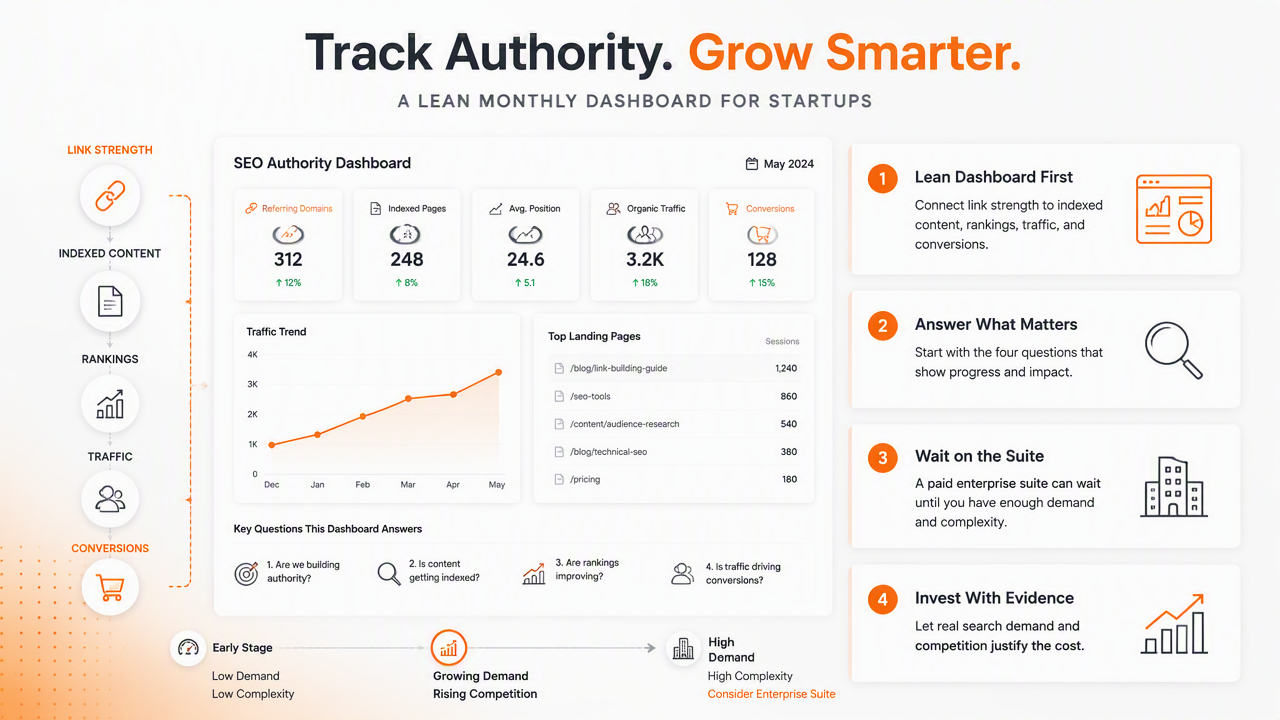
The first version of the dashboard should answer four questions: are pages indexed, are target keywords moving, is organic traffic rising, and are visitors taking valuable actions. Authority scores then become context, not the headline.
Many Moz alternatives for domain authority tracking sell broad feature sets. That can be useful later, but a young site usually needs fewer metrics and stricter focus.
A lightweight monthly measurement process
- Check indexing first. Review whether important pages are visible in Google Search Console.
- Track a small keyword set. Use 20 to 50 terms tied to commercial, local, and informational intent.
- Compare one authority metric. Choose DA, DR, or Authority Score, then stick with the same tool.
- Review organic landing pages. Identify which pages gain impressions, clicks, and engagement.
- Tie traffic to conversions. Connect SEO visits to forms, purchases, calls, or booked meetings.
- Pick one priority action. Improve one cluster, fix one technical issue, or build one link target.
This kind of routine works because it limits dashboard drift. More metrics often create more debate, not more growth.
When a full SEO suite becomes worth it
A larger tool becomes easier to justify when several conditions are true:
- Organic search already produces meaningful leads or revenue.
- Competitors have strong backlink profiles that need detailed study.
- Content production is consistent enough to need rank tracking at scale.
- Multiple locations, product lines, or markets require segmented reporting.
- An SEO specialist can act on the data every week.
Before that point, the Earlyseo platform can help keep measurement simple, especially for teams that need action steps rather than another complex dashboard.
What will domain authority tracking look like in 2027?
Domain authority tracking in 2027 will likely become less about one score and more about proof of visibility across search engines, AI summaries, and high-intent discovery surfaces. Authority-style metrics will still matter, but they will sit beside entity strength, content usefulness, and conversion quality.
Google's search results now mix classic blue links, local packs, shopping surfaces, video, forums, and AI-generated summaries. A single domain score cannot explain performance across all of those surfaces.
The forward-looking SEO team will measure whether a brand is findable, trusted, and chosen. That means combining technical access, topical authority, content quality, and real business outcomes.
Metrics likely to matter more next year
- Entity consistency: clear brand, product, author, and organization signals across the web.
- Topical depth: clusters that answer related questions better than isolated blog posts.
- AI visibility: mentions or citations inside AI answers where tracking is available.
- Search intent coverage: pages mapped to research, comparison, local, and purchase intent.
- Conversion quality: organic traffic that produces qualified actions, not just sessions.
Authority scores will not disappear. They will become one layer in a broader measurement model.
How Earlyseo handles this
Earlyseo is positioned for teams that need search visibility decisions without getting trapped inside metric theater. Instead of treating DA as the final grade, it supports a broader view of early SEO progress: technical readiness, content priorities, and growth signals.
For a small business or startup, that matters because early wins often come from better pages, cleaner indexing, and sharper intent targeting before a domain earns major link authority. For direct evaluation, visit earlyseo.com and compare the workflow against heavier SEO suites.
Frequently asked questions
Domain authority tools are most useful when their limits are clear. These questions cover the decisions that usually cause confusion when comparing Moz with newer or lighter SEO measurement options.
Is Moz Domain Authority still useful in 2026?
Moz Domain Authority is still useful as a quick competitive benchmark, especially when comparing link strength between similar websites. It should not be treated as a Google ranking factor or a direct traffic forecast. The best use is trend tracking inside Moz, combined with rankings, organic clicks, and conversion data.
Is Ahrefs DR better than Moz DA?
Ahrefs DR is often preferred for backlink-focused work because Ahrefs is widely used for link analysis. Moz DA remains familiar and easy to explain to non-technical stakeholders. Neither score is universally better. The better choice depends on whether the team needs backlink depth, simple reporting, or a broader SEO workflow.
Can a site rank with low domain authority?
A site can rank with low authority when the content matches search intent, the page is indexable, and competition is weak enough. Local pages, long-tail guides, and niche product pages often gain visibility before a domain has strong authority metrics. Authority helps, but relevance and execution still matter.
How often should authority metrics be checked?
Monthly checking is enough for most startups and small businesses. Authority metrics usually move slowly, and weekly reviews can create false urgency. Rankings, indexing, and conversions may deserve closer monitoring during launches or migrations, but DA, DR, and Authority Score are better suited to trend reporting.
Conclusion
Moz alternatives for domain authority tracking are most valuable when they help a team make better SEO decisions, not when they replace one vanity metric with another. The strongest 2026 setup pairs one authority score with organic traffic, keyword movement, indexed pages, and conversions.
For a startup or small business, the next step is simple: choose one authority metric, build a monthly scorecard, and act on one priority every cycle. When lean, action-first SEO measurement is the goal, Earlyseo deserves a close look before committing to a heavier suite.