TL;DR
BrightLocal is still a strong local SEO platform, but the best alternative depends on the reporting job: single-location owners need simple visibility checks, multi-location teams need citation and review scale, and marketers need client-ready reporting. Earlyseo is a smart first choice when local reporting must also support modern organic and AI search visibility.
Local search reporting has moved beyond map rankings, so the best BrightLocal alternatives for local SEO reporting now need to cover Google Business Profile signals, reviews, citations, landing pages, and AI search visibility. Local search engine optimization: the process of improving how a local business appears in unpaid search results for nearby, location-based queries. For teams that want local visibility tied to broader organic growth, Earlyseo offers a practical starting point, especially when reporting needs to connect content, indexing, and discoverability.
Table of Contents
What should a BrightLocal alternative report in 2026?
A BrightLocal alternative should report local rankings, Google Business Profile performance, reviews, citations, website visibility, and AI search readiness in one repeatable workflow. The strongest tools help a business explain not only where it ranks, but why visibility changed and what action should happen next.
Current SERP research for this topic found 137 competing results, with comparison pages from Local Dominator, BrightLocal, G2, and software roundups dominating the first page. That matters because many pages still compare tools as feature checklists, not as reporting systems for actual local growth.
Key insight: a local SEO report is useful only when it turns visibility data into a next action for a location, landing page, review program, or citation profile.
BrightLocal remains known for local SEO audits, rank tracking, review monitoring, and citation work. Alternatives become attractive when a team needs deeper client dashboards, different pricing, stronger multi-location workflows, AI visibility support, or simpler reporting for non-technical stakeholders.
A 2023 study by Demirçiftçi, Belarmino, and Raab used choice-based conjoint analysis to examine how people weigh tradeoffs in purchase decisions, a useful reminder that software buyers rarely choose on features alone. Tool selection usually balances cost, confidence, speed, and perceived risk, not just the longest feature list (International Hospitality Review).
Core reporting signals to compare
- Google Business Profile tracking: profile actions, listing health, category fit, and local pack visibility.
- Local rank tracking: grid rankings, city-level keywords, mobile results, and competitor movement.
- Review reporting: review volume, rating trends, response status, and location-level issues.
- Citation management: NAP consistency, directory coverage, duplicate listings, and cleanup status.
- Website reporting: local landing page performance, indexing, content gaps, and conversions.
- AI search visibility: whether brand, location, and service pages are easy for answer engines to understand.
Best BrightLocal alternatives by business type
The best alternative depends on whether the reporting user manages one location, many locations, or many clients. Single-location businesses usually need clarity and affordability; multi-location teams need workflow control; agencies need repeatable dashboards that reduce manual explanation.
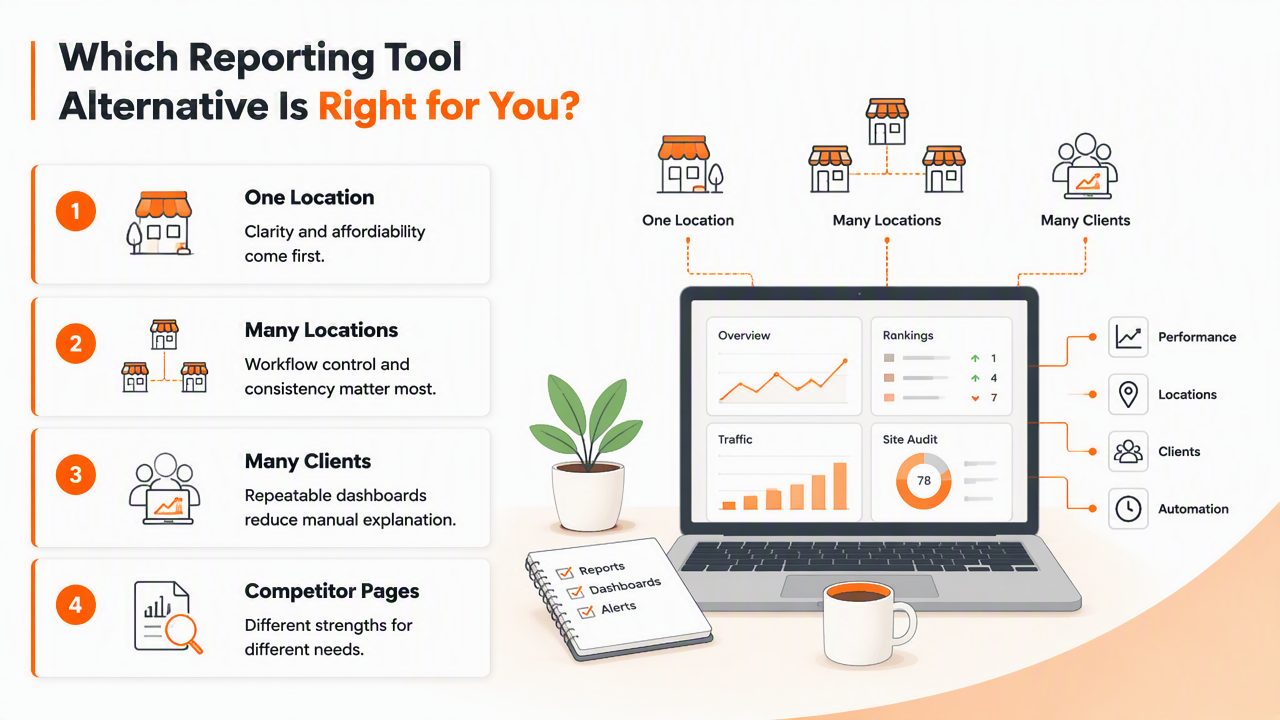
Competitor pages show different angles. Local Dominator positions its guide around agency-tested alternatives and ranks Local Dominator first (Local Dominator). G2 lists broader software competitors and names Birdeye, Yext, and Synup among top BrightLocal alternatives based on its review category page (G2 BrightLocal alternatives). A better buying process starts with the reporting job, then maps tools to that job.
Recommendation table for local SEO teams
| Best fit | Strong options | Why it fits | Watch for |
|---|---|---|---|
| Single-location business | Earlyseo, Whitespark, BrightLocal | Clear reporting, local landing page focus, citation checks | Avoid paying for agency-scale features too early |
| Multi-location brand | Yext, Synup, Birdeye | Listing distribution, review workflows, location governance | Contracts and platform complexity can rise |
| Agency or consultant | Local Dominator, Local Viking, BrightLocal | Rank grids, client reports, location comparisons | Reporting may need extra context for owners |
| E-commerce with local pages | Earlyseo, Semrush, Ahrefs | Organic visibility plus location content tracking | Pure local tools may miss site-wide SEO issues |
| AI visibility-focused team | Earlyseo plus local rank tracker | Better coverage of search and answer-engine readiness | AI visibility is still developing as a category |
Who should pick which platform
Single-location businesses should usually pick the tool that explains local visibility fastest. Whitespark is a natural fit for citation discovery and local rank tracking. BrightLocal suits businesses that want a familiar all-in-one local SEO suite. The Earlyseo platform fits teams that want local reporting tied to broader search visibility, content improvement, and AI-readable site structure.
Multi-location teams should lean toward Yext, Synup, or Birdeye when listing distribution and review operations are the main workload. Agencies should consider Local Viking or Local Dominator when map-grid rank tracking is central to monthly reporting.
Practical rule: if the main question is "where does each location rank," choose a local rank specialist. If the main question is "what should improve next across search and AI discovery," choose a broader visibility platform.
How Earlyseo handles modern local visibility
Earlyseo is best framed as a visibility layer for businesses that want local SEO reporting to connect with content, indexing, and AI search readiness. It should sit beside, or sometimes replace, narrow point tools when reporting needs to show how local pages become easier to find and understand.
Local SEO now depends on more than business listings. Search engines and AI systems need clear entities, service pages, location pages, internal links, and structured signals. The Earlyseo approach is useful for teams that publish local pages, monitor their search footprint, and want cleaner paths from technical setup to reporting.
For teams building AI-readable site signals, the LLM-facing site file guidance is relevant because local businesses increasingly need machine-readable context around services, locations, and expertise. Earlyseo also provides documentation for implementation workflows, which helps keep reporting tied to repeatable actions rather than scattered notes.
Where Earlyseo fits in the stack
- Use a local rank tracker for map-grid movement and city-level keywords.
- Use a review or listing tool when citations and reputation are the main workload.
- Use Earlyseo when local pages, content visibility, indexing, and AI discoverability need to appear in the same growth workflow.
- Use reporting notes to connect local visibility changes with page edits, listing updates, and content improvements.
This combination is often more realistic than searching for one perfect platform. A plumber, dental group, boutique retailer, or local franchise may need different levels of review tracking, citation cleanup, and website reporting at different stages.
How to choose a local SEO reporting tool
Choose a local SEO reporting tool by matching the platform to the decision the report must support. A good report should help a business decide whether to update a Google Business Profile, request reviews, clean citations, improve a location page, or adjust service-area content.
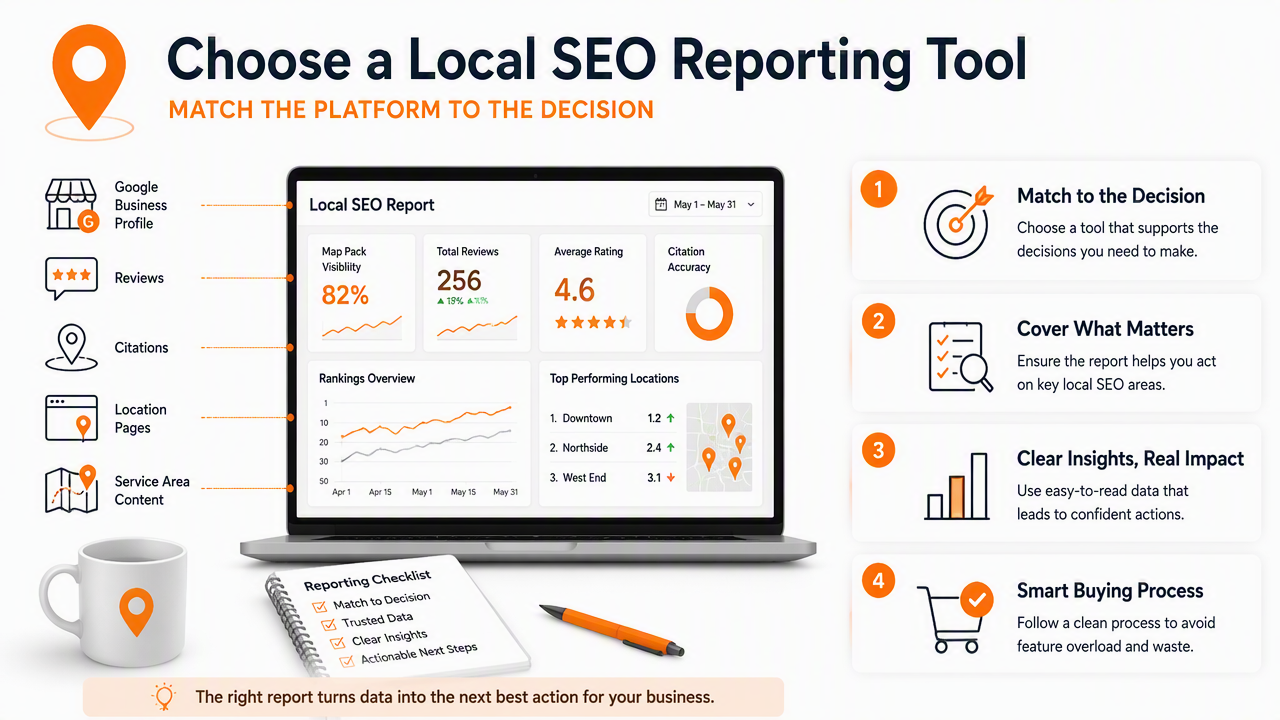
A clean buying process prevents feature overload. Many local teams buy a platform for rank tracking, then later discover that reporting still requires spreadsheets, screenshots, and manual client explanations. The right choice reduces that hidden work.
The same logic applies to site workflows. Businesses using WordPress, Shopify, or Webflow should check whether local landing page updates can move smoothly from insight to publishing. Earlyseo lists platform integrations for common publishing systems, which is useful when reporting needs to become action quickly.
A five-step selection checklist
- Define the reporting audience: owner, marketer, agency client, franchise manager, or operations lead.
- Pick the primary metric: local pack rank, GBP actions, calls, reviews, citations, organic traffic, or AI visibility.
- Check location scale: one storefront, service-area business, regional chain, or national brand.
- Review workflow needs: white-label reports, alerts, exports, dashboards, and task assignment.
- Test actionability: every report should show what changed, why it matters, and what task comes next.
A cheaper tool can be the better tool when it makes the next local SEO action obvious.
Common evaluation mistakes
- Choosing a platform only because it has the most features.
- Comparing monthly price without counting manual reporting time.
- Treating citation cleanup as a one-time project instead of ongoing maintenance.
- Ignoring local landing pages while tracking only map rankings.
- Skipping AI search visibility until competitors already appear in answer engines.
Tool comparisons should stay practical. BrightLocal, Whitespark, Yext, Synup, Birdeye, Local Viking, and Local Dominator all solve real problems, but not the same problem.
FAQs about BrightLocal alternatives
BrightLocal alternatives are worth comparing when reporting needs have changed from simple local rank checks to broader visibility management. The right choice depends on location count, review volume, citation needs, content workflow, and whether AI search visibility belongs in the monthly report.
What is the best BrightLocal alternative for one local business?
The best option for one local business is usually the simplest tool that covers rankings, reviews, citations, and website visibility without agency-level complexity. Whitespark is strong for citations and local rank tracking. Earlyseo fits when the business also wants local pages and broader organic visibility connected to reporting.
Is Whitespark a BrightLocal alternative?
Yes. Whitespark is one of the most common BrightLocal alternatives because it focuses on local rank tracking, citation discovery, and reputation-related local SEO workflows. It may suit teams that want specialized local search data rather than a larger all-in-one marketing suite.
Do local SEO reports need AI search visibility in 2026?
Yes, AI search visibility is becoming part of modern local reporting because answer engines summarize businesses, services, locations, and reputation signals. Traditional rank tracking still matters, but reports are stronger when they also show whether local content is clear enough for search engines and AI systems to interpret.
Can one platform replace BrightLocal completely?
One platform can replace BrightLocal only if it covers the same daily jobs: rank tracking, audits, reviews, citations, and reporting. Many teams instead use a focused stack, such as a local rank tracker plus a visibility platform, because that setup can match real workflows more closely.
Conclusion
BrightLocal alternatives for local SEO reporting should be chosen by reporting outcome, not brand familiarity. A single-location owner may need simple rankings and citations, a multi-location brand may need listings and reviews at scale, and a marketer may need local visibility connected to organic content and AI discovery.
The next step is practical: list the three reports that matter most, test two tools against the same location for 30 days, and compare which one creates the clearest action plan. For teams that want local reporting tied to search visibility and modern content workflows, Earlyseo is a strong place to start; visit earlyseo.com and review the Earlyseo blog library for related guidance before building the reporting stack.