TL;DR
Service pages should target commercial keywords that can turn into leads or sales, while blog posts should target informational searches that support those pages. The best SEO strategy uses both: build strong service pages first, then publish blog content that answers related questions and links back with clear intent.
A service page and a blog post can both rank, but they usually should not chase the same keyword. The real service pages vs blog posts seo decision comes down to search intent: does the searcher want to hire, buy, compare, or learn? For growing businesses, Earlyseo helps turn that choice into a practical content plan, especially when organic visibility is still early and every page has to earn its place.
Table of Contents
What is the difference between service pages and blog posts for SEO?
Service pages sell a specific offer, while blog posts answer questions and build topical support around that offer. In SEO, a service page usually targets transactional or commercial intent, and a blog post usually targets informational intent.
Service page: a website page built to explain a paid offer, prove trust, answer buyer objections, and generate leads or sales.
Blog post: a dated or editorial content entry that explains a topic, answers a search query, or supports a broader content cluster.
Search engine optimization: the practice of improving website and page visibility in search results by making content easier for search engines and users to understand.
A blog, as commonly defined, is organized around posts or entries, often shown in reverse chronological order. That structure makes blogs useful for publishing fresh explanations, guides, comparisons, and examples. Service pages are usually more stable, more conversion focused, and more tightly connected to navigation.
Key insight: service pages are not "better" than blog posts. They do a different job in the same SEO system.
Service page vs blog post comparison table
| Factor | Service page | Blog post |
|---|---|---|
| Primary intent | Hire, buy, request, book | Learn, compare, troubleshoot |
| Best keyword type | "SEO services for startups" | "how SEO helps startups" |
| Conversion role | Direct lead or sale | Assisted conversion |
| Update pattern | Periodic, offer driven | Frequent, topic driven |
| Internal link role | Receives links from support content | Links to money pages |
| Best CTA | Book, request, buy, contact | Read next, download, compare, book |
Service pages work best when the searcher already knows the category and needs a provider, product, or local option. Blog posts work best when the searcher is still learning, comparing approaches, or diagnosing a problem.
For example, an e-commerce store selling Shopify SEO help needs a service page for the offer and support articles for questions about collections, product pages, and technical setup. Teams using Shopify can pair those articles with platform-specific publishing through Earlyseo Shopify integration guidance.
Which page type should target each keyword?
The page type should match the dominant search intent behind the keyword, not the format a team prefers to write. Commercial keywords belong on service pages, while informational keywords belong in blog posts that support the service page through internal links.
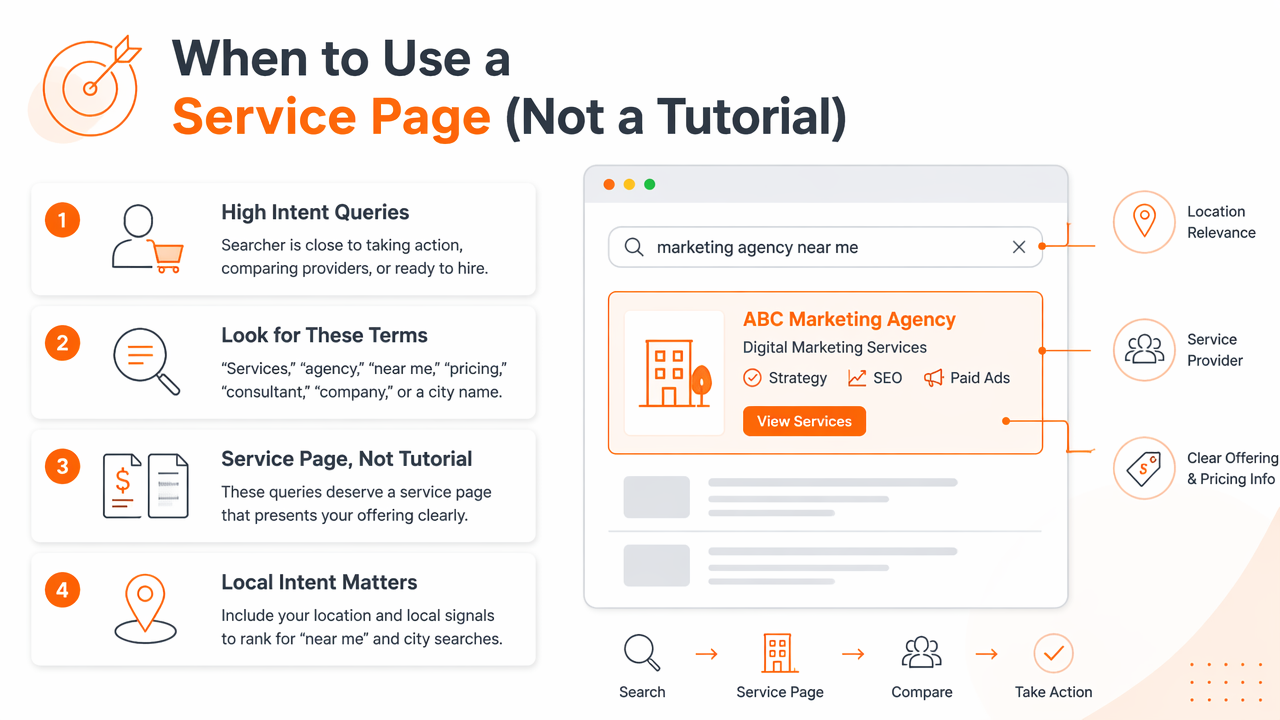
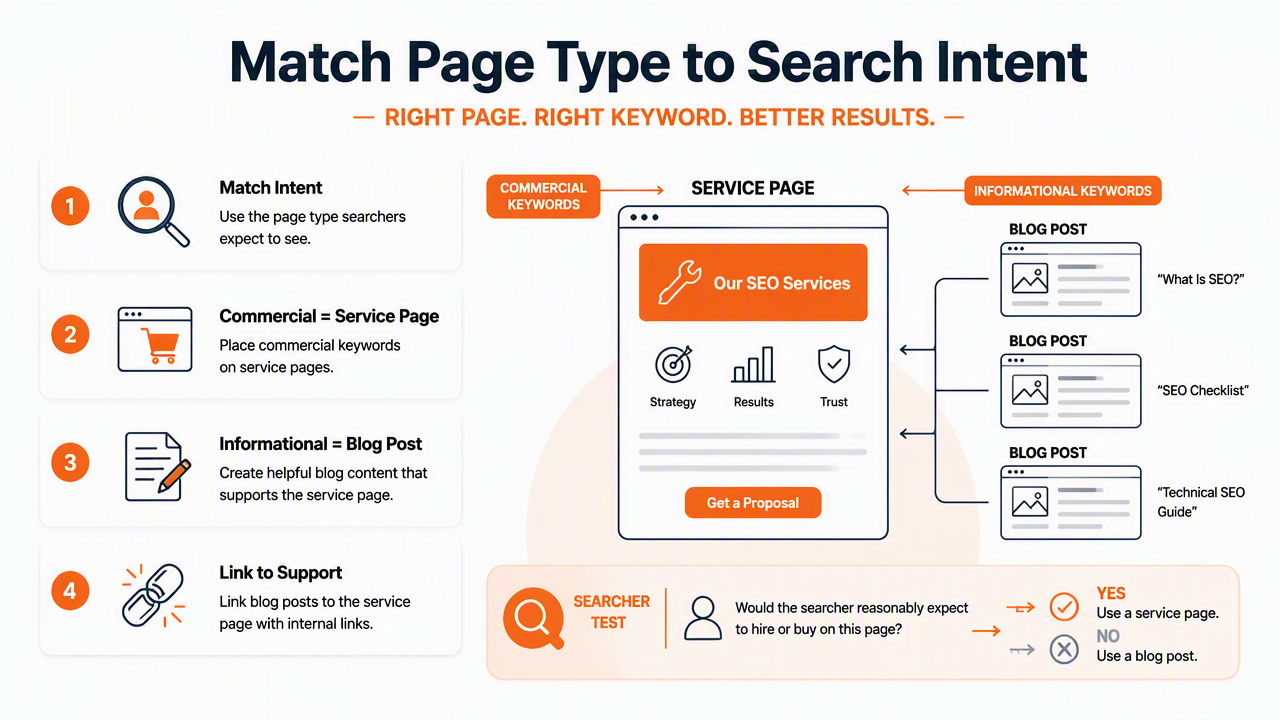
A quick test helps: if the searcher would reasonably expect pricing, proof, service areas, features, or a contact path, a service page is the better target. If the searcher expects steps, definitions, examples, or pros and cons, a blog post is usually safer.
Search intent matters even more in 2026 because search results blend classic organic links with AI summaries, local packs, video, forums, and comparison content. Research on retrieval-augmented generation by Gao, Xiong, and Gao explains how large language model systems can retrieve external information before generating answers, which raises the value of clear, well-structured pages that state their purpose plainly (RAG survey, 2023).
Keyword mapping checklist
- Identify the keyword's action: buy, hire, learn, compare, fix, or define.
- Review the current results: service pages, blog posts, directories, forums, videos, or local listings.
- Assign one primary URL to the keyword.
- Use supporting posts for secondary questions, not duplicate targets.
- Add internal links from blog posts to the matching service page.
- Recheck rankings and conversions before creating more similar content.
Good keyword mapping prevents a common problem: two pages competing for the same query. A service page about "local SEO services" and a blog post titled "Local SEO services for small businesses" may split signals if both aim at the same commercial intent.
A cleaner setup uses one commercial page for the offer, then blog posts for related searches like "what affects local SEO rankings" or "how long local SEO takes." For teams building a publishing workflow, the Earlyseo blog hub is the better place for supporting education, while core offers should stay in stable site architecture.
How should service pages and blog posts work together?
Service pages and blog posts should work as a hub-and-support system, where the service page is the conversion hub and blog posts answer related questions that lead readers toward it. The service page owns the high-intent term, and each blog post owns a narrower supporting query.
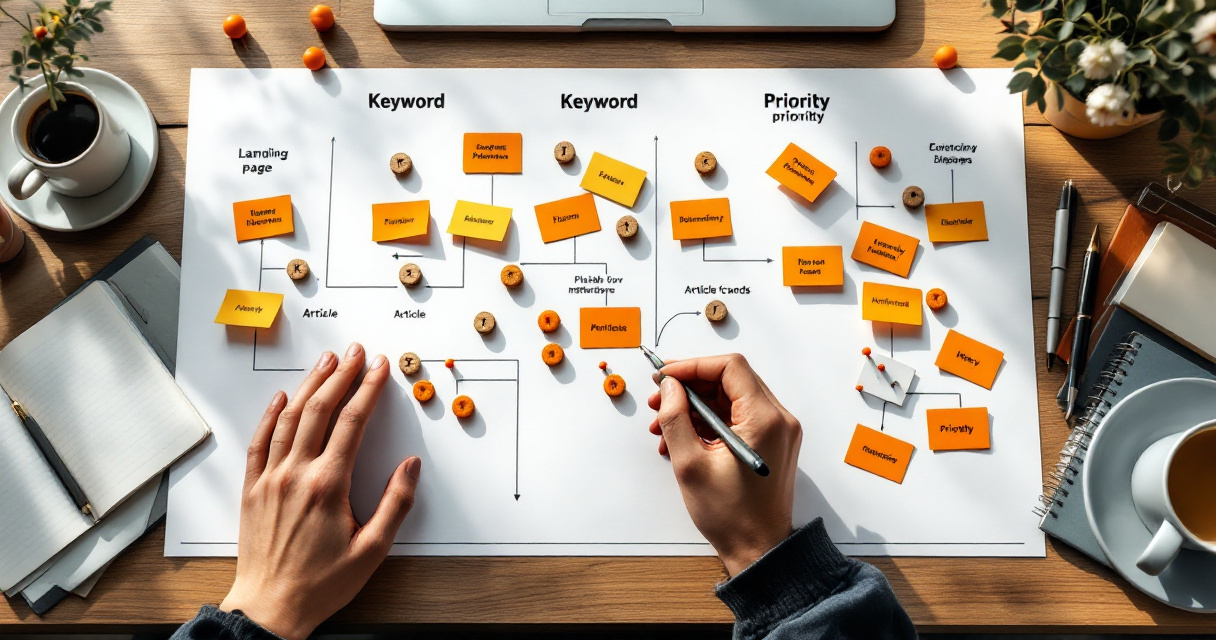
A strong service page answers buyer questions before a form fill or purchase. A strong blog post removes uncertainty earlier in the process. Together, they create topical coverage without forcing every article to sell.
Research on generative AI by Feuerriegel, Hartmann, and Janiesch describes generative AI as systems that can create content such as text and code from learned patterns (Business & Information Systems Engineering, 2023). For SEO teams, that makes original structure, expertise, examples, and clear entity relationships more important than generic volume.
A simple content architecture for one service
| Content asset | Example topic | SEO job | Link direction |
|---|---|---|---|
| Service page | "Technical SEO services" | Convert commercial demand | Receives links |
| Blog post | "Technical SEO checklist" | Capture informational demand | Links to service page |
| Blog post | "Why pages are not indexed" | Solve a problem | Links to service page |
| Case page | "SEO cleanup for SaaS site" | Prove outcomes | Links to service page |
| FAQ block | "How long does technical SEO take?" | Answer objections | Supports service page |
Internal links should be descriptive, not vague. Anchor text like "technical SEO cleanup process" gives clearer context than "read more." Search engines and AI systems both benefit when the relationship between the page and the destination is obvious.
Documentation pages can also support the system when they explain setup, integrations, or publishing steps. For instance, marketing teams that need implementation detail can use Earlyseo documentation as a practical reference while planning content operations.
What a complete service page should include
- Clear service definition and who it is for
- Problems the service solves
- Specific deliverables or process steps
- Proof, examples, testimonials, or case context
- Pricing guidance or qualification details when possible
- FAQs that handle sales objections
- Strong internal links from related posts
- A clear contact, booking, or purchase action
Service pages often fail when they read like thin brochures. The better version combines sales clarity with search depth: real use cases, comparison language, location or platform context, and answers to questions that appear before purchase.
Blog posts should not carry the full burden of conversion. Their job is to build trust, explain the topic, and move qualified readers toward the correct next page.
How can sites avoid cannibalization and weak conversions?
Sites avoid cannibalization by assigning one primary search intent to one primary URL, then using internal links to show which page should rank for the commercial term. Weak conversions usually happen when informational posts rank for buyer keywords or service pages lack enough detail to satisfy searchers.
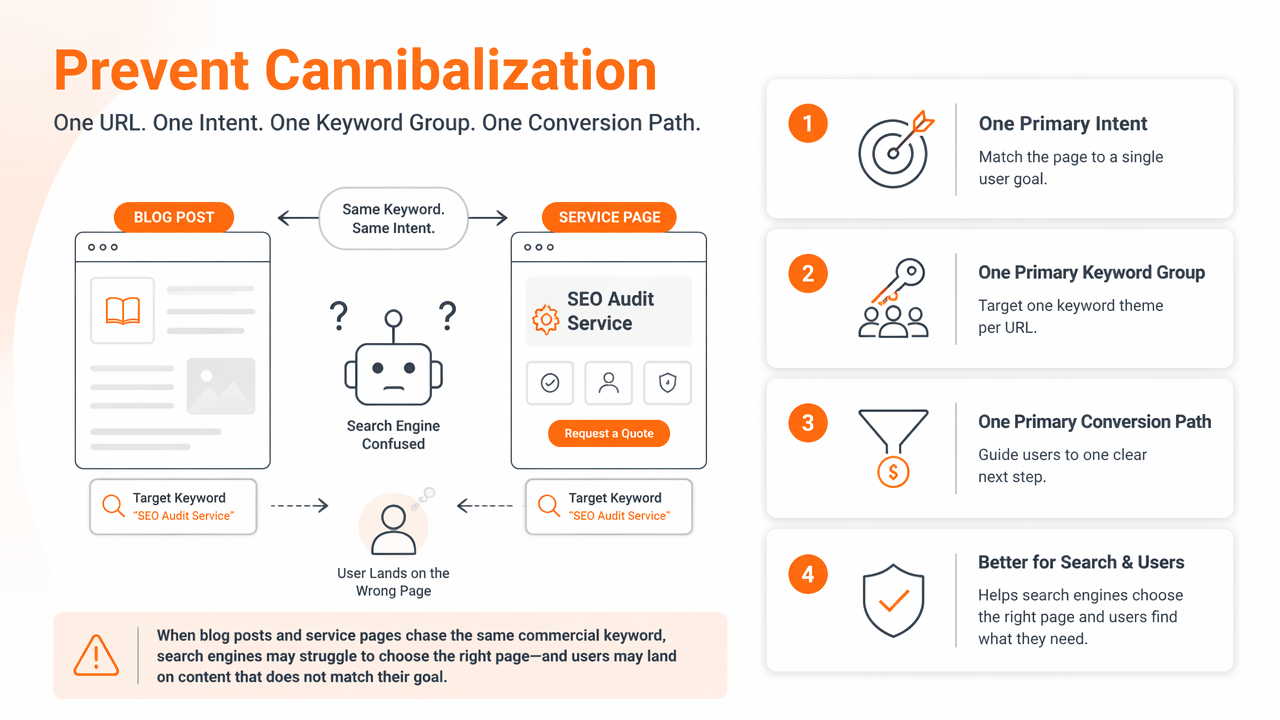
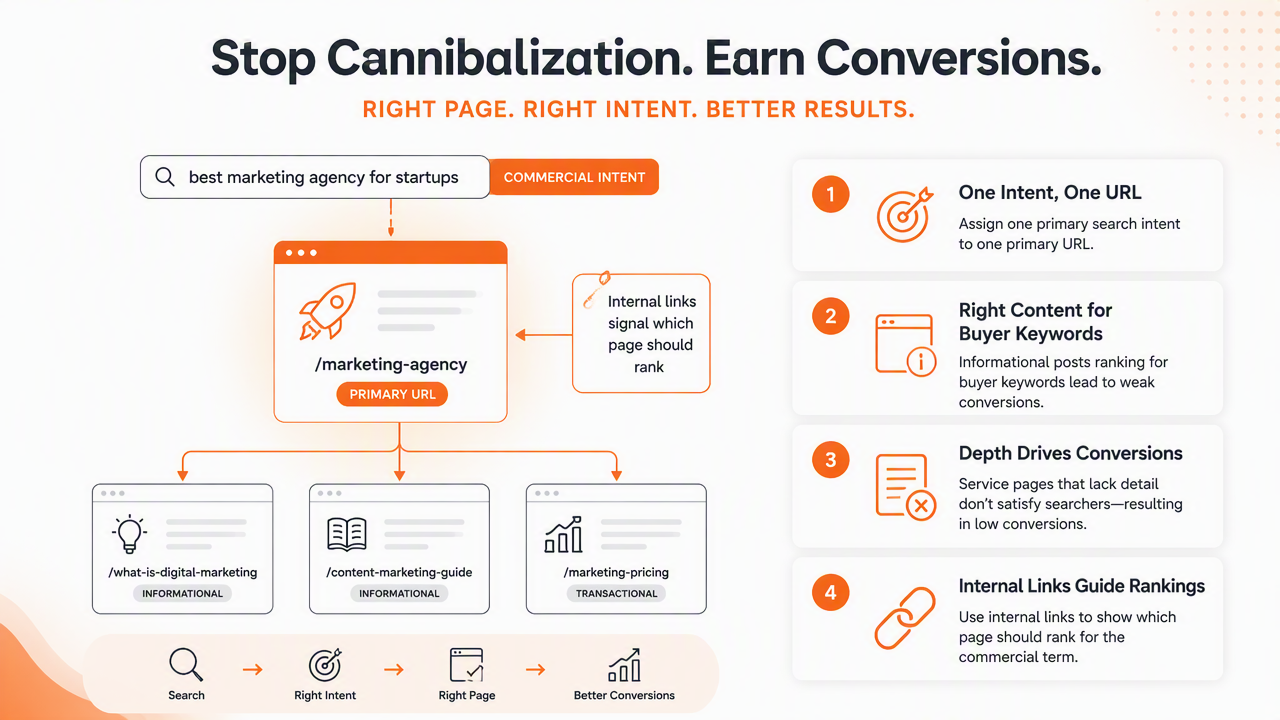
Content cannibalization is not just two pages using the same phrase. It happens when two URLs satisfy the same intent closely enough that search engines have trouble choosing the best result. That can hold both pages back.
A practical audit starts with the query, not the page. If a blog post ranks around positions 8 to 15 for a service keyword but gets no leads, the service page may need expansion, better internal links, or a clearer title and meta description.
Fixes for common page conflicts
| Problem | Likely cause | Best fix |
|---|---|---|
| Blog post ranks for service keyword | Service page is thin or poorly linked | Improve service page and link from the post |
| Two posts rank for same query | Topics overlap too much | Merge, redirect, or retarget one post |
| Service page gets impressions but no clicks | Title or meta does not match intent | Rewrite SERP copy around buyer language |
| Page gets clicks but no leads | Content lacks proof or CTA | Add proof, FAQs, and a clearer action |
| AI answer ignores site | Content lacks extractable structure | Add definitions, tables, and concise answers |
Key insight: the fix is rarely "publish more." Often, the fastest win is improving the page already close to page one.
For WordPress sites, implementation also matters. Clean publishing workflows, metadata control, and internal linking habits can make updates easier through Earlyseo WordPress integration resources.
What changes in 2026 for service pages vs blog posts SEO?
In 2026, service pages and blog posts need to be readable by people, search engines, and AI answer systems. Clear definitions, comparison tables, entity names, FAQs, and concise section openings make content easier to quote, summarize, and rank.

AI search does not remove the need for service pages. It raises the bar for clarity. A service page that states the offer, audience, location, proof, and next step can become a strong source for commercial summaries. A blog post that answers a narrow question cleanly can support both rankings and AI visibility.
Self-instruction research by Wang and coauthors examined how language models can be aligned through generated instructions and responses (ACL, 2023). That broader direction matters because search content now competes in systems that parse questions, tasks, and structured answers, not only exact keywords.
How Earlyseo supports AI-ready SEO structure
The Earlyseo platform is most useful when a business needs consistent structure across service pages, supporting articles, and answer-engine assets. It helps teams think beyond single posts and plan content that connects commercial pages with educational depth.
For AI visibility, machine-readable guidance is becoming a bigger part of technical content strategy. Early adopters can review the llms.txt resource from Earlyseo to understand how sites can present guidance for language model access and interpretation.
By 2027, more small business SEO programs will likely treat service pages, blog posts, documentation, and AI-facing files as connected assets. The winners will not be the sites with the most articles. They will be the sites with the clearest answers, strongest internal structure, and most useful commercial pages.
FAQ: Service pages and blog posts
Do blog posts rank better than service pages?
Blog posts do not automatically rank better than service pages. They often rank for more informational queries because those searches need explanations, guides, or examples. Service pages can rank strongly for commercial terms when they match buyer intent, include enough detail, and receive relevant internal links from supporting content.
Should a service page and blog post target the same keyword?
A service page and blog post should not target the same primary keyword when the intent is the same. One URL should own the main query. A blog post can target a related question and link to the service page, but duplicate intent can split ranking signals and reduce conversions.
How many blog posts should support one service page?
One service page can be supported by three to ten strong blog posts, depending on demand and topic depth. Quality matters more than volume. Each post should answer a distinct question, attract a distinct query, and link naturally to the service page with descriptive anchor text.
Are service pages better for local SEO?
Service pages are often better for local SEO when the search has buyer intent, such as "plumber in Austin" or "SEO agency near me." Blog posts can support local visibility by answering local questions, covering service-area topics, and linking back to the relevant location or service page.
Can AI search cite service pages?
AI search systems can reference service pages when the content is clear, structured, and useful. Definitions, tables, FAQs, named entities, and direct answers make a page easier to understand. Thin sales copy is less useful than a complete page that explains the offer and answers buyer questions.
Conclusion
The smartest service pages vs blog posts seo strategy is simple: let service pages own commercial intent and let blog posts build the support system around them. A business near page one should improve the high-intent page first, then create or refresh articles that answer related questions and pass clear internal relevance.
Next steps are straightforward: map keywords by intent, choose one primary URL per query, expand weak service pages, add useful supporting posts, and check whether titles match the searcher's goal. For teams ready to make that structure easier to manage, Earlyseo offers a practical path for planning pages that can rank, convert, and stay clear for AI search. More details are available at earlyseo.com.