TL;DR
Accounting firms should prioritize local service pages, Google Business Profile strength, reviews, and tax-season content before chasing broad finance keywords. The fastest path is a clear page map: one page per core service, targeted city pages where the firm can serve clients, and proof-heavy content that builds trust.
Search visibility can decide which accountant gets the call when a business owner searches for payroll help, tax filing, or monthly bookkeeping. SEO for accountants and bookkeepers works best when it connects high-intent searches to clear service pages, local proof, and trustworthy advice. The Earlyseo platform can help firms plan, publish, and monitor that work without turning SEO into another full-time job. SERP research for this topic found 173 results and an average competitor article length of 2,509 words, but many pages lean too heavily on generic agency pitches instead of practical page examples.
Table of Contents
What is SEO for accountants and bookkeepers?
SEO for accountants and bookkeepers is the process of improving an accounting website so search engines, AI assistants, and local search tools can understand its services, locations, expertise, and proof of trust. In 2026, the strongest strategy combines service pages, city relevance, reviews, technical SEO, and helpful content tied to tax and bookkeeping questions.
Accountant SEO: a niche local SEO strategy that helps CPA firms, bookkeeping practices, tax preparers, and advisory firms appear for service-based searches such as small business accountant near me, bookkeeping services in Austin, or tax planning for contractors.
Key insight: accounting SEO is not about publishing random finance tips. It is about matching search intent to a service, location, credential, or deadline.
Search results for this topic show a clear gap. Competitors discuss keywords, AI search, and generic SEO services, but fewer give a usable page map for small firms. That matters because a local bookkeeping office does not need the same plan as a national tax software brand.
Search intent accountants should target first
Accounting searches usually fall into four useful groups:
- Service intent: searches for a specific offering, such as payroll, tax preparation, or catch-up bookkeeping.
- Local intent: searches that include a city, suburb, neighborhood, or "near me" modifier.
- Problem intent: searches about late taxes, messy books, audit letters, or cash-flow reporting.
- Trust intent: searches for reviews, credentials, pricing clues, industry expertise, or firm comparisons.
Earlyseo can support this by turning these intent groups into a publishing plan, then helping teams keep pages consistent across a website.
How AI search changes firm visibility
AI search tools favor pages that explain entities clearly. A firm should name its services, locations, credentials, industries served, and client types in plain language. Pages that only say "complete financial solutions" give AI systems less to extract.
For firms that want AI crawlers to understand site structure, Earlyseo's llms.txt resource is useful background on making content easier for large language models to read.
Which pages should an accounting firm build first?
An accounting firm should build service pages before blog posts because service pages convert high-intent searches into consultations. A simple site can start with five to eight pages: homepage, bookkeeping, tax preparation, payroll, advisory, industry page, city page, and contact page.
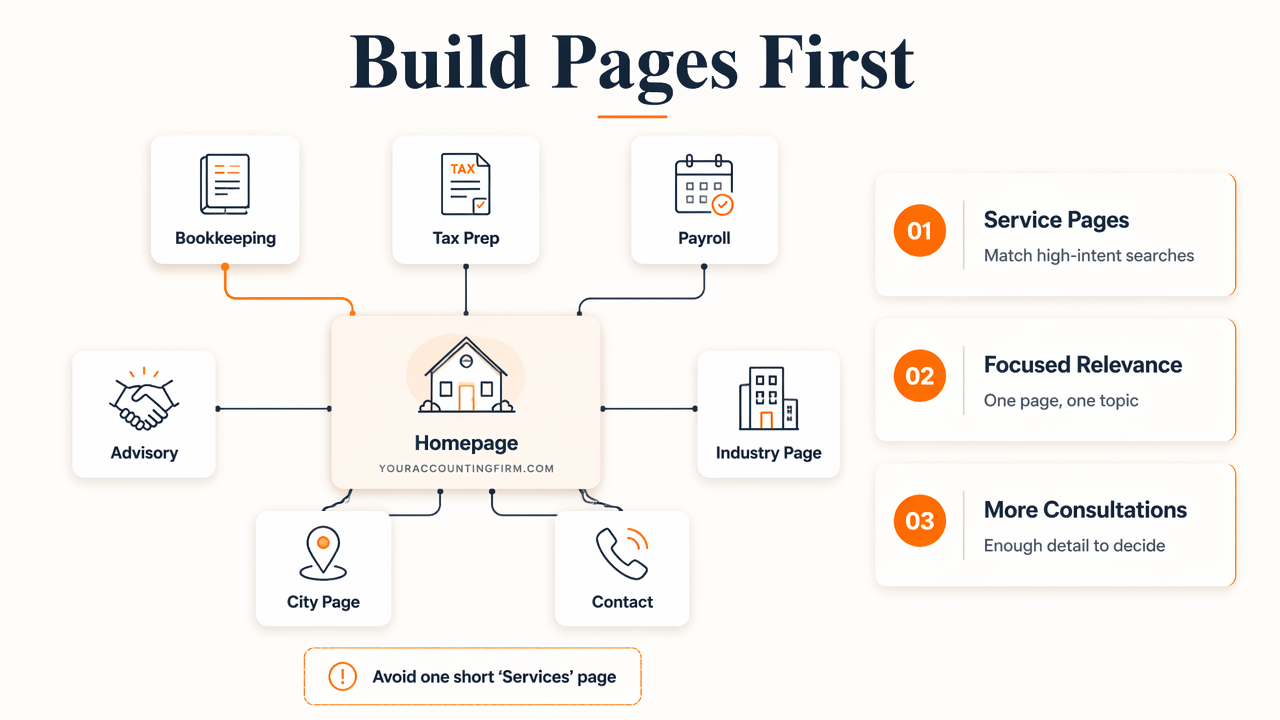
A common mistake is putting every service on one short "services" page. Search engines need a focused page to understand relevance. Prospects also need enough detail to decide whether the firm handles their situation.
Priority page map with keyword examples
| Page type | Example keyword | Best-fit page title | What the page must prove |
|---|---|---|---|
| Core service | bookkeeping services for small business |
Small Business Bookkeeping Services | Monthly process, software used, reporting cadence |
| Tax service | business tax preparation near me |
Business Tax Preparation | Deadlines, entity types, CPA or EA credentials |
| Local page | bookkeeper in Denver |
Bookkeeping Services in Denver | Local service area, reviews, nearby industries |
| Industry page | accountant for contractors |
Accounting for Contractors | Job costing, 1099s, cash-flow needs |
| Problem page | catch up bookkeeping help |
Catch-Up Bookkeeping Services | Cleanup process, timeline, software access |
| Trust page | CPA firm reviews |
Client Reviews and Results | Testimonials, rating widgets, case details |
Each page should answer one commercial question. For example, a tax preparation page should not also try to rank for payroll, CFO services, and entity formation. A clean structure helps Google, Bing, and AI assistants connect the page to one job.
Service page checklist
Strong accounting service pages include:
- A plain-language explanation of the service.
- The client types served, such as freelancers, retailers, SaaS firms, or local contractors.
- The software supported, such as QuickBooks Online, Xero, Gusto, or Shopify accounting workflows.
- Credentials, licenses, firm history, and team bios.
- A short process section that explains onboarding.
- Clear next steps for booking a consultation.
Firms using WordPress can connect publishing workflows through Earlyseo's WordPress integration, which helps keep service updates and SEO tasks in one place.
How should local SEO and reviews work for accounting firms?
Local SEO for accounting firms should connect a verified Google Business Profile, consistent local citations, location-specific pages, and recent reviews. The goal is not only to appear on a map, but to prove the firm is active, nearby, and trusted by the right client type.
For accountants, local relevance is stronger when the website and profile say the same thing. If the site promotes tax planning for dentists in Phoenix, the business profile, reviews, and service descriptions should reinforce that focus.
Local visibility checklist
- Google Business Profile: choose accurate categories, add services, upload current photos, and keep hours updated around tax season.
- NAP consistency: match name, address, and phone number across directories, social profiles, and accounting association listings.
- Review strategy: ask satisfied clients to mention the service, industry, or city naturally.
- City pages: create pages only for real service areas where the firm can reasonably support clients.
- Local proof: add chamber memberships, CPA society links, community involvement, and office photos where relevant.
Strong local SEO reads like proof, not decoration. Real reviews, real addresses, and real service areas beat thin city pages every time.
Review signals that build trust
Accounting is a high-trust service, so reviews need more context than star ratings. A useful review mentions a problem solved, such as monthly reconciliations, tax filing, payroll setup, or cleanup after missed bookkeeping.
Firms should avoid scripted review language. Natural wording is safer, more credible, and easier for search systems to classify. A review that says "helped a restaurant fix payroll and sales tax reporting" gives more useful context than "great service."
City targeting without doorway pages
City pages should be created only when each page has unique local value. A legitimate page can mention the local office, service area, local client types, appointment options, and city-specific tax or business context.
Thin pages that swap only the city name are risky and unhelpful. A better approach is one strong metro page plus supporting pages for suburbs only when the firm has real client experience or local proof.
How should tax-season content win qualified traffic?
Tax-season content should answer urgent questions, then guide readers to the relevant service page. The best topics cover deadlines, documents, deductions, estimated taxes, entity changes, payroll forms, and bookkeeping cleanup before filing.
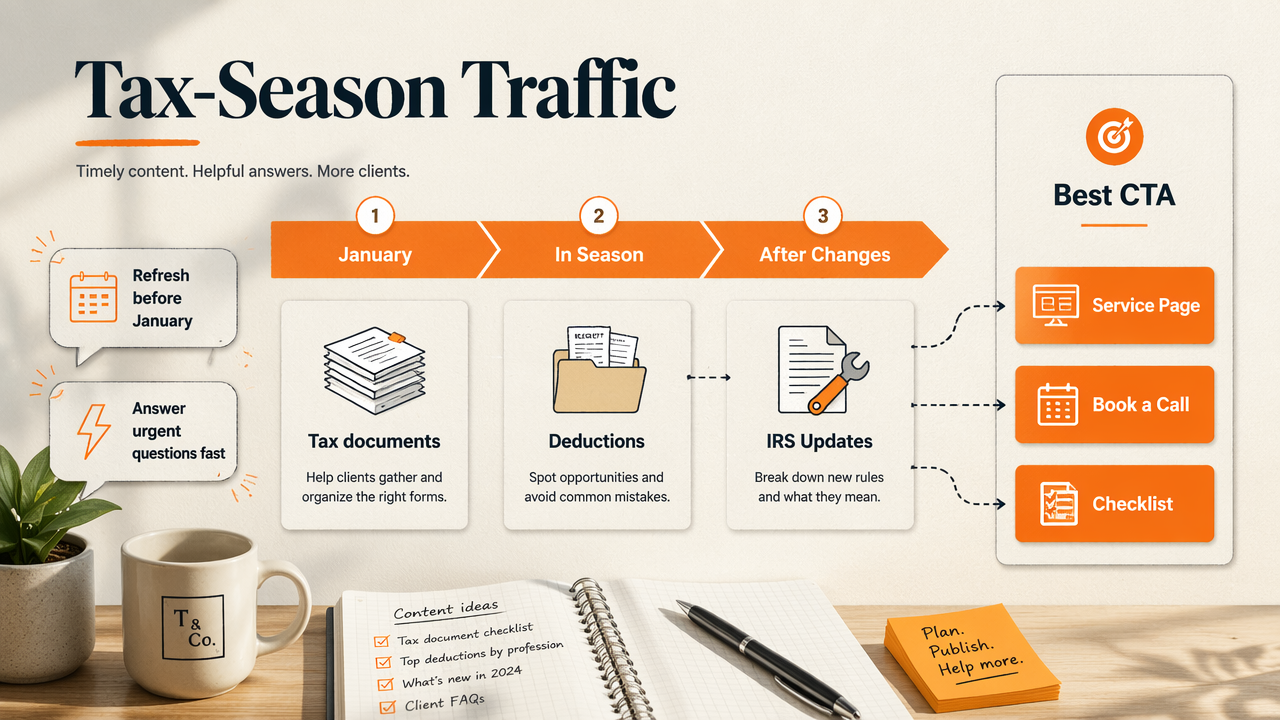
Content timing matters. Many firms publish tax articles too late, when search demand has already peaked. A 2026 plan should prepare seasonal pages before January, refresh them during filing season, and update evergreen pages after major IRS or state changes.
Content ideas by season and intent
| Timing | Topic example | Search intent | Best CTA |
|---|---|---|---|
| January | tax documents small business needs |
Preparation | Book tax prep consult |
| February | 1099 deadline help |
Urgent compliance | Request filing help |
| March | catch up bookkeeping before taxes |
Problem solving | Start cleanup review |
| April | file extension for business taxes |
Deadline pressure | Ask about extension support |
| June | estimated tax payments for freelancers |
Planning | Schedule quarterly tax planning |
| November | year-end tax planning checklist |
Advisory | Book planning session |
A content hub works better than one-off posts. For example, a "Small Business Tax Center" can link to tax prep, bookkeeping cleanup, estimated tax, payroll tax, and entity planning pages.
How Earlyseo handles this
Earlyseo helps turn seasonal SEO into a repeatable calendar instead of a last-minute task. The platform can organize service pages, content briefs, and publishing workflows so accounting teams keep moving before tax season gets crowded.
Teams that need implementation detail can review Earlyseo's documentation for setup guidance. For broader topic planning, the Earlyseo blog library gives related SEO reading that supports ongoing content decisions. More information is also available at earlyseo.com.
What to expect in 2027
Accounting SEO is moving toward clearer entity signals and stronger proof. AI assistants are likely to cite firms that state who they serve, where they operate, what credentials they hold, and which problems they solve.
Firms should expect less reward from generic blog volume. Specific pages, named expertise, clean technical structure, and current service information will matter more as AI search becomes a bigger discovery channel.
FAQ about accounting SEO
Accounting SEO works best when common questions are answered directly and tied back to service intent. Short FAQ sections can help search engines understand pages, while also reducing confusion for prospects comparing firms.
How long does SEO take for an accounting firm?
Local accounting SEO often starts showing early movement after key service pages, Google Business Profile updates, and reviews are in place, but meaningful results usually require consistent publishing and technical maintenance. Competitive cities and broad tax keywords take longer than niche searches such as "bookkeeper for contractors" or "catch-up bookkeeping for Shopify stores."
Should bookkeepers target the same keywords as CPAs?
Bookkeepers should not copy CPA keyword strategies exactly. A bookkeeping firm should prioritize monthly bookkeeping, cleanup, payroll support, financial reports, and software-specific searches. CPA firms can target tax preparation, tax planning, audits, entity advisory, and compliance topics when those services match their licenses and client work.
Are blog posts or service pages more important?
Service pages usually matter more at the start because they match commercial searches and convert visitors into leads. Blog posts become valuable when they support those pages with related questions, seasonal tax topics, industry-specific guidance, and internal links. A blog without strong service pages often attracts readers who are not ready to hire.
Can one accounting firm rank in multiple cities?
A firm can rank in multiple cities when each location page reflects a real service area and includes useful local proof. Pages should mention actual service coverage, local industries, reviews, and appointment options. Search engines are less likely to trust city pages that only replace one location name with another.
Conclusion
SEO for accountants and bookkeepers should start with a practical plan: build focused service pages, strengthen local trust, collect specific reviews, and publish tax-season content before demand peaks. The next step is a simple audit of existing pages against the service map above, followed by one priority page refresh per week. For firms ready to turn that into a repeatable workflow, Earlyseo and earlyseo.com provide a practical place to start.