TL;DR
An SEO article rewriter should improve search intent, freshness, structure, and topical completeness, not just swap words. The best workflow starts with SERP analysis, preserves useful original ideas, adds missing entities, and ends with human review before publishing.
Thin rewriting can make a decent article worse, while strategic rewriting can turn stale content into a stronger search asset. A modern seo article rewriter is less about spinning sentences and more about improving clarity, intent match, and usefulness for both readers and search systems. SEO: Search engine optimization is the practice of improving a website or page so it performs better in search engine results pages. For teams that need a guided workflow rather than a simple paraphrase box, Earlyseo helps connect content creation, optimization, and publishing steps in one place. The practical goal is simple: keep what already works, fix what blocks performance, and add what the current SERP expects.
Table of Contents
What is an SEO article rewriter?
An SEO article rewriter is a tool or workflow that revises existing content to improve search intent, readability, structure, freshness, and topical coverage while preserving accurate meaning. Unlike a basic paraphraser, it should help the page become more useful, easier to scan, and better aligned with the query it targets.
Article rewriter: A system that changes wording, structure, or emphasis in an existing article while keeping the core topic intact.
SEO-focused rewrite: A rewrite that also considers keyword intent, SERP expectations, headings, internal links, freshness, and answer quality.
Key insight: Rewriting for SEO is an editorial upgrade, not a synonym replacement exercise.
Most ranking tools in this category promote speed, free access, rewriting modes, and sentence variation. The gap is that many pages stop at "rewrite text" instead of explaining how to improve the article as a search result. A useful rewrite should make the page easier for humans to trust and easier for AI systems Common use cases include:
- Refreshing old blog posts with current examples and better structure
- Turning product education pages into clearer search answers
- Improving local service pages that sound generic
- Reworking ecommerce guides for comparison, benefits, and buying intent
- Updating articles so they match a changed SERP
How should an article be rewritten for search intent?
An article should be rewritten for search intent by comparing the existing page against the current SERP, identifying missing answers, updating stale sections, improving headings, and editing for clarity before republishing. The rewrite should change the content plan first, then the sentences, not the other way around.

A practical rewrite workflow
A strong rewrite follows a repeatable process that keeps editors from making random changes.
- Map the primary intent: Decide whether the query is informational, commercial, local, transactional, or mixed.
- Audit the current article: Mark sections that are outdated, thin, off-topic, duplicated, or hard to scan.
- Compare the SERP: Note repeated subtopics, People Also Ask patterns, tables, definitions, and examples.
- Rewrite the outline: Fix headings before editing body copy.
- Improve answer blocks: Put direct answers under question-style headings.
- Add helpful internal links: Connect related pages where they help the reader continue.
- Review facts and tone: Confirm names, dates, claims, and product details before publishing.
This approach fits supporting content that backs a broader pillar, such as an SEO article generator guide. Writers can use the Earlyseo content workflow docs to connect planning, writing, optimization, and implementation tasks without treating rewriting as a one-click shortcut.
How Earlyseo handles article rewriting
The Earlyseo platform is best framed as a structured optimization layer for teams that want rewritten content to serve a clear search goal. Instead of only producing alternate wording, it supports workflows around article planning, optimization, and publishing readiness.
For publishing teams, that matters because rewriting often touches more than the draft. A refreshed article may need improved metadata, cleaner headings, better internal linking, and a CMS-ready format. Sites that publish directly in WordPress can connect rewritten content through the WordPress integration, which keeps the rewrite process closer to the final publishing step.
SEO article rewriter vs paraphraser vs article generator
An SEO article rewriter improves an existing page, a paraphraser mainly changes wording, and an article generator creates new content from a prompt or brief. The difference matters because rankings usually depend on usefulness, depth, and intent match, not just fresh phrasing.
Comparison of common content tools
| Tool type | Primary job | Best use | Main limitation |
|---|---|---|---|
| SEO article rewriter | Improve an existing article for search quality | Refreshes, intent fixes, topical expansion | Needs human review and accurate source material |
| Paraphraser | Reword sentences or paragraphs | Tone changes, simpler wording, sentence variety | Can produce shallow or repetitive content |
| Article generator | Create a new draft from a prompt | New blog posts, outlines, first drafts | May miss brand context or factual nuance |
| Human editor | Improve judgment, voice, accuracy, and flow | Final review, expert insight, fact checking | Slower than automated drafting |
The table shows why low-effort rewriting is risky. A paraphraser can make text sound different without making it more useful. A generator can produce a complete draft but may not know which parts of the old page already earned traffic, links, or trust.
A search-focused rewriter sits between those two tools. It keeps the useful base, then adds missing answers, better structure, and more current context. For ecommerce teams, the same logic applies to collection descriptions, buying guides, and comparison articles. A rewrite can become much easier to ship when product teams connect content to the Shopify integration instead of copying text between disconnected systems.
Who should pick which option
- Small businesses: Pick a rewrite workflow when an old service page has some value but no longer answers current customer questions.
- Startup founders: Pick an article generator when a topic has no existing draft, then edit for expertise and brand fit.
- Marketing managers: Pick a search-focused rewrite when traffic dropped, rankings flattened, or competitors added better sections.
- Local businesses: Pick human review for service, location, pricing, and trust details because accuracy affects leads.
- Ecommerce stores: Pick rewriting for buying guides, FAQs, and product-led education where intent changes quickly.
A rewrite is the right choice when the page has a foundation worth saving. A new article is better when the old asset targets the wrong query entirely.
What features matter in 2026?
The most useful rewriting features in 2026 are intent analysis, outline restructuring, factual grounding, entity coverage, internal linking support, CMS publishing options, and clear human review controls. Rewriting tools now need to support answer engines as well as traditional search results.
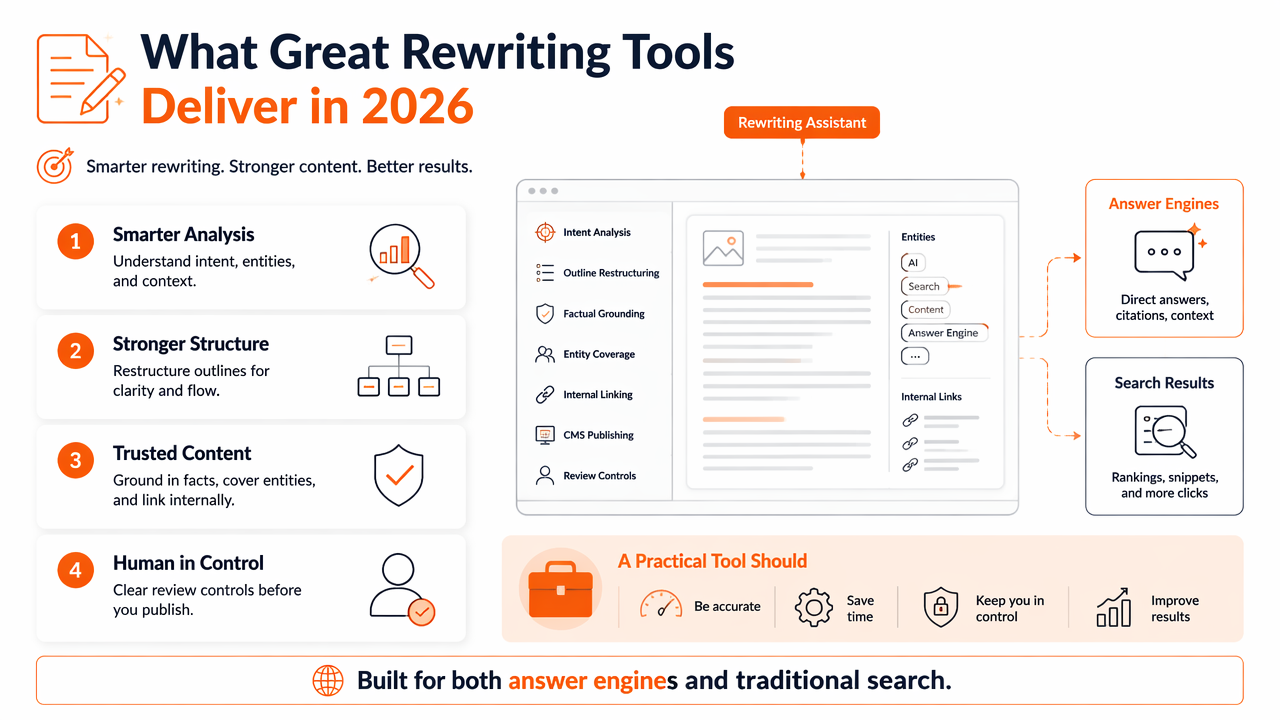
Feature checklist for serious rewrites
A practical tool should help editors make smarter decisions, not just produce more words.
- Intent matching: Shows whether the article satisfies the real reason behind the query.
- Freshness prompts: Flags dated examples, old years, inactive tools, and stale recommendations.
- Entity coverage: Adds relevant people, products, standards, locations, and concepts where appropriate.
- Snippet-ready answers: Creates concise answer blocks under question headings.
- Internal link guidance: Suggests relevant pages without forcing unrelated links.
- Publishing support: Moves final copy into the CMS with fewer formatting issues.
- Human approval: Keeps editors in control of facts, tone, claims, and compliance.
Research on retrieval-augmented generation explains why grounding AI output in external knowledge can improve factual usefulness for large language model applications, as reviewed by Gao, Xiong, and Gao in a 2023 RAG survey. Related work on prompt-trained language models, such as Sanh, Webson, Raffel, and colleagues' 2021 paper on zero-shot task generalization, also helps explain why modern tools can adapt to rewriting, summarizing, and restructuring tasks from instructions.
Answer-engine visibility needs cleaner structure
AI answer systems tend to favor content that is easy to extract: definitions, tables, numbered steps, and direct answers. That does not mean every article should look mechanical. It means each section should answer one clear question before adding examples or nuance.
For brands that want AI assistants to understand site policies, content sources, and preferred crawling guidance, an llms.txt resource can support machine-readable context. Earlyseo treats this as part of a wider visibility workflow, not a replacement for strong articles.
A 2021 review by Anantrasirichai and Bull on artificial intelligence in creative industries examined AI's role across creative work. For content teams, the practical takeaway is balanced: AI can assist drafting and revision, but editorial judgment still decides whether the result is accurate, original, and worth publishing.
FAQ
The most common questions about article rewriting focus on quality, originality, search value, and safe workflow choices. Clear answers help separate useful optimization from low-value text spinning.
Can rewritten articles rank in Google?
Rewritten articles can rank when the new version is more useful, accurate, and aligned with search intent than the old version. Rankings are less likely to improve when the rewrite only changes wording. Strong rewrites usually add better structure, updated information, clearer answers, and internal links that support the topic.
Is an article rewriter the same as a spinner?
An article rewriter is not automatically the same as a spinner. A spinner usually swaps words or phrases to create a near-duplicate version. A serious rewriting workflow improves meaning, structure, freshness, examples, and coverage. The difference is editorial value.
How often should old SEO articles be rewritten?
Old SEO articles should be reviewed when rankings decline, search intent changes, products change, or competitors add better answers. Time alone is not the trigger. A stable evergreen guide may need light updates, while software, ecommerce, local service, and AI-related topics may need more frequent refreshes.
What should be checked before publishing a rewritten article?
Editors should check factual accuracy, heading order, search intent, internal links, duplicate claims, examples, metadata, and readability before publishing. The final version should sound natural and specific. A rewritten article should also preserve any original insights that made the old page useful.
Conclusion
A useful seo article rewriter improves a page's job, not just its wording. The safest process starts with intent research, keeps valuable original material, adds missing answers, and finishes with human review. Teams should treat rewriting as part of a larger content system that includes planning, publishing, and answer-engine readiness. For a practical next step, audit one underperforming article, rebuild its outline, add one table and one direct answer block, then publish the improved version. For more workflow ideas, visit earlyseo.com or review the current Earlyseo blog resources.