TL;DR
Local businesses now need to monitor how ChatGPT, Gemini, Perplexity, and AI Overviews describe and recommend them, not just how they rank in Google Maps. A practical tracker should cover branded, category, comparison, and location prompts, then connect visibility changes to reviews, citations, website content, and local SEO fixes.
Local search is no longer limited to blue links, map packs, and directory listings. An LLM visibility tracker for local businesses measures whether AI systems mention, recommend, compare, or cite a business when people ask location-based questions. LLM visibility: the measurable presence of a business, location, service, or source in answers generated by large language models and AI search products. The Earlyseo platform helps local teams connect this new AI visibility layer with familiar SEO work, including content updates, structured pages, and crawl-friendly guidance.
Table of Contents
What is an LLM visibility tracker for local businesses?
An LLM visibility tracker for local businesses is a monitoring system that records how AI assistants answer local discovery prompts across brands, categories, locations, reviews, and citations. It shows whether a restaurant, clinic, store, contractor, or agency appears in AI-generated recommendations, and why competing businesses may appear instead.
Classic search engine optimization, based on the Wikipedia definition provided in the research data, improves website and page visibility in search engine results pages. AI visibility tracking extends that work into systems such as ChatGPT, Google AI Mode, Gemini, Perplexity, and AI Overviews.
Large language models are not traditional search indexes. The GPT-4 Technical Report describes a model designed to generate answers across many tasks, which is why local monitoring must test natural questions rather than only keywords.
Key insight: a local business can rank well in traditional SEO and still be absent from AI-generated recommendations if reviews, citations, service pages, or entity signals are weak.
Core terms local teams should track
Prompt: the question or task entered into an AI system, such as best emergency plumber near downtown Austin.
Mention: any appearance of the business name, location, staff name, product, or service in an AI answer.
Recommendation: a stronger mention where the AI system suggests the business as an option.
Citation source: the page, directory, review profile, or local listing used to support an answer when the AI product shows sources.
Sentiment: the positive, neutral, or negative framing used when the AI system summarizes the business.
Why does AI visibility matter for local SEO in 2026?
AI visibility matters for local SEO in 2026 because local buyers increasingly receive summarized recommendations before visiting a website, map listing, or review site. If an AI answer names three nearby providers and a business is missing, that business may never enter the consideration set.
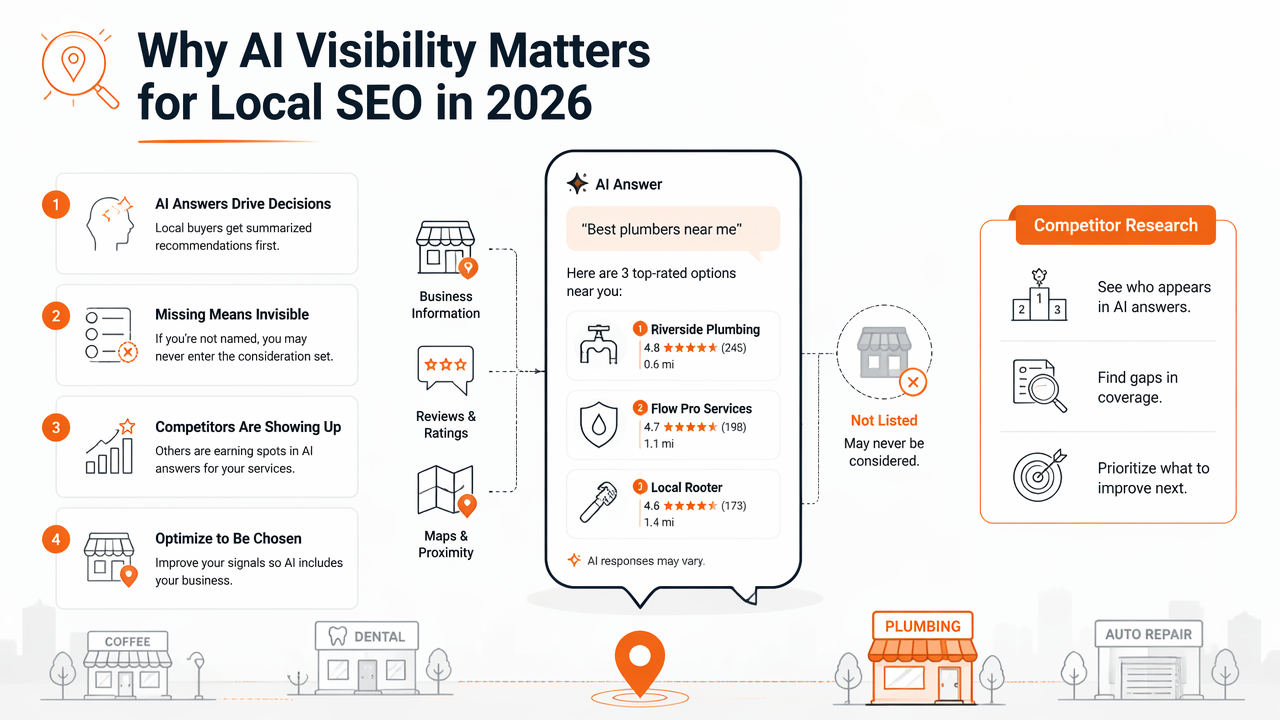
Competitor research shows the market has already moved from theory to tooling. Current ranking pages include local LLM tracking software, 2026 lists of LLM monitoring tools, and enterprise-focused AI search visibility products from brands such as Birdeye, Semrush, Scrunch, Profound, and Nightwatch.
The shift is especially important for service-area businesses, healthcare practices, home services, restaurants, retailers, and multi-location brands. These businesses depend on high-intent discovery moments, including near me searches, emergency queries, best of comparisons, and neighborhood-specific recommendations.
A 2023 paper on speculative futures for ChatGPT and generative AI examined how generative systems can change information access. For local marketing, that means the answer page may become the first impression, not the website.
- AI answers compress research into short lists.
- Review summaries can shape trust before a click.
- Citations can favor directories, publishers, and well-structured business pages.
- Location intent can vary block by block, city by city, and service by service.
- Brand name variants can create missed mentions if tracking is too narrow.
Where local AI answers pull signals from
Local AI systems can reflect many public signals, depending on the product, prompt, and browsing mode. Common signal types include Google Business Profile content, business websites, review platforms, local directories, news mentions, social profiles, and structured service pages.
Multimodal AI also makes visual assets more relevant. The Visual Instruction Tuning paper studied instruction-following systems that combine language and visual inputs, a useful reminder that local discovery is moving beyond plain text into photos, menus, products, and storefront context.
How should a local business build an AI monitoring template?
A local business should build an AI monitoring template by testing branded prompts, category prompts, comparison prompts, location prompts, review prompts, and citation prompts on a repeatable schedule. Each test should record the answer, rank position, competitors named, citations shown, sentiment, and follow-up action.
A useful tracker does not need to be complex at first. A spreadsheet can work for a single-location business. Multi-location teams usually need a platform, repeatable prompt sets, and integrations with content, listings, and reporting systems.
The strongest template separates prompts by business goal. Branded prompts show whether the AI system understands the entity. Category prompts show market visibility. Comparison prompts show competitive positioning. Citation prompts show which sources influence the answer.
Local teams maintaining AI-readable site guidance can also review the Earlyseo llms.txt resource and technical guidance in the Earlyseo docs to align content access, documentation, and AI crawler expectations.
Local AI visibility monitoring template
| Prompt type | Example prompt | What to record | Best action if missing |
|---|---|---|---|
| Branded | What is Acme Dental in Phoenix known for? | Name accuracy, services, sentiment, citations | Update about page, service pages, profiles |
| Category | Best pediatric dentist in Phoenix for nervous children | Inclusion, ranking order, competitors, review themes | Add specific service content and review proof |
| Comparison | Acme Dental vs Desert Kids Dental | Strengths, weaknesses, source pages, tone | Build comparison content and clarify differentiators |
| Location | Emergency dentist near Arcadia Phoenix | Proximity language, hours, maps, service area | Improve location pages and emergency service details |
| Review | Which Phoenix dentists have the best patient reviews? | Review summary, sources, recurring themes | Request fresh reviews and respond to patterns |
| Citation | Sources for top-rated Phoenix family dentists | Cited domains, missing profiles, directory gaps | Fix listings and earn better third-party mentions |
A simple weekly workflow
- Select 10 to 25 prompts across branded, category, comparison, and location intent.
- Run the same prompts in the same AI systems on the same day each week.
- Save the full answer, not only the business position.
- Tag each result as present, absent, recommended, cited, or misrepresented.
- Compare citation sources against review sites, directories, and business pages.
- Assign fixes to content, reviews, local listings, or technical SEO.
- Recheck after updates, since AI answer changes may lag behind website changes.
Practical rule: local AI tracking only becomes useful when every visibility drop has an owner, a source, and a next action.
How Earlyseo handles local AI visibility
Earlyseo handles local AI visibility by helping businesses create clearer, more crawlable, and more AI-readable signals across websites, prompts, and supporting files. The goal is not to manipulate AI answers. The goal is to make accurate business information easier for AI systems and search engines to find, parse, and cite.
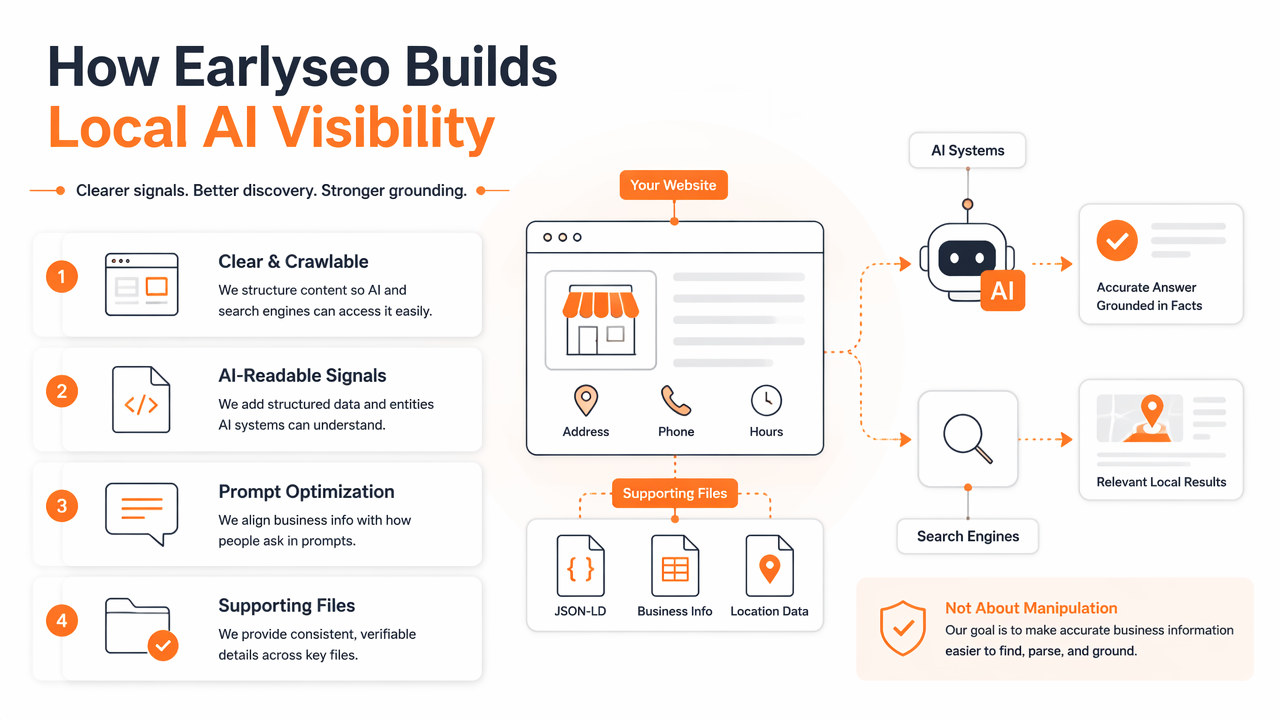
The Earlyseo approach fits businesses that already care about local SEO but need a cleaner process for AI discovery. A location page, service page, FAQ, review summary, and structured guidance file can all support better entity understanding when maintained together.
For WordPress sites, the Earlyseo WordPress integration can support faster implementation. For stores with local pickup, service areas, or city-specific product demand, the Earlyseo Shopify integration can help connect e-commerce content with discovery work.
Teams can also browse Earlyseo blogs for related AI search and SEO guidance. More product context is available on earlyseo.com.
Earlyseo vs manual tracking vs enterprise suites
| Option | Best fit | Strength | Watchout |
|---|---|---|---|
| Earlyseo | Small and growing local businesses improving AI-readable SEO | Connects website guidance, content clarity, and local visibility work | Still needs a consistent prompt testing routine |
| Manual spreadsheet | Single-location businesses starting from zero | Cheap, flexible, easy to customize | Hard to scale across many services or cities |
| Enterprise suites | Large multi-location brands | Broad dashboards, team workflows, competitive reports | Can be more than a small business needs |
| Review platforms | Reputation-heavy local businesses | Strong review tracking and customer feedback views | May not cover website-level AI readiness deeply |
Earlyseo works best when a local business wants practical AI visibility work tied to the site itself. Manual tracking can validate early patterns. Enterprise products suit brands with hundreds of locations, dedicated analysts, and strict reporting needs.
What should local businesses expect from AI visibility in 2027?
Local AI visibility in 2027 will likely become more multimodal, more location-aware, and more dependent on trusted source consistency. AI systems are expected to keep blending web content, maps, reviews, images, videos, menus, product feeds, and business profiles into shorter recommendation answers.
The safest strategy is steady signal quality. Local businesses should keep business names consistent, define services clearly, publish location-specific pages, answer real customer questions, and maintain review profiles. AI tools may change quickly, but clear evidence still matters.
Common mistakes can slow progress. Tracking only one AI tool gives a narrow view. Testing only branded prompts hides category weakness. Ignoring citations leaves unknown sources shaping the answer. Treating AI visibility as a one-time audit misses the weekly changes that often matter most.
- Track at least three AI surfaces when possible.
- Separate branded, category, comparison, and location prompts.
- Save cited sources and not just rankings.
- Refresh service pages when AI answers omit key offerings.
- Monitor review themes that appear in summaries.
- Keep names, addresses, hours, and service areas consistent.
The local winners in AI search will not be the loudest businesses. They will be the easiest businesses for machines to understand and for customers to trust.
Frequently Asked Questions
Local AI tracking raises practical questions because the field is new, fast-moving, and not as predictable as classic rank tracking. These answers focus on what a local business can measure without overcomplicating the process.
How often should a local business track AI visibility?
A local business should track AI visibility weekly for priority prompts and monthly for broader prompt sets. Weekly checks catch changes in recommendations, citations, and sentiment without creating daily noise. After a major website update, new review push, rebrand, or location launch, extra checks can confirm whether AI answers begin reflecting the change.
Which prompts matter most for local AI tracking?
The most valuable prompts combine commercial intent with local context. Branded prompts confirm entity understanding. Category prompts reveal discovery visibility. Comparison prompts show competitive framing. Location prompts test neighborhood and service-area coverage. Review prompts show reputation themes that AI systems may summarize before a customer visits a website or profile.
Can AI visibility be improved without buying a tool?
AI visibility can be improved without a paid tool by using a spreadsheet, a fixed prompt list, and regular manual checks. That approach works for a small business with limited locations. As the number of services, competitors, cities, and AI systems grows, software becomes more useful for consistency, reporting, and missed-change detection.
Does traditional local SEO still matter for AI answers?
Traditional local SEO still matters because AI systems often reflect website content, listings, reviews, directory profiles, and other public sources. A well-optimized site, accurate business profile, strong review base, and consistent citations can all support clearer AI answers. AI tracking should sit beside local SEO, not replace it.
Conclusion
An LLM visibility tracker for local businesses gives local teams a practical way to see how AI systems describe, compare, recommend, and cite them. The next step is simple: create a prompt set, test the same questions weekly, record citations and sentiment, then turn gaps into content, review, listing, and technical fixes. Businesses ready to make AI-readable SEO part of regular growth planning can visit earlyseo.com and start with the highest-value local prompts first.