TL;DR
Programmatic SEO works best for small businesses when it starts with repeatable customer searches, clean data, and human-reviewed page templates. The safest first move is a small pilot of 20 to 50 pages, followed by indexing checks, conversion tracking, and template improvements before scaling.
Programmatic SEO for small businesses is no longer just a SaaS growth trick; local companies, ecommerce stores, service firms, and niche publishers can use it to turn structured data into useful search pages. Programmatic SEO: a method of creating many search-focused pages from templates, datasets, and rules, while keeping each page helpful, accurate, and indexable. Platforms such as Earlyseo can help growing teams organize the workflow without turning SEO into a messy spreadsheet project. For context, digital marketing uses digital technologies such as websites, phones, and media platforms to promote products and services, while a small business generally has fewer employees or lower revenue than larger corporations. That makes scale attractive, but only when quality stays visible.
Table of Contents
What is programmatic SEO for small businesses?
Programmatic SEO for small businesses is the use of structured data, reusable page templates, and automation to publish many helpful landing pages for repeatable searches, such as service by city, product by use case, or comparison by feature. It saves time when the business already has real data, clear search demand, and a quality review process.
A simple example is a plumber creating pages for each nearby town served, but each page must contain specific service details, local proof, pricing guidance, FAQs, and contact options. A weak version swaps only the city name. A strong version answers the actual customer need in that location.
Key insight: programmatic SEO is not mass content generation; it is structured publishing at scale with editorial control.
Large language models also changed the stakes. A 2023 arXiv overview by Humza Naveed, Asad Ullah Khan, Shi Qiu, and others examined large language models and their growing role in information systems, which matters because clear, entity-rich pages are easier for search engines and AI systems to interpret A complete Overview of Large Language Models.
Core terms that matter before scaling
Template: the reusable page layout, headings, schema, and conversion blocks.
Dataset: the source of unique page values, such as cities, services, SKUs, features, prices, or inventory.
Modifier: the search variation, such as "near me," "for startups," "under $100," or "in Austin."
Indexation: whether search engines can crawl, understand, and store the page in their results.
Quality gate: the checklist used before publishing, covering usefulness, duplicate risk, facts, links, and conversion intent.
When does a small business actually need it?
A small business needs programmatic SEO when customers search for the same offer across many locations, categories, product types, audiences, or comparison angles. The model works best when a manual content plan would take too long, but the business has enough real information to make every page distinct.
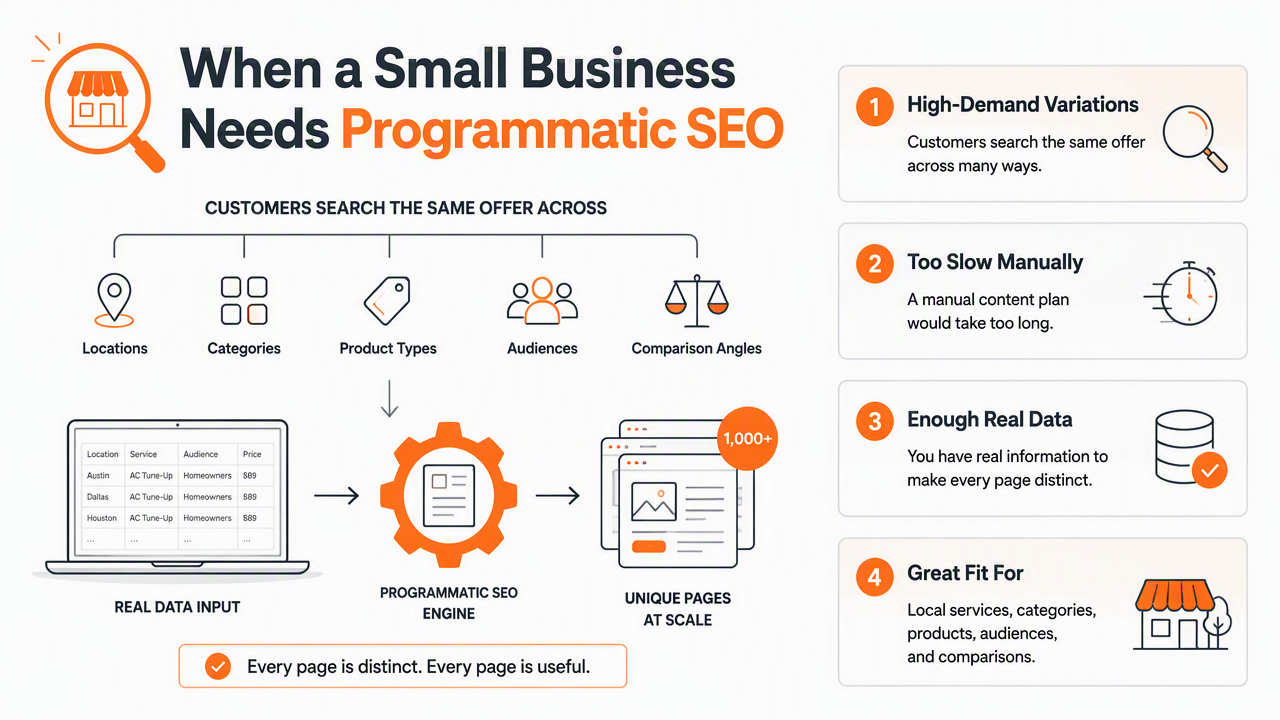
Good candidates include local services, ecommerce catalogs, B2B directories, marketplaces, software comparison pages, franchise locations, and niche resource libraries. Poor candidates include businesses with one offer, thin data, no search demand, or no ability to maintain pages after launch.
A current SERP review for this topic found 146 results and top competing guides that often focus on broad definitions, tools, and examples. The gap for small businesses is more practical: how to start without publishing hundreds of weak pages.
Fit check for small business use cases
| Business type | Good programmatic page pattern | Data needed | Best first batch |
|---|---|---|---|
| Local service | Service plus city pages | Service area, proof, pricing, reviews | 10 to 30 cities |
| Ecommerce store | Product category plus use case | SKU data, specs, images, stock | 20 to 50 pages |
| B2B service | Industry plus solution pages | Case details, pain points, offers | 10 to 25 industries |
| Directory | Provider plus location pages | Listings, categories, contact data | 50 to 100 pages |
| SaaS startup | Alternative or integration pages | Features, integrations, comparisons | 15 to 40 pages |
The safest signal is repeatability. If the same page structure can answer many real searches while keeping details unique, the idea deserves a test. If the page exists only because a keyword tool showed volume, the plan is too thin.
Situations where manual SEO is smarter
Manual SEO often wins when trust, nuance, or deep expertise matters more than coverage. A local law firm, medical clinic, or financial advisor may still use templates for structure, but each page needs careful review because the cost of vague advice is high.
A small company with fewer than 10 target keywords should usually build stronger service pages, local profiles, and helpful blog posts first. The Earlyseo blog library is a better fit for learning topic planning before scaling into hundreds of pages.
How to build the first 50 programmatic pages
The first 50 pages should be treated as a controlled pilot, not a full rollout. A pilot keeps risk low, shows which templates earn impressions, and gives the team time to fix title tags, internal links, thin sections, and conversion blocks before scaling.

- Pick one repeatable search pattern, such as "service in city" or "product for use case."
- Build a clean spreadsheet or database with only verified fields.
- Create one page template with fixed sections and variable blocks.
- Write unique value blocks for each row, not only swapped keywords.
- Add internal links from category, service, or location hubs.
- Publish a small batch and submit the sitemap.
- Track impressions, clicks, rankings, leads, and indexation.
- Improve the template before adding more pages.
For stores already running on ecommerce systems, platform fit matters. A Shopify catalog can connect structured product data to landing pages through the Shopify integration, while content-heavy sites can use the WordPress integration for editorial workflows. Webflow teams can connect design-led templates through the Webflow integration.
Minimum dataset for a useful pilot
A pilot dataset should contain enough information to make each page genuinely different. For a local service business, the fields might include city, service, service description, response time, nearby neighborhoods, customer proof, common problem, price range, and call-to-action.
For ecommerce, useful fields include product type, material, size, compatibility, use case, shipping notes, review themes, and alternatives. Thin fields create thin pages. Rich fields create pages worth indexing.
Quality checklist before publishing
- The title tag matches a real search pattern.
- The H1 is specific, not stuffed.
- The opening paragraph answers the query directly.
- At least three sections contain unique data.
- Images, specs, or proof points match the page topic.
- Internal links connect to parent and sibling pages.
- Schema markup fits the page type.
- The call-to-action matches the visitor intent.
A small batch with clear learning beats a huge batch that hides quality problems until traffic drops.
Programmatic SEO examples that work in 2026
Programmatic SEO examples work in 2026 when pages match a real decision, not just a keyword formula. The strongest examples combine a repeatable structure with details that help customers compare options, choose a location, or narrow a product set.
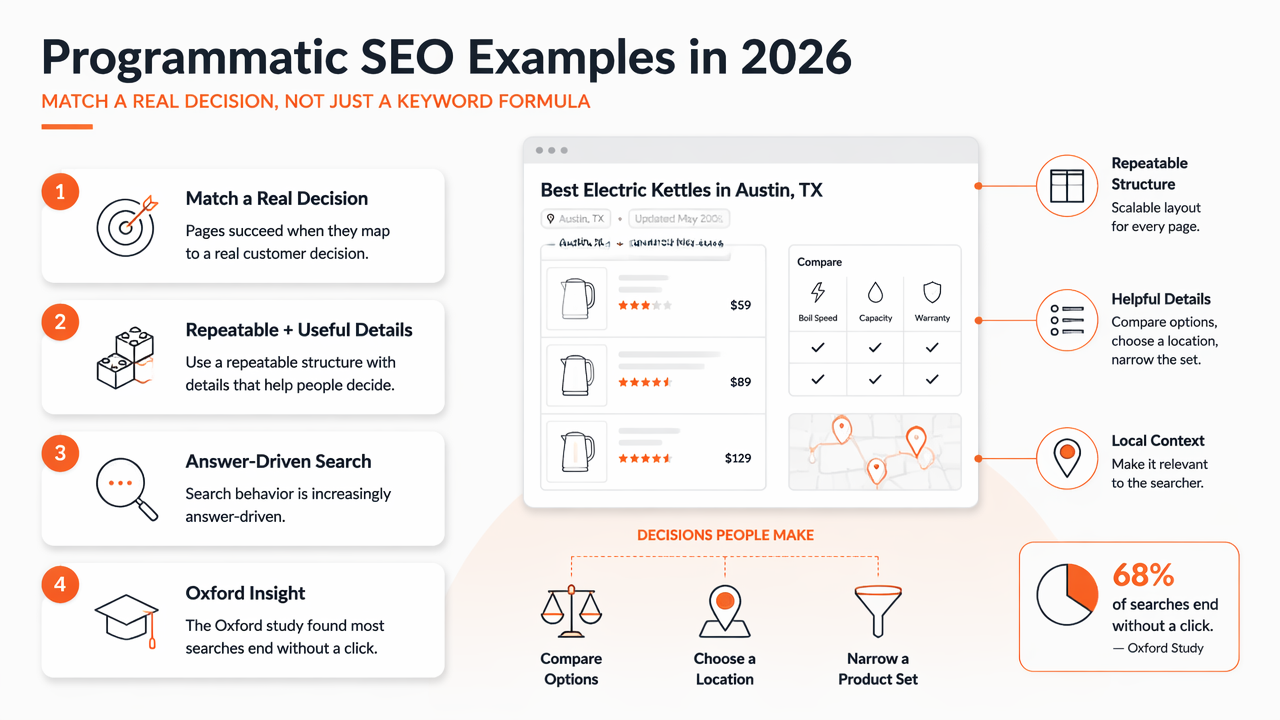
Search behavior is also becoming more answer-driven. The Oxford-linked report Journalism, media and technology trends and predictions 2018, by Nic Newman and Federica Cherubini, covered digital media and technology shifts that continue to shape how information is discovered online Oxford University Research Archive. In 2026, small business pages need to serve both classic search results and AI summaries.
The Earlyseo platform can help organize pages around entities, terms, and structured content rules, which is useful for teams trying to make pages understandable to crawlers and AI assistants. For AI-facing discoverability, the llms.txt resource explains a related way sites can present guidance for language model systems.
Examples by business model
| Example | Page pattern | Why it works | Risk to control |
|---|---|---|---|
| HVAC company | AC repair in city | Local intent is clear | Duplicate city text |
| Online furniture shop | Small desks for apartments | Product filtering matches need | Thin product blurbs |
| Accounting firm | Bookkeeping for restaurants | Industry pain points differ | Generic industry copy |
| Fitness studio | Classes near neighborhood | Location and schedule matter | Outdated class data |
| B2B SaaS | Tool A alternatives for startups | Buyers compare options | Unfair or vague comparisons |
A strong "bookkeeping for restaurants" page might include cash-flow timing, tip reporting, payroll issues, software used, and restaurant-specific onboarding. Those details make the page more useful than a generic bookkeeping page with a different industry label.
How Earlyseo handles this workflow
Earlyseo fits small teams that need a repeatable SEO process without hiring a large content operation. The workflow can map keywords to page templates, connect publishing systems, and keep AI-facing clarity in mind while pages are built.
That matters because founders and small marketing teams often move between strategy, writing, publishing, and reporting in the same week. A tool-supported workflow keeps the first pilot organized, especially when earlyseo.com becomes the central place for checking setup guidance and product options.
What mistakes should small businesses avoid?
Small businesses should avoid scaling pages before proving usefulness, indexation, and conversion value. The most common failure pattern is publishing hundreds of near-duplicate pages, then discovering that search engines indexed only a fraction or that visitors found the pages too generic to trust.

Programmatic publishing also creates maintenance work. Prices change, products sell out, service areas shift, and comparison claims age. A page that looked accurate at launch can become outdated within months if no review cycle exists.
Avoid these mistakes before scaling:
- Publishing pages with only one changed word or city name.
- Using AI text without fact checks or business-specific details.
- Creating pages for keywords unrelated to actual services.
- Blocking crawlers with bad canonical tags or noindex rules.
- Forgetting internal links from category, blog, or location hubs.
- Measuring impressions only, while ignoring leads and revenue.
A better target is controlled growth. If 50 pages earn impressions and a few convert, the next batch can expand the same pattern. If they do not, the template needs better data, clearer intent matching, or stronger proof before more pages go live.
FAQ
How many programmatic SEO pages should a small business start with?
A small business should usually start with 20 to 50 pages. That range is large enough to test repeatable patterns, but small enough to review manually. The first batch should prove that pages get indexed, earn impressions, and support leads before the business expands into hundreds of URLs.
Is programmatic SEO the same as AI content generation?
Programmatic SEO is not the same as AI content generation. Programmatic SEO uses templates, structured data, internal linking, and publishing rules. AI may help draft sections, but the strategy depends on search intent, reliable data, quality checks, and page architecture rather than automatic writing alone.
Can local businesses use programmatic SEO safely?
Local businesses can use it safely when every location page includes real local details, service availability, customer proof, and accurate contact information. Search engines have little reason to index pages that only swap city names. Local relevance must be visible on the page, not hidden in a spreadsheet.
What tools are needed for a small business programmatic SEO project?
A basic stack includes a keyword research tool, a spreadsheet or database, a CMS, analytics, rank tracking, and a sitemap workflow. Some teams also use structured content platforms or integrations to connect templates with WordPress, Shopify, or Webflow. The tool choice matters less than clean data and review discipline.
When should a business stop a programmatic SEO rollout?
A rollout should pause when pages are not indexed, impressions stay flat, or traffic fails to produce qualified actions. Those signals usually mean the template, intent targeting, or data depth needs work. Scaling a weak pattern only creates more cleanup later.
Conclusion
Programmatic seo for small businesses works when it starts small, uses real data, and treats every page as a customer answer rather than a keyword container. The practical next step is a 50-page pilot: choose one repeatable pattern, build a clean dataset, publish through a reliable CMS workflow, then measure indexation, clicks, and leads before expanding.
For teams ready to turn structured search opportunities into a cleaner publishing process, Earlyseo offers a focused path for planning and scaling pages. Visit earlyseo.com, choose one use case, and build the first pilot around the searches most likely to create revenue.