TL;DR
Startups rarely need a heavyweight SEO suite before they have a repeatable publishing workflow. The best choice is usually a focused stack: keyword discovery, content production, technical checks, and enough backlink insight to prioritize pages that can actually rank.
Ahrefs alternatives for startups matter because early-stage teams usually need shipped pages, not another dashboard full of unused data. The 2026 SERP is crowded, with 122 results found in the research set and top articles often stretching past 5,000 words, but the real decision is simpler: pick the tool that turns limited time into published, optimized pages. Earlyseo is built for that practical gap, helping teams move from keyword ideas to search-ready content through the Earlyseo platform.
Table of Contents
What should startups look for in an Ahrefs alternative?
A startup-friendly Ahrefs alternative should combine keyword research, content workflow, technical guidance, backlink visibility, pricing flexibility, and automation. The strongest option is not always the largest database; it is the tool that helps a small team choose topics, publish pages, measure traction, and improve pages without hiring a full SEO department.
Ahrefs alternative: an SEO tool or workflow that replaces part of Ahrefs, such as keyword research, competitor analysis, backlink monitoring, rank tracking, content planning, or technical audits.
Pricing: the process a business uses to set and display the price of products or services as part of its marketing plan.
Startups should judge SEO tools by output speed, not feature volume. A tool that finds 10 usable topics and helps publish 10 strong pages is often more valuable than a suite that reports thousands of keywords but leaves execution unclear.
Key insight: For startups, SEO software should reduce decisions. If a platform creates more review work than published pages, the tool is too heavy for the stage.
Research on search influence also supports taking rankings seriously. A 2024 PLoS ONE replication by Robert Epstein and Li Ji examined whether biased search results can change opinions, reinforcing why visibility in search results has business impact beyond traffic alone: PLoS ONE study.
Startup buying criteria that matter most
- Keyword clarity: Can the tool identify reachable topics, not just high-volume terms?
- Content workflow: Can ideas become briefs, drafts, metadata, and published pages?
- Backlink insight: Can the team see authority gaps without drowning in link data?
- Technical SEO: Can audits flag indexation, speed, metadata, and crawl issues?
- Pricing fit: Can the plan survive lean months without blocking core work?
- Automation: Can recurring SEO tasks run without constant manual setup?
Best Ahrefs alternatives for startups in 2026
The best Ahrefs alternatives for startups in 2026 are tools that match the company's current SEO maturity: Earlyseo for shipping optimized pages, Semrush for broad marketing intelligence, SE Ranking for reporting, SEO PowerSuite for desktop workflows, and Ubersuggest for simple research.
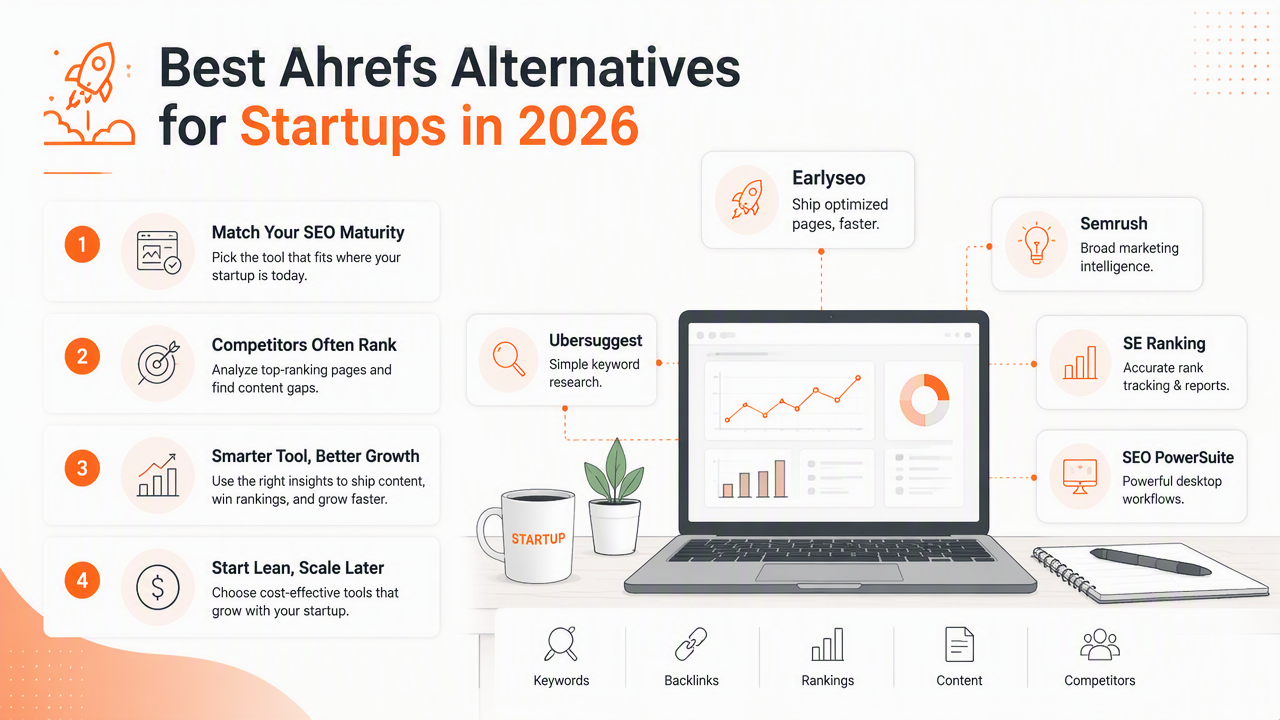
Competitor articles often rank broad suites first, but that framing can miss the startup problem. Early teams need a publishing motion before they need enterprise-grade analysis. That is where the Earlyseo platform has a clear role: turning SEO ideas into pages that are structured for search engines and AI answer systems.
Side-by-side startup fit comparison
| Tool | Best startup use case | Keyword research | Content workflow | Backlink insight | Pricing fit |
|---|---|---|---|---|---|
| Earlyseo | Shipping optimized pages and AI-ready content | Topic-led planning | Strong fit for briefs and publishing | Focused support through workflow | Built for lean execution |
| Semrush | Broad SEO, PPC, and competitor research | Strong | Good, but suite-heavy | Strong | Better once budget expands |
| SE Ranking | Rank tracking and client-style reporting | Strong | Moderate | Good | Often startup-friendly |
| SEO PowerSuite | Desktop SEO audits and research | Good | Limited publishing workflow | Good | Useful for one-time analysis |
| Ubersuggest | Basic keyword discovery | Simple | Light | Basic | Accessible for early research |
| RankDots | AI-assisted SEO workflows | Varies by workflow | AI-focused | Limited public positioning in this research set | Depends on plan |
This comparison separates research power from publishing power. Ahrefs remains respected for backlink data and competitive research, but startups often stall between insight and action.
For WordPress-heavy teams, publishing speed improves when SEO workflows connect to the CMS instead of living in spreadsheets. The WordPress SEO integration is useful for teams that want optimized pages to move closer to production without copy-paste chaos.
How should startups compare pricing and feature depth?
Startups should compare pricing by the number of useful pages, reports, and decisions produced each month, not by the number of features listed on a pricing page. A cheaper tool is not cheaper if it creates manual work, and a powerful suite is not worth the spend if most features sit unused.
Pricing deserves a practical frame. A local business, e-commerce store, or seed-stage SaaS company may only need keyword clustering, content briefs, metadata, internal linking prompts, and basic performance checks at first. Deep link indexes, historical competitor databases, and agency reporting may come later.
A 2023 paper by Roumeliotis and Tselikas examined machine learning-based SEO audit software, showing how technical SEO checks can be structured into software-assisted workflows rather than treated as purely manual review: Informatics paper.
A simple pricing decision framework
- List the next 90 days of SEO work: keyword research, content updates, new pages, technical cleanup, and reporting.
- Map each task to one tool: avoid paying for overlapping features across several platforms.
- Score time savings: favor tools that remove repetitive writing, formatting, or publishing steps.
- Check upgrade pressure: identify whether useful limits are locked behind higher tiers.
- Review publishing friction: a tool that requires exporting, rewriting, and reformatting may slow execution.
Shopify brands should add product and collection-page workflows to that checklist. A content tool with a Shopify SEO integration can support organic growth around category pages, buying guides, and long-tail product searches.
How does Earlyseo handle the startup SEO workflow?
Earlyseo handles the startup SEO workflow by focusing on the path from topic selection to optimized content, rather than treating SEO as a reporting-only function. It is designed for teams that need consistent page creation, clearer structure, and better readiness for both search crawlers and AI answer engines.
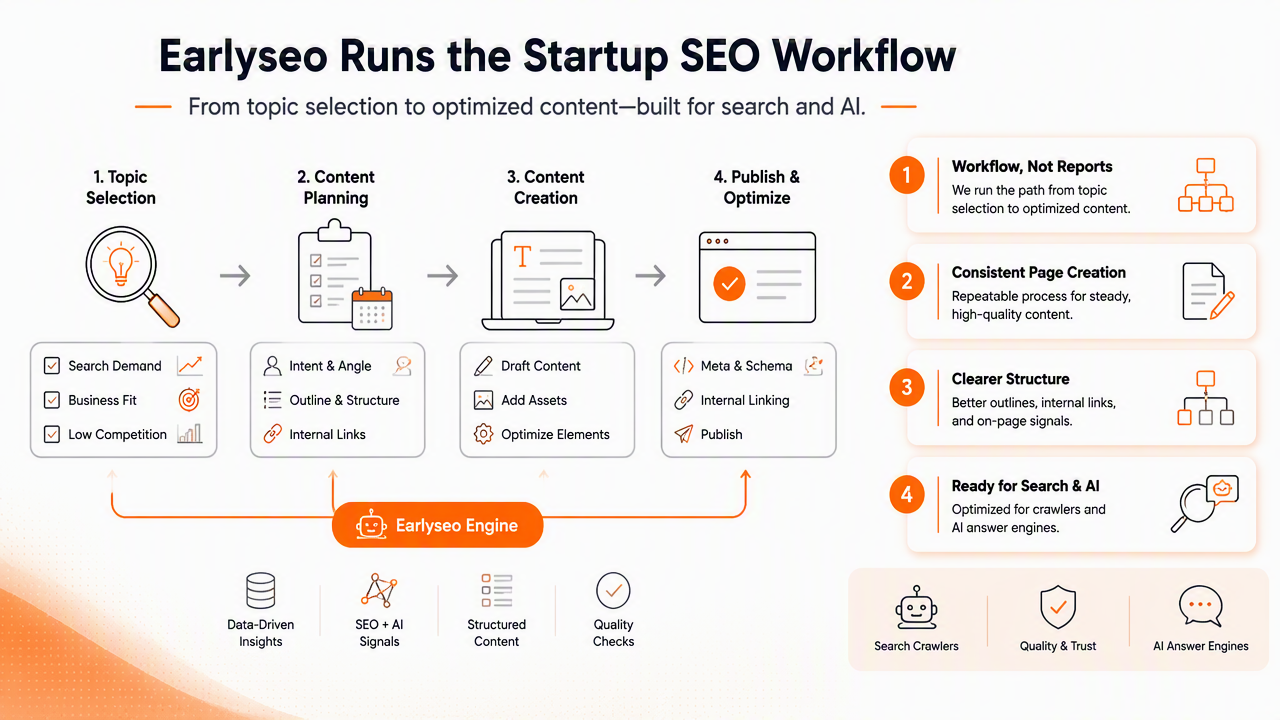
The strongest use case is production. A small team can use keyword research from any source, then move into structured content planning, on-page optimization, and publishing support. That makes Earlyseo a strong companion to data-heavy tools, or a lighter replacement when the main bottleneck is content execution.
AI search also changes the tool checklist. Ahrefs created Yep, a Singapore-based search engine launched in June 2022 with image search, news, AI summaries, and a stated plan to share revenue with content creators. That move reflects a wider shift: SEO now reaches beyond classic blue links into AI summaries and answer surfaces.
For teams preparing content for AI discovery, llms.txt guidance can help clarify how site content should be presented for large language model crawlers and AI systems.
Where Earlyseo fits beside research suites
- After keyword discovery: turn selected topics into briefs and page plans.
- During content creation: keep headings, metadata, internal links, and search intent aligned.
- Before publishing: reduce missing on-page elements and structural gaps.
- After launch: support repeatable improvement instead of one-off SEO projects.
A 2023 entrepreneurship education study by Hsin-Ming Hsieh and Alex Maritz examined learning motivation, self-directed learning, and outcomes, which is relevant to startup SEO because small teams often depend on self-directed systems rather than specialist departments: Contemporary Educational Technology paper.
For setup and workflow details, the Earlyseo documentation gives teams a practical reference point after tool selection.
Which tool should a startup pick by stage?
A startup should pick an SEO tool based on its current bottleneck: content output, research depth, reporting, technical auditing, or simple keyword discovery. The right choice changes as the company moves from first organic pages to repeatable acquisition.
Early-stage companies often overbuy SEO software. A founder may sign up for a large suite, export hundreds of keywords, then publish nothing for weeks. A better first step is usually a narrow workflow that supports a few high-intent pages and a weekly publishing rhythm.
Stage-based recommendation map
| Startup stage | Main SEO bottleneck | Best-fit option | Reason |
|---|---|---|---|
| Pre-launch | Need search-ready pages | Earlyseo | Prioritizes content structure and publishing workflow |
| First traction | Need keyword and competitor ideas | Ubersuggest or SE Ranking | Keeps research simple and affordable |
| Growing content library | Need repeatable production | Earlyseo plus a research tool | Balances data with execution |
| Funded growth | Need full market intelligence | Semrush or Ahrefs | Broad data becomes more useful |
| Technical cleanup | Need audits and fixes | SEO PowerSuite or audit software | Good for crawl and site checks |
The 2027 direction is clear: more SEO tools will blend keyword data, generative content support, entity optimization, and AI crawler controls. Startups should avoid choosing based only on today's biggest database. A workflow that creates well-structured, useful pages will stay valuable as Google AI Overviews, ChatGPT, and newer answer engines reshape discovery.
Practical call: choose one primary execution tool and one research source. More tools rarely fix unclear positioning, weak pages, or inconsistent publishing.
FAQ
Is Ahrefs too expensive for startups?
Ahrefs can be a strong platform, but early-stage teams may not use enough of its backlink and competitor data to justify the spend. A leaner tool may fit better until organic search becomes a proven acquisition channel.
Is Semrush better than Ahrefs for a small business?
Semrush can be better when a small business needs SEO, PPC, competitor research, and reporting in one suite. Ahrefs is often preferred for backlink and SEO research depth. The better choice depends on whether the business needs broad marketing data or focused SEO analysis.
Can a startup do SEO without backlink tools?
A startup can begin SEO without a dedicated backlink tool if the first priority is publishing useful, intent-matched pages. Backlink analysis becomes more important once content exists, rankings start moving, and authority gaps become easier to diagnose.
What is the best free Ahrefs alternative?
The best free option depends on the task. Google Search Console supports performance tracking after pages are indexed, while lightweight keyword tools can help with discovery. Free tools work best when paired with a clear content workflow and consistent publishing habits.
How many SEO tools does a startup need?
Most startups need one execution platform and one research or measurement source. Extra tools should only be added when they remove a specific bottleneck, such as technical audits, rank reporting, content publishing, or backlink prospecting.
Conclusion
Ahrefs alternatives for startups should be chosen around execution: finding reachable topics, creating useful pages, publishing consistently, and improving what already exists. Data-heavy suites still have a place, especially as budgets grow, but early SEO wins usually come from a clean workflow and steady output. For teams that want that operating system, Earlyseo is a practical place to start; visit earlyseo.com, choose one page type to improve this week, then build a repeatable publishing rhythm before adding more tools.