TL;DR
Backlink exchanges can help with relationship building only when links are editorial, relevant, and limited. The safer play in 2026 is to treat exchanges as a minor collaboration tactic, then focus most effort on useful content, technical visibility, and natural digital PR.
A backlink exchange platform sounds efficient, but efficiency is exactly where search-quality risk can start. Modern link collaboration tools promise partner discovery, credit systems, or ABC swaps, while small teams mainly need one thing: visibility that does not create a cleanup project later. Research on small business digital marketing, including a 2024 Sustainability study on SMEs and modern digital transformation, shows why organic visibility matters for growing companies, even though link tactics still need careful judgment (Sharabati, Ali, and Allahham, 2024).
Table of Contents
What is a backlink exchange platform?
A backlink exchange platform is a marketplace or matching system where website owners find partners willing to place reciprocal or indirect links. The core idea comes from link exchange networks, where sites register with a central organizer and receive links from other participating sites.
Backlink exchange platform: a tool that connects websites for agreed link placements, usually through direct swaps, three-way swaps, credits, or partner outreach workflows.
The current SERP shows a split market. Reddit threads ask whether legitimate platforms exist, while tools such as KarmaLinks, NetLinkDeal, and Swap Backlink position themselves around verified websites, credits, or niche-relevant partner matching. Ranking Raccoon focuses more heavily on ABC exchanges, where Site A links to Site B, while Site B links from a different property.
Key insight: the platform is not the ranking asset. The asset is a relevant editorial link that would still make sense without a swap.
The safest reading is simple. A tool can help with discovery and organization, but it cannot make a weak placement valuable. Search engines evaluate patterns, context, quality, and intent, not just the existence of a backlink.
Common exchange models
- Direct reciprocal swap: Site A links to Site B, and Site B links back to Site A.
- ABC exchange: Site A links to Site B, while Site B links to a third property owned or managed by Site A.
- Credit-based exchange: a member earns credits by linking out, then spends credits to receive links.
- Relationship-based collaboration: two brands co-create content, cite each other when relevant, and keep editorial control.
AI communication research also matters here. Elena Esposito's 2022 MIT Press work on artificial communication examined how automated systems affect communication processes, which is relevant as AI matching tools enter SEO workflows (Esposito, 2022). Automation can speed up matching, but it cannot replace editorial relevance.
When can exchanges help, and when do they create risk?
Link exchanges can help when they reflect a real business relationship, a relevant citation, and a reader-useful resource. They create risk when the placement exists mainly to manipulate rankings, repeats at scale, uses irrelevant anchors, or comes from low-quality networks with no editorial standards.
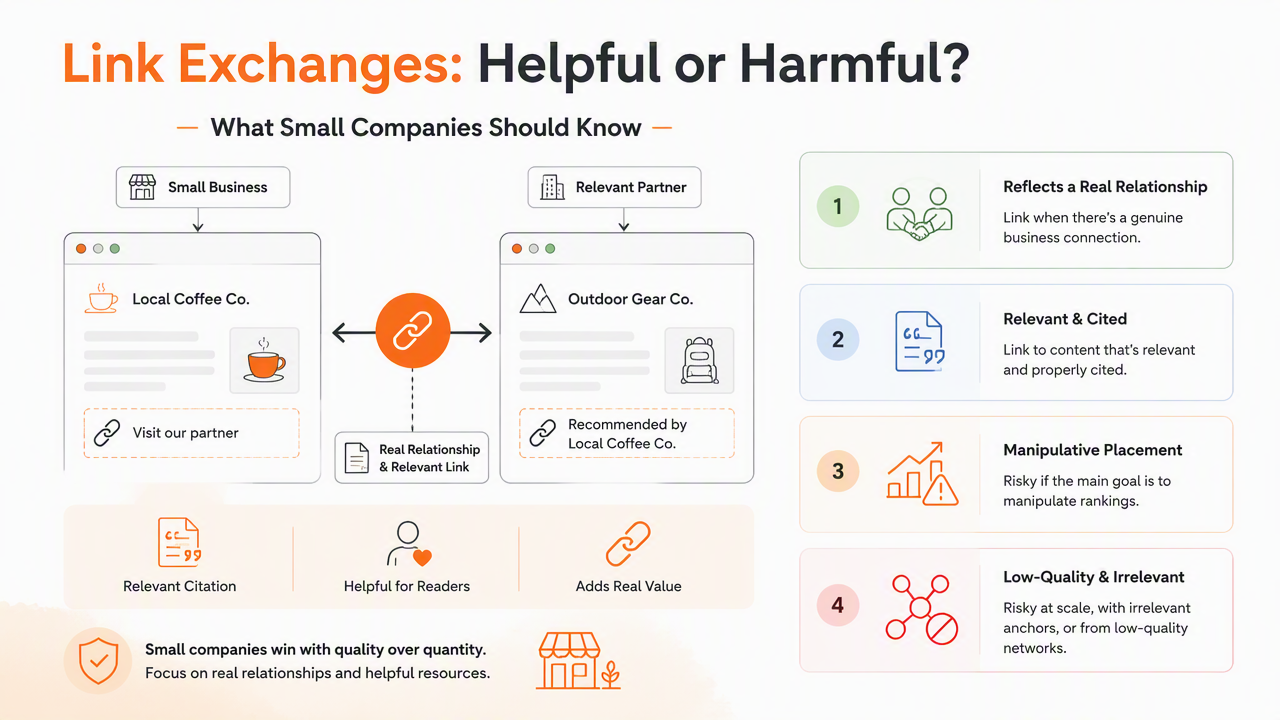
Small companies often consider swaps because paid PR, content teams, and agency link building can be expensive. That pressure is real. Still, a shortcut can become costly if a site builds a backlink profile that looks synthetic rather than earned.
Safe link collaboration has a narrow lane. A supplier page citing a partner, a guest article with a relevant source mention, or a local association linking to a member resource can all be natural. A spreadsheet of hundreds of exact-match anchor swaps across unrelated sites is a different story.
Safe-use comparison table
| Scenario | Risk level | Why it matters | Better rule |
|---|---|---|---|
| Relevant partner cites a useful guide | Low | Link serves the reader first | Keep anchor natural |
| Two local businesses link from partner pages | Low to medium | Relationship is real, but repeated patterns can show | Limit and vary context |
| ABC swap across owned sites | Medium | Less obvious than direct swaps, but still coordinated | Use only when editorially justified |
| Credit marketplace placement | Medium to high | Incentive can favor volume over quality | Vet every domain manually |
| Sitewide footer or sidebar swap | High | Looks mechanical and rarely helps readers | Avoid sitewide swaps |
| Exact-match anchors across unrelated blogs | High | Pattern signals manipulation | Use branded or descriptive anchors |
The practical threshold is intent plus pattern. One relevant citation usually looks normal. Many similar citations, across thin sites, with similar anchors, tell a very different story.
Red flags before joining a network
- Promises of autopilot ranking gains without editorial review.
- Public lists of exchange members that make patterns easy to detect.
- Mandatory do-follow links with no option for editorial discretion.
- Irrelevant categories, thin content, or sites built mainly to sell placements.
- Anchor text rules that force commercial keywords.
- No quality controls for traffic, topical fit, or content standards.
A healthy platform should make rejection normal. If every placement is accepted, quality is probably not the filter.
How should teams vet exchange partners in 2026?
Teams should vet exchange partners by checking topical relevance, editorial quality, traffic signals, outbound-link behavior, anchor text, and whether the link would help a real reader. A simple workflow keeps link collaboration from turning into random swapping.
A practical vetting checklist
- Confirm topical overlap. A SaaS analytics site and a marketing operations blog may fit. A casino coupon site and a local dentist do not.
- Read recent content. Thin AI pages, copied summaries, and generic posts signal weak editorial standards.
- Inspect outbound links. Too many commercial anchors to unrelated sites can indicate a link-selling pattern.
- Check placement context. In-body citations beat author bios, footers, and random resource lists.
- Use natural anchors. Brand names, product names, and descriptive phrases look more credible than repeated money keywords.
- Cap the volume. Exchanges should be a small part of link acquisition, not the main engine.
- Document the reason. Each link should have a clear business or editorial reason.
Teams running content operations can keep standards consistent by documenting approval rules in internal playbooks. Technical teams can use publishing and setup documentation to keep SEO workflows organized while content teams focus on earning links worth keeping.
A good exchange decision should survive one question: would the link still belong on the page if rankings did not exist?
Manual review still matters in 2026 because AI-generated outreach has made weak link requests easier to send at scale. That noise raises the value of selective, human-reviewed partnerships.
What safer alternatives build authority without swaps?
Safer authority building comes from useful assets, technical discoverability, partner content, and citations that are earned rather than traded. A backlink exchange platform can sit in the toolkit, but it should not replace content quality, product-led resources, or search-friendly site structure.
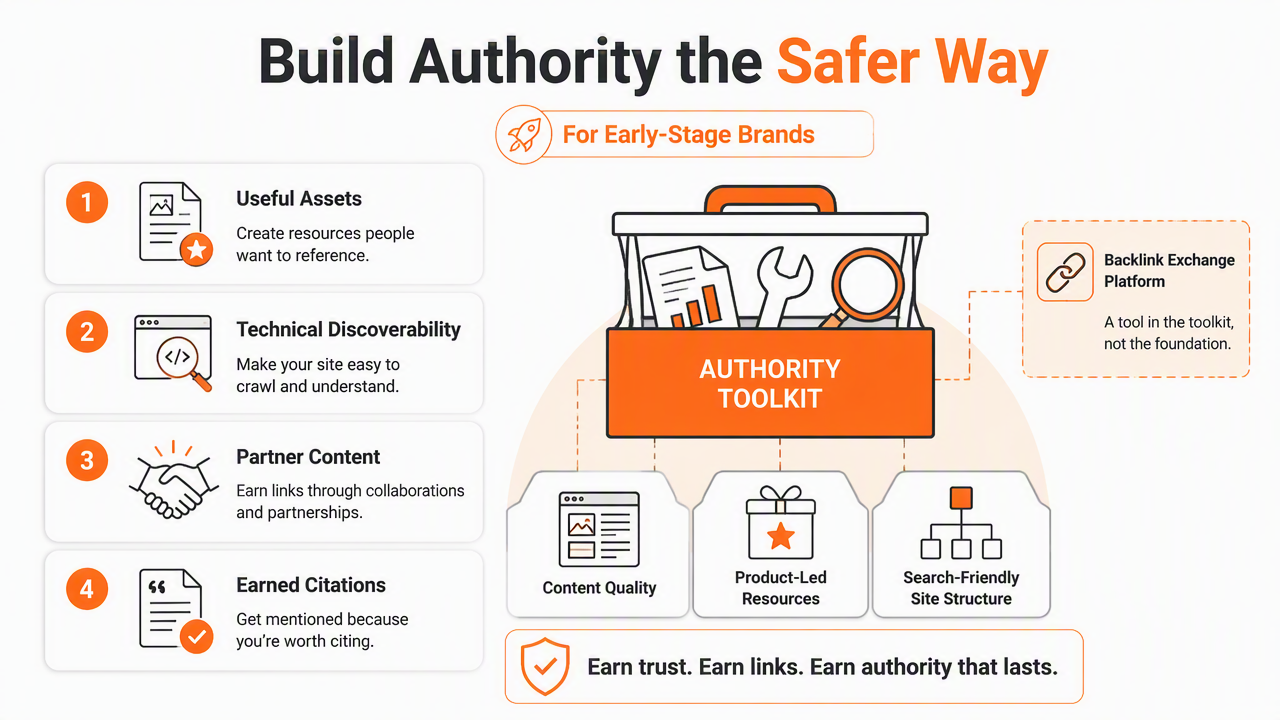
For early-stage brands, the best link strategy often starts with pages that deserve citations. Examples include original data, calculators, comparison pages, local guides, documentation, templates, and research-backed explainers. These assets give journalists, bloggers, customers, and AI systems something specific to reference.
The Earlyseo platform fits this wider authority-building approach by helping growing sites improve search visibility without depending on link swaps alone. Teams publishing on common CMS platforms can also connect SEO workflows through the WordPress integration or Shopify integration, which is useful for blogs, service pages, and ecommerce collections.
Best non-swap link assets
| Asset type | Best fit | Why it earns links |
|---|---|---|
| Original survey or benchmark | B2B, SaaS, agencies | Writers need current data points |
| Free template or checklist | Startups, consultants | Useful resources get saved and cited |
| Local industry guide | Local services | Community relevance supports natural mentions |
| Product comparison page | Ecommerce, SaaS | Buyers and reviewers cite clear differences |
| Technical documentation | Software, platforms | Developers link to stable reference pages |
| Expert glossary | Complex niches | Definitions are easy for AI and humans to quote |
Structured content also matters for AI visibility. Publishing clear definitions, comparison tables, and crawlable reference files can help answer engines understand a site's entities. Teams exploring that direction can review AI-readable site file guidance while building assets meant for both search engines and AI assistants.
Earlyseo also supports a practical content habit: publish assets that answer specific buyer questions before chasing links. More on earlyseo.com can help teams connect those assets to broader organic growth.
What should happen next in link collaboration?
Link collaboration in 2026 should become more selective, more editorial, and less dependent on closed exchange networks. AI tools will keep making partner discovery faster, but search systems and human reviewers will keep rewarding links that match real expertise, relevance, and reader value.
The likely shift is from swap volume to citation quality. Brands that publish original resources, keep clean site architecture, and build real partnerships will have more durable authority than brands relying on credit loops. A small number of relevant collaborations can still help, but only when each placement makes sense on its own.
For buyers comparing platforms, the strongest decision is not "which tool gives the most links?" The better question is "which process creates links that would not be embarrassing during a manual review?" That question filters out most risky offers quickly.
Decision checklist for platform buyers
- Pick tools that allow manual approval for every placement.
- Prefer niche matching over large general marketplaces.
- Avoid mandatory exact-match anchors.
- Reject sitewide links and thin resource pages.
- Track accepted, rejected, and removed links.
- Keep exchange links below naturally earned links as a share of total acquisition.
- Pair outreach with content assets that deserve citations.
Related reading from the SEO learning hub can help marketing teams build a content plan before committing budget to any link collaboration tool.
FAQ about backlink exchange platforms
Short answers help separate useful collaboration from risky link schemes.
Are backlink exchanges always bad for SEO?
Backlink exchanges are not automatically bad, but large-scale or manipulative patterns are risky. A relevant partner citation can be normal when it helps readers and reflects a real relationship. Problems start when links are traded mainly for rankings, repeated across unrelated sites, or controlled through rigid anchor text rules.
Is an ABC link exchange safer than a direct swap?
An ABC exchange can look less obvious than a direct reciprocal link, but it is not automatically safe. If the link exists only because of a coordinated trade, the underlying risk remains. The safer test is whether each placement is relevant, editorial, and useful without needing the exchange arrangement.
How many exchanged links are too many?
No universal safe number exists. The concern is pattern, proportion, and quality. A few relevant partner citations inside a broader profile of earned links may look natural. A profile dominated by similar swaps, commercial anchors, and unrelated domains can create search-quality risk.
What is the best alternative to a backlink exchange platform?
The best alternative is a citation-worthy content program supported by technical SEO and relationship-based outreach. Original data, tools, templates, local guides, and clear documentation attract more durable mentions than traded links. Exchanges can remain a small supplement, but earned authority should carry the strategy.
Conclusion
A backlink exchange platform is useful only when it helps find relevant partners without replacing editorial judgment. The best next step is to audit current link sources, define a written approval checklist, reject risky patterns, and invest in assets that deserve citations. For teams building that foundation, Earlyseo can support the content and visibility work that makes safer link acquisition possible.