TL;DR
Rank tracking is best for measuring visibility, while an SEO execution platform is better for turning keyword data into shipped pages, links, fixes, and reports. Teams with limited SEO time should prioritize execution; teams with mature workflows may still need dedicated rank tracking for diagnostics.
A search for rank tracking vs SEO execution platform sits inside a crowded market with 8,560,000 SERP results, but the real buying question is simple: does the tool only report movement, or does it help work get shipped? Earlyseo fits the second category by connecting SEO planning with content production, internal linking, and operations.
Rank tracking: software that monitors keyword positions across search engines, locations, devices, and SERP features.
SEO execution platform: software that helps teams turn SEO opportunities into completed work, including content briefs, publishing workflows, internal links, competitor research, and reporting.
Key insight: rankings explain what changed; execution tools help decide what to do next and who owns it.
Table of Contents
What is the difference between rank tracking and an SEO execution platform?
Rank tracking measures keyword visibility, while an SEO execution platform manages the work required to improve that visibility. In 2026, rank tracking is a diagnostic layer; execution software adds recommendations, content workflows, automation, internal linking, and accountability so SEO becomes a repeatable operating process rather than a monthly report.
Buyer comparison for 2026 SEO teams
| Capability | Rank tracking tool | SEO execution platform |
|---|---|---|
| Reporting | Shows positions, movement, tags, and share of voice | Connects performance to tasks, owners, and shipped work |
| Recommendations | Flags ranking drops or winners | Suggests content, technical, and linking actions |
| Content production | Usually limited to keyword exports | Creates briefs, outlines, drafts, and publishing workflows |
| Internal linking | May show linked pages indirectly | Finds link opportunities and supports implementation |
| Automation | Alerts and scheduled reports | Automated workflows, briefs, audits, and task routing |
| Accountability | Useful for analysts | Useful for founders, marketers, writers, and agencies |
| Best fit | Mature teams with clear execution systems | Lean teams that need strategy and production in one place |
Large language models have also changed what visibility means. The 2022 PaLM research by Chowdhery, Narang, Devlin, and others studied scaling language modeling with Pathways, a sign of how fast answer systems have advanced beyond classic blue-link search (PaLM paper). Rank reports still matter, but AI answers, entity mentions, and content freshness now need operational follow-through.
When is rank tracking enough?
Rank tracking is enough when a team already has a strong SEO process and only needs measurement. Agencies, larger marketing departments, and consultants often use dedicated tracking because they already know how to turn changes in keyword positions into tickets, briefs, and experiments.
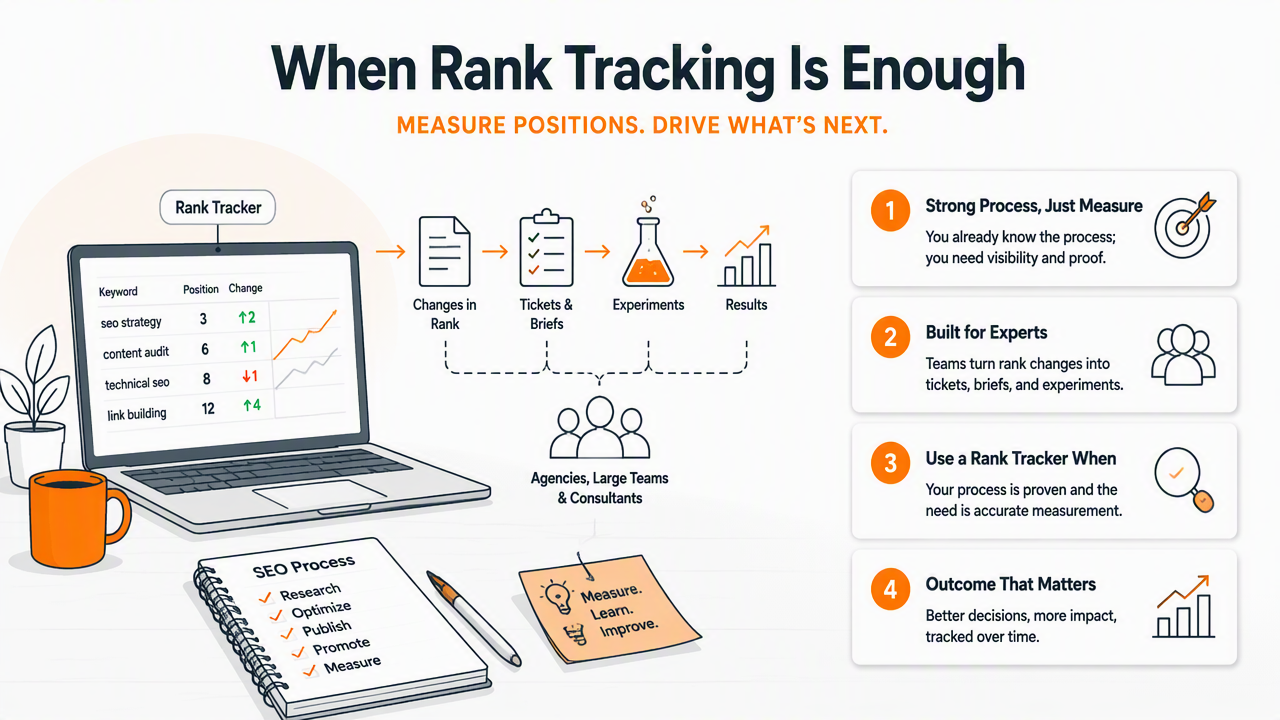
A rank tracker makes sense when the main job is monitoring:
- Local pack movement: tracking city-level terms for service areas and stores.
- Campaign reporting: proving whether a recent SEO sprint improved visibility.
- Competitive checks: watching rivals gain or lose positions on valuable terms.
- Technical diagnostics: spotting ranking drops after migrations, template changes, or indexation problems.
- Client reporting: preparing clear updates for stakeholders who need trend lines.
Rank tracking can also support focused local SEO. A small service company, for example, may track "emergency plumber near me" across nearby towns, then connect findings to a local content plan such as SEO for service-based businesses.
Rank tracking is not outdated; it is incomplete when the team lacks a system for turning alerts into published improvements.
The limitation is workflow. A ranking drop can reveal that a page lost visibility, but it cannot write the replacement section, brief a writer, add internal links, update schema, or assign the task to an owner.
When does an SEO execution platform make more sense?
An SEO execution platform makes more sense when the bottleneck is production, not information. Many startups, e-commerce brands, and local businesses do not fail because rankings are unknown; they stall because nobody has time to convert keyword research into pages, links, and updates.
Execution platforms are strongest when SEO work needs to move through a queue:
- Find keywords and competitor gaps.
- Prioritize pages by business value.
- Create briefs or drafts.
- Add internal link targets.
- Publish or hand off tasks.
- Track what shipped.
- Review performance and refresh content.
For new websites, this matters more than another dashboard. A founder building topical authority needs a publishing system like a 90-day SEO sprint, not only weekly keyword charts.
Execution platforms also fit e-commerce teams that need repeatable category, collection, and product content. Store owners can pair workflow software with a focused plan such as Shopify SEO for beginners, then track which pages actually get produced.
Earlyseo is built around that operating model. The Earlyseo platform supports competitor-aware planning, content workflows, and SEO operations so teams can move from idea to published asset with fewer handoffs. Its SEO operations features are especially relevant when marketing managers need a shared place for priorities, tasks, and progress.
Research by Ahmed, Alam, Hassan, and others reviewed current progress and challenges in deep learning applications, showing how fast AI-assisted systems are expanding across practical workflows (Artificial Intelligence Review, 2023). In SEO, that shift favors tools that help create and refine work, not only observe search results.
How should buyers evaluate both options?
Buyers should evaluate SEO software by the job that must improve in the next 90 days: measurement, production, or accountability. A cheaper rank tracker can be the right purchase for a mature team, while an execution platform can save more time when content and links are stuck in planning.
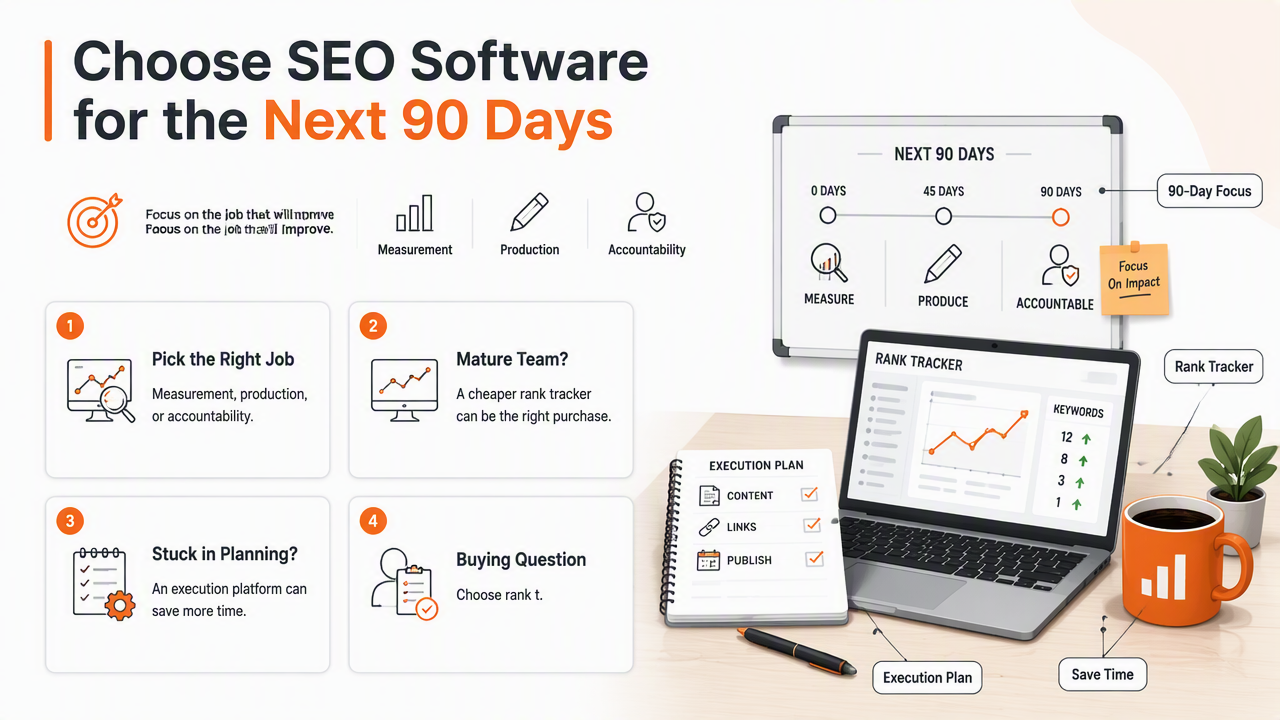
Practical scorecard before buying
| Buying question | Choose rank tracking if... | Choose an execution platform if... |
|---|---|---|
| Main pain | Visibility is unclear | Work is not getting shipped |
| Team size | SEO specialist already owns process | Generalist marketers need guidance |
| Reporting need | Keyword movement is the key output | Leaders need status, work, and outcomes |
| Content need | Writers already have briefs | Briefs and drafts need support |
| Linking need | Links are handled manually | Internal link ideas need to become tasks |
| Automation need | Alerts are enough | Workflow automation saves weekly time |
A good trial should test real work, not demo polish. The strongest 30-day evaluation uses one topic cluster, one priority page, and one reporting cycle.
- Select 20 to 50 keywords tied to revenue.
- Pick three pages that need new content or refreshes.
- Ask the tool to identify competitors and gaps.
- Create at least two content briefs.
- Add internal link recommendations using a process like an internal linking strategy for SEO.
- Publish or hand off the work.
- Compare the final report with what actually changed.
For agencies, the deciding factor is often repeatability across clients. Agency teams may need both a tracker and an execution layer, especially when client reporting must connect rankings to deliverables. A workflow such as agency SEO content production helps turn that connection into a client-facing system.
What changes in 2027 and common questions
SEO tools in 2027 will likely measure visibility across classic rankings, AI answers, entity mentions, and execution speed. Rank tracking will remain useful, but it will be only one signal inside a broader performance system.
Expect three changes:
- AI visibility reporting becomes normal: tools will track citations, summaries, and branded mentions in answer engines.
- Content operations get tighter: briefs, drafts, refreshes, and internal links will sit closer to analytics.
- Accountability matters more: teams will expect software to show who owns a task and whether it shipped.
For teams comparing platforms now, the safest choice is the one that improves the current constraint. If keyword reporting already works, add execution. If production already runs smoothly, improve measurement. With Earlyseo, teams focused on publishing and SEO operations can see more at earlyseo.com.
Is rank tracking still worth paying for in 2026?
Yes, rank tracking is still worth paying for when keyword movement, local visibility, and competitor monitoring guide decisions. It becomes less valuable as a standalone purchase when the team cannot act on the data. In that case, software that creates tasks, briefs, and linking workflows usually has a clearer business impact.
Can an SEO execution platform replace a rank tracker?
Sometimes, but not always. Some execution platforms include performance reporting, while dedicated rank trackers often provide deeper location, device, and SERP feature data. A lean team may prefer one execution platform first. A mature agency or enterprise team may use both categories together.
Which option is better for a new website?
An SEO execution platform is usually better for a new website because early growth depends on publishing the right pages, building internal links, and fixing basic content gaps. Rank tracking becomes more useful after enough pages exist to monitor meaningful movement across topics and search intent.
How does internal linking affect the decision?
Internal linking pushes the choice toward execution software because link opportunities must be found, prioritized, assigned, and added. A rank tracker may show that a page is stuck on page two, but an execution platform can help connect that page to stronger supporting content.
Conclusion
Rank tracking vs SEO execution platform is not a battle between good and bad software; it is a choice between measurement and momentum. Rank tracking is the right fit when a team already knows what to do. An execution platform is the better fit when the work needs to be planned, produced, linked, shipped, and reviewed.
The next step is practical: run a 30-day trial around one topic cluster, one priority page, and one publishing workflow. If the biggest gain comes from clearer reporting, choose tracking. If the biggest gain comes from shipped SEO work, visit earlyseo.com and evaluate Earlyseo as the execution layer.