TL;DR
AI-assisted SEO content needs human QA before publishing because models can miss intent, blur facts, and create thin differentiation. The best workflow checks accuracy, originality, search fit, internal links, schema, citations, and brand voice in one repeatable pass.
AI can draft a useful article in minutes, but ranking content still depends on accuracy, intent match, trust, and polish. A practical AI content QA checklist for SEO turns AI-assisted drafts into publishable pages by combining editorial review, on-page SEO, source validation, and technical checks. AI content QA: a repeatable pre-publish process that verifies an AI-assisted page is accurate, original, useful, brand-safe, and ready for search engines. Teams that want a structured workflow can use Earlyseo to plan, research, and review SEO content without treating the AI draft as the final product.
Table of Contents
What is an AI content QA checklist for SEO?
An AI content QA checklist for SEO is a pre-publish review system that tests an AI-assisted draft against search intent, factual accuracy, originality, on-page optimization, citations, internal linking, schema, and brand voice. The goal is simple: publish content that helps readers and gives search engines clear quality signals.
AI output should be treated as a draft, not a finished asset. Research on large language models, including the 2023 Nature paper Large language models encode clinical knowledge, shows that models can encode useful domain patterns, but that does not remove the need for human review. In SEO, even a well-written draft can fail if it targets the wrong intent or makes claims without support.
A good QA checklist does not ask, "Does this sound good?" It asks, "Is this accurate, useful, differentiated, and technically ready to rank?"
Core QA terms for AI-assisted SEO content
| Term | SEO meaning | QA test |
|---|---|---|
| Search intent | The reason a searcher enters a query | Does the page answer the likely task behind the keyword? |
| Factual accuracy | Claims match reliable sources or first-hand knowledge | Are names, dates, features, and stats verified? |
| Originality | The page adds value beyond competitors | Is there a unique angle, example, workflow, or data point? |
| Internal linking | Links guide readers and crawlers to related pages | Do links use relevant anchors and support topic depth? |
| Schema | Structured data that clarifies page type and entities | Is markup valid and matched to the content? |
This vocabulary matters because content, SEO, design, and legal reviewers often use different standards. A shared checklist prevents vague feedback and makes approvals faster.
How should the pre-publish QA workflow run?
The pre-publish QA workflow should move from strategy to facts, then from SEO elements to final editorial polish. That order prevents wasted time, because a draft with the wrong search intent should be fixed before grammar, schema, or image alt text gets reviewed.
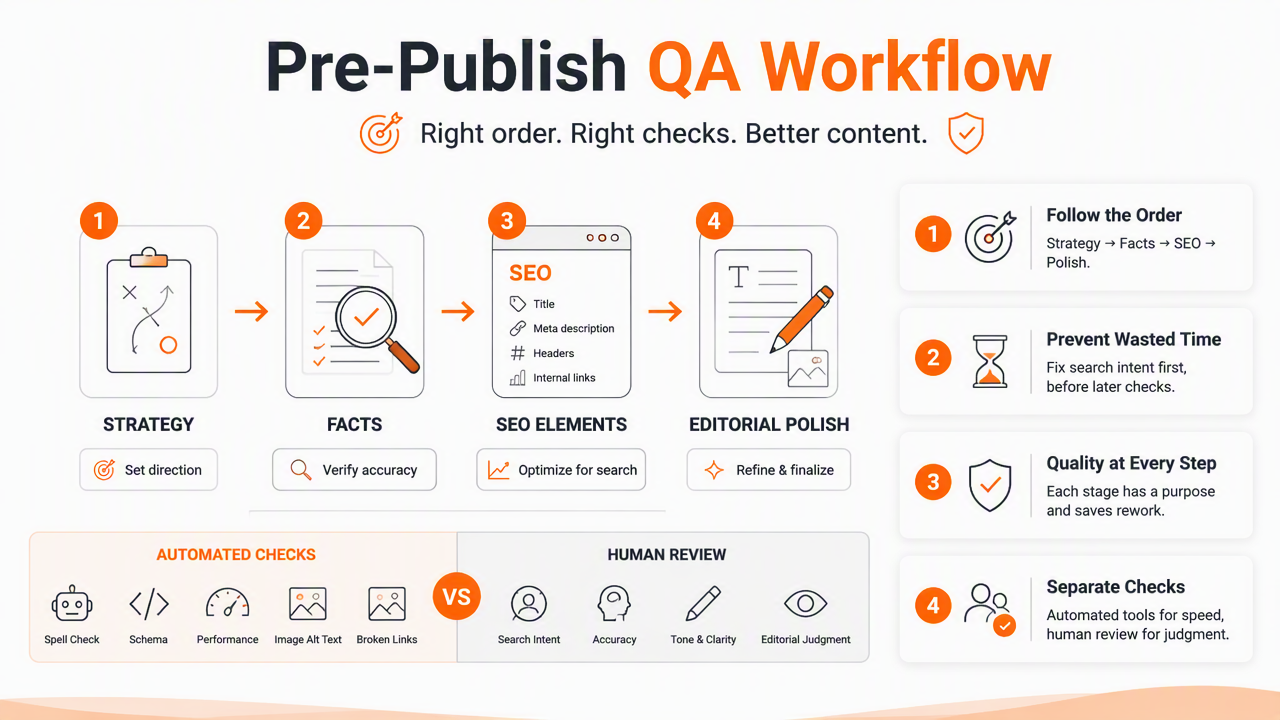
A strong workflow also separates automated checks from human judgment. Tools can flag missing metadata, broken links, or repeated headings, but humans still need to verify nuance, brand tone, expert claims, and whether the answer deserves to exist.
The 15-point pre-publish checklist
- Confirm the primary keyword and related terms match the brief.
- Check the SERP intent: informational, commercial, local, transactional, or mixed.
- Compare the draft against competitor headings and fill missing subtopics.
- Verify every factual claim, number, product feature, and cited study.
- Remove unsupported claims, filler, and generic AI phrasing.
- Add first-hand examples, screenshots, workflows, or product-specific details when available.
- Check title tag, meta description, H1, and H2 structure.
- Confirm the opening gives a direct answer, not a slow setup.
- Add internal links to relevant supporting pages.
- Add external citations only where they support a real claim.
- Review images for descriptive alt text and compression.
- Validate schema against the page type.
- Check mobile readability, spacing, and table formatting.
- Read aloud for brand voice, clarity, and repetition.
- Assign an owner for post-publish monitoring.
A content brief makes this workflow easier because it sets the target before drafting starts. For a cleaner starting point, the SEO content brief template explains how to define search intent, headings, and source requirements before any AI draft is created.
Pass, fix, or reject decision rules
| QA status | Meaning | Action |
|---|---|---|
| Pass | The draft is accurate, useful, optimized, and on-brand | Publish or schedule |
| Fix | The draft is close but has gaps in facts, intent, links, or formatting | Send back with marked changes |
| Reject | The draft misses intent, repeats competitors, or contains risky claims | Restart from the brief |
Clear decision rules reduce endless editing loops. They also help agencies and growing marketing teams keep standards stable as content volume grows.
Which SEO and trust checks matter most?
The most useful SEO and trust checks are intent fit, entity coverage, source quality, internal links, schema, and clear authorship signals. These checks help a page satisfy readers while giving search engines better context about the topic, evidence, and site structure.
AI drafts often look complete because the wording is fluent. The deeper test is whether the article solves the exact search problem. A page about "AI content QA" should not stop at grammar checks; it should cover accuracy, originality, links, markup, citations, and review ownership.
SEO checks before publishing
- Intent match: The format should match the query. A checklist keyword needs steps, not a broad essay.
- Heading logic: H2s should answer specific questions or tasks.
- Title and meta: The title should promise the actual workflow, while the meta description should name the key checks.
- Internal links: Related pages should support the user path without overlinking.
- Technical basics: Indexability, canonical tags, page speed, mobile layout, and structured data should be checked before launch.
For page-level optimization, the on-page SEO checklist template pairs well with this QA process. For crawling and indexation checks, the technical SEO audit checklist for beginners covers the site-level items that content editors may miss.
Citation checks deserve extra care. Academic collections such as Findings of the Association for Computational Linguistics: EMNLP 2021 show how broad the natural language processing field has become, but SEO content should not cite research just to look authoritative. Every citation should support a specific claim in the paragraph nearby.
Trust checks for facts, claims, and originality
| Risk area | Common issue | QA fix |
|---|---|---|
| Statistics | Numbers appear without a source | Link the original source or remove the number |
| Product claims | Features are described too broadly | Verify against product docs or a subject matter expert |
| Medical, legal, or finance topics | Advice sounds definitive without credentials | Add expert review or narrow the claim |
| Competitor overlap | Draft follows the same structure as ranking pages | Add a distinct workflow, example, table, or decision rule |
| Brand voice | Copy sounds generic or over-polished | Edit for plain language, audience fit, and specific examples |
Research about applied AI, such as the 2021 Journal of Big Data review Deep Learning applications for COVID-19, shows how domain context shapes AI usefulness. SEO content follows the same pattern: technical fluency is not enough without relevant human review.
How does Earlyseo support AI content QA?
Earlyseo supports AI content QA by connecting research, competitor context, content planning, and human review into a more repeatable SEO workflow. That structure helps teams catch weak intent, missing evidence, thin differentiation, and poor internal linking before a draft reaches the CMS.
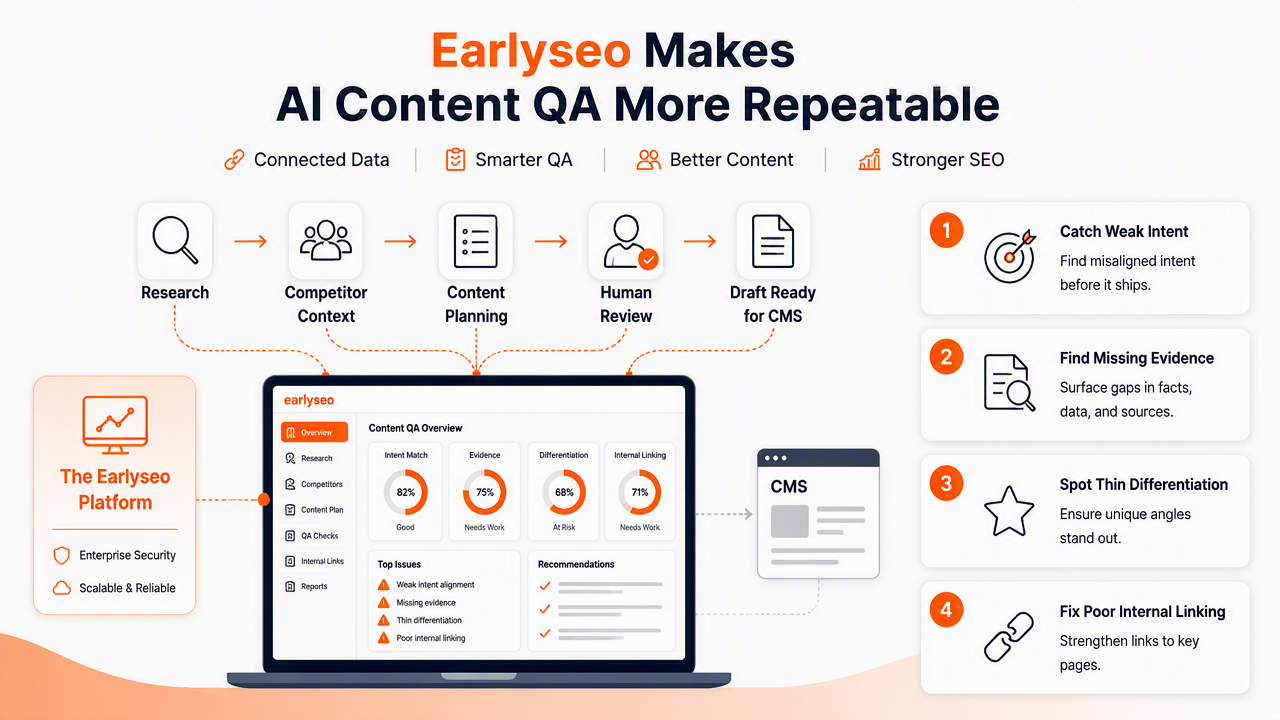
The Earlyseo platform is most useful when content teams need consistent output across many articles. Its research-backed workflow can support briefs, source-aware drafting, and review steps, while editors keep control over claims and tone.
Where Earlyseo fits in the checklist
| QA need | Manual process | Earlyseo support |
|---|---|---|
| Search intent | Review SERPs and map the query type | Plan content around keyword and topic context |
| Competitive gaps | Compare ranking pages by hand | Use competitor-aware SEO content workflows |
| Source quality | Collect citations in docs | Use research-backed AI content for evidence-led drafts |
| Team workflow | Track edits across spreadsheets | Use SEO operations to organize production |
| Editorial review | Assign an editor after drafting | Add human checks through a defined review process |
This keeps AI in the role where it works best: speeding up research and drafting. Editorial judgment still decides what gets published.
For teams building visibility from scratch, the process also connects to broader planning. The guide on content strategy for new blogs SEO helps place each article inside a larger topic plan instead of treating QA as a final proofreading step.
Best-fit use cases for the workflow
- Startups publishing their first SEO articles and needing repeatable quality gates.
- Local businesses creating service pages that must stay accurate and location-specific.
- E-commerce teams reviewing category content, buying guides, and product-led articles.
- Agencies managing many client drafts with different brand voices.
- International teams that need consistent review across markets.
For multilingual publishing, quality control needs native-language review and local intent checks. Earlyseo also offers multilingual SEO content support for teams that need search-ready pages across regions. More details are available on earlyseo.com.
What should change in 2027 content QA?
Content QA in 2027 should place more weight on evidence, entity clarity, post-publish updates, and answer-engine readability. Search engines and AI answer systems increasingly reward pages that provide direct answers, clear sourcing, and structured information that can be safely summarized.
The old "write, optimize, publish" model is too thin for AI-assisted production. A better approach treats QA as an ongoing system with pre-publish review, launch checks, and scheduled refreshes.
A practical 2027-ready QA rhythm
- Before drafting: Create a brief with intent, sources, audience, entities, and internal link targets.
- Before publishing: Run the checklist for facts, originality, SEO, schema, and voice.
- After indexing: Check whether the page is crawled, indexed, and appearing for expected queries.
- After 30 to 60 days: Review impressions, clicks, ranking movement, and engagement.
- Every quarter: Refresh outdated claims, screenshots, citations, and internal links.
The future of AI content QA is not heavier editing. It is clearer ownership, better evidence, and a tighter loop between planning, publishing, and updating.
Teams running sprints can connect this cadence to a structured growth plan, such as the 90-day SEO sprint. The key is to make QA visible in the workflow, not hidden inside one editor's memory.
FAQ: AI content QA for SEO teams
How long should AI content QA take?
AI content QA should take 15 to 45 minutes for a standard blog post when the brief is strong and sources are prepared. More complex topics, such as finance, health, legal, or technical software, need longer review because claims, terminology, and compliance risk require closer human judgment.
Can AI check its own SEO content quality?
AI can help flag missing headings, weak summaries, repeated phrasing, and basic SEO gaps, but it should not be the only reviewer. Human editors are still needed for intent judgment, factual verification, brand voice, legal sensitivity, and whether the page adds value beyond existing search results.
What is the biggest QA mistake with AI-written SEO content?
The biggest mistake is reviewing only grammar and keyword placement. A fluent draft can still miss the search intent, copy competitor structure, cite weak sources, or make unsupported claims. Strong QA starts with the brief and ends with technical checks, not surface-level proofreading.
Should every AI-assisted article include citations?
Every AI-assisted article should cite sources when it includes facts, statistics, research claims, definitions, or third-party product information. Opinion, basic workflow advice, and first-hand operational guidance may not need citations, but unsupported numbers or scientific claims should be removed or linked to reliable sources.
Conclusion
A strong AI content QA checklist for SEO protects rankings by catching the problems that fluent AI drafts can hide: weak intent, thin originality, unsupported claims, poor links, missing schema, and off-brand wording. The next step is to turn the checklist into a repeatable approval gate with clear owners, source standards, and post-publish refresh dates. For teams that want that process supported by planning, research, and workflow tools, visit earlyseo.com and build the review system before the next draft goes live.