TL;DR
Startups should treat content velocity as a controlled publishing system, not a race to post daily. A practical plan starts with topical coverage, search intent, internal links, and indexation checks, then scales only when quality stays consistent.
A content velocity SEO strategy for startups can create early search visibility faster, but only when publishing pace matches topic focus, editing capacity, and Google indexation. Content velocity: the number of SEO assets published within a set time period, usually measured weekly or monthly across blog posts, landing pages, comparisons, and supporting pages. For startups building the first serious SEO motion, Earlyseo helps turn research, briefs, and publishing calendars into a repeatable system instead of a random backlog.
Table of Contents
What is content velocity in startup SEO?
Content velocity in startup SEO is the planned rate at which a young company publishes useful, search-targeted content to build topical authority and organic demand. The goal is not maximum output; the goal is enough high-quality coverage to help search engines understand the site, crawl it often, and match it with relevant searches.
Competitor SERP analysis shows that ranking pages define content velocity as publishing volume over time, with 2025 and 2026 articles stressing pace, authority, and quality. Bonzer frames it around how much content it takes to win, while Storyblok connects publishing speed with speed to market in content operations through its guide on accelerating content velocity.
Key insight: content velocity is an operating rhythm, not a vanity metric. A startup that publishes 8 strong pages in a focused cluster can often learn more than one that ships 30 thin posts across unrelated topics.
Early-stage teams should measure velocity by completed strategic assets, not drafts. A finished SEO asset includes search intent mapping, expert input, internal links, schema where relevant, indexation checks, and refresh ownership.
Core terms for content velocity planning
Publishing velocity: the number of live pages shipped in a defined period.
Topical coverage: the degree to which a site answers the major questions around a product, category, or customer problem.
Indexation: the process by which search engines discover, process, and store pages for potential ranking.
Content decay: the loss of traffic or relevance when older pages become outdated, incomplete, or weaker than newer competitors.
A startup content plan should connect all four terms. A faster cadence that ignores indexation or decay creates a pile of URLs, not durable SEO growth.
How much content should startups publish each month?
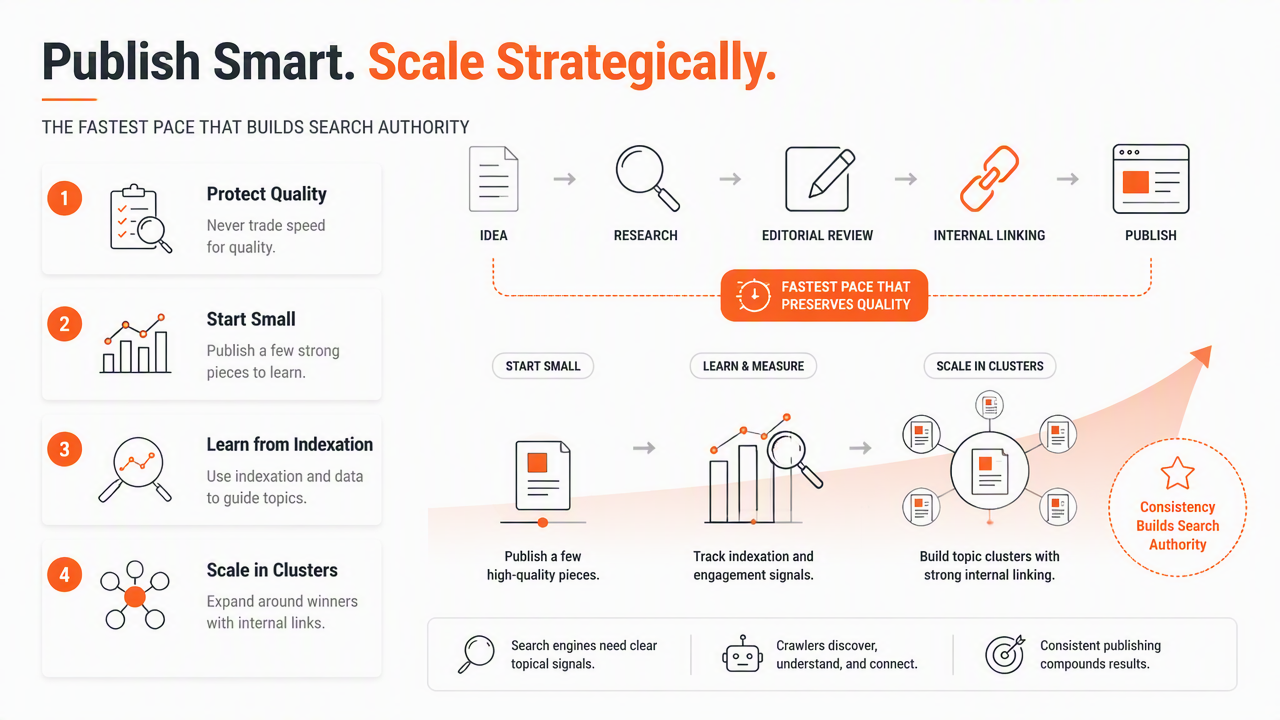
Startups should publish at the fastest pace that preserves research quality, editorial review, and internal linking, which usually means starting small, learning from indexation, then scaling in topic clusters. For most new sites, consistency beats sudden spikes because search engines need clear topical signals and users need useful answers.
The competitive benchmark in the research set shows an average ranking article length of 3,113 words across three analyzed competitors, but length alone does not define quality. A tighter 1,500-word page can outperform a longer page when it answers intent clearly, cites current sources, and links into a focused cluster.
A practical startup cadence depends on authority, market complexity, and team capacity. The table below gives planning ranges, not universal rules.
Monthly publishing benchmarks by startup stage
| Startup stage | Suggested monthly output | Best content mix | Main risk to manage |
|---|---|---|---|
| Pre-launch or new domain | 4 to 8 pages | Founder-led guides, product use cases, problem-aware posts | Publishing before positioning is clear |
| Early traction | 8 to 16 pages | Topic clusters, comparison pages, how-to articles | Weak editing and duplicate angles |
| Growing site | 16 to 30 pages | Cluster expansion, updates, industry pages, programmatic tests | Indexation waste and thin coverage |
| Local or service business | 4 to 12 pages | Service pages, local pages, FAQs, case-led posts | Generic city pages with no proof |
| E-commerce startup | 8 to 24 pages | Category guides, product education, alternatives, buying guides | Content not tied to revenue paths |
Startups with no SEO base should often begin with a 90-day sprint rather than an open-ended daily posting goal. A simple first sprint can include:
- Choose one core product category or customer pain.
- Build 3 to 5 pillar pages around buying intent and education.
- Add 8 to 12 supporting articles that answer specific questions.
- Link every supporting article to a relevant commercial or pillar page.
- Review indexing, impressions, and ranking movement after 30 and 60 days.
Teams creating the first calendar can use a deeper guide to content strategy for new blogs and SEO before increasing output. The Earlyseo platform is especially useful when the next bottleneck is turning keyword research into briefs, outlines, and publishable pages at a predictable pace.
How should startups balance speed, quality, and topical coverage?
Startups should balance speed, quality, and topical coverage by treating every page as part of a cluster with a clear job. A page should either attract early awareness, explain a problem, compare options, support a product page, or help convert existing demand.
A common mistake is separating velocity from strategy. Publishing more pages only helps when those pages reduce topical gaps and strengthen internal link paths. Bonzer's 2025 article on content velocity emphasizes that pace only works when content holds up, a useful standard for startup teams with limited credibility.
The best framework is simple: publish fast enough to test, slow enough to edit, and structured enough to compound.
The four-part velocity framework
- Coverage: every article belongs to a specific cluster, not a random keyword list.
- Intent: the page format matches the query, such as guide, comparison, checklist, template, or landing page.
- Proof: claims are supported with examples, product context, data, or named sources.
- Distribution: each page has internal links, newsletter placement, social repurposing, or sales enablement use.
For startups selling in crowded categories, competitor gaps matter. Competitor-aware SEO content can help identify which ranking pages already exist, where they are thin, and which angle a startup can credibly own.
Academic research outside SEO shows why quality controls matter in scaled systems. A 2021 survey on deep learning for object detection in self-driving cars by Gupta, Anpalagan, and Guan reviewed challenges in complex perception systems, reinforcing a broader point: scale without validation increases error risk, especially when outputs affect decisions ScienceDirect PDF. In content operations, validation means human review, fact checks, and performance feedback.
A strong brief is the easiest quality control to add before velocity rises. Startups can standardize briefs with search intent, audience pain, competing pages, required examples, internal links, and a unique point of view. A reusable SEO content brief template keeps writers from guessing.
How can startups increase content velocity without creating low-quality pages?
Startups can increase content velocity by removing workflow bottlenecks before hiring more writers or publishing more drafts. The safest path is to standardize research, briefs, approvals, internal links, and updates so each new page has a repeatable quality bar.
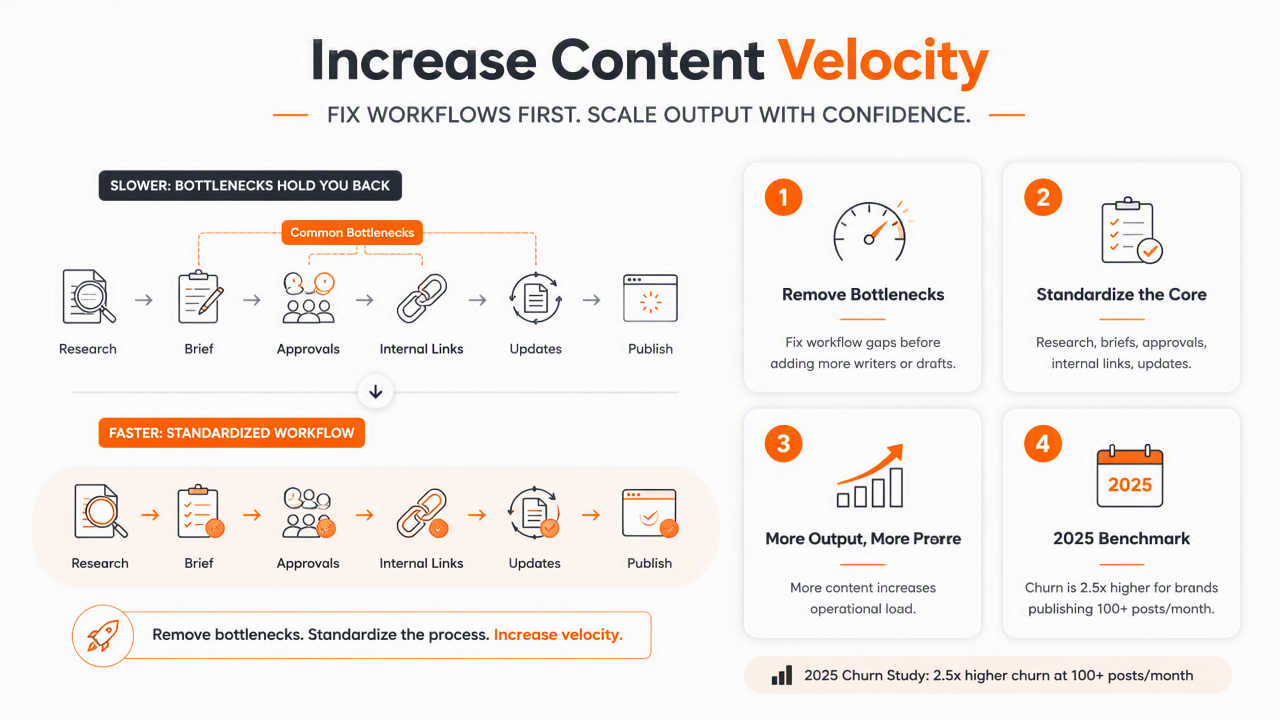
More output creates more operational pressure. A 2025 Chemical Reviews paper by Wang, Stansberry, and Mukundan examined cell-level considerations for gigawatt-scale water electrolysis deployment, a reminder from another field that scaling requires system-level constraints, not just more production eScholarship PDF. SEO content has similar constraints: editors, subject experts, CMS workflows, and crawl quality all limit useful scale.
Practical rule: increase publishing volume only after the previous month's pages are indexed, internally linked, and assigned to a refresh owner.
A repeatable startup publishing workflow
- Plan clusters first: group keywords by topic, funnel stage, and product relevance.
- Prioritize by business value: start with pages that support sales objections, demos, local demand, or category education.
- Create briefs in batches: prepare 4 to 8 briefs at a time so writers follow the same standard.
- Edit for usefulness: remove filler, add examples, check claims, and clarify the opening answer.
- Build internal links: connect new pages to older assets and revenue pages before publication.
- Check indexation: confirm discovery and indexing before assuming the page is part of the SEO system.
- Refresh monthly: update pages that gain impressions but lag in clicks or rankings.
Internal links are especially important for new sites because they help search engines understand relationships between pages. The guide to internal linking strategy for SEO gives a deeper structure for hubs, supporting pages, and conversion paths.
For teams publishing across markets, translation alone does not create international SEO value. Multilingual SEO content should adapt search intent, local terms, and examples rather than copying an English cluster into another language.
Earlyseo can support this workflow by combining planning, research-backed drafts, and human review steps. For teams comparing SEO with faster channels, the tradeoff is clear: paid ads can validate demand quickly, while SEO builds a compounding asset when the publishing system stays consistent. A related breakdown on SEO vs paid ads for startups can help set budget expectations.
What should startups measure in 2026 and 2027?
Startups should measure content velocity by indexed quality pages, topical coverage, assisted conversions, and refresh efficiency rather than raw article count. In 2026, AI search experiences and answer engines make clarity, structure, and entity-rich explanations more valuable than generic volume.
The SERP for this topic is already competitive, with 888,000 total results in the research set. That means a startup needs a sharper point of view, cleaner formatting, and stronger topic ownership than broad publishing advice. Pages should be easy for humans to scan and easy for AI systems to extract.
A useful measurement dashboard includes:
- Published pages: count only pages that pass editorial review.
- Indexed pages: track which URLs enter search results.
- Cluster coverage: measure completed pages against planned topic maps.
- Internal link depth: confirm that important pages are reachable in a few clicks.
- Impressions by cluster: watch early demand before clicks arrive.
- Conversion assists: attribute demos, trials, calls, or purchases touched by content.
- Refresh rate: count meaningful updates to existing pages, not just new posts.
In 2027, content velocity will likely shift further from "how many articles" toward "how many reliable answers." AI Overviews, ChatGPT-style search, and Google AI Mode favor pages with direct definitions, comparison tables, FAQs, and named entities. That rewards startups that publish structured, specific, well-maintained content.
A balanced forecast should avoid panic. Human-led expertise, customer examples, and original product knowledge remain hard for generic content systems to copy. Research-backed AI content can speed production, but human judgment still decides what deserves to be published. Teams that want a managed system can review Earlyseo at earlyseo.com and decide whether the workflow fits the current stage.
FAQ: startup content velocity questions
What is a safe publishing pace for a brand-new startup site?
A safe pace for a brand-new startup site is usually 4 to 8 high-quality pages per month. That gives enough volume to build topical signals while leaving time for research, editing, internal links, and indexation checks. More pages can work when the team has clear positioning and a strong review process.
Does publishing every day improve SEO faster?
Daily publishing does not automatically improve SEO faster. Search engines reward useful, relevant, and discoverable content, not just frequency. A daily cadence can help a mature team, but a startup with thin articles, weak links, or unclear topics may dilute quality and slow learning.
Should startups update old content or publish new content?
Startups should do both, but the split changes by stage. New domains usually need more net-new coverage during the first 90 days. Once impressions appear, updates become valuable because they improve pages already visible to search engines and reduce content decay.
How long before content velocity affects results?
Content velocity can show early signals within weeks through indexing and impressions, but meaningful traffic often takes longer. Timing depends on domain authority, competition, search demand, content quality, and internal linking. The best early measure is cluster-level progress, not one article's ranking.
Can AI-generated content support startup SEO?
AI-assisted content can support startup SEO when it is guided by research, edited by humans, and tied to real customer knowledge. Unreviewed generic output is risky because it often repeats common advice. Structured briefs, expert review, and original examples make AI support more useful.
Conclusion
A strong content velocity SEO strategy for startups starts with a focused cluster, a realistic monthly cadence, and a quality bar that survives scale. The next step is simple: pick one topic cluster, plan 12 to 20 assets, publish in controlled batches, and review indexation before increasing pace. For teams that want the planning, research, and production process handled in one place, visit earlyseo.com and turn publishing velocity into a repeatable growth system.