TL;DR
An SEO automation API makes sense when content work has repeatable steps, multiple systems, and frequent updates. Dashboards still help with analysis, but APIs are better for briefing, publishing, internal linking, schema, and refresh workflows that need to run at scale.
Content teams lose speed when SEO work lives in tabs, spreadsheets, and one-off tools instead of repeatable workflows. An SEO automation API for content teams connects keyword data, briefs, CMS publishing, internal links, structured data, and performance updates so routine steps can run without manual handoffs. Earlyseo helps teams turn search intent and competitor context into content operations, and the platform is available at Earlyseo.
Table of Contents
What is an SEO automation API?
An SEO automation API is a programmable interface that lets content systems request SEO data, generate workflow outputs, and push updates into tools such as a CMS, content calendar, analytics platform, or internal linking system.
SEO automation API: a software connection that lets content teams automate repeatable SEO tasks, including briefs, optimization checks, metadata, schema, links, and reporting.
Content engineering: a practice focused on managing content in computer-supported environments, especially where structure, systems, and reuse matter.
Generative AI research by Feuerriegel, Hartmann, and Janiesch (2023) describes how AI systems can create text, images, audio, and code, which helps explain why SEO workflows now mix data retrieval, generation, and review rather than simple keyword exports (source).
Key insight: APIs do not replace editorial judgment; they remove repetitive coordination work so editors can spend more time on positioning, accuracy, and usefulness.
Core API jobs in a content workflow
A content team usually needs an API when work depends on repeated inputs from several systems. The most common jobs are practical, not flashy.
- Briefing: pull keywords, competitors, entities, questions, and outline requirements into a standard brief.
- Publishing: send titles, metadata, body copy, images, and status changes into a CMS.
- Internal linking: find related pages and insert or recommend contextual links.
- Schema generation: produce JSON-LD for articles, FAQs, products, local pages, or breadcrumbs.
- Performance updates: refresh dashboards, flag decaying pages, and trigger rewrite tasks.
For teams still shaping editorial foundations, a clear content strategy for new blogs should come before any automation build.
When should content teams use an API instead of dashboards?
Content teams should use an API instead of dashboards when the same SEO action must happen often, across many pages, with low tolerance for skipped steps.
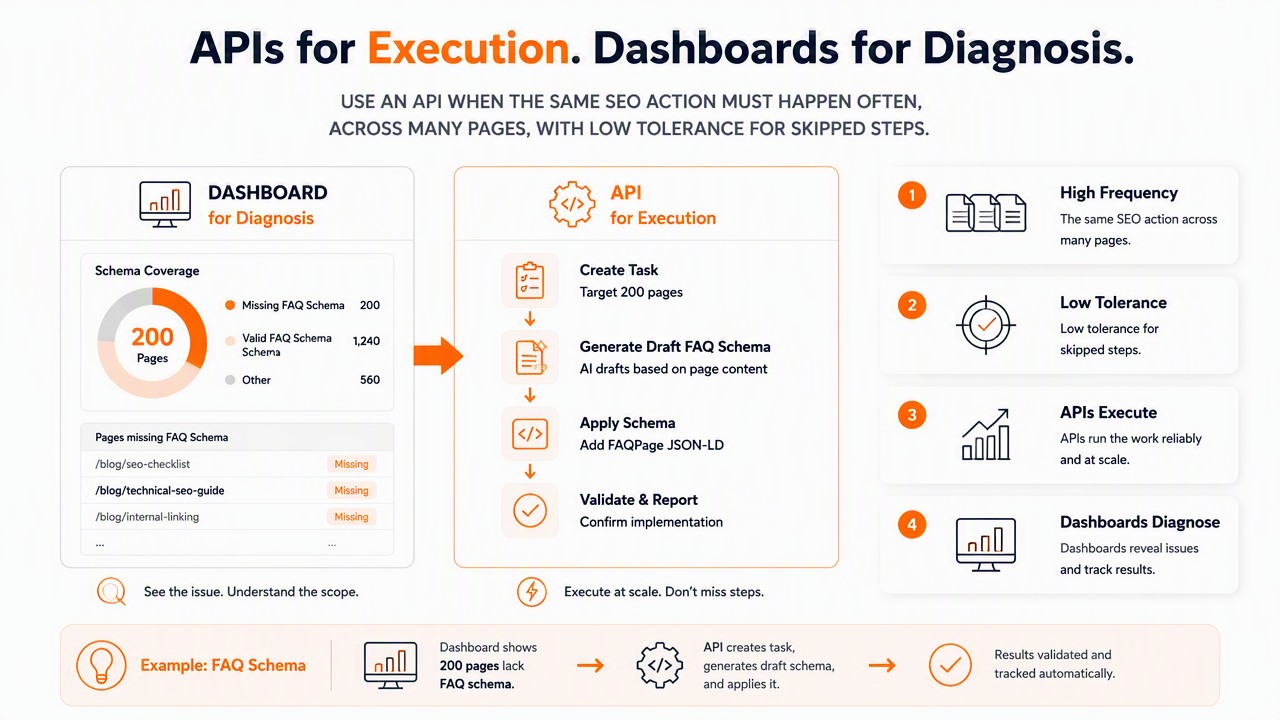
Dashboards are strong for diagnosis. APIs are strong for execution. A dashboard can show that 200 pages lack FAQ schema; an API can create a task, generate draft schema, pass it for review, and update the CMS after approval.
Manual tools still fit early-stage teams with low publishing volume. Once briefs, optimization checks, internal links, and updates become weekly operations, the API approach usually wins on consistency.
Dashboard versus API decision table
| Workflow need | Manual dashboard fits when | API fits when |
|---|---|---|
| Keyword research | A few pages are planned each month | Briefs must be generated in batches |
| Competitor review | Editors inspect SERPs manually | Competitor headings, gaps, and entities must feed templates |
| Internal linking | A site has a small page count | Hundreds of new link opportunities appear monthly |
| Schema | Page types are simple and rare | Structured data must match templates at scale |
| Reporting | Stakeholders need periodic snapshots | Performance changes must trigger tasks automatically |
Competitor-aware workflows are especially API-friendly because SERP patterns change often. Teams building briefs from live SERP structure can study competitor-aware SEO content to see how competitive context fits the editorial process.
Signals that automation is ready
A content operation is ready for API automation when bottlenecks are predictable. The goal is not to automate everything; the goal is to automate the parts that should not depend on memory.
- A brief template already exists and is used by several writers.
- Editors repeat the same SERP checks for every article.
- CMS uploads require copy-paste work.
- Internal linking is often handled after publication.
- Metadata, schema, or image alt text gets missed.
- Old articles decay before anyone notices.
Teams serving several clients also tend to reach this point faster. Agency teams can use agency SEO content workflows as a model for repeatable production.
Which SEO workflows benefit most from automation?
Briefing, publishing, internal linking, schema, and performance refreshes benefit most because they combine repeatable logic with clear human review points.
Automation works best when a team can define acceptable inputs, outputs, and approvals. A weak workflow gets messy faster when automated, so process design matters before code. Research on language model risks by Weidinger, Uesato, and Rauh (2022) is a useful reminder that generated outputs need governance around accuracy, bias, and misuse (source).
Briefing and editorial planning
Brief generation is often the easiest first use case because the output can remain a draft. An API can collect primary keywords, related queries, search intent, competitor headings, entity coverage, and suggested internal links.
A strong brief should still leave room for editorial judgment. A template from an SEO content brief guide can help standardize the inputs before any API call is added.
Useful brief fields include:
- Target query and secondary query set
- Search intent and page type
- Required entities and definitions
- Competitor gaps to address
- Internal link suggestions
- Schema type recommendation
- Quality notes for reviewers
Publishing, links, and schema
Publishing automation reduces the gap between approved content and live content. An API can push clean HTML, metadata, canonical settings, image fields, and article status into a CMS.
Internal linking automation is usually more valuable after a site has enough content depth. The system can match anchors to existing URLs, avoid duplicate links, and surface orphan pages. For international sites, multilingual SEO content adds another layer because hreflang, localized intent, and translated metadata must stay aligned.
Schema is another strong API use case because the output has a strict format. Article, FAQ, Product, BreadcrumbList, and LocalBusiness schema can be generated from structured fields, then validated before publishing.
How Earlyseo handles content automation workflows
The Earlyseo platform is built for content teams that need repeatable SEO outputs without turning every editor into a systems engineer.
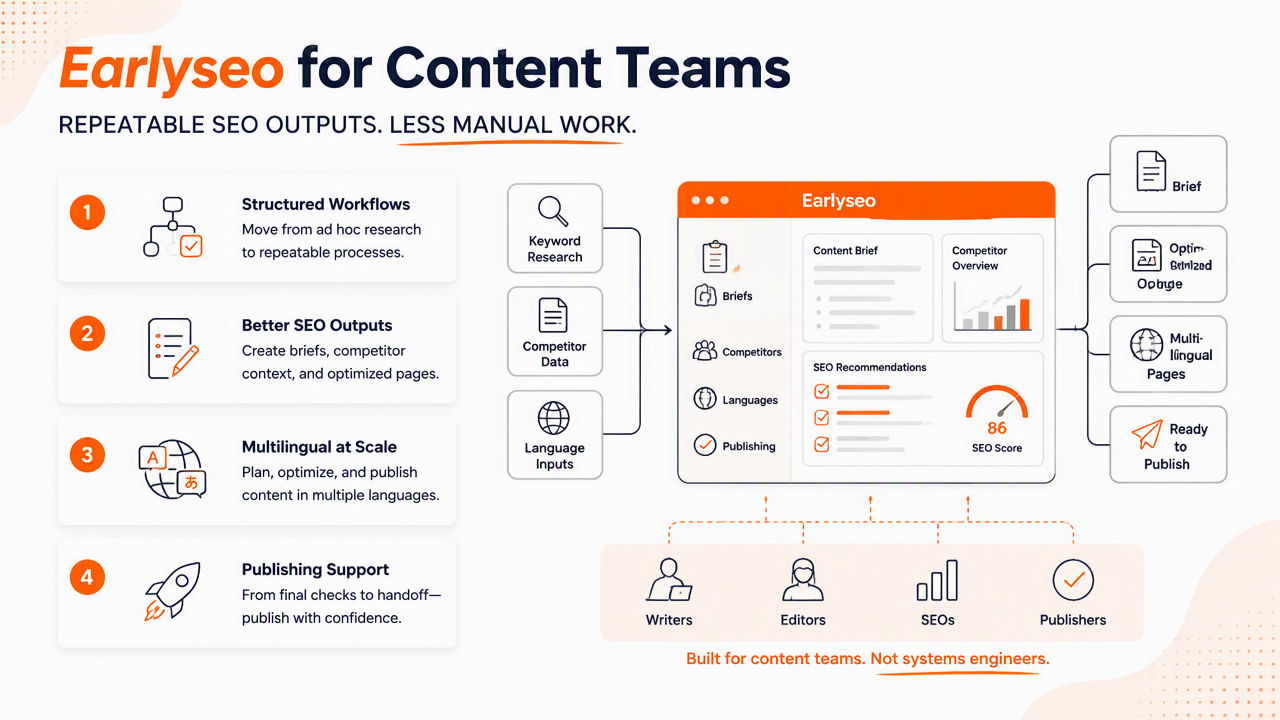
With Earlyseo, teams can move from ad hoc research to structured workflows for briefs, competitor context, multilingual pages, and publishing support. The strongest use case is not replacing writers; it is giving writers and editors a cleaner starting point with fewer missing SEO requirements.
The practical benefit shows up when teams need the same quality bar across many pages. Briefs can follow a consistent structure, competitor patterns can inform outlines, and updates can be handled as part of a planned content system rather than a rescue project.
Key insight: the best automation setup keeps humans in charge of claims, examples, brand voice, and final approval while software handles repeatable SEO assembly.
API-ready workflow map
| Stage | Human decision | API-supported output |
|---|---|---|
| Topic selection | Business priority and audience fit | Keyword clusters and opportunity data |
| Briefing | Angle, expertise, and page purpose | Outline, entities, questions, and competitor gaps |
| Draft review | Accuracy, tone, and originality | SEO checks, missing sections, metadata drafts |
| Publishing | Final approval | CMS fields, schema, links, and status updates |
| Refreshing | Rewrite depth and commercial priority | Decay alerts, update tasks, and comparison snapshots |
Teams evaluating the fit can visit earlyseo.com and map one repeatable workflow first, usually briefing or refresh monitoring. A small pilot gives clearer answers than a broad automation plan.
What should content teams watch in 2026 and 2027?
Content teams should expect SEO automation to move from single-task tools toward connected workflows that prepare content for search engines, AI answers, and human reviewers at the same time.
The shift is already visible in competitor coverage: current top-ranking pages focus heavily on SEO automation tools, AI agents, keyword research, content refreshes, and enterprise workflows. The next step is deeper integration, where APIs connect content inventory, SERP evidence, structured data, and approval systems.
A 2024 IEEE Access review by Yenduri and coauthors examined GPT technologies, applications, challenges, and future directions, which aligns with the broader move toward LLM-powered software workflows rather than isolated prompts (source).
Practical 2026 checklist
A good automation roadmap stays grounded. Fancy agents matter less than reliable inputs, review steps, and measurable outputs.
- Pick one workflow with clear repetition, such as briefs or schema.
- Define required fields before choosing software.
- Keep human approval for claims, advice, and final copy.
- Log every automated change in the CMS or project system.
- Track outcomes by page type, not only total traffic.
- Review generated links and schema before publishing.
- Update templates when SERP formats change.
By 2027, more content APIs will likely include AI citation checks, entity coverage scoring, and automated refresh triggers. The winning teams will still be the ones with clean processes, not the most complicated stack.
Frequently asked questions
Is an SEO automation API only for large companies?
No. Smaller teams can use an API when a repeatable process already exists. The deciding factor is not company size; it is workflow volume. A local business with many service pages or an e-commerce store with many product categories may benefit sooner than a large brand publishing only a few pages.
Can automation write all SEO content without editors?
Automation can create drafts, outlines, metadata, and structured data, but editors still need to check accuracy, originality, legal risk, and brand fit. Language model research highlights real risks around generated content, so human review remains a core part of responsible SEO operations.
What is the safest first workflow to automate?
Content briefs are usually the safest first workflow because they are planning documents rather than final public pages. A team can test keyword collection, competitor analysis, entity suggestions, and internal link ideas while keeping editorial control over the final article.
How does an API improve internal linking?
An API can scan existing URLs, match related topics, suggest anchor text, and flag orphan pages. Editors can then approve the best links before publication. This approach is more consistent than relying on memory, especially when a site has hundreds of articles or product pages.
Does schema generation need developer support?
Schema generation may need initial developer support, especially for CMS integration and validation. After setup, content teams can often manage structured fields inside templates. The safest setup validates JSON-LD before publication and stores changes for later review.
Conclusion
An SEO automation API for content teams is worth using when SEO work has become repeatable, cross-functional, and too easy to miss by hand. The best next step is a narrow pilot: choose one workflow, define the required fields, add human review, and measure the time saved plus quality gained. For teams ready to turn briefs, competitor context, schema, links, and refreshes into a cleaner content operation, Earlyseo is a practical place to start; head to earlyseo.com and map the first workflow before building a bigger system.