TL;DR
AI-assisted publishing scales only when ownership, review stages, source standards, and performance feedback are defined before volume increases. Small teams should create a lightweight governance model that controls duplicate risk, factual accuracy, compliance, and CMS release workflows without slowing every article to a crawl.
AI can make a small content team look big, but unmanaged output can make a brand look careless fast. SEO content governance for AI publishing is the operating system that keeps AI-assisted articles accurate, differentiated, compliant, and useful enough to earn search visibility in 2026. Teams using Earlyseo can pair research-backed planning with human review rules so article volume grows without losing editorial control. For teams comparing process options, earlyseo.com is a practical place to start.
Table of Contents
What is SEO content governance for AI publishing?
SEO content governance for AI publishing: a documented set of roles, standards, review gates, and performance loops that controls how AI-assisted content is planned, produced, checked, published, and improved for organic search.
SEO content governance for AI publishing defines who owns each decision, what evidence an article must use, how risks are reviewed, and when content is approved for release. It turns AI from a loose writing shortcut into a controlled publishing process that protects rankings, trust, and brand reputation.
Website governance: the staff structure, technical systems, policies, and procedures used to maintain and manage a website.
Web content development: the process of researching, writing, gathering, organizing, and editing information for website publication.
AI governance matters because language models can create confident but unsupported claims. A 2022 ACM Fairness, Accountability, and Transparency paper by Laura Weidinger, Jonathan Uesato, Maribeth Rauh, and coauthors mapped categories of risks posed by language models, including harms tied to information quality and misuse. That risk profile fits SEO publishing directly: inaccurate pages can hurt users, legal confidence, and search performance.
Key insight: AI publishing governance is not a style guide. It is a control system for decisions that affect discoverability, accuracy, and accountability.
Core governance terms small teams should define
| Term | Plain meaning | Small-team rule |
|---|---|---|
| Content owner | Person accountable for the final page | One named owner per URL |
| Source standard | Evidence required before claims publish | Primary or reputable secondary sources only |
| Review gate | Required approval step | SEO, factual, legal, or brand check |
| Duplicate-risk control | Process for avoiding near-copy pages | Compare intent, angle, headings, and SERP overlap |
| Feedback loop | Performance review after publishing | Update, consolidate, or expand based on data |
Governance should be light enough to use every week. A ten-person company rarely needs an enterprise committee, but it does need named decision makers, a source policy, and a publishing checklist.
Who owns AI-assisted SEO content before it goes live?
AI-assisted SEO content needs one accountable owner, plus clear supporting roles for research, subject review, SEO, compliance, and CMS publishing.
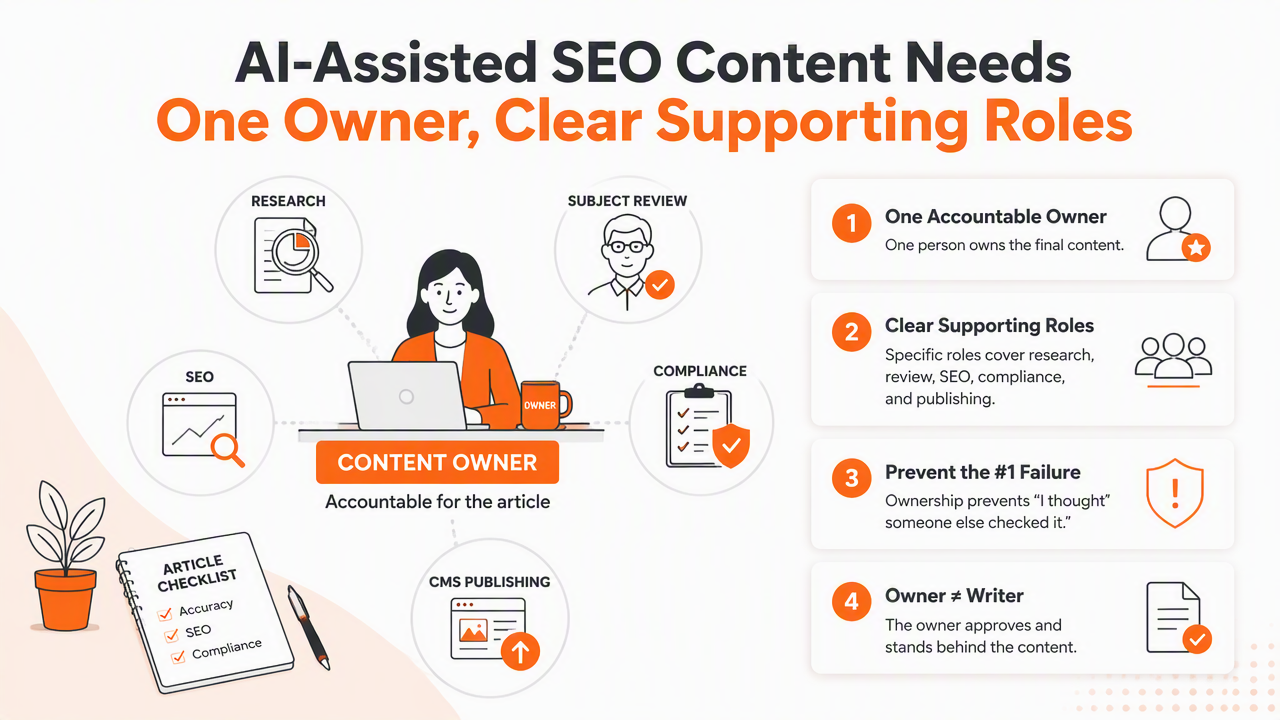
Ownership prevents the biggest small-team failure: everyone assumes someone else checked the article. The content owner does not need to write every line. That person approves the brief, confirms the page purpose, assigns review, and decides whether the content is ready for publication.
A practical workflow starts before drafting. The brief should define search intent, audience, internal links, source expectations, unique angle, and the intended conversion path. Teams building repeatable briefs can adapt an SEO content brief template so AI prompts follow editorial strategy instead of guessing.
Role clarity also reduces tool sprawl. Brightspot and other competitor pages often discuss AI in governance broadly, but small businesses need a more basic answer: who signs off, who checks facts, and who updates the article when rankings shift.
A simple RACI model for small content teams
| Task | Responsible | Accountable | Consulted | Informed |
|---|---|---|---|---|
| Topic selection | SEO lead | Content owner | Sales or support | Founder |
| AI draft generation | Writer or marketer | Content owner | SEO lead | Team lead |
| Fact-checking | Subject reviewer | Content owner | Legal if needed | Writer |
| On-page SEO | SEO lead | Content owner | Writer | Publisher |
| CMS release | Publisher | Content owner | SEO lead | Stakeholders |
| Performance review | SEO lead | Content owner | Writer | Leadership |
This model keeps accountability visible without adding heavy process. In a tiny team, one person may hold several roles, but the article should still have a single accountable owner.
Minimum approval rules before publication
Every AI-assisted article should pass five approval checks:
- Intent match: the article answers the searcher's likely job, not just the keyword.
- Evidence check: factual claims match linked sources or internal expertise.
- Originality check: the angle, structure, and examples differ from ranking pages.
- Brand check: tone, claims, and recommendations fit the company's position.
- Release check: metadata, schema, internal links, and CMS formatting are correct.
For companies with many drafts moving at once, an AI content planner helps map topics, ownership, and publishing priority before production starts.
How should teams control fact, duplicate, and compliance risk?
Teams should control AI publishing risk with source rules, originality checks, sensitive-claim review, and a documented approval trail.
Generic AI output is risky because it can sound polished while missing context, sources, or legal nuance. The fix is not banning AI. The fix is requiring evidence for claims and narrowing where AI is allowed to decide. Research, outlining, drafting, summarizing, and formatting can be AI-assisted. Final factual judgment should stay with a human owner.
Compliance risk depends on the niche. Health, finance, legal, cybersecurity, and regulated e-commerce content need tighter review than a local service FAQ. Claims about pricing, guarantees, certifications, safety, and comparisons deserve extra attention.
A 2021 AI & Society article by Josh Cowls, Andreas Tsamados, Mariarosaria Taddeo, and coauthors examined opportunities, challenges, and recommendations for artificial intelligence in climate action. While the topic differs, the governance lesson translates well: AI value rises when risks, responsibilities, and human oversight are explicit.
Risk controls that belong in the editorial checklist
- Citation policy: require a link for every statistic, study, legal claim, or technical benchmark.
- No unsupported superlatives: block words like "best," "only," and "guaranteed" unless evidence supports them.
- Duplicate-intent scan: compare the draft against existing site URLs before publishing.
- SERP differentiation review: check whether the article adds examples, steps, tables, or current context missing from ranking pages.
- Human expert gate: route sensitive content to a qualified reviewer before CMS approval.
- Version history: keep the brief, source list, draft, reviewer notes, and publish date.
The strongest duplicate control is editorial intent. Two pages can target different keywords and still compete if both answer the same question in the same way. Teams using competitor-aware SEO content can spot overlap earlier and shape a more distinct angle.
Fact-checking standards by claim type
| Claim type | Required proof | Review owner |
|---|---|---|
| Statistic | Linked source with the exact figure | SEO lead or editor |
| Product feature | Current product documentation | Product owner |
| Legal or compliance claim | Legal-approved source | Compliance reviewer |
| Medical or financial guidance | Qualified expert review | Specialist reviewer |
| Competitor comparison | Publicly visible evidence | Content owner |
Fact-checking should be strictest where harm is highest. A blog about internal linking can move faster than an article giving tax guidance, but both still need traceable sources.
How Earlyseo handles governance for AI-assisted publishing
The Earlyseo platform supports AI-assisted publishing by connecting planning, research, content production, and CMS workflows around repeatable SEO operations.
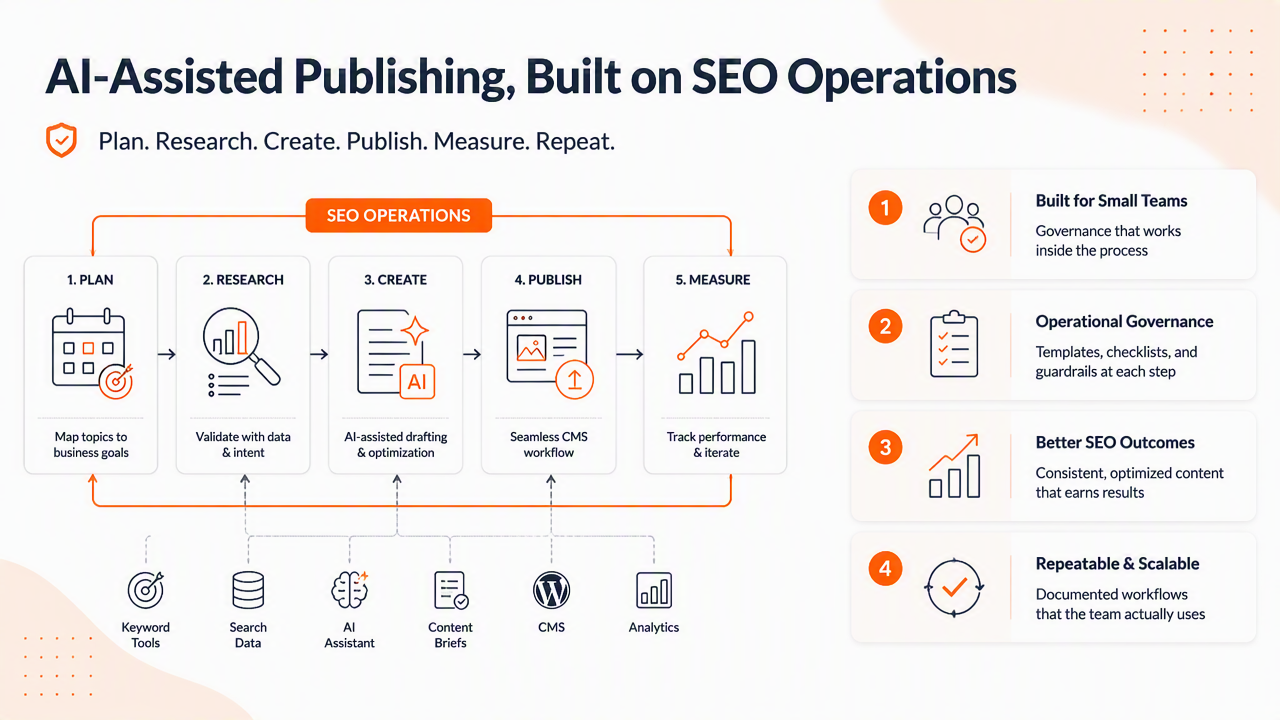
Small teams often need governance that works inside the publishing process, not a separate document nobody opens. Earlyseo fits that need by helping teams plan article topics, create research-backed drafts, manage SEO operations, and prepare content for CMS release. The goal is simple: make good editorial behavior the default path.
Teams building a new organic program can connect governance with broader strategy by reading about content strategy for new blogs. That keeps AI production tied to topic focus, audience needs, and realistic publishing capacity.
Earlyseo is especially useful when volume increases across multiple markets or article types. For example, a team creating localized pages can pair governance rules with multilingual SEO content so translation, intent, and review standards stay consistent.
Where governance fits in an Earlyseo workflow
A practical Earlyseo workflow follows six stages:
- Plan: select topics based on search demand, business value, and coverage gaps.
- Brief: define intent, audience, sources, internal links, and conversion goal.
- Draft: create AI-assisted copy within the approved structure.
- Review: check facts, originality, SEO elements, and compliance needs.
- Publish: move approved content into the CMS with consistent formatting.
- Improve: review performance and update pages based on rankings, clicks, and conversions.
For teams that want fewer manual handoffs, CMS publishing can help make the release step cleaner after review is complete. Earlyseo also supports article scaling through article auto-publishing, which works best when approval rules are already defined.
What should content governance prepare for in 2027?
Content governance should prepare for more AI-generated reference sources, answer-engine visibility, stricter review expectations, and faster content refresh cycles.
Search is no longer only about blue links. AI Overviews, chat assistants, and answer engines summarize content into direct responses. That means governance must make articles easy for machines to parse and safe for humans to trust. Clear definitions, tables, source links, and direct answers now matter as much as classic on-page SEO.
The launch of Grokipedia in 2025, described in research data as an AI-generated online encyclopedia operated by xAI, reflects a broader shift toward machine-generated reference layers. That trend raises the bar for source quality. If AI systems learn from, summarize, or compare web content, weak pages can be ignored while clear, well-sourced pages become easier to cite.
A 2021 survey on deep learning for self-driving cars by Abhishek Gupta, Alagan Anpalagan, and Ling Guan covered challenges and open issues in AI systems. The publishing parallel is practical: complex AI systems need monitoring, not blind trust.
Governance upgrades to schedule before 2027
- Entity rules: name products, companies, standards, and people clearly so AI systems can identify them.
- Answer blocks: place 40 to 60 word direct answers under question headings.
- Structured comparisons: use tables for alternatives, criteria, and decision paths.
- Refresh triggers: update pages when search intent, product details, or competitor pages change.
- Archive rules: prune, merge, or redirect low-value pages that split authority.
Key insight: AI-era SEO rewards pages that are easy to verify, easy and hard to confuse with generic output.
FAQ
Can AI-written content rank in Google Search?
AI-assisted content can rank when it is useful, accurate, original, and aligned with search intent. Governance matters because low-quality automation can create thin pages, factual errors, or duplicate coverage. A safer process uses AI for drafting and research support while humans approve claims, angle, structure, and publication readiness.
How many review stages does a small team need?
Most small teams need three stages: brief approval, editorial review, and final pre-publish check. Regulated topics may need legal or expert review as a fourth stage. The process should be written down, assigned to named owners, and short enough to run consistently.
What is the biggest duplicate-content risk with AI publishing?
The biggest risk is not exact copied text. The bigger issue is publishing several pages with the same search intent, similar headings, and no distinct value. Governance should require an existing-content check before drafting and a SERP differentiation review before approval.
How often should AI-assisted SEO content be reviewed after publishing?
Review timing should match business value and volatility. High-value commercial pages may need monthly checks, while evergreen educational posts can be reviewed quarterly or twice per year. Triggers should include ranking drops, outdated claims, product changes, and new competitor formats in search results.
Conclusion
SEO content governance for AI publishing works best when it stays practical: one owner per URL, clear source rules, defined review gates, duplicate-risk checks, and a feedback loop after publication. Small teams should start with a one-page policy, turn it into a checklist, then apply it to the next ten articles before scaling output. For a smoother operating model, evaluate Earlyseo and visit earlyseo.com to connect planning, research, publishing, and SEO improvement in one workflow.