TL;DR
Small SEO teams should rank backlog items by impact, effort, confidence, and urgency, then commit only to the highest-scoring work for the next sprint. The best backlog blends quick wins, compounding content, technical fixes, and local or link work without turning planning into a second job.
SEO backlog prioritization for small teams breaks down when every task looks urgent: publish content, fix crawl issues, earn links, refresh old pages, improve Google Business Profile, and somehow report results by Friday. A small team needs a decision system, not a giant spreadsheet. SEO backlog: a prioritized list of search growth tasks across content, technical SEO, authority building, analytics, and local visibility. The Earlyseo platform helps teams turn that list into repeatable SEO operations instead of scattered requests.
Table of Contents
What is an SEO backlog?
An SEO backlog is a ranked list of search tasks that a small team may work on next, similar to the agile product backlog, which Wikipedia defines as a prioritized list of functionality a product should contain. In SEO, the backlog is a decision tool for choosing tradeoffs across traffic, revenue, risk, and available capacity.
A useful backlog is not a wish list. It captures work that has a clear owner, expected outcome, evidence, and next action. For background on whether SEO deserves a place in the operating plan at all, small companies can start with SEO basics for small businesses.
Key insight: a backlog only helps when it forces choices. If everything stays marked high priority, the backlog has become storage, not strategy.
What belongs in the backlog
A small-team SEO backlog should include work that can change search visibility, conversion quality, or measurement accuracy.
- Content: new pages, refreshes, briefs, title rewrites, internal links, product category copy.
- Technical SEO: indexing fixes, Core Web Vitals work, schema, canonical cleanup, redirects.
- Local SEO: Google Business Profile updates, service pages, reviews, location landing pages.
- Authority: digital PR ideas, partner links, supplier citations, unlinked brand mentions.
- Operations: dashboards, keyword maps, content QA, reporting templates.
Tasks without a business goal should be parked in an idea list, not the active backlog.
How should SEO backlog prioritization for small teams work?
SEO backlog prioritization for small teams should use a simple scoring model: estimate impact, effort, confidence, and urgency, then pick work that fits the next 2 to 4 weeks of capacity. The goal is not perfect prediction. The goal is fewer random tasks and faster learning.
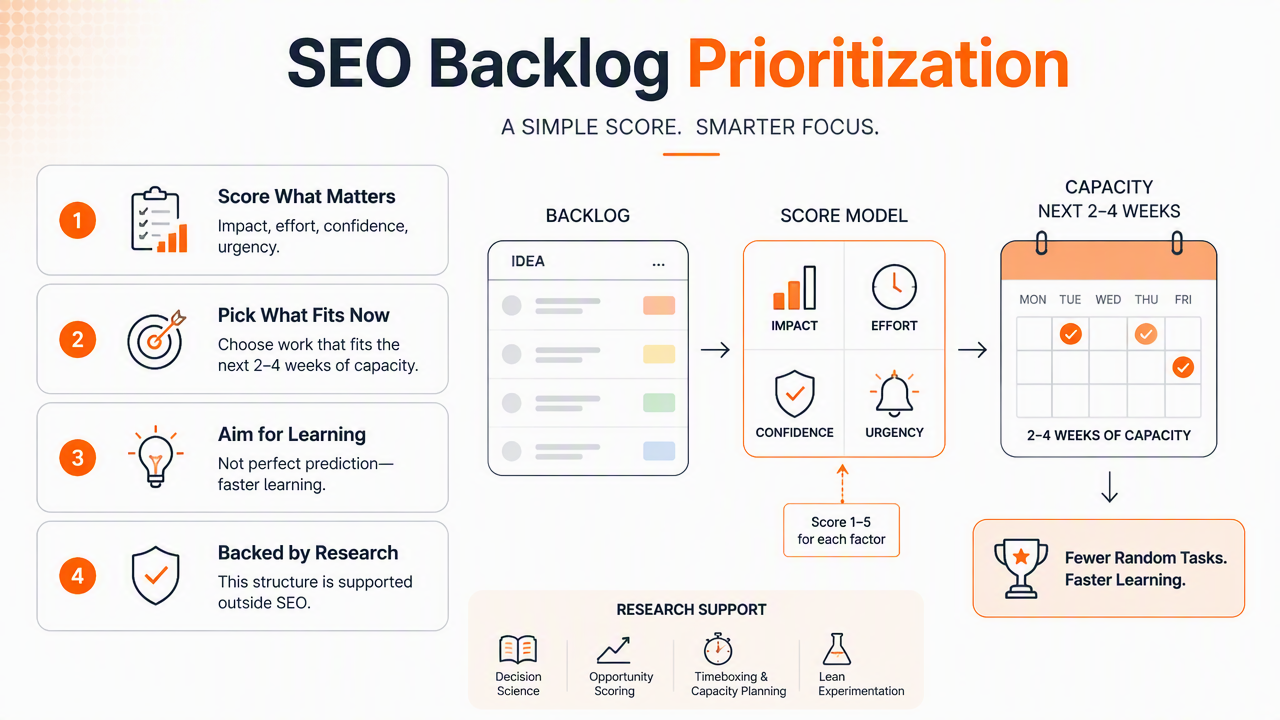
Research outside SEO supports this structured approach. A 2022 Delphi consensus study in Nature used expert agreement to organize complex public-health priorities, showing how explicit criteria can help groups move from opinions to decisions (Lazarus, Romero, Kopka, 2022). For small marketing teams, the same principle applies at a smaller scale: make judgment visible.
Scoring rubric for small teams
| Factor | Score 1 | Score 3 | Score 5 |
|---|---|---|---|
| Impact | Minor visibility or cleanup value | Likely ranking, traffic, or conversion lift | Direct revenue, lead, local, or strategic upside |
| Effort | More than 2 weeks or cross-team delay | Several focused workdays | Same day or already partly done |
| Confidence | Based on guesswork | Supported by SERP, Search Console, or competitor data | Supported by multiple signals and clear intent |
| Urgency | Nice to have | Needed this quarter | Time-sensitive, blocking, or tied to launch |
A simple formula works well: Priority score = impact + confidence + urgency - effort. A task with impact 5, confidence 4, urgency 3, and effort 2 scores 10. That is usually better than a shiny idea with impact 5, confidence 1, urgency 1, and effort 5, which scores 2.
Earlyseo supports this type of repeatable planning through SEO operations workflows, especially when content, technical, and competitor tasks need one shared queue.
Example scoring in practice
A local bakery with one marketer might compare three items. Fixing missing title tags on service pages could score 8. Publishing a wedding cake guide could score 9. Redesigning the blog template might score 3 if no crawl or conversion issue exists.
For e-commerce, the same method prevents endless category debates. Store owners can compare product-page refreshes, collection-page copy, and technical fixes using evidence from small-store e-commerce SEO planning, then select the work with the best score and shortest path to publication.
Which SEO tasks should small teams rank first?
Small teams should rank tasks first when they combine clear business value, low delivery friction, and enough evidence to act. In practice, that usually means indexation fixes, high-intent page improvements, local visibility basics, and content refreshes before speculative campaigns.
Priority order by team situation
| Situation | First-priority work | Why it moves faster |
|---|---|---|
| New website | Indexing, site structure, core service pages | Search engines need a clean base before scale |
| Local business | Google Business Profile, reviews, location pages | Local intent can convert without huge traffic |
| Online store | Collection pages, product schema, internal links | Commercial pages can capture buying intent |
| SaaS startup | Use-case pages, comparison pages, technical cleanup | Mid-funnel searches can support demos and trials |
| Content-heavy site | Refresh decaying pages, consolidate duplicates | Existing URLs often have history and links |
A strong backlog usually includes one task from each time horizon:
- This week: a fast fix with clear evidence, such as broken internal links or missing local categories.
- This month: a content or technical project with measurable upside.
- This quarter: a larger asset, template change, or authority campaign.
Local businesses should not copy national SEO playbooks blindly. A cleaner path is a smaller local queue that ranks Google Business Profile completeness, service-area pages, citations, and review operations. The local business SEO playbook gives that backlog a practical structure.
Key insight: the highest-value task is often not the biggest task. It is the task that can ship, be measured, and improve the next decision.
When content beats technical work
Content should outrank technical work when the site is crawlable, the page speed is acceptable, and the biggest gap is missing search intent. For example, a roofing company with no emergency repair page should usually create that page before debating advanced schema.
The Earlyseo platform can help identify competitor-aware topics when a backlog lacks content direction, especially for teams comparing SERP gaps against realistic publishing capacity.
When technical work beats content
Technical work should outrank content when search engines cannot crawl, index, render, or understand key pages. Duplicate templates, bad canonicals, redirect chains, blocked pages, and thin category pages can reduce the value of every future content task.
Developer-led teams often need a separate technical queue, with SEO tickets written clearly enough for sprint planning. The guide for developer-led SEO teams fits that operating style.
How can small teams run the backlog weekly?
Small teams can run the SEO backlog with a 30-minute weekly review, a monthly scoring refresh, and a 90-day roadmap. The cadence matters because search work compounds slowly, while business priorities shift quickly.
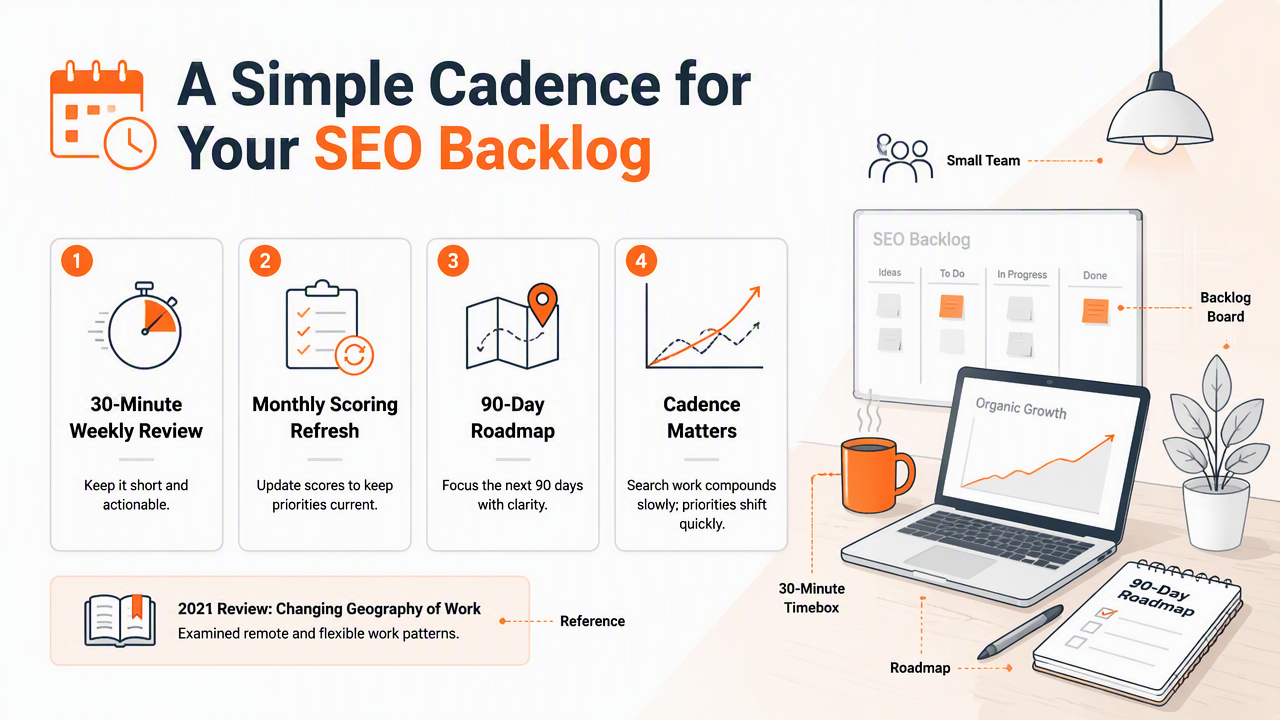
A 2021 review on the changing geography of work examined remote and flexible work patterns, a useful reminder that teams often make decisions asynchronously now (Choudhury, 2021). A backlog should therefore be readable without a meeting. Every ticket needs context, score, owner, status, and expected measurement.
Weekly operating checklist
- Add new tasks with evidence: Search Console data, rank movement, customer questions, competitor pages, crawl findings.
- Score only active candidates: Avoid scoring hundreds of ideas that will not ship soon.
- Select 3 to 7 committed tasks: Match the list to real capacity, not ambition.
- Define done: A content brief, published page, fixed redirect, or updated local listing needs a visible finish line.
- Review outcomes: Mark impact as observed, delayed, unclear, or no lift.
Small teams should protect backlog hygiene. Old tasks with no owner should expire. Vague requests should be rewritten. Repeated ideas should merge into one ticket. If a task cannot be described in one sentence, it is probably not ready for scoring.
For a quarter-length operating rhythm, a 90-day SEO sprint gives teams a way to group backlog items into setup, execution, measurement, and iteration. More examples and product details are available at earlyseo.com.
Backlog ticket template
A clean SEO ticket can stay short:
- Task: Refresh the "emergency plumber" service page.
- Why now: Search Console shows impressions without clicks.
- Evidence: Ranking near page one, weak title, missing FAQs.
- Score: impact 4, effort 2, confidence 4, urgency 3.
- Owner: content lead.
- Done means: updated copy, title, FAQs, internal links, submitted for indexing.
- Measure: clicks, click-through rate, calls, and local pack movement after 30 to 60 days.
That level of detail is enough for action without creating project-management theater.
What should small teams expect in 2027?
In 2027, SEO backlogs will likely include more AI search visibility work, more entity cleanup, and tighter content-quality review. Classic ranking tasks will still matter, but teams will need to prioritize pages and assets that answer questions clearly enough for Google AI Overviews, ChatGPT, and other answer engines That shift favors structured content. Definition blocks, comparison tables, concise FAQs, author details, and clear product positioning will become more common backlog items. Competitor research will also need to track which brands AI systems cite, not only which URLs rank.
A 2022 Technovation paper on open new idea organizations studied limiting factors in social product development, showing that collaboration systems can face practical constraints even when participation is high (Abhari and McGuckin, 2022). SEO teams face a similar issue: more ideas do not automatically create more progress. Capacity remains the constraint.
2027 backlog additions to consider
- Answer-engine formatting: add definition lists, direct answers, and compact comparison tables.
- Entity consistency: align names, addresses, products, authors, categories, and schema.
- Content refresh cycles: update pages before decay becomes severe.
- Multilingual expansion: score new-language content only after source-market pages prove demand.
- Competitor citation tracking: monitor which brands appear in AI answers and why.
International or multilingual teams should treat translation as a scored investment, not a default expansion. The multilingual SEO content workflow can help prioritize markets, topics, and localized pages with less guesswork.
FAQ
Small-team SEO planning gets easier when common backlog questions have short, shared answers.
How many SEO tasks should a small team keep active?
A small team should usually keep 3 to 7 active SEO tasks in progress, depending on capacity. The full backlog can hold more ideas, but the active lane should stay narrow. Too many open tasks slow publishing, blur ownership, and make outcome measurement harder.
How often should SEO priorities change?
SEO priorities should be reviewed weekly and rescored monthly. Weekly reviews catch blockers and new evidence. Monthly rescoring prevents stale assumptions from controlling the plan. Major business changes, site migrations, product launches, or sudden traffic drops can justify an immediate review.
Should quick wins always come first?
Quick wins should come first when impact and confidence are also strong. A low-effort task with weak business value can still waste time. The better rule is to ship fast tasks that either improve revenue pages, remove technical blockers, strengthen local visibility, or teach the team something useful.
What is the best tool for SEO backlog prioritization?
The best tool is the one that keeps evidence, scoring, ownership, and measurement in the same workflow. Spreadsheets work for very small sites. As the queue grows, Earlyseo can support a more structured process for planning, content execution, and SEO operations without turning the backlog into busywork.
Conclusion
SEO backlog prioritization for small teams works best as a lightweight operating habit: define the task, score impact and effort, commit to a short list, ship, then measure. A team does not need a complex model to make better search decisions. It needs a shared way to say yes, no, and not yet.
The next step is simple: export every current SEO idea, delete unclear tasks, score the top 20, and choose the highest-scoring 3 to 7 items for the next sprint. For teams that want a cleaner operating system, visit earlyseo.com and turn the backlog into a repeatable growth process.