TL;DR
SEO agents are best for adaptive, goal-based tasks that need reasoning, while SEO automation platforms are best for repeatable workflows with controls. Most small teams should start with an automation platform, then add agentic steps once SEO strategy, approvals, and measurement are stable.
Autonomous SEO sounds attractive, but the real buying decision in 2026 is control versus initiative. The phrase SEO agent vs SEO automation platform compares two different operating models: one tries to decide the next action, while the other runs structured SEO workflows. For founders, small businesses, e-commerce teams, and lean marketing departments, the safer choice is usually a workflow platform first, then selective agent support. Earlyseo fits that practical middle ground by helping teams plan, produce, and manage SEO content without handing every decision to a black box.
SEO agent: an AI system that can interpret a goal, choose steps, call tools, and adapt based on intermediate results.
SEO automation platform: software that runs defined SEO tasks, workflows, checks, and reporting with predictable inputs, rules, and approvals.
Table of Contents
What is an SEO agent?
An SEO agent is an AI-driven system that works toward an SEO goal by planning actions, using tools, and adjusting its next step based on results. Unlike a static automation, an agent may decide whether to cluster keywords, draft content, inspect internal links, or request more data before continuing.
The concept borrows from broader artificial intelligence research. A 2023 paper by Stefan Feuerriegel, Jochen Hartmann, and Christian Janiesch on generative AI examined systems that generate outputs from learned patterns, which helps explain why modern SEO agents can draft, classify, summarize, and reason across tasks.
Key insight: An SEO agent is not just an AI writer. It is closer to a task manager that can decide what SEO action should happen next.
Common SEO agent jobs in 2026
SEO agents are strongest when the task has a clear objective but several possible paths. They can reduce handoffs across keyword tools, spreadsheets, content briefs, crawlers, and CMS queues.
Typical agent jobs include:
- Finding keyword gaps from competitor pages
- Grouping search terms into topic clusters
- Drafting content briefs from SERP patterns
- Suggesting internal links from existing URLs
- Flagging pages with thin or duplicated content
- Turning crawl data into prioritized recommendations
Agents still need boundaries. A local dentist, Shopify store, or SaaS startup may not want an autonomous system publishing pages, changing titles, or rewriting product copy without approval.
Where agentic SEO can go wrong
Agent risk comes from autonomy, not from AI alone. A system that can choose actions can also choose the wrong sequence, over-prioritize easy fixes, or generate recommendations that sound confident but miss business context.
Common failure points include:
- Weak prompts that produce vague SEO plans
- Missing brand, legal, or product constraints
- Poor tool permissions inside CMS or analytics accounts
- No human approval before publishing
- No measurement loop tied to rankings, traffic, or conversions
AI research outside marketing shows similar governance concerns. A 2021 review by Sofiat Abioye, Lukumon O. Oyedele, and Lukman Akanbi on artificial intelligence adoption studied opportunities and future challenges in another complex industry, which reinforces the need for oversight when AI systems affect real operations.
What is an SEO automation platform?
An SEO automation platform is software that runs repeatable SEO workflows such as keyword research, content planning, optimization checks, internal linking, reporting, and publishing support. It uses rules, templates, integrations, and sometimes AI, but the workflow is usually designed before execution.
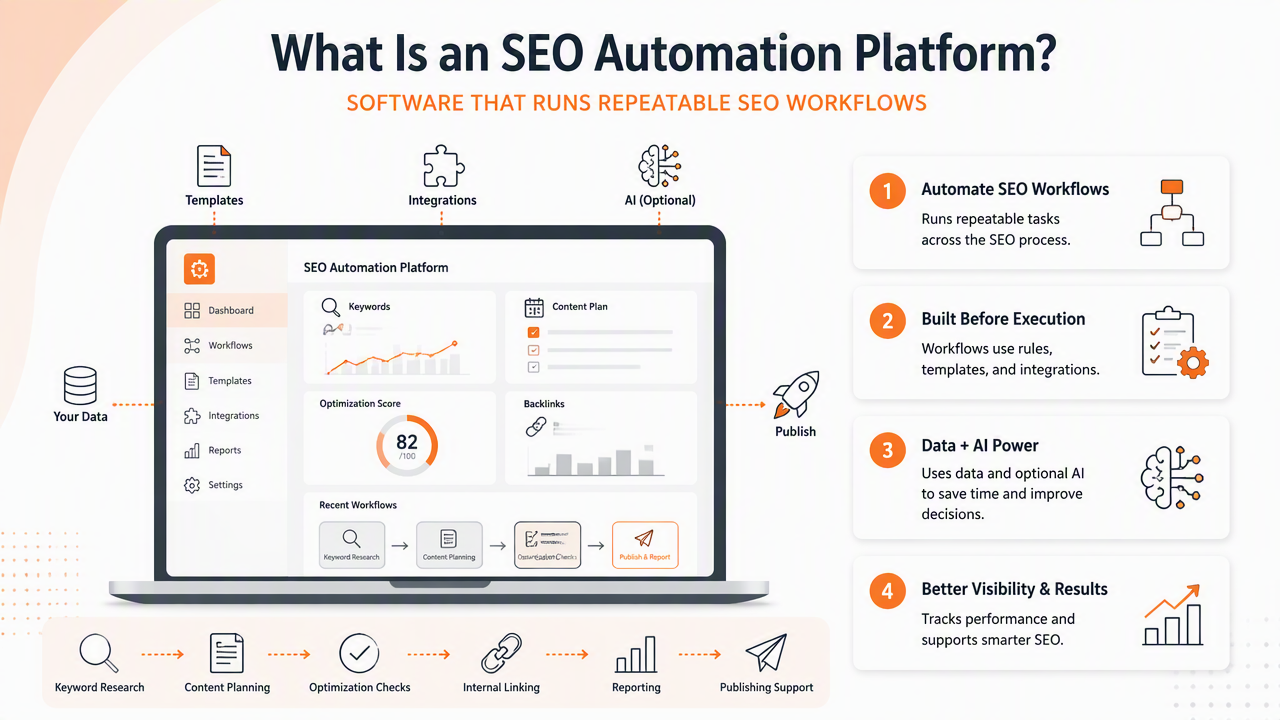
Search engine optimization means improving website and page visibility in search results. Automation platforms support that goal by making the work more consistent, especially for teams that lack dedicated SEO operations staff.
A platform is less flashy than an autonomous agent, but often more useful for small teams. It turns SEO into a reliable production system instead of a set of one-off tasks.
Platform features that matter most
A strong platform helps teams move from scattered SEO activity to a repeatable operating cadence. Earlyseo, for example, is built around structured SEO content workflows rather than unmanaged AI output.
Useful platform capabilities include:
- Keyword and topic planning: turns messy research into publishable priorities
- Competitor-aware briefs: compares SERP patterns before content production
- Content operations: tracks briefs, drafts, approvals, and updates
- Internal linking support: helps connect new and existing pages
- Localization workflows: supports multilingual or international SEO expansion
- Reporting: shows what shipped and what changed afterward
Teams building a repeatable publishing system can use SEO operations workflows to keep planning, production, and review in one process.
Tasks better suited to structured automation
Structured automation wins when accuracy, repeatability, and approvals matter more than free-form reasoning. That includes early-stage SEO programs where the main issue is not creativity, but consistency.
Good automation candidates include:
- Building content calendars from approved keyword sets
- Creating briefs from repeatable templates
- Checking titles, meta descriptions, headings, and internal links
- Managing multilingual content production
- Tracking page updates and publishing status
- Reporting progress to clients or leadership
For newer sites, a planned sprint can work better than a loose agent experiment. The 90-day SEO sprint gives small teams a practical structure for turning research into shipped pages.
SEO agent vs SEO automation platform: the practical comparison
The practical difference is that an SEO agent decides actions dynamically, while an SEO automation platform executes controlled workflows. Agents bring flexibility. Platforms bring governance, repeatability, and easier team adoption.
SERP competitors often blur this distinction by calling every AI workflow an agent. That framing misses the core buying question: should the system be allowed to decide the next SEO move, or should it help a team execute an approved process faster?
Side-by-side comparison table
| Category | SEO agent | SEO automation platform | Best fit |
|---|---|---|---|
| Operating style | Goal-based and adaptive | Workflow-based and repeatable | Depends on maturity |
| Human control | Lower unless approvals are built in | Higher by design | Regulated or brand-sensitive teams |
| Setup effort | Needs prompts, tool access, rules, testing | Needs templates, integrations, process design | Platforms are easier for beginners |
| Best tasks | Research synthesis, clustering, diagnostics | Briefs, publishing workflows, checks, reporting | Mixed teams use both |
| Main risk | Wrong action with high confidence | Rigid workflow if poorly designed | Review cadence matters |
| Measurement | Can be inconsistent without logging | Easier to track by workflow stage | Managers and agencies |
| Cost pattern | Can rise with tool calls and iterations | Usually tied to seats, volume, or features | Predictable budgets |
Decision rule: Choose agentic SEO for ambiguous analysis, and choose platform automation for repeatable work that affects live pages, clients, or revenue.
Who should pick which
Early-stage companies usually need a platform before an agent. The reason is simple: most small teams do not have enough SEO process, content inventory, or review discipline for full autonomy.
A practical selection model:
- Solo founder: choose a platform for keyword planning, content briefs, and publishing cadence
- Local business: choose a platform for service pages, location pages, and basic reporting
- Shopify store: choose automation for product, collection, and blog workflows, with agent help for gap analysis
- SaaS marketing team: use both, with agents for research and a platform for production
- Agency: use a platform for client delivery, then add agents for discovery and reporting summaries
E-commerce teams can pair automation with a focused Shopify SEO playbook, while agencies may prefer repeatable delivery systems like agency SEO content workflows.
How Earlyseo handles SEO automation with AI support
Earlyseo handles SEO automation as a managed content and operations workflow, with AI used to speed research and production rather than replace strategic control. That makes the Earlyseo platform more suitable for teams that want scale, but still care about positioning, approvals, and quality.
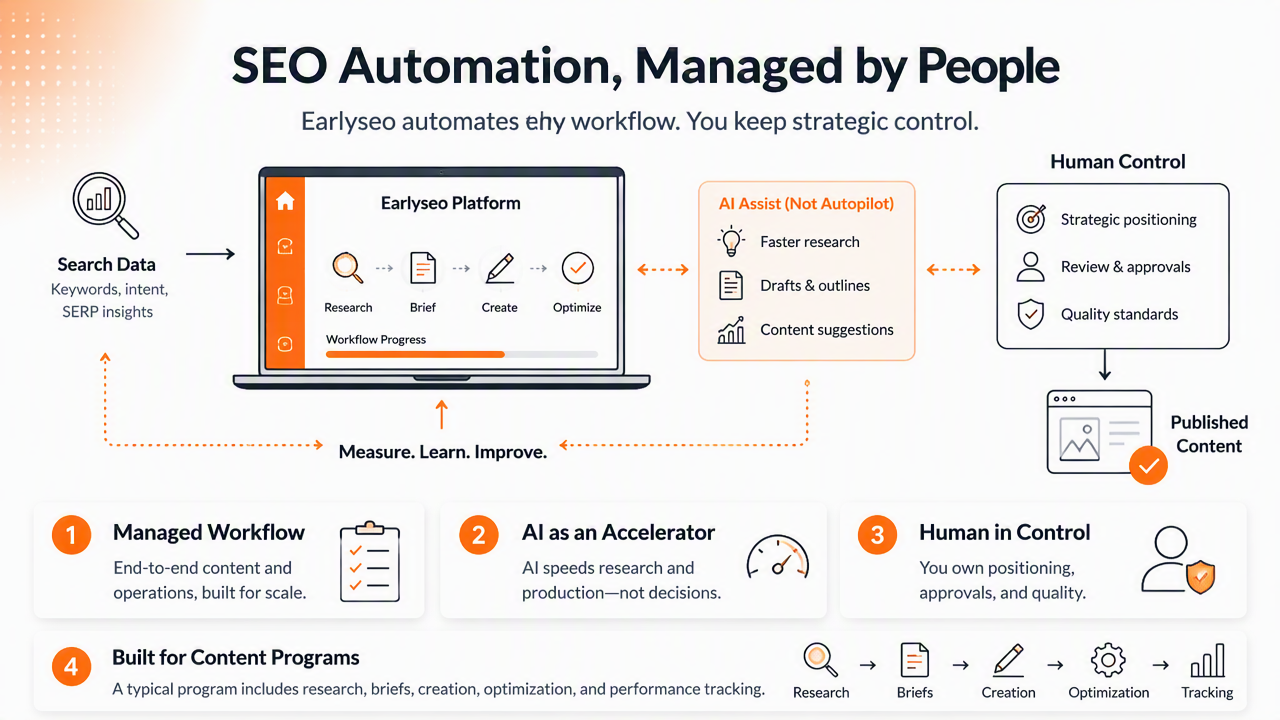
A content program usually breaks when ideas, briefs, drafts, links, and updates live in separate tools. Earlyseo helps connect those steps so SEO work becomes a system. That matters for small businesses and growing teams because visibility depends on shipping the right pages consistently, not just generating more text.
The platform is especially relevant when competitor context shapes content planning. Teams that need search-aware briefs can use competitor-aware SEO content to avoid writing in isolation.
Best use case: Earlyseo is a strong fit when a team needs repeatable SEO content output, clear operations, and AI-assisted planning without fully autonomous publishing.
For international growth, workflow control becomes even more important. Translation alone does not solve search intent, regional keyword demand, or localized page structure. The multilingual SEO content workflow supports expansion without turning localization into a manual spreadsheet process.
More details about product fit are available at earlyseo.com.
Buyer recommendation by maturity
| SEO maturity | Main problem | Recommended model | Reason |
|---|---|---|---|
| Beginner | No process or content plan | Automation platform | Creates structure first |
| Growing | Too many manual SEO tasks | Automation platform plus AI assistance | Speeds execution with control |
| Advanced | Complex research and prioritization | Platform plus limited agents | Agents help analysis, platform governs output |
| Enterprise or agency | Multiple sites, clients, approvals | Platform-led system | Workflow visibility matters most |
The best stack in 2026 is rarely pure agent or pure automation. A platform should own the operating system. Agents can sit inside specific steps where flexible analysis has clear value.
What to expect from SEO tools in 2027
SEO tools in 2027 will likely combine agentic reasoning with platform controls, making the distinction less about features and more about governance. The winning products will show what the AI did, why it did it, and which human approved the change.
Search is also broadening beyond classic blue links. Generative answer engines, AI Overviews, and AI visibility platforms are pushing teams to structure content so machines can extract clear answers. That favors definition blocks, comparison tables, concise FAQs, entity-rich headings, and original examples.
Research on AI and human interaction is relevant here. A 2021 study by Kyoungwon Seo, Joice Tang, and Ido Roll examined AI effects on learner-instructor interaction, showing why human-AI collaboration design matters when tools influence decisions.
Practical expectations for 2027:
- More platforms will add limited autonomous agents
- More agents will add approval logs and workflow controls
- Content briefs will include AI citation and answer-engine formatting
- Reporting will connect shipped SEO work to business outcomes
- Human review will remain normal for publishing, legal, and brand-sensitive pages
A sensible roadmap starts with workflow clarity, then adds autonomy in narrow places. That order protects quality while still capturing AI speed.
FAQ
Is an SEO agent the same as SEO automation?
No. An SEO agent can decide actions based on a goal, while SEO automation follows a defined workflow. Some platforms include agent-like features, and some agents run automated tasks, but the core difference is decision-making authority.
Can an SEO agent replace an SEO manager?
An SEO agent can reduce manual analysis and production work, but it should not replace strategy, prioritization, stakeholder alignment, or final approval. SEO decisions still involve brand positioning, audience knowledge, commercial goals, and risk tolerance.
Is an automation platform better for small businesses?
Usually, yes. Small businesses often need structure more than autonomy. A platform can help create service pages, content briefs, reporting habits, and internal linking routines before advanced agent workflows are worth the added complexity.
When should a team add agentic SEO?
Agentic SEO makes sense after a team has clean data, approved workflows, content standards, and a review process. Good starting points include keyword clustering, competitor research, content refresh suggestions, and technical issue summaries.
What is the safest choice in the SEO agent vs SEO automation platform decision?
The safest choice is a platform-led workflow with selective AI assistance. That approach gives teams speed without losing control over publishing, brand voice, internal links, and business priorities.
Conclusion
The SEO agent vs SEO automation platform choice is really a maturity test. Agents are useful when the task needs reasoning, exploration, or synthesis. Automation platforms are better when the team needs dependable output, approvals, and a clear production rhythm.
For most startups, local businesses, online stores, and growing marketing teams, the next step is to map the SEO workflow first: research, brief, draft, optimize, link, publish, update, and report. Then choose where AI should assist and where humans must approve. Earlyseo supports that platform-first approach for teams that want practical SEO momentum without handing the entire process to autonomous software. For a closer look, visit earlyseo.com and review how the workflow fits the next 90 days of SEO work.