TL;DR
Auto directory submission can help local SEO when it creates accurate listings on trusted, relevant directories. Mass submissions to weak sites usually waste budget and can create duplicate, inconsistent business data that hurts trust.
Auto directory submission local SEO works only when automation supports citation quality, not when it sprays business details across random websites. Local businesses need accurate name, address, phone, category, hours, and review signals in places search engines and customers already trust. Earlyseo helps local teams manage that workflow with more control than one-click bulk submission.
Local citation: A local citation is an online mention of a business name, address, phone number, website, category, and related details on a directory, map app, review site, chamber page, or industry listing.
Key insight: Directory submission is not dead in 2026. Low-quality mass submission is the part that should be retired.
Table of Contents
What is auto directory submission local SEO?
Auto directory submission local SEO is the use of software or services to place business information into online directories, with the goal of improving local visibility, citation consistency, and discovery across search engines, maps, and review platforms.
Search engines respond to queries by returning links and relevant web information. Local search adds location, business entities, proximity, and trust signals to that process. A directory listing can support that trust when it confirms the same business facts found on Google Business Profile, Apple Business Connect, Bing Places, Yelp, and the business website.
Automation handles repetitive form filling, submission tracking, and listing updates. Human judgment still matters because category choice, duplicate suppression, review platform fit, and local relevance cannot be reduced to a bulk upload file.
Core terms local teams should separate
- Citation management: Maintaining accurate business data across trusted platforms.
- Directory submission: Creating or updating listings on business directories.
- NAP consistency: Keeping name, address, and phone number identical across key listings.
- Mass submission: Sending business data to many directories with little quality control.
- Aggregator: A data provider or platform that distributes business information to other sites.
A sitemap tells search engines which website URLs are available for crawling, but citations tell local systems where a business exists across the wider web. Both support discovery, but they solve different problems.
For a broader local plan, the local business SEO playbook is the better starting point before any listing campaign begins.
When do directories help local rankings?
Directories help local rankings when they strengthen entity confidence, match real customer behavior, and appear on trusted platforms that are relevant to the business category or city.
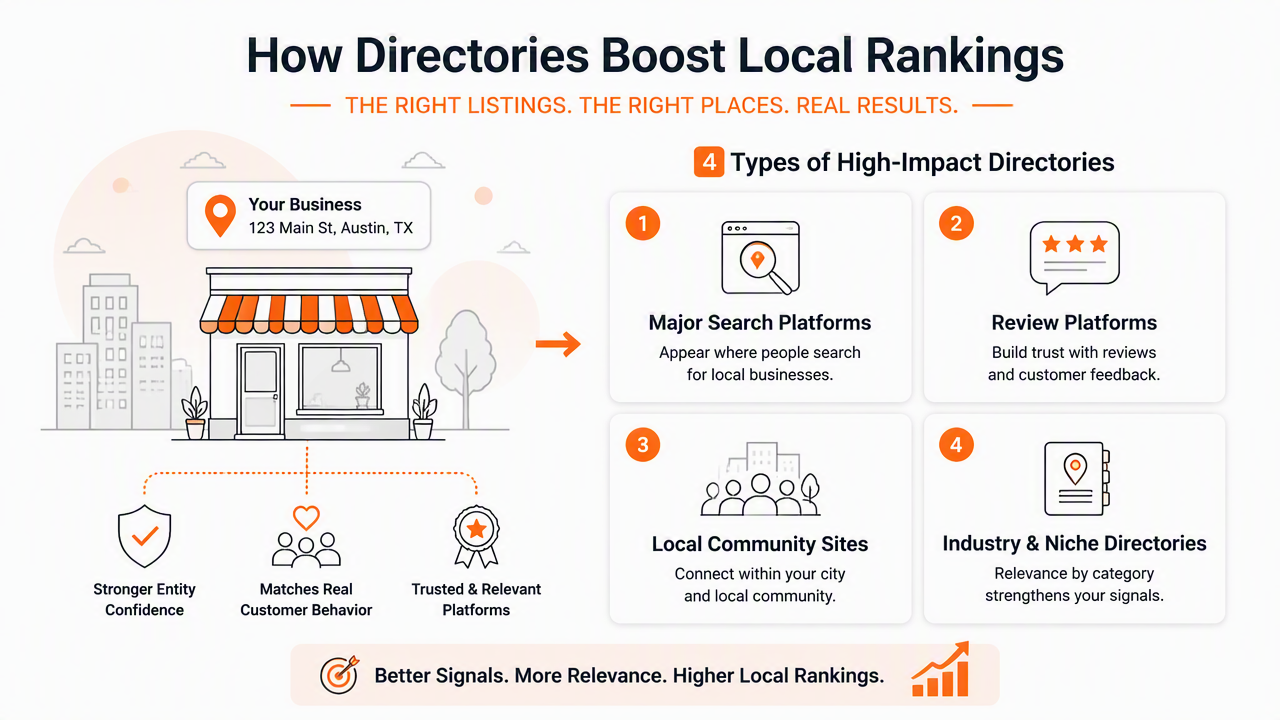
The most useful directories usually fall into one of four groups: major search platforms, review platforms, local community sites, and industry-specific directories. A restaurant, dentist, plumber, law firm, auto repair shop, and home service contractor should not have the same directory list.
Search engines value consistency because conflicting business records create uncertainty. Customers value directories when those pages show hours, services, photos, reviews, booking links, and directions.
Directory value comparison for 2026
| Directory type | Local SEO value | Best use case | Risk level |
|---|---|---|---|
| Google Business Profile, Apple Business Connect, Bing Places | High | Core map visibility and business facts | Low |
| Yelp, Tripadvisor, Angi, Houzz, Healthgrades, Avvo | High when relevant | Reviews and category discovery | Low to medium |
| Chamber of commerce and local associations | Medium to high | Local authority and community proof | Low |
| Niche trade directories | Medium | Industry relevance and referral traffic | Medium |
| Generic free directories with no audience | Low | Usually little value | Medium to high |
| Bulk networks created mainly for links | Very low | Not recommended | High |
Good directories behave like customer discovery channels. Weak directories behave like link dumps.
A local citation also helps when it fills a visibility gap. For example, a new HVAC company may need core map listings first, then trade directories and local association pages. An e-commerce brand with no storefront may need product SEO and merchant platforms more than local directories.
Budget-limited businesses should prioritize a smaller set of accurate listings. The guide to small business local SEO without a large budget explains how to sequence visibility work without buying every tool at once.
When does mass directory submission waste budget?
Mass directory submission wastes budget when it prioritizes the number of listings over accuracy, relevance, review value, and the ability to maintain records after publication.
Many older directory packages sold hundreds of submissions as if volume alone improved rankings. That approach no longer matches how modern local search works. In 2026, a business gains more from 20 accurate, trusted listings than from 300 weak pages that never send customers.
Bad submission campaigns often create duplicate profiles, mismatched phone numbers, outdated addresses, wrong categories, and thin pages that nobody visits. Those problems can force future cleanup work before meaningful local SEO progress can resume.
Warning signs of a low-quality submission offer
- Promises hundreds or thousands of listings without naming the sites.
- Treats every business type and city the same.
- Ignores Google Business Profile, Apple Business Connect, Bing Places, and review platforms.
- Uses old address data from previous locations.
- Creates listings under broad or wrong categories.
- Provides no duplicate check before submission.
- Gives no plan for updates when hours, phone numbers, or services change.
Security and data handling also matter. A 2021 review of SQL injection attack prevention technology examined common web application risks, which is relevant whenever third-party tools collect business logins, forms, and structured company data. Directory automation should not require unsafe credential sharing.
Research in other technical fields also shows the value of consistency across datasets. A 2023 review on image harmonization methods examined approaches for reducing batch effects, a different field but a useful reminder that inconsistent data sources can distort system outputs.
For growing teams, directory work belongs inside repeatable SEO operations rather than a one-time blast. The SEO operations workflow shows how recurring checks can keep listings, content, and reporting organized over time.
How should a safe submission process work?
A safe submission process should verify business facts first, choose relevant platforms second, check duplicates third, then submit listings with consistent NAP data, categories, URLs, photos, and review links.
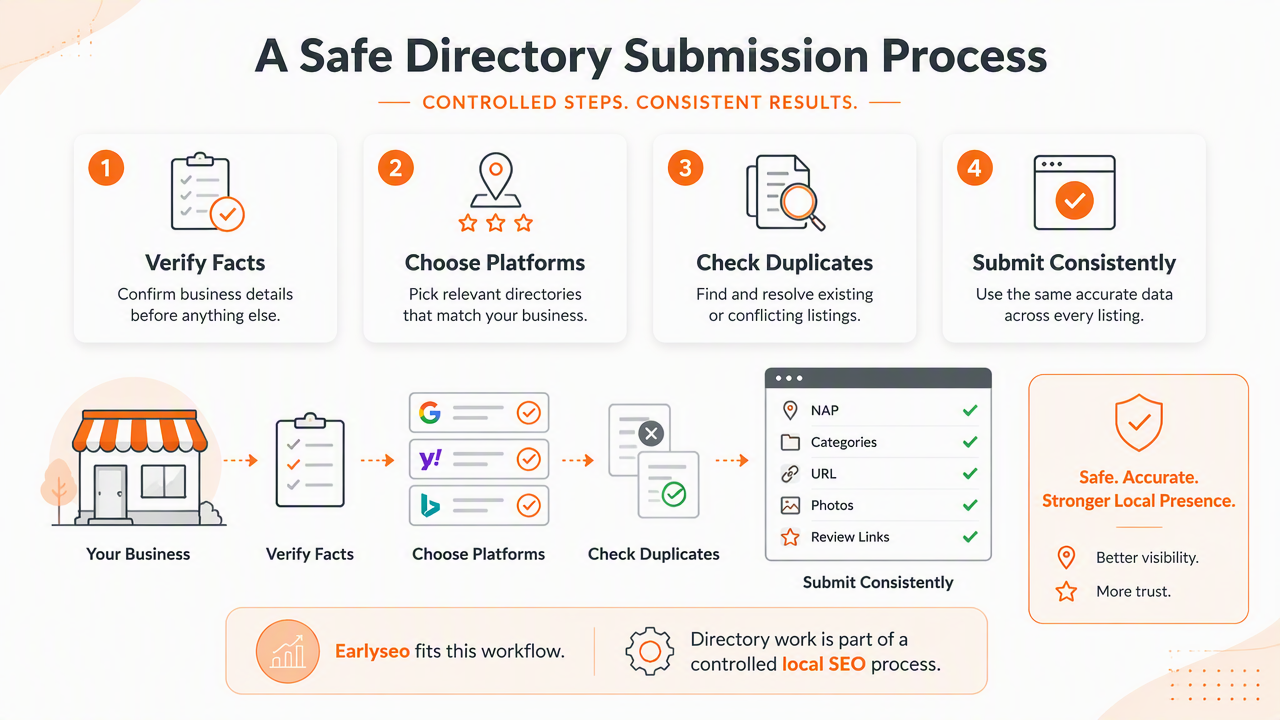
The Earlyseo platform fits this type of controlled workflow because directory work is treated as part of local visibility, not as a volume contest. That distinction matters for service businesses, storefronts, clinics, agencies, and local e-commerce pickup locations.
Safe local citation checklist
- Lock the source of truth. Confirm legal business name, public name, address format, phone number, website URL, hours, service area, and primary category.
- Audit existing listings. Search the business name, old phone numbers, old addresses, owner names, and common misspellings.
- Prioritize trusted platforms. Start with Google Business Profile, Apple Business Connect, Bing Places, major review sites, and real local directories.
- Match categories carefully. Pick the closest primary category and avoid unrelated category stuffing.
- Remove or merge duplicates. Fix duplicate listings before creating new ones.
- Add proof assets. Use logo, photos, service descriptions, appointment links, menu links, or product links where relevant.
- Track logins and update dates. Keep records so future changes do not create conflicting listings.
- Review quarterly. Recheck hours, phone numbers, reviews, and broken listing links.
What to submit on every strong listing
| Field | Standard to use | Why it matters |
|---|---|---|
| Business name | Public-facing name only | Reduces entity confusion |
| Address | Same format everywhere | Supports map confidence |
| Phone | Local number when possible | Helps verification and calls |
| Website URL | Canonical location page | Connects citation to site relevance |
| Category | Closest real service category | Improves query matching |
| Description | Specific services and city terms | Adds context without stuffing |
| Photos | Real storefront, team, work, or products | Builds customer trust |
| Review link | Platform-approved review path | Supports reputation growth |
Businesses with multiple locations need location-specific URLs, phone numbers, photos, and landing pages. A single shared profile rarely gives search engines enough detail to separate branches.
Local teams that need a managed path can review the Earlyseo local business solution. More examples and implementation notes are available on earlyseo.com.
What should local businesses expect in 2027?
Local citation work in 2027 will likely become more entity-driven, more review-aware, and more tied to AI answer systems than traditional directory link building.
AI search experiences summarize businesses from structured sources, map data, reviews, websites, and recognizable third-party profiles. That makes accuracy more important, not less. A wrong category or stale address can spread into more surfaces as search tools reuse entity data.
Directory submissions will also keep moving away from pure SEO link value. The stronger play will be platform fit: where customers compare options, read reviews, request quotes, book appointments, or confirm trust before visiting.
2027 local citation priorities
- Entity clarity: Consistent business facts across maps, directories, website schema, and location pages.
- Review depth: Active review profiles on platforms customers actually check.
- Vertical proof: Presence on industry directories that influence buyer choice.
- Update speed: Fast correction of hours, holiday closures, phone changes, and moved locations.
- Content connection: Location pages, service pages, and citations supporting the same business facts.
For businesses publishing location pages or service-area content alongside citations, competitor-aware SEO content can help align pages with the terms and entities local competitors already rank for.
Frequently asked questions
Is auto directory submission safe for local SEO?
Auto submission is safe when it uses verified business data, submits only to relevant platforms, checks duplicates, and allows future edits. Risk increases when software submits to large lists without reviewing quality, category fit, existing listings, or data ownership.
Are directory backlinks still useful?
Directory backlinks can be useful when the directory has real users, local relevance, or industry trust. The link alone should not be the main reason to submit. A listing that brings calls, reviews, directions, or brand confirmation is usually more valuable than a weak backlink.
How many directories does a local business need?
No universal number applies. A small local business usually needs accurate listings on major maps, key review platforms, local business groups, and a few industry directories. Quality, consistency, and maintenance matter more than total listing count.
Should duplicates be fixed before new submissions?
Duplicates should be fixed before broad submission starts. Existing duplicate listings can split reviews, confuse customers, and spread old NAP data. A careful audit lowers the chance that new submissions reinforce outdated records.
Conclusion
Auto directory submission local SEO should be treated as citation management, not a shortcut for quick rankings. The practical next step is simple: audit existing listings, fix NAP conflicts, choose relevant directories, document every login, and review the data every quarter.
Earlyseo can support that process when local businesses need a more organized way to manage visibility work across listings, content, and SEO tasks. For the next step, visit earlyseo.com and start with the highest-trust directories before spending money on any broad submission package.