TL;DR
Strong category pages target commercial search intent, organize products clearly, and give Google enough context to rank and summarize them. The main work is cleaner structure, unique copy, useful filters, internal links, and regular refreshes based on search demand.
Category pages are often the money pages of ecommerce search because they match shoppers who know the product type but have not chosen a specific item yet. A careful rewrite of an existing page targeting (inferred from site context) ecommerce category page seo should make the page easier to rank, easier to scan, and easier for AI search systems For teams that need a repeatable workflow, Earlyseo helps turn category research, page briefs, and content updates into a managed SEO process.
Table of Contents
What is ecommerce category page SEO?
Ecommerce category page SEO is the process of optimizing product listing pages so search engines understand the product group, shoppers find relevant choices faster, and the page can rank for commercial queries such as "women's running shoes," "organic dog food," or "small office desks."
Category page: a product listing page that groups related products under a shared theme, product type, use case, audience, or brand.
Shopping cart software: ecommerce software on a web server that lets visitors select items for eventual purchase, often powering category, product, cart, and checkout pages.
Context: the surrounding information that gives meaning to a page, including headings, product names, filters, internal links, reviews, images, and supporting copy.
Key insight: a category page should not act like a thin shelf of products. It should act like a guided buying hub for one clear search intent.
Core elements search engines evaluate
Search engines need clear signals about what the collection contains, who it serves, and how it connects to the rest of the store. A page with strong products but weak context can still struggle because the crawler sees a grid, not a useful answer.
The main signals include:
- Title tag and H1: the category's primary commercial query.
- Intro copy: a short explanation of the category and buying criteria.
- Product grid: relevant, crawlable listings with useful names and images.
- Filters: attributes such as size, color, brand, price, fit, rating, or material.
- Internal links: links to parent categories, subcategories, buying guides, and best sellers.
- Schema markup: structured data where appropriate for breadcrumbs, products, ratings, and FAQs.
Why category pages matter more in 2026
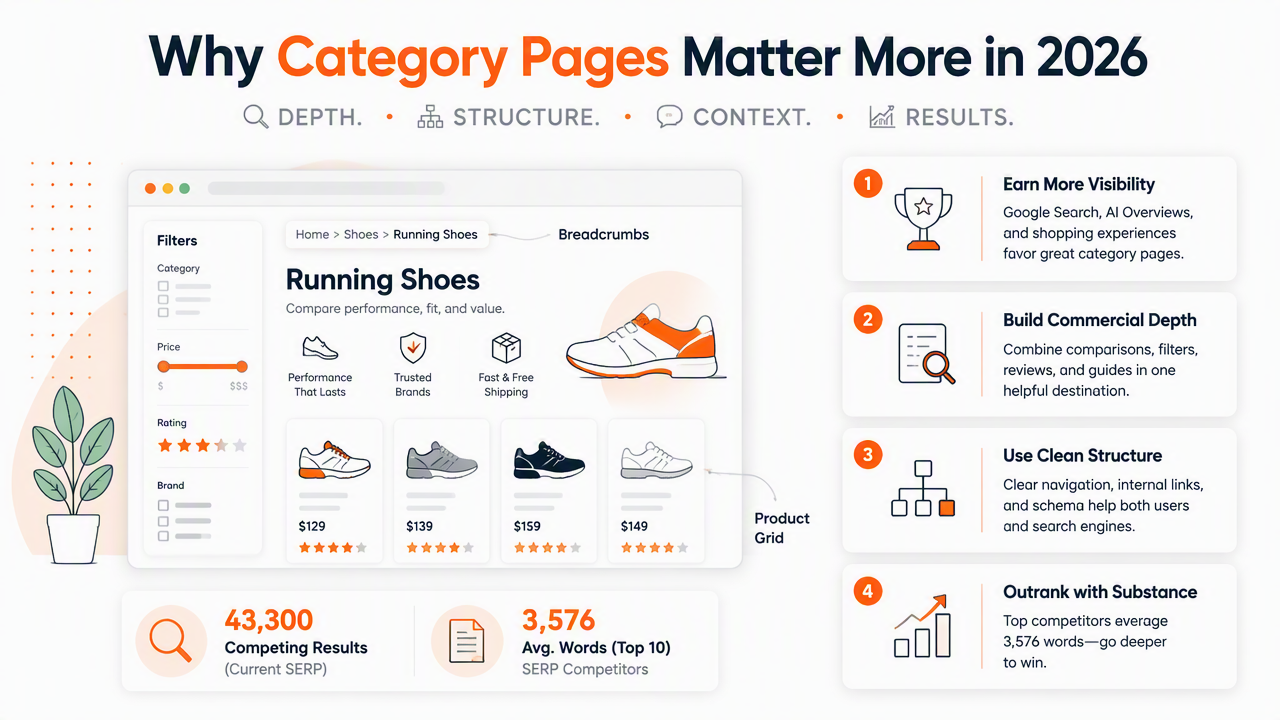
Category pages matter more in 2026 because Google Search, AI Overviews, and shopping-focused experiences reward pages that combine commercial depth, clean structure, and helpful context in one place. Current SERP research for this topic shows 43,300 competing results, with top competitors averaging 3,576 words, so concise pages need sharper structure to compete.
A 2023 systematic review by Kacprzak and Hensel in the International Journal of Consumer Studies examined online customer experience research, reinforcing that digital shopping depends on more than product availability alone: navigation, information quality, and interaction design all shape the experience (Kacprzak and Hensel, 2023).
A 2025 ACM Computing Surveys paper by Hasan, Rahman, and Ding reviewed review-based recommender systems, a useful signal for ecommerce teams because reviews, product attributes, and recommendation logic increasingly shape product discovery (Hasan, Rahman, and Ding, 2025).
Category page value by SEO goal
| SEO goal | What the category page must do | Practical example |
|---|---|---|
| Rank for commercial terms | Match broad product-type intent | "linen bedding," "standing desks," "vegan skincare" |
| Support AI visibility | State clear definitions, criteria, and product options | Short intro, FAQ, comparison blocks |
| Improve crawl paths | Link parent, child, and related pages logically | Dresses → summer dresses → linen dresses |
| Increase conversions | Help shoppers narrow options fast | Filters, sort options, best sellers, trust signals |
| Build topical authority | Connect category pages to guides and product pages | Buying guides, care guides, size guides |
Category pages also help smaller stores compete without publishing endless blog posts. A store with limited resources can build visibility by improving its highest-value collections first, then using supporting content from a guide such as ecommerce SEO for small online stores to expand around those pages.
How to optimize an ecommerce category page
To optimize an ecommerce category page, map one search intent to one collection, write unique copy, improve product discoverability, add crawlable internal links, manage filters carefully, and refresh the page as inventory and search demand change.

- Choose the primary keyword and close variants.
- Align the H1, title tag, URL, and intro copy.
- Add short, useful copy above or beside the product grid.
- Link to subcategories, best sellers, and relevant guides.
- Make filters helpful without creating index bloat.
- Add structured data where it fits the page.
- Review performance every 30 to 90 days.
A good category page usually needs fewer words than a blog post, but every sentence must earn its spot. The page should answer buying questions while keeping products visible.
On-page checklist for product collections
Category optimization works best when the same checklist is applied across priority pages. A single template helps ecommerce teams compare pages fairly and spot missing elements faster.
Use this checklist:
- Write a unique title tag under normal search-result display limits.
- Use one clear H1 that matches the collection.
- Keep the URL short, readable, and stable.
- Add 80 to 200 words of helpful intro copy.
- Include links to subcategories and related collections.
- Add buyer-focused FAQs near the lower page.
- Use descriptive image alt text for category visuals.
- Keep pagination, canonical tags, and index rules consistent.
For a deeper page-level workflow, the on-page SEO checklist template gives a practical structure for reviewing titles, headings, links, and content quality.
Filters, faceted navigation, and index control
Filters are useful for shoppers but risky for crawl management when every combination creates a new URL. A color, size, brand, price, and rating system can quickly create thousands of near-duplicate pages.
The clean approach is simple: index only filter combinations with real search demand, unique products, and useful copy. Low-value combinations should usually be canonicalized, noindexed, blocked from crawl paths, or handled through parameters depending on the platform and technical setup.
Best practice: treat filtered pages as landing pages only when they deserve to rank on their own.
What should a 2026 category page include?
A 2026 category page should include a clear commercial heading, a concise buying explanation, crawlable product listings, helpful filters, internal links, trust signals, structured data, and short FAQ content that answers real pre-purchase questions.
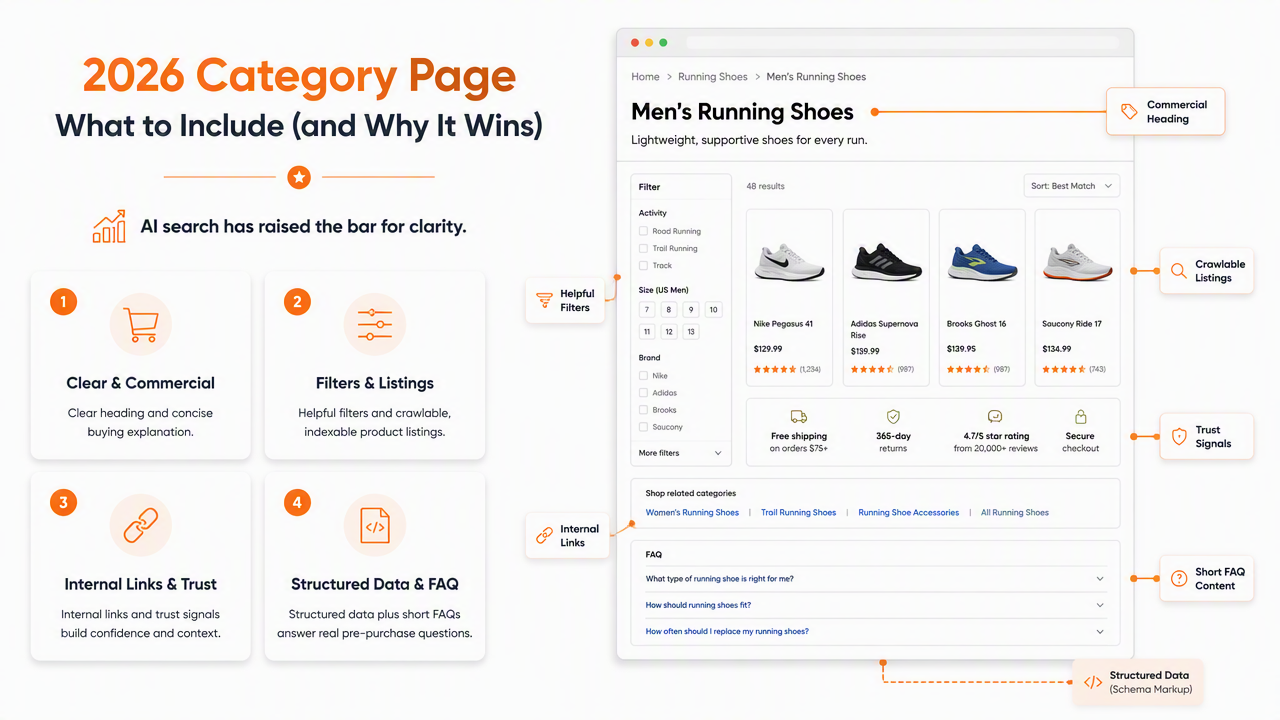
AI search has raised the bar for clarity. Pages that define the category, explain selection criteria, and show product relationships are easier for large language models That does not mean stuffing long essays above the product grid. It means adding the right context in the right place.
Modern category page template
| Page area | Recommended content | Why it matters |
|---|---|---|
| Above the fold | H1, short intro, product count, top filters | Confirms relevance fast |
| Product grid | Crawlable cards, prices, availability, ratings if available | Gives search engines and shoppers product context |
| Subcategory links | Popular segments and use cases | Builds internal paths to deeper pages |
| Mid-page content | Buying tips, material notes, sizing, comparisons | Adds unique value without hiding products |
| Trust signals | Shipping, returns, reviews, guarantees | Reduces hesitation |
| FAQ block | 3 to 5 concise answers | Supports long-tail and AI extraction |
| Bottom links | Guides, related categories, brand pages | Spreads authority and improves discovery |
For stores running content across many platforms, the Earlyseo platform can help turn this template into repeatable briefs and update tasks. Ecommerce teams using Webflow can also pair collection-page work with platform-specific guidance for SEO on Webflow sites.
Content that helps without slowing the sale
Helpful copy should reduce uncertainty. For example, a "trail running shoes" page can explain terrain, cushioning, waterproofing, grip, and fit. A "linen bedding" page can explain weave, weight, breathability, and care.
Good category copy avoids vague claims. It should describe how products differ, what shoppers should compare, and where to go next. Stores selling across countries or languages also need localized category context, not simple word-for-word duplication. Earlyseo's multilingual SEO content feature fits that use case when category pages need to scale across markets.
How should teams maintain category rankings?
Teams should maintain category rankings by tracking priority collections, updating copy when inventory changes, comparing competitor page structure, fixing crawl issues, and refreshing internal links as new products and guides go live.

Category pages are not one-time assets. Stock changes, seasonal demand, competitor edits, review growth, and new AI search formats can all change performance. A page sitting near position 8 can often improve with better CTR signals, clearer titles, richer copy, and stronger links from relevant pages.
A practical refresh cycle
A 30 to 90 day refresh cycle keeps category pages current without creating busywork.
- Pull impressions, clicks, CTR, and average position from Search Console.
- Identify pages ranking between positions 5 and 15.
- Compare titles, intros, filters, and subcategory links against ranking pages.
- Update copy based on missing buyer questions.
- Add internal links from relevant guides and nearby categories.
- Check canonical, pagination, and indexation rules.
- Recheck performance after enough data has accrued.
For teams managing many updates, SEO operations can keep audits, briefs, approvals, and refresh tasks organized. Competitor review also matters, especially when category SERPs shift quickly; competitor-aware SEO content supports that workflow.
What to expect from AI shopping search in 2027
AI shopping search is likely to reward category pages that expose clean product attributes, reliable reviews, clear comparisons, and strong topical relationships. The future is less about longer category copy and more about structured clarity.
Stores should prepare by cleaning product feeds, standardizing attributes, improving review quality, and making category pages readable to both crawlers and shoppers. A 2021 Management Research Review study by Pundir, Devi, and Nath examined planned behavior around fake news sharing, a different field, but still relevant to digital trust because credibility signals shape online decisions (Pundir, Devi, and Nath, 2021).
FAQ
How much text should an ecommerce category page have?
Most ecommerce category pages need enough text to explain the collection, guide product selection, and answer common buying questions. A practical range is often a short intro plus supporting sections below the grid. The exact length should depend on search intent, product complexity, and the amount of useful information needed before purchase.
Should category descriptions appear above or below products?
The most useful category description usually starts above the product grid with a concise summary, then continues lower on the page with buying guidance, FAQs, and related links. This layout gives search engines context while keeping products visible for shoppers who are ready to browse.
Are filtered category pages good for SEO?
Filtered category pages can be good for SEO when they match real search demand and offer a distinct product set. Examples include brand, material, size, or use-case combinations with enough value to stand alone. Thin filter combinations should not be indexed just because the platform can generate them.
How often should category pages be refreshed?
Priority category pages should be reviewed every 30 to 90 days, especially when rankings sit near the bottom of page one. Refresh work can include better title tags, updated internal links, improved filters, new FAQs, seasonal copy, and checks for indexation or canonical issues.
Conclusion
(Inferred from site context) ecommerce category page seo works best when every collection page has a clear job: match one commercial intent, explain the product group, guide comparison, and connect to the rest of the store. The next step is to pick the 10 highest-value categories, audit titles and intros, add useful internal links, and schedule a 90-day refresh plan. Teams that want help turning category updates into a repeatable system can visit earlyseo.com and use Earlyseo to plan briefs, compare competitors, and manage SEO improvements without adding more spreadsheet chaos.