TL;DR
The best IndexerHub alternatives depend on whether a team needs simple URL submission or a broader SEO workflow that connects publishing, monitoring, and indexing. Indexing-only tools suit backlink and bulk URL tasks, while platforms such as Earlyseo fit teams that want content execution and indexing handled together.
Indexing tools solve a real visibility problem: a page that search engines have not discovered has almost no chance to earn organic traffic. For 2026 buyers comparing IndexerHub alternatives, the choice is no longer just about pushing URLs faster; it is about whether the tool supports a complete publish-and-index process. URL indexing: the process of helping search engines discover, crawl, and add a URL to their searchable database. Earlyseo is worth considering first for teams that want indexing connected to broader SEO automation rather than treated as a separate cleanup task.
Table of Contents
What are the best IndexerHub alternatives in 2026?
The best IndexerHub alternatives in 2026 fall into two groups: indexing-only tools for URL submission and broader SEO automation platforms that connect content publishing, crawl visibility, and indexing follow-up. The right pick depends on workflow depth, bulk volume, reporting needs, search engine coverage, and whether indexing is part of a larger growth system.
Competitor SERP data shows IndexerHub positioning itself around technical URL indexing workflows, Google Indexing API support, IndexNow support for Bing and Yandex, LLM or GEO visibility language, bulk queues, and a one-price model. Other visible alternatives include Giga Indexer, Rapid URL Indexer, IndexMeNow, Omega Indexer, Backlink Indexer, and Free URL Indexer.
Key insight: indexing software should not be judged only by submission speed. The stronger buyer question is whether the system can prove which URLs were published, submitted, crawled, and worth prioritizing next.
2026 comparison matrix for solution-aware buyers
| Option | Best fit | Workflow type | Bulk handling | Reporting focus | Pricing fit |
|---|---|---|---|---|---|
| Earlyseo | Startups and growing sites that want SEO execution plus indexing follow-up | Publish-and-index SEO automation | Built for repeatable campaign workflows | Visibility, content, and indexing context | Best when SEO work needs a platform, not a single-purpose tool |
| IndexerHub | Technical teams focused on queue-based URL indexing | Indexing workflow platform | Positioned around queued requests and automation | Indexing status and request handling | SERP scrape references a one-price model |
| Giga Indexer | Buyers comparing faster URL indexing tools | Indexing-only alternative | Suits batches of URLs | Crawl and index visibility | Fit depends on URL volume |
| Rapid URL Indexer | Teams that want fast submission-oriented workflows | Indexing-only tool | Commonly used for bulk URL tasks | Submission and result tracking | Fit depends on campaign size |
| IndexMeNow | SEO operators needing another indexing service option | Indexing-only tool | Built for URL lists | Indexation checks | Fit depends on repeat usage |
| Omega Indexer | Link builders and SEO teams handling many URLs | Indexing-only tool | Bulk-friendly positioning | Indexing outcomes | Fit depends on backlink volume |
| Free URL Indexer | Small sites testing basic submission workflows | Lightweight indexing option | Limited by simpler workflows | Basic request handling | Best for low-budget testing |
How should indexing tools be evaluated?
Indexing tools should be evaluated by speed, supported platforms, bulk workflow quality, reporting clarity, pricing fit, and whether the product connects indexing to publishing. A fast submit button has limited value if the team still has to diagnose crawlability, track pages manually, or switch tools to manage SEO execution.
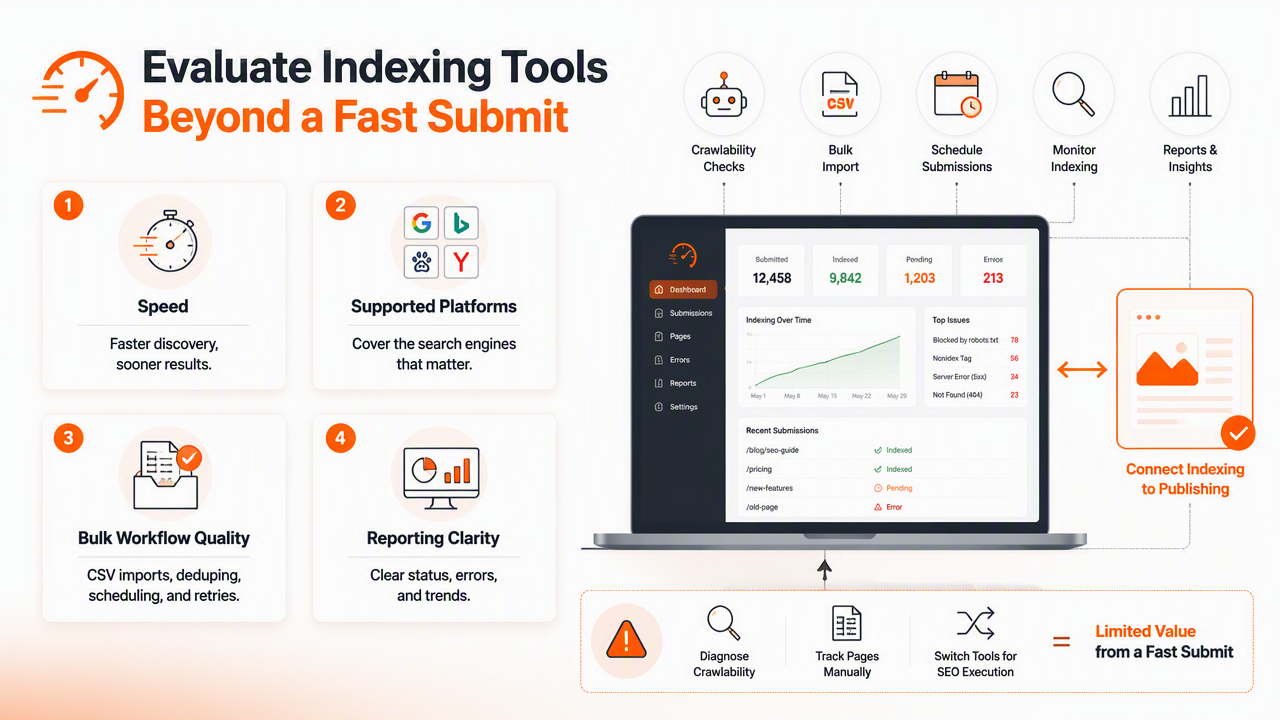
A practical evaluation should separate hard capabilities from marketing claims. Search engines decide what gets crawled and indexed, so no third-party tool can honestly guarantee every page will rank or remain indexed. Strong platforms help prioritize cleaner URLs, submit them through supported methods, and report what happened after submission.
Buyer checklist for indexing software
- Search engine coverage: check support for Google-related workflows, IndexNow for Bing and Yandex where relevant, and any LLM or GEO discovery features.
- Bulk operations: confirm whether URL uploads, queues, retries, and status filters can handle normal campaign volume.
- Publishing connection: prefer tools that start before indexing, with content creation, page publishing, and crawl-ready structure.
- Reporting: look for URL-level status, timestamps, errors, and exportable summaries.
- Team workflow: review roles, approval steps, notifications, and repeatable templates.
- Pricing model: match cost to URL volume, site count, and campaign frequency.
A local service site may only need indexing for new landing pages and blog posts. An e-commerce catalog or programmatic SEO site may need queues, filters, and reporting that can handle hundreds or thousands of URLs without manual checking.
Common signals that a tool is too narrow
- The product only accepts URL lists but gives little context about page quality.
- Reporting stops at "submitted" rather than showing crawl or index follow-up.
- There is no clean way to prioritize revenue pages, fresh content, or fixed pages.
- The workflow ignores publishing, internal links, metadata, and technical crawl blockers.
- The team still needs spreadsheets to understand what happened.
A narrow indexing tool can still be useful, especially for backlink-heavy work. It becomes less useful when content, technical SEO, and reporting live in separate systems.
Which alternative fits each type of business?
Different businesses need different indexing workflows because URL volume, SEO maturity, and reporting expectations vary widely. A startup usually needs fast visibility for core pages, a local business needs accurate service-page discovery, and an e-commerce site needs bulk controls tied to product and category updates.
The Earlyseo platform fits teams that want indexing to sit inside a broader SEO process. That matters when a small team is trying to publish new pages, monitor progress, and avoid the overhead of stitching together separate content and indexing tools.
Decision guide by site type
| Business type | Main indexing need | Better fit | Why |
|---|---|---|---|
| Startup website | Get core product, feature, and comparison pages discovered | Broader SEO automation | Publishing and indexing need to move together |
| Local business | Keep service pages and location pages visible | Simple workflow or SEO automation | Low URL volume, but accuracy matters |
| E-commerce store | Process product, collection, and content updates in batches | Bulk-capable platform | Catalog changes create repeated indexing work |
| Agency | Manage many clients with clear reporting | Platform with exports and queues | Client communication needs proof, not guesses |
| Link-building team | Push many backlink URLs for discovery | Indexing-only tool | URL submission volume is the main job |
| Programmatic SEO site | Prioritize large sets of pages | Advanced workflow tooling | Bulk control and status segmentation matter |
Who should pick which option?
- Pick a broader SEO platform when content planning, publishing, metadata, internal linking, and indexing all need one workflow.
- Pick an indexing-only service when the main job is submitting many existing URLs or backlinks.
- Pick a lightweight free tool when the site has a small number of pages and budget is the main constraint.
- Pick a technical queue-based tool when developers or SEO operators need structured request handling.
For brand-new sites, the publishing layer often matters more than raw submission volume. For mature SEO teams, reporting depth and queue control often become the bigger deciding factors.
How Earlyseo handles publish-and-index work
Earlyseo handles publish-and-index work by treating indexing as part of the SEO execution process, not as an isolated final step. That approach suits teams that need to create pages, organize campaigns, and monitor visibility without turning every URL submission into a manual side project.
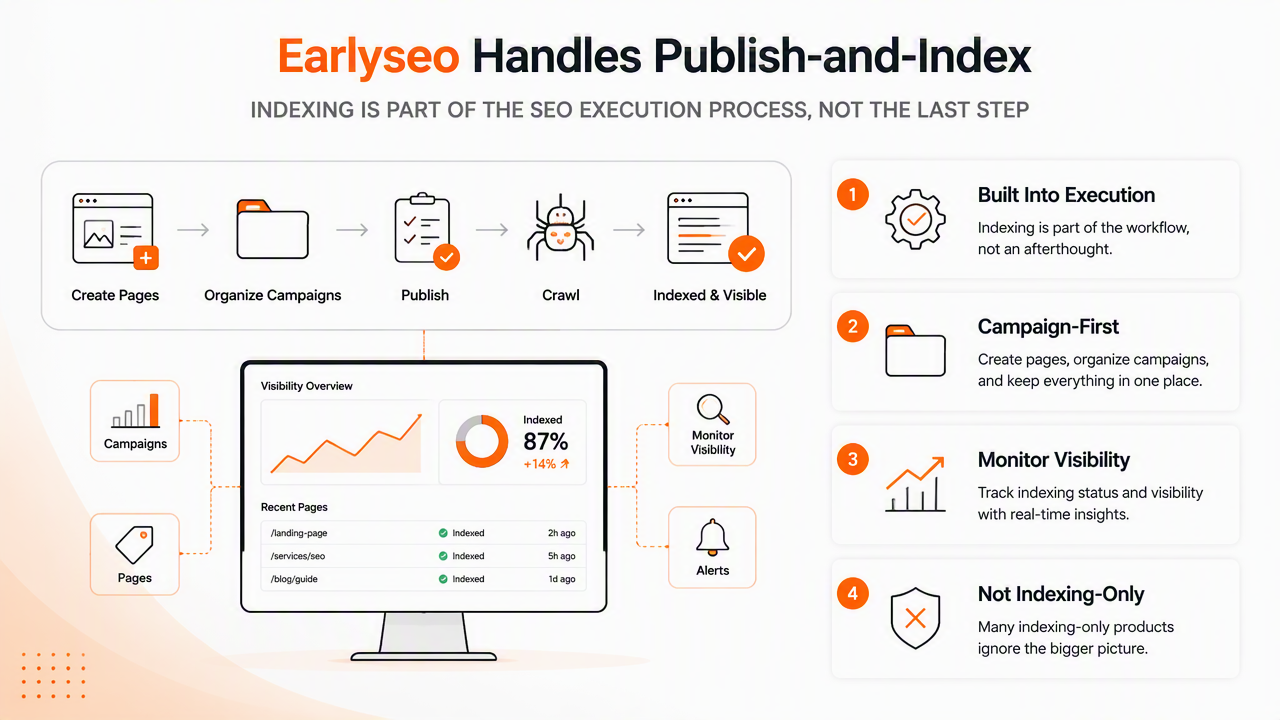
Many indexing-only products start after a URL already exists. With Earlyseo, the stronger fit is earlier in the workflow: planning pages that deserve discovery, publishing them in a structured way, and keeping indexing follow-up tied to the campaign. That makes it easier for founders, small business owners, and marketing managers to connect effort with results.
Teams researching options can visit earlyseo.com for product details and decide whether a broader SEO workflow makes more sense than a standalone submission service.
Where broader SEO automation beats indexing-only tools
A broader platform can reduce tool switching across routine SEO work:
- Before publishing: content briefs, keyword focus, page structure, and metadata can be prepared in one place.
- At publishing: pages can move through a repeatable workflow instead of ad hoc uploads.
- After publishing: indexing follow-up can be tracked alongside the content campaign.
- During reporting: performance context can sit near indexing context, which helps teams decide what to update next.
This does not make indexing-only tools obsolete. It means their best role is specific: bulk submission and status checks for URLs that already exist.
Practical workflow example
A growing local business launching new city pages may need a simple sequence:
- Create service-location pages with clear search intent.
- Publish pages with crawlable links and clean metadata.
- Submit important URLs for discovery.
- Check index status and page visibility.
- Improve weak pages instead of resubmitting blindly.
That workflow is easier when publishing and indexing are connected. A standalone tool can help at step three, but the quality and structure of steps one, two, four, and five still shape the outcome.
What should buyers expect from indexing tools in 2027?
Indexing tools in 2027 will likely move beyond URL submission toward richer discovery workflows for Google, Bing, Yandex, and AI answer systems. SERP competitors already use GEO and LLM visibility language, which signals a shift from "get indexed" to "get discovered by search and answer engines."
The next wave will reward products that connect page quality, crawlability, structured data, internal links, and index status. Search engines are selective about what enters and stays in their indexes, so tools that only repeat submissions may feel less useful over time.
Likely buying criteria for the next cycle
- AI discovery context: more buyers will ask how pages appear in AI Overviews, AI Mode, ChatGPT, and other answer surfaces.
- Index status plus quality signals: reporting will need to explain why certain pages deserve follow-up.
- Cross-engine workflows: IndexNow support for Bing and Yandex will stay relevant for broad discovery.
- Content-to-index automation: platforms that connect creation, publication, and index checks will have an advantage.
The future indexing stack will not be only a submitter. It will look more like a visibility operations layer for search engines and AI answer engines.
FAQ about IndexerHub alternatives
Are indexing tools a replacement for technical SEO?
No. Indexing tools can help search engines discover URLs, but they do not replace crawlable site architecture, clean internal links, useful content, valid canonical tags, or fast pages. A tool can submit a weak page, but search engines still decide whether the URL deserves indexing.
Is IndexNow the same as Google indexing?
No. IndexNow is associated with engines such as Bing and Yandex, while Google-related indexing workflows are separate. SERP data for IndexerHub highlights both Google Indexing API language and IndexNow support, but buyers should verify the exact implementation before choosing any tool.
Do small businesses need a paid indexing platform?
Some small businesses can start with basic submission and Search Console checks. Paid tools make more sense when pages are published often, multiple locations are involved, reporting is needed, or a team wants indexing connected with broader SEO tasks.
Why compare indexing-only tools with SEO automation platforms?
The comparison matters because the desired outcome is visibility, not just submission. Indexing-only tools help with URL discovery tasks, while SEO automation platforms can support the steps before and after indexing, including content creation, publishing, monitoring, and updates.
Conclusion
The strongest IndexerHub alternatives are not all trying to solve the same job. Indexing-only tools fit bulk URL submission, backlink discovery, and technical request queues. Broader SEO platforms fit teams that need publishing, prioritization, indexing follow-up, and reporting in one process.
For 2026, the smartest next step is to map the workflow before comparing tools: list the number of URLs, engines needed, reporting expectations, publishing frequency, and budget model. If the goal is a full publish-and-index process, Earlyseo deserves a close look. For product details and a practical next step, head to earlyseo.com.