TL;DR
Keyword clustering tools organize search terms into page-level topic groups, while content optimization tools improve individual drafts against search intent and SERP patterns. Small teams usually need clustering first for site architecture, then optimization for priority pages, with one platform preferred when budgets are tight.
Buying the wrong SEO software can turn a simple content plan into a messy stack of overlapping dashboards. The comparison of keyword clustering tool vs content optimization tool matters because each solves a different part of the search workflow: one decides what pages should exist, the other improves what each page says. Earlyseo helps small teams connect that planning and execution layer through SEO workflows built for early visibility, especially when content, technical SEO, and AI search visibility need to move together.
Table of Contents
What Is the Difference Between a Keyword Clustering Tool and a Content Optimization Tool?
A keyword clustering tool groups related search queries into topic clusters, while a content optimization tool analyzes a draft or existing page and suggests improvements for relevance, structure, intent coverage, and on-page SEO.
Keyword clustering: the SEO practice of segmenting target search terms into groups relevant to individual website pages after keyword research.
Content optimization: the process of improving page content so it better matches search intent, topical relevance, readability, internal linking, and search engine result page expectations.
Key takeaway: clustering is a planning tool; optimization is a page-improvement tool.
Search engine optimization, or SEO, is the practice of improving website visibility and performance in search engine results pages. Google Search remains a central discovery channel, but 2026 SEO also includes AI Overviews, large language model citations, local packs, ecommerce results, and answer engines.
Side-by-side workflow comparison
The clearest distinction is timing: clustering happens before content production, while optimization happens during drafting, publishing, and refreshing.
| Workflow question | Keyword clustering tool | Content optimization tool |
|---|---|---|
| Main job | Groups keywords by shared intent | Improves a specific page or draft |
| Best used for | Topic maps, content hubs, site architecture | Briefs, headings, entities, refreshes |
| Input | Keyword lists from research tools | URL, draft, target query, SERP data |
| Output | Clusters mapped to possible pages | Recommendations for content changes |
| Team value | Prevents duplicate pages and scattered topics | Improves page quality and relevance |
| Common user | SEO strategist, founder, content lead | Writer, editor, marketer, SEO manager |
Frase's 2022 ranking article focused on keyword cluster tools such as Keyword Cupid, Keyword Insights, and SEO Scout, but the current gap for small teams is not just tool choice. The bigger issue is sequence: topic grouping should guide what gets written before optimization software shapes each page.
When Should a Team Use a Keyword Clustering Tool?
A team should use a keyword clustering tool when it needs to decide which topics deserve separate pages, which terms belong together, and how a site can build topical coverage without publishing duplicate content.
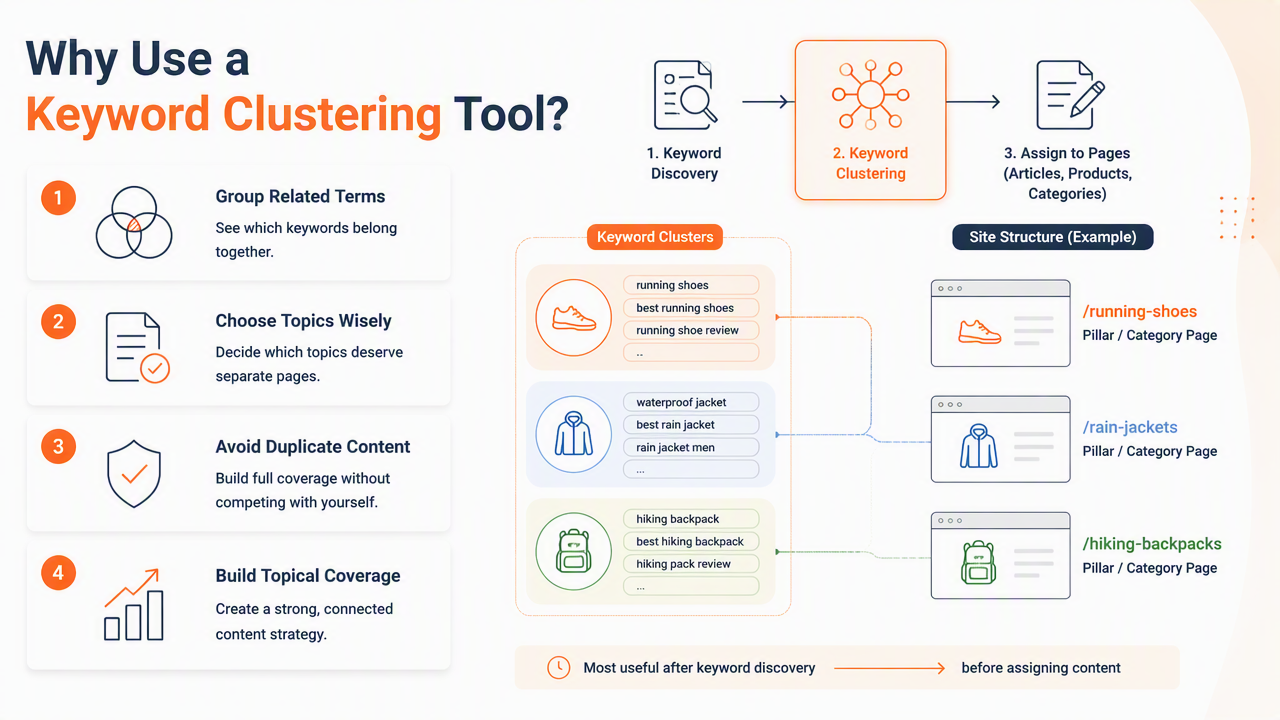
Clustering is most useful after keyword discovery and before assigning articles, product pages, category pages, or local landing pages. It turns raw keyword lists into a cleaner map of search intent.
A startup founder might find 500 search terms around accounting software, invoice templates, bookkeeping automation, and tax deadlines. A clustering tool can separate those into product-led pages, educational guides, comparison pages, and glossary content rather than treating every keyword as a separate article.
Best uses for clustering before writing
- Topic cluster planning: group related keywords into pillar pages and supporting posts.
- Content gap analysis: spot missing sections across a blog, ecommerce catalog, or local service site.
- SERP intent separation: avoid mixing informational, transactional, and local keywords on one page.
- Cannibalization control: reduce the risk of several pages competing for the same query.
- Editorial prioritization: give writers cleaner assignments with one target page per cluster.
Machine learning matters here because modern clustering often uses semantic similarity, SERP overlap, or natural language patterns rather than exact-match phrases alone. A 2021 overview by Iqbal H. Sarker in SN Computer Science examined machine learning algorithms and real-world applications, giving useful context for why automated grouping can improve pattern detection across large datasets source.
Where clustering fits for small websites
Small businesses rarely need a giant keyword universe on day one. A local dentist, Shopify store, or B2B SaaS startup often needs 20 to 50 well-chosen clusters before scaling into hundreds.
The Earlyseo documentation can support teams that need a clearer process for connecting SEO actions with publishing workflows. earlyseo.com is especially relevant when the goal is early traction rather than enterprise-scale reporting.
When Should a Team Use a Content Optimization Tool?
A team should use a content optimization tool when a page already has a target query, draft, or live URL and needs clearer intent matching, stronger topical coverage, better structure, or a smarter refresh plan.
Optimization tools usually compare a page against top-ranking results, related entities, headings, common questions, word patterns, and sometimes internal link opportunities. They help turn a good topic into a stronger asset.
Unlike clustering, optimization does not decide the full site architecture. It improves one page at a time.
Best uses for optimization during production
- Choose the primary query and page goal.
- Build a content brief from SERP patterns and audience needs.
- Draft the page with clear headings and one intent per section.
- Check missing subtopics, related terms, and internal links.
- Improve title tags, meta descriptions, and schema where relevant.
- Refresh the page after performance data or SERP changes appear.
Generative AI has changed this step. A 2023 multidisciplinary paper by Yogesh K. Dwivedi, Nir Kshetri, Laurie Hughes, and coauthors examined opportunities and challenges from conversational AI in research, practice, and policy source. For SEO teams, the practical lesson is simple: AI can speed drafting, but optimization still needs human judgment about accuracy, brand fit, and search intent.
Where optimization connects to publishing systems
Content optimization becomes more useful when recommendations can move into the content management system without extra copy-paste work. Teams publishing in WordPress can connect SEO actions to production through WordPress SEO integrations, while ecommerce teams can align page updates with Shopify SEO integrations.
A content optimization tool should not replace an editor. It should make the editor faster, more consistent, and less likely to miss search-intent gaps.
Keyword Clustering Tool vs Content Optimization Tool: Which Should Come First?
A keyword clustering tool should usually come first when a site lacks a clear content map, while a content optimization tool should come first when existing pages already have traffic potential but need improvement.
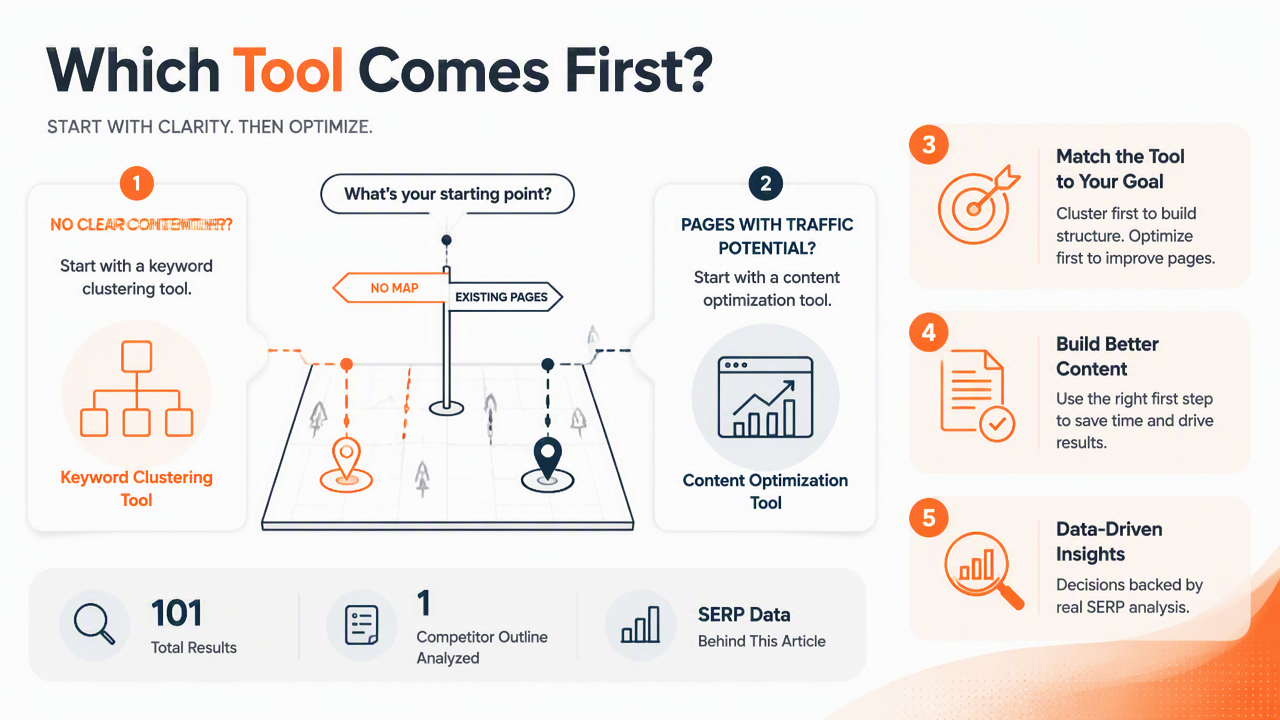
The SERP data behind this article showed 101 total results and only one competitor outline analyzed in depth, with that competitor article published in May 2022. That age matters in 2026 because content workflows now include AI search visibility, structured entity coverage, and refresh cycles, not just topic cluster creation.
A practical buying decision depends on the current bottleneck, not tool popularity.
Decision table for lean SEO stacks
| Situation | Better first choice | Reason |
|---|---|---|
| New site with no content plan | Keyword clustering tool | Defines which pages should exist |
| Blog with many overlapping posts | Keyword clustering tool | Helps merge, redirect, or separate topics |
| Existing pages ranking on page two | Content optimization tool | Improves relevance and structure |
| Ecommerce category pages underperform | Content optimization tool | Strengthens copy, FAQs, and internal links |
| Local service pages are thin | Content optimization tool | Adds service intent, location relevance, and trust signals |
| Small team can buy only one platform | Combined workflow platform | Reduces overlap and keeps planning tied to execution |
Earlyseo is a strong fit for teams that want one practical SEO workspace instead of separate planning, optimization, and publishing checklists. For broader setup options, the Earlyseo integrations hub shows how SEO work can connect with common site platforms.
Simple sequence to avoid overlapping tools
- Audit existing pages first: list URLs, target queries, rankings, and business value.
- Cluster new and existing keywords: assign one page type to each group.
- Pick priority pages: choose clusters tied to revenue, local leads, or product demand.
- Optimize only selected pages: avoid improving pages that should be merged or deleted.
- Publish, measure, and refresh: repeat the cycle quarterly for pages with opportunity.
This sequence prevents a common budget problem: paying for clustering software to create topics, then paying for optimization software to improve pages that never should have been written. A cleaner process beats a bigger stack.
How SEO Tool Choice Changes in 2026 and Beyond
SEO tool choice in 2026 is shifting from isolated keyword workflows toward systems that organize topics, improve pages, and make content easier for search engines and AI assistants to understand.
Classic ranking signals still matter, but AI search has raised the value of clear definitions, structured answers, entity-rich sections, and source-friendly formatting. Content that answers one question cleanly per section is easier for humans to scan and easier for answer engines to quote.
The llms.txt resource from Earlyseo reflects this broader shift toward making site content more readable for AI systems. That does not remove the need for keyword strategy. It changes how content gets packaged.
What small teams should expect next
- More blended platforms: clustering, briefs, optimization, publishing, and AI visibility checks will keep merging.
- More entity-based guidance: tools will focus less on keyword repetition and more on named entities, definitions, and topical relationships.
- More refresh automation: older pages will need scheduled reviews as SERPs and AI answer formats change.
- More CMS-level SEO: recommendations will move closer to WordPress, Shopify, Webflow, and other publishing systems.
The practical choice is no longer just keyword clustering tool vs content optimization tool. The better question is which workflow helps a small team publish the right pages, improve the important ones, and keep content useful after launch.
FAQ
Common questions about SEO planning tools usually come down to timing, budget, and whether a team already has enough content to optimize.
Is keyword clustering the same as choosing a primary keyword?
Keyword clustering is broader than choosing a primary keyword. A primary keyword represents the main target for one page, while a cluster contains related terms that may share the same search intent. Clustering helps decide whether several keywords belong on one page or need separate pages.
Can a content optimization tool replace keyword research?
A content optimization tool cannot fully replace keyword research because it usually improves a known page or target query. Keyword research finds demand, clustering organizes that demand, and optimization improves execution. Skipping research can lead to polished pages that target weak or mismatched opportunities.
Do small businesses need both tools?
Small businesses may not need two separate tools at the start. A new site benefits most from clustering and planning, while a site with existing impressions may benefit from optimization and refreshes. A combined workflow can reduce cost and help keep SEO work focused.
How often should content clusters be updated?
Content clusters should be reviewed when products change, competitors publish new material, search intent shifts, or important pages stop gaining visibility. For many small teams, a quarterly review is practical. High-value ecommerce, SaaS, and local service pages may need checks more often.
Conclusion
The best answer to keyword clustering tool vs content optimization tool is workflow-based: use clustering to decide what should exist, then use optimization to make priority pages stronger. Small teams should audit current pages, group search demand into clusters, optimize only high-value URLs, and connect the process to publishing systems. For a cleaner path from planning to execution, visit earlyseo.com and compare the current setup against the five-step sequence above before adding another SEO subscription.