TL;DR
Track ChatGPT citations by testing repeatable prompts, saving answers, recording cited sources, and comparing brand visibility against competitors. A lightweight spreadsheet works for small teams, while Earlyseo helps growing sites monitor AI visibility alongside SEO workflows.
ChatGPT citations have become a visibility signal for brands that depend on search, reviews, guides, and product recommendations. Learning how to track ChatGPT citations means checking whether ChatGPT mentions a brand, cites a URL, recommends a competitor, or uses third-party sources that influence the answer. ChatGPT citation tracking: the process of repeatedly testing prompts in ChatGPT, recording brand mentions and cited URLs, comparing competitors, and turning gaps into content, PR, or technical SEO actions. Teams that want one place for AI visibility and SEO monitoring can start with Earlyseo, then connect findings to site improvements, content briefs, and reporting.
Table of Contents
What counts as a ChatGPT citation?
A ChatGPT citation is a source, URL, publication, product page, or named brand that appears in a ChatGPT answer, especially when the answer includes browsed results, source cards, or recommendation-style language. A mention matters too, because ChatGPT may name a brand without linking to it.
AI systems can also produce hallucinations, meaning false or misleading information presented as fact. That makes citation tracking partly a visibility task and partly a quality-control task. The 2023 paper by Dwivedi, Kshetri, Hughes, and coauthors on generative AI discusses broad opportunities and risks for research, practice, and policy, including trust and responsible use concerns (International Journal of Information Management).
Key insight: a brand can be visible in ChatGPT in three different ways: as a linked source, as an unlinked mention, or as an implied recommendation based on third-party content.
Citation signals worth separating
Different ChatGPT answers create different evidence. A tracked result should not mix a direct source link with a casual brand mention, because each one leads to a different action.
- Linked citation: ChatGPT shows a URL or source card that points to a page.
- Brand mention: the answer names a company, product, or domain without a link.
- Recommendation: the answer suggests a brand as a choice, often alongside competitors.
- Competitor citation: another brand earns the mention or source slot instead.
- Source influence: a third-party page, such as a review or directory, shapes the answer.
For sites preparing content for AI retrieval, publishing clear machine-readable guidance can help. Early-stage teams can review the Earlyseo llms.txt resource when documenting which pages should be easier for AI systems to understand.
How to track ChatGPT citations step by step
Track ChatGPT citations by creating a fixed prompt set, running the same prompts on a schedule, saving the exact answer, logging sources and competitors, then assigning a follow-up action. The process works best when prompts match real buying, comparison, and local discovery questions.
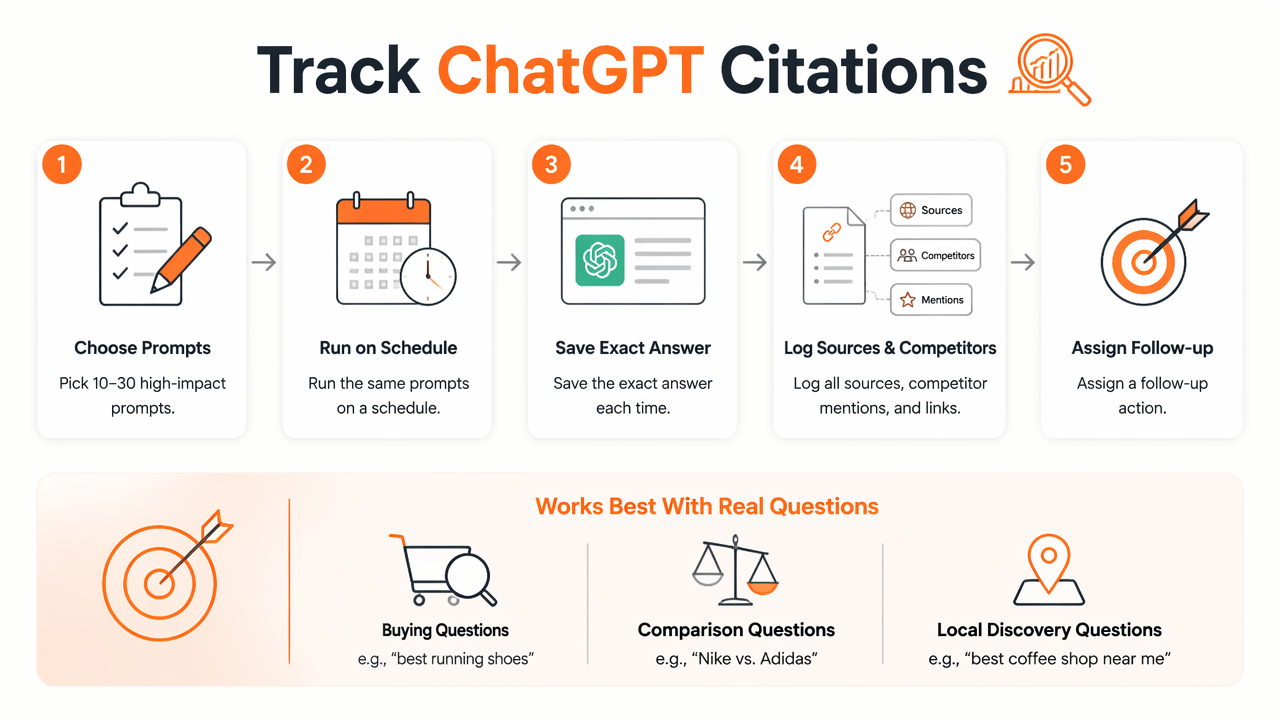
- Choose 10 to 30 prompts: include category, comparison, pricing, local, and problem-aware prompts.
- Run prompts in the same environment: keep model, location context, browsing setting, and date consistent.
- Save the full answer: copy text, cited links, source names, and screenshots when available.
- Tag the outcome: mark linked citation, mention only, no mention, competitor win, or inaccurate answer.
- Compare repeat runs: rerun weekly or monthly to spot gains, losses, and unstable answers.
- Assign actions: create content updates, digital PR targets, directory fixes, or technical cleanup tasks.
This manual workflow prevents overreacting to one answer. ChatGPT responses can vary across sessions, so the useful signal is the pattern across repeated prompts, not a single result.
Spreadsheet structure for lightweight tracking
A simple spreadsheet is enough for small business owners, founders, and marketing managers testing AI visibility for the first time.
| Column | What to record | Example |
|---|---|---|
| Date | Run date and time | 2026-07-22 |
| Prompt | Exact query tested | Best CRM for small ecommerce store |
| Model or mode | ChatGPT version, browsing status, location context | ChatGPT with browsing |
| Brand result | Cited, mentioned, recommended, absent | Mentioned |
| Answer excerpt | Short copied answer segment | Named in comparison list |
| Source URL | Linked citation or source card URL | Review article or product page |
| Competitors | Brands that appeared instead | Competitor A, Competitor B |
| Sentiment | Positive, neutral, negative, mixed | Neutral |
| Accuracy issue | Any wrong fact or outdated claim | Old pricing shown |
| Action | Content, PR, technical, local, no action | Update comparison page |
Teams using WordPress can connect the tracking sheet to content execution through the Earlyseo WordPress integration, especially when updates need to move from prompt findings into page improvements quickly.
Prompt types that reveal citation gaps
The best prompt set should mirror how buyers ask for help. A local dentist, Shopify store, and SaaS startup should not track the same questions.
- Category prompts: best inventory software for small retailers.
- Comparison prompts: Brand A vs Brand B for local SEO.
- Problem prompts: how to reduce abandoned carts in Shopify.
- Local prompts: best emergency plumber in Austin.
- Source prompts: which websites explain ecommerce SEO well.
- Trust prompts: most reliable tools for tracking AI search visibility.
A Shopify business can pair these prompts with product and collection-page improvements through the Earlyseo Shopify integration. That keeps AI visibility work close to revenue-driving pages instead of treating it as a separate reporting chore.
Which metrics show real AI visibility?
Real AI visibility comes from repeatable evidence across prompts, not a single ChatGPT answer. The strongest metrics combine share of prompts, citation frequency, competitor presence, source quality, and action completion.
A 2023 paper by Ali, Abuhmed, El-Sappagh, and coauthors reviewed explainable artificial intelligence and the broader challenge of trustworthy AI systems (Information Fusion). For marketers, the practical takeaway is simple: recorded evidence matters. If the source, answer, and prompt cannot be reviewed later, the metric is weak.
Better reporting asks, "Which prompts changed, which source caused the change, and what business action follows?" not just "Did ChatGPT mention the brand?"
Metrics to report monthly
A monthly report should separate visibility, competitiveness, and accuracy. That split helps a team decide whether to create content, improve existing pages, fix public data, or pursue third-party citations.
| Metric | Why it matters | Good next action |
|---|---|---|
| Prompt coverage | Shows how often the brand appears across tracked prompts | Expand pages that match winning prompts |
| Citation count | Shows how often URLs are linked or sourced | Strengthen cited pages and internal links |
| Mention count | Captures unlinked brand visibility | Improve entity clarity and brand descriptions |
| Competitor wins | Shows where rivals dominate answers | Build comparison, alternatives, or review content |
| Source diversity | Reveals whether ChatGPT relies on owned or third-party pages | Pitch directories, partners, and publishers |
| Accuracy issues | Flags outdated or wrong answers | Update site facts and public profiles |
| Action completion | Connects tracking to execution | Review unresolved tasks each month |
Content teams can use Earlyseo docs to keep implementation notes organized when prompt findings turn into page edits, metadata changes, or AI-facing documentation.
Manual tracking versus a ChatGPT rank tracker
Manual tracking is useful at the start because it forces clear prompt design. A ChatGPT rank tracker becomes more useful when the same prompt set must run across locations, competitors, time periods, and client accounts.
Manual tracking fits founders and local businesses that need an early read on visibility. A dedicated tracker fits agencies, ecommerce teams, and marketing managers who need screenshots, trend lines, and repeatable reporting.
The Earlyseo platform is built for teams that want AI search tracking to sit beside practical SEO tasks, not in a disconnected spreadsheet. For brand recall and direct navigation, earlyseo.com is the place to review the product in more detail.
What actions improve ChatGPT citations?
Better ChatGPT citations usually come from clearer entities, stronger pages, better third-party references, and consistent public facts. Tracking alone does not create visibility; it shows where content, authority, and data quality need work.
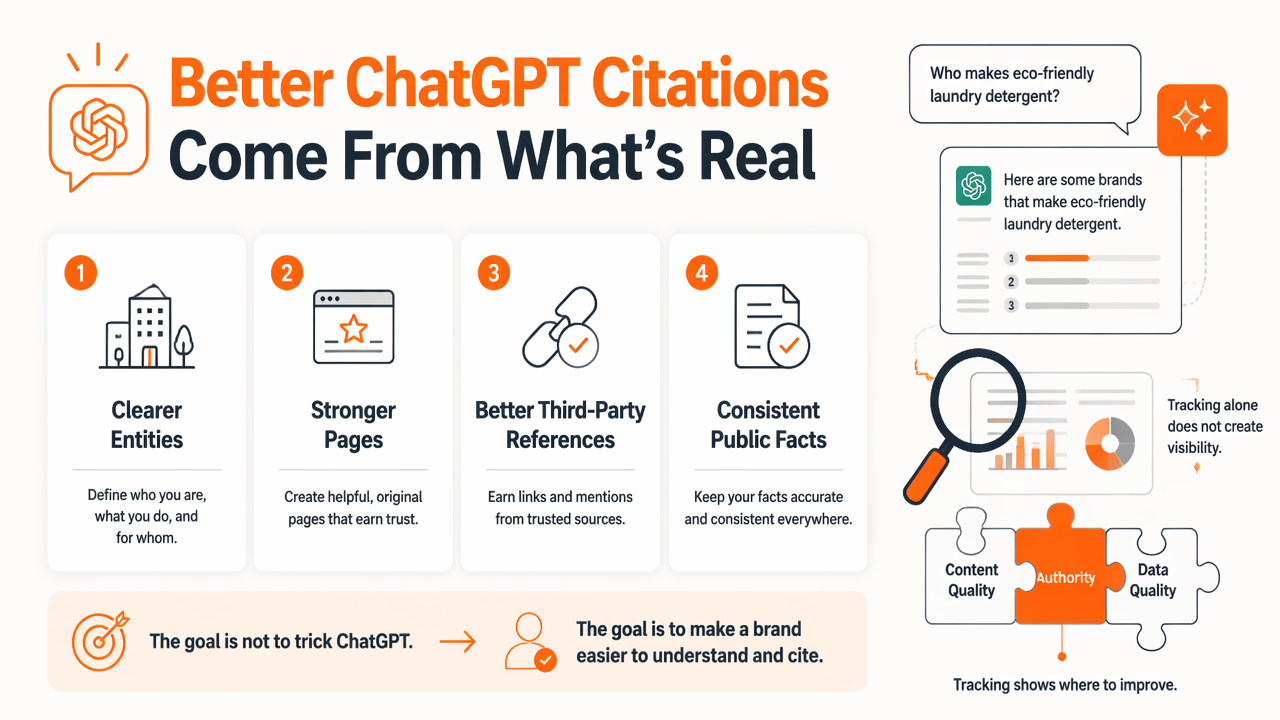
The goal is not to trick ChatGPT. The goal is to make a brand easier to understand, verify, compare, and cite across trusted sources. Research by Chan and Hu in 2023 examined student perceptions, benefits, and challenges around generative AI in higher education, reinforcing the wider need to treat AI outputs as useful but imperfect information tools (International Journal of Educational Technology in Higher Education).
High-impact fixes after tracking
The best follow-up actions depend on the gap found in the spreadsheet. A missing brand mention needs different work than a wrong citation or a competitor-dominated answer.
- If the brand is absent: create a clear category page, comparison page, or use-case page that matches the prompt.
- If competitors dominate: publish fair alternatives content and earn mentions on third-party lists.
- If ChatGPT cites weak sources: improve owned pages and seek citations from stronger industry pages.
- If facts are wrong: update website copy, schema, business profiles, and public directories.
- If mentions are generic: clarify entity signals, product positioning, service areas, and proof points.
Companies with custom sites can connect AI visibility work to publishing workflows through the Earlyseo Webflow integration. That helps teams turn citation gaps into live content changes without long development queues.
Common tracking mistakes to avoid
Several mistakes make citation data noisy. The most common one is changing prompts every week, which hides whether visibility improved or the test changed.
- Tracking only the company name instead of category and problem prompts.
- Ignoring competitor mentions that reveal lost recommendation slots.
- Treating one ChatGPT answer as a stable ranking.
- Recording citations without saving the exact prompt and answer.
- Fixing only owned pages while third-party sources still carry outdated facts.
A clean tracking process should stay boring. Same prompts, same fields, same review rhythm. That boring structure is what turns AI visibility into a management habit.
Frequently asked questions
ChatGPT citation tracking is still young, so practical questions usually focus on frequency, tools, accuracy, and the difference between mentions and links.
How often should ChatGPT citations be tracked?
Most small teams should track citations monthly, while active campaigns can run weekly checks. Daily tracking often creates noise because ChatGPT answers may vary by session, model behavior, browsing availability, and source freshness. A stable monthly rhythm makes trends easier to see and gives enough time for content or PR actions to take effect.
Can Google Analytics 4 show ChatGPT citations?
Google Analytics 4 can show referral traffic from some AI surfaces when a visitor clicks through, but it cannot show every ChatGPT mention, recommendation, or cited source. Citation tracking needs prompt testing because many valuable answers create awareness without a click. GA4 is helpful evidence, not a complete AI visibility report.
Is a ChatGPT mention as valuable as a citation?
A linked citation is usually stronger because it can send traffic and show the source behind the answer. A brand mention still matters when ChatGPT recommends a company in a buying or comparison prompt. The best reports separate linked citations, unlinked mentions, and recommendations so each signal receives the right follow-up action.
What should be done when ChatGPT shows wrong brand information?
Wrong brand information should be logged with the prompt, answer, date, model, and suspected source. The next step is to correct owned pages, structured data, business profiles, and third-party listings that may feed the answer. Because hallucinations can happen, the goal is to reduce ambiguity across reliable sources rather than chase one response.
Conclusion
The practical answer to how to track ChatGPT citations is simple: build a fixed prompt set, record every answer, separate citations from mentions, compare competitors, and assign one action to every gap. That workflow gives founders, local businesses, ecommerce stores, and marketing teams a clear view of where AI answers already trust the brand and where stronger proof is needed.
Earlyseo can help turn that workflow into a repeatable visibility process across SEO and AI search. For teams ready to move past occasional screenshots, the next step is to choose 10 priority prompts, run the first baseline report this week, and use earlyseo.com to connect findings with content and technical improvements.