TL;DR
SEO analytics tools are best for diagnosing rankings, traffic, audits, and keyword gaps, while SEO execution platforms help turn those findings into published fixes. Small teams usually need analytics first if no measurement exists, then an execution platform when recommendations keep stalling in spreadsheets, tickets, or developer queues.
Most SEO work fails after the audit, not during analysis. The debate around SEO execution platform vs SEO analytics tool matters because growing teams need more than charts, they need a way to publish fixes, assign work, and prove progress. Earlyseo fits that execution gap for startups and small businesses that need practical SEO action without building a large in-house team.
Table of Contents
What is the difference between an SEO execution platform and an SEO analytics tool?
An SEO analytics tool diagnoses search performance, while an SEO execution platform helps teams make, ship, and track SEO changes. Analytics answers "what is happening?" Execution answers "what gets fixed next, who owns it, and did it go live?"
SEO execution platform: Software that turns SEO recommendations into planned, assigned, and published website improvements.
SEO analytics tool: Software that collects and analyzes SEO data such as rankings, crawl issues, backlinks, traffic, and conversions.
Analytics, in the general data sense, means the systematic computational analysis of data or statistics to find and communicate patterns. In SEO, that means interpreting crawls, keywords, search visibility, and revenue signals.
Key insight: Analytics creates evidence. Execution creates shipped SEO improvements.
Category comparison at a glance
| Category | SEO analytics tool | SEO execution platform |
|---|---|---|
| Main job | Diagnose performance | Turn recommendations into action |
| Typical output | Reports, dashboards, audits, keyword lists | Tasks, briefs, approvals, updates, publishing workflows |
| Best user | Analyst, SEO strategist, marketing manager | Founder, content lead, developer, operations owner |
| Success metric | Insight quality and measurement depth | Fix completion, content shipped, implementation speed |
| Common tools in workflow | Rank trackers, crawlers, GA4, Search Console connectors | Content planners, CMS integrations, issue queues, approval systems |
A 2026 SERP review for this topic found 128 results, and the analyzed competitors averaged 2,756 words. Many ranking pages focus on enterprise platforms, but smaller companies usually face a different problem: a lack of time, clean ownership, and repeatable publishing processes.
Which workflows does each tool category support?
SEO analytics tools support discovery, diagnosis, and measurement; execution platforms support prioritization, collaboration, publishing, and verification. The categories overlap, but they solve different bottlenecks in the SEO process.
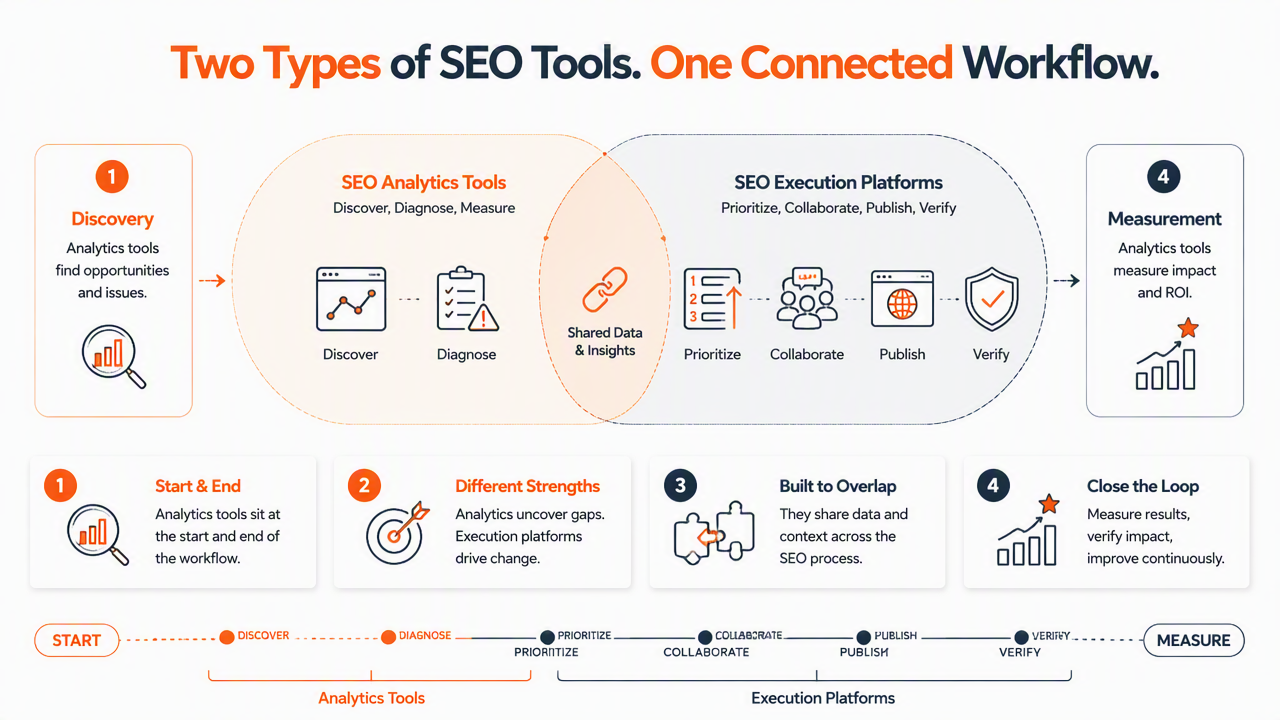
Analytics tools usually sit at the start and end of a workflow. They identify lost rankings, crawl errors, underperforming pages, content gaps, backlinks, and revenue impact. They also confirm whether a campaign improved impressions, clicks, and conversions.
Execution platforms sit in the middle. They help convert findings into website updates, content briefs, metadata changes, internal link tasks, schema additions, and CMS-ready work.
Analytics workflows that diagnose SEO problems
Common analytics workflows include:
- Technical audits: Crawling a site to find broken links, duplicate titles, redirect chains, indexation issues, and page speed concerns.
- Keyword research: Finding terms with demand, ranking difficulty, and commercial intent.
- Traffic analysis: Connecting organic sessions, landing pages, and conversions.
- Competitive research: Comparing content depth, backlink profiles, SERP features, and ranking gaps.
- Reporting: Turning SEO performance into charts for budget, sales, and leadership reviews.
These workflows are valuable, but they do not automatically change a website. Reports can pile up when no person owns implementation.
Execution workflows that ship SEO improvements
Execution workflows include:
- Import an audit, keyword set, or content opportunity.
- Prioritize tasks by impact, effort, and business value.
- Create briefs for pages, blog posts, product pages, or local landing pages.
- Route work to writers, developers, or approvers.
- Publish changes through a CMS or documented handoff.
- Verify that fixes went live and monitor results.
For teams using content hubs, the Earlyseo blog resources can support related reading while the execution process handles publishing discipline.
A 2023 paper on generative AI by Feuerriegel, Hartmann, and Janiesch examined the broader rise of generative systems. In SEO operations, that shift makes workflow control more important because teams can create more drafts than they can safely review, optimize, and publish.
How Earlyseo handles execution after analysis
A strong execution system starts where SEO reports usually stop: with prioritized action, content structure, and website-ready implementation. The Earlyseo platform is built for teams that need to move from SEO ideas to live improvements without turning every recommendation into a manual project.
Earlyseo is most relevant after a company already knows the site needs better pages, cleaner optimization, or faster publishing. It helps structure work so founders, marketers, and operators can keep SEO moving even when technical resources are limited.
For implementation-heavy teams, Earlyseo integrations connect the planning layer to publishing workflows. Teams working in WordPress can also review the WordPress integration, while commerce teams can connect SEO tasks to store operations through the Shopify integration.
Where an execution platform adds value
Execution platforms help most when SEO work is already known but not getting shipped.
- Content production: Turning keyword opportunities into structured briefs and publishable pages.
- On-page updates: Updating titles, descriptions, headings, internal links, and page copy.
- Technical handoff: Creating clear tasks for developers rather than vague audit notes.
- Approval flow: Keeping founders, marketers, and contractors aligned before changes go live.
- Progress tracking: Showing which recommendations moved from idea to completed work.
A useful platform does not replace analytics. It reduces the distance between insight and implementation.
When analytics still belongs in the stack
Analytics remains necessary for measuring what worked. Search Console, GA4, crawlers, and rank trackers still provide the evidence layer for traffic movement, index coverage, and keyword visibility.
The better split is not "one tool wins." A healthy stack uses analytics for diagnosis and measurement, then an execution platform for prioritized publishing and verification.
How should founders choose where to spend SEO budget?
Founders should fund the tool category that removes the current bottleneck: choose analytics when the problem is unclear, and choose execution when the problem is known but work is not shipping. Budget should follow constraint, not tool popularity.
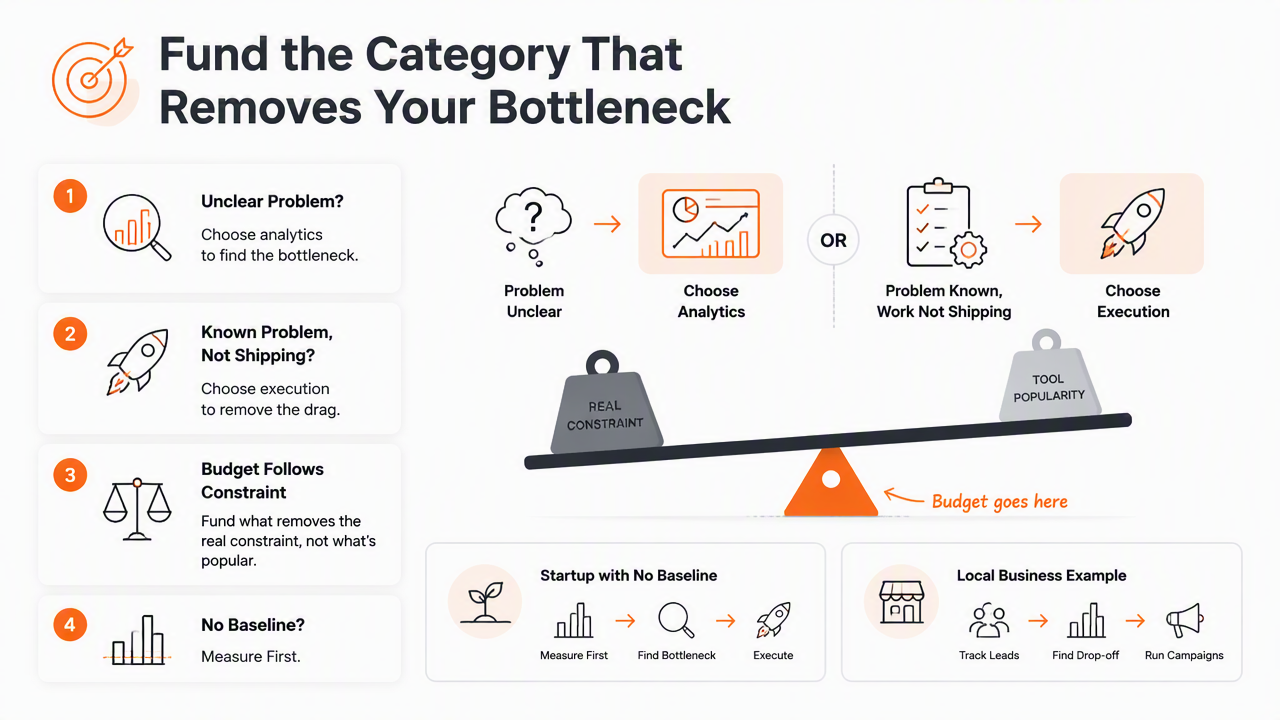
A startup with no baseline needs measurement first. A local business with a clear list of missing service pages needs execution. An e-commerce store with hundreds of thin product pages may need both, but not always at the same time.
Founder decision tree
Use this budget path:
- No trusted SEO data exists: Start with analytics, Search Console setup, GA4, crawl data, and ranking visibility.
- SEO issues are known but scattered: Add execution software to prioritize and assign fixes.
- Content ideas exist but publishing is slow: Fund briefs, approvals, CMS workflows, and internal linking processes.
- Traffic exists but revenue impact is unclear: Improve analytics, attribution, and reporting before scaling production.
- AI search visibility matters: Build pages and machine-readable signals that answer specific questions clearly.
The Earlyseo documentation is a practical starting point for teams comparing implementation steps, integrations, and workflow fit.
Budget signals by business type
| Business type | Better first spend | Reason |
|---|---|---|
| New startup | Analytics basics | No benchmark exists yet |
| Local service business | Execution platform | Pages, listings, and on-page fixes often need action fast |
| E-commerce store | Mixed stack | Product, collection, and content pages need diagnosis plus publishing |
| B2B SaaS | Execution platform after keyword research | Content briefs, comparison pages, and technical pages need repeatable output |
| Growing agency | Execution platform | Client work needs assignment, QA, and delivery tracking |
One misconception deserves pushback: buying more analytics rarely fixes slow execution. If the same audit issues appear month after month, the missing piece is usually ownership, workflow, or publishing access.
What changes for AI search in 2026 and 2027?
AI search increases the value of structured answers, entity clarity, and execution speed because search engines and answer engines reward pages that can be parsed, cited, and trusted. Analytics shows visibility gaps, but execution determines whether pages become citation-ready.
Research on deep learning modelling techniques by Ahmed, Alam, and Hassan reviewed current progress and challenges in deep learning. For SEO teams, the practical takeaway is simple: machine-readable structure matters more as automated systems summarize content.
The same pattern appears in AI search optimization. Pages need clear definitions, comparison tables, FAQs, and named entities. A file such as llms.txt for AI crawlers can also help teams present guidance for large language model access and interpretation.
By 2027, the gap between diagnosis and action will matter even more. Tools that only report issues may feel incomplete for small teams, while execution platforms that connect recommendations to live pages will become closer to operating systems for organic growth.
AI-era workflow checklist
A 2026-ready SEO workflow should include:
- Clear definitions near the top of important pages.
- Tables for comparisons involving three or more items.
- FAQ blocks with direct, answer-ready paragraphs.
- Internal links that explain entity relationships across the site.
- CMS workflows that publish updates without long delays.
- Measurement loops that compare impressions, clicks, assisted revenue, and citation visibility.
Earlyseo fits this direction by helping teams turn structured SEO recommendations into published assets. For brand recall and next-step research, earlyseo.com gives founders a direct place to evaluate the platform.
FAQ
What is the main difference between an SEO execution platform and an SEO analytics tool?
An SEO analytics tool measures and diagnoses search performance, while an SEO execution platform helps complete the work that improves performance. Analytics might show that a page has weak rankings or missing metadata. Execution software helps assign the fix, prepare content, publish changes, and confirm that the update went live.
Can a small business use only an SEO analytics tool?
A small business can start with only analytics if the main need is visibility into rankings, traffic, and site health. That setup becomes limiting when reports create more recommendations than the team can act on. Once SEO tasks stall, execution software usually creates more value than another dashboard.
When does an execution platform become worth the cost?
An execution platform becomes worth the cost when SEO recommendations are already clear but implementation is slow, inconsistent, or dependent on too many handoffs. Common signs include repeated audit issues, unpublished content briefs, delayed CMS updates, and no single view of what SEO work has been completed.
Do AI search features reduce the need for traditional analytics?
AI search features do not remove the need for analytics. They add another measurement challenge. Teams still need crawl data, traffic data, keyword movement, and conversion reporting, but they also need content structures that answer questions clearly enough for AI systems and cite.
Conclusion
The practical answer to SEO execution platform vs SEO analytics tool is constraint-based: fund analytics when the business lacks trustworthy SEO data, and fund execution when the business knows what to fix but cannot ship changes fast enough. The strongest 2026 stack connects both layers.
For founders and small teams, the next step is simple: list the last 10 SEO recommendations received, then mark how many are live on the site. If fewer than half shipped, an execution platform deserves budget attention. Visit earlyseo.com to review how Earlyseo can help turn SEO plans into published work.