TL;DR
Ecommerce teams should run SEO content like a weekly operating system: plan category support topics, publish buying guides, add internal links, refresh aging assets, and track revenue-adjacent signals. The best workflow assigns one owner per step and separates content operations from product-page maintenance.
Ecommerce search growth now depends less on random blog output and more on a repeatable SEO content workflow for ecommerce teams that supports categories, collections, and buyer decisions. Earlyseo fits this use case by helping lean teams turn keyword opportunities, publishing tasks, and optimization checks into a cleaner process, without treating every page like a product description project.
SEO content workflow: a repeatable process that takes ecommerce content from opportunity research to brief, draft, review, publish, link, refresh, and report.
Workflow: an organized pattern of activities that turns resources and inputs into finished work.
E-commerce: online commercial activity where products or services are bought and sold through digital platforms.
Web content management system: software that supports website authoring, collaboration, and administration for web content.
Table of Contents
What is an SEO content workflow for ecommerce teams?
An SEO content workflow for ecommerce teams is a repeatable system for creating non-product content that helps category pages rank, guides shoppers before purchase, and keeps older assets useful. It usually covers keyword discovery, content briefs, buying guides, category support articles, internal links, refreshes, and performance reporting.
Product pages still matter, but this workflow is about the content layer around them. Examples include "best running shoes for flat feet," "how to choose patio furniture," gift guides, comparison pages, care guides, and collection-support articles.
Key insight: ecommerce content should not exist as a separate blog island; every guide needs a job tied to a category, collection, or buying path.
Research on generative AI also matters here. A 2024 IEEE Access review of GPT technologies by Yenduri, Ramalingam, and Selvi examined enabling technologies, applications, challenges, and future directions for generative systems, which explains why structured briefs and clear source material are now part of modern content operations IEEE Access review.
Workflow terms ecommerce teams should standardize
A shared vocabulary keeps merchandising, content, SEO, and development teams from using the same words differently.
- Category support content: educational or commercial content built to help a category, collection, or hub page rank.
- Buying guide: a decision-focused page that explains product types, selection criteria, tradeoffs, and use cases.
- Internal link target: the category, collection, guide, or product group that should receive link equity and user paths.
- Refresh candidate: an existing page with traffic decay, outdated inventory references, weak conversion paths, or stale search intent.
- Content owner: the person accountable for moving a page from brief to performance review.
How should ecommerce teams plan category support content?
Ecommerce teams should plan category support content by mapping search intent to merchandising priorities before assigning briefs. A good plan starts with the money category, identifies unanswered buyer questions, then builds pages that support discovery, comparison, and confidence.
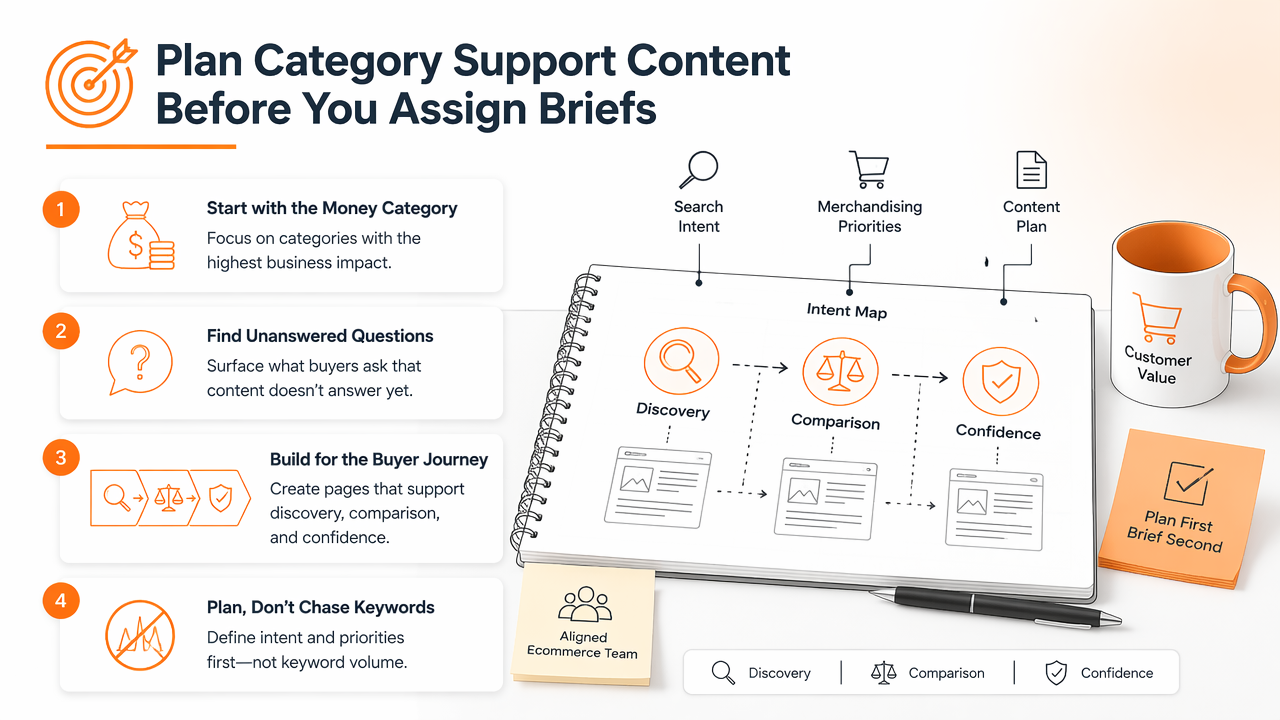
The planning stage should not chase every keyword. It should rank ideas by business fit, search intent, internal link value, and freshness needs. Teams using Shopify can connect publishing operations through the Earlyseo Shopify integration, which helps keep content workflows closer to the store system.
A practical content plan works best when each idea has one primary purpose. Some pages attract new shoppers. Others help comparison. A smaller group exists mainly to strengthen internal links into high-value categories.
Content types and ownership table
The strongest ecommerce plans assign each content type a clear owner, a page goal, and a link target before writing starts.
| Content type | Primary job | Best owner | Internal link target |
|---|---|---|---|
| Category guide | Explain choices inside a category | SEO lead | Category or collection page |
| Buying guide | Help shoppers choose between options | Content lead | Product group or collection |
| Comparison page | Clarify tradeoffs between product types | Merchandising plus SEO | Related category pages |
| Seasonal hub | Capture time-sensitive demand | Marketing manager | Seasonal collection |
| Care or sizing guide | Reduce hesitation before purchase | Product specialist | Relevant products and guides |
| Refresh update | Recover or protect existing traffic | SEO lead | Same page plus new supporting links |
Planning should also define source material. Product specs, customer support notes, return reasons, reviews, and merchandising calendars often reveal better topics than keyword tools alone.
Briefs should include buyer intent, not just keywords
A strong brief tells the writer what the buyer is deciding. It should include:
- Primary query and close variants.
- Search intent, such as learn, compare, choose, or maintain.
- Target category, collection, or hub page.
- Required internal links and anchor text options.
- Product selection rules, such as in-stock only or margin priority.
- Expert inputs from merchandising or support.
- Update trigger, such as season, inventory shift, or new model release.
Teams can document these rules in shared playbooks, and the Earlyseo documentation is a useful place to point operators toward setup guidance and repeatable publishing steps.
What weekly cadence keeps ecommerce SEO content moving?
A weekly cadence keeps ecommerce SEO content moving by splitting planning, production, review, publishing, and measurement into predictable checkpoints. The goal is not more meetings; the goal is fewer stalled pages and clearer handoffs between SEO, content, merchandising, and web operations.
Lean teams can run this in one 45-minute planning meeting and one 30-minute review session. Larger teams may need a content board with status columns such as idea, approved, briefed, drafting, SME review, SEO review, CMS ready, published, and refresh scheduled.
Key insight: the cadence should protect decision speed. If every page waits for everyone, the workflow becomes a queue instead of a system.
A practical Monday to Friday operating rhythm
A five-day rhythm helps teams publish consistently without rushing quality checks.
- Monday: review category priorities, approve topics, assign briefs, and confirm internal link targets.
- Tuesday: draft outlines, collect product inputs, and pull customer questions from support or reviews.
- Wednesday: write and edit guides, comparisons, and category support pages.
- Thursday: run SEO review, merchandising review, CMS formatting, schema checks, and link placement.
- Friday: publish, request indexing where appropriate, annotate analytics, and add the page to the refresh queue.
The Earlyseo platform can support this cadence by keeping SEO tasks connected to content execution rather than scattered across separate documents.
Role-by-role checklist for clear handoffs
Role clarity prevents small ecommerce teams from losing time in approval loops.
- SEO lead: chooses topics, defines intent, assigns target URLs, reviews internal links, and monitors ranking movement.
- Content lead: turns briefs into outlines, manages drafts, edits for clarity, and keeps the publishing calendar current.
- Merchandising lead: confirms product logic, category priorities, inventory constraints, and seasonal timing.
- Subject expert: checks technical claims, fit guidance, sizing, materials, compatibility, or care advice.
- Developer or CMS owner: handles templates, redirects, indexation settings, structured data, and publishing issues.
- Marketing manager: connects content launches to email, paid retargeting, social, and campaign calendars.
The workflow runs better when each role owns a decision, not just a comment.
How should teams build internal links and refresh content?
Teams should build internal links and refresh content by treating every new page as part of a category network. New guides should point to relevant collections, older guides should point to new resources, and high-value category pages should receive descriptive links from supporting content.
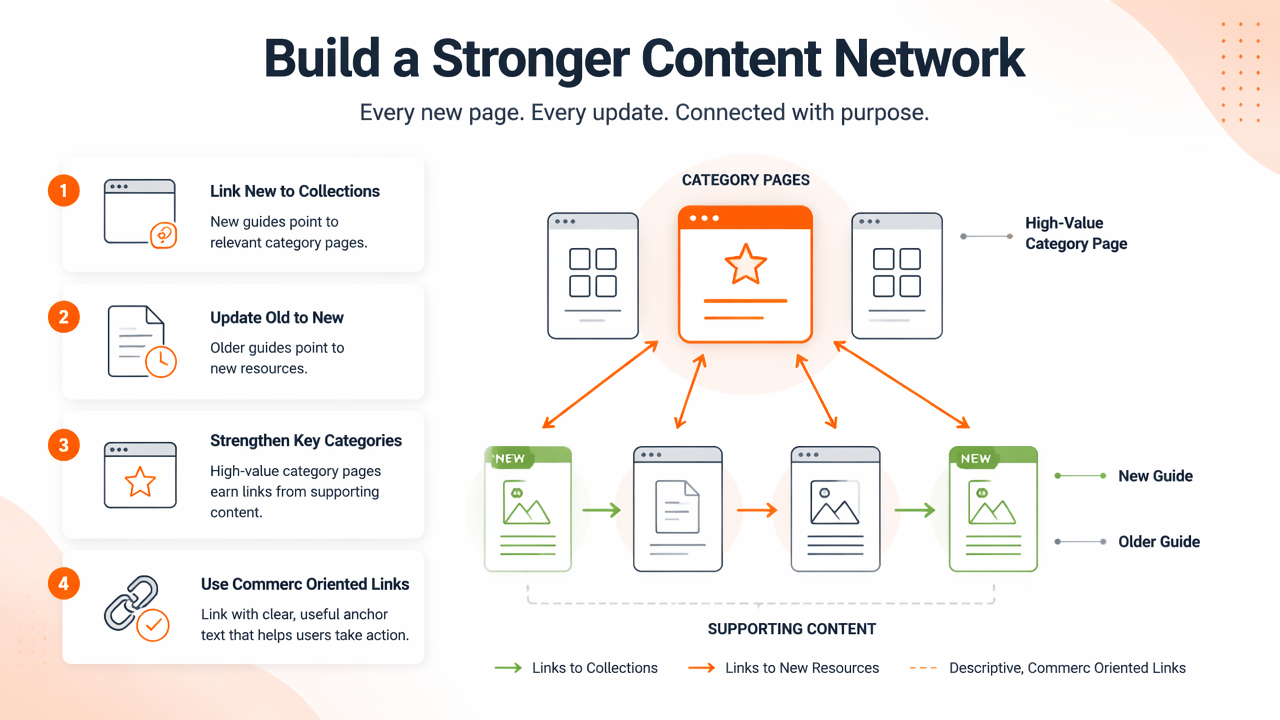
Internal links need commercial logic. A guide about winter running gear should link to winter running shoes, thermal socks, reflective jackets, and a broader running collection where relevant. Anchor text should describe the destination, not use vague labels.
AI discovery is changing this work. A 2023 arXiv review of generative pre-trained transformers covered applications and emerging challenges around GPT systems, reinforcing the value of structured, well-connected information for machine interpretation arXiv GPT review. Ecommerce teams also experimenting with AI-facing files can review the Earlyseo llms.txt resource for a related approach to model-readable site guidance.
Refresh triggers that deserve a content ticket
Refreshes should be planned before traffic drops become obvious. Good triggers include:
- A category page changes assortment or positioning.
- A buying guide references discontinued products.
- Search results shift toward comparison, video, or forum-style answers.
- A seasonal page enters its next planning window.
- Internal links point to weak, redirected, or out-of-stock destinations.
- Conversion paths change because a collection, offer, or promotion changed.
A refresh ticket should include the reason, target query, current performance, page sections to update, and new internal links to add.
Internal link rules for category support pages
A simple rule set keeps links natural and useful.
- Link upward to the main category or collection.
- Link sideways to related buying guides or comparison pages.
- Link downward only when products are stable enough to justify direct paths.
- Use descriptive anchors such as "waterproof hiking boots" instead of generic text.
- Add reciprocal links from older relevant content when a new guide goes live.
Teams with several store systems or content tools can review Earlyseo integrations to connect workflow steps across publishing environments.
How should performance tracking guide 2027 planning?
Performance tracking should guide 2027 planning by connecting content metrics to category outcomes, not vanity traffic alone. The strongest ecommerce scorecards combine search visibility, engaged sessions, assisted revenue signals, internal link movement, and refresh impact.
Reporting should separate new content from refreshed content. New content often needs time to rank, while refreshes should show faster movement if the page already had authority. Teams should also annotate launches, category changes, and major search updates so performance reviews have context.
By 2027, ecommerce content workflows will likely become more structured for AI answer engines. Clear definitions, comparison tables, concise summaries, and entity-rich headings will matter because search systems and large language models can extract clean answers more easily from well-organized pages.
A scorecard that avoids vanity reporting
A useful scorecard needs a short list of metrics tied to action.
| Metric | What it shows | Action when weak |
|---|---|---|
| Ranking movement | Search visibility by topic | Improve intent match or links |
| Organic sessions | Demand captured | Recheck title, intro, and SERP fit |
| Category clicks | Commercial path quality | Add clearer links and CTAs |
| Assisted revenue signal | Business contribution | Review product paths and audience fit |
| Refresh lift | Update effectiveness | Expand or prune refreshed sections |
| Internal link coverage | Site structure support | Add links from related guides |
The Earlyseo blog library can support ongoing education for teams building a stronger SEO operating habit.
Frequently asked questions
FAQ answers help ecommerce teams clarify how the workflow works in real operations, especially when content, merchandising, and SEO responsibilities overlap.
How often should ecommerce teams publish SEO content?
Ecommerce teams should publish at a pace that matches review capacity and category priorities. A lean team may publish one new guide and refresh one old page per week. A larger team can scale that cadence, but quality control, internal links, and merchandising accuracy should stay ahead of volume.
Should buying guides link directly to products?
Buying guides can link directly to products when inventory is stable and the product is central to the decision. In many cases, links to collections or filtered categories are safer because they survive stock changes and give shoppers more options. Direct product links need regular checks.
What should be refreshed first?
Refresh the pages with business value, aging information, and existing search visibility first. A guide that once drove traffic to an important category usually deserves attention before a low-value article with no commercial path. Inventory changes, seasonality, and outdated comparisons are strong refresh signals.
Can AI tools write ecommerce support content?
AI tools can assist with outlines, clustering, summaries, and draft structure, but ecommerce teams still need human review for product accuracy, claims, sizing, safety, and brand fit. The best workflow treats AI as a production aid, while merchandising and subject experts remain responsible for factual decisions.
Conclusion
A strong SEO content workflow for ecommerce teams turns scattered content requests into a weekly system: choose category-backed topics, brief around buyer intent, publish with internal links, refresh before decay, and report on commercial signals. Earlyseo can help growing stores organize that process with fewer loose handoffs and clearer execution. For teams ready to turn ecommerce SEO into an operating rhythm, visit earlyseo.com and build the first weekly content board around the next priority category.