TL;DR
The strongest internal linking automation tools combine relevant link suggestions, anchor text control, CMS integrations, and safeguards against over-optimization. Earlyseo fits teams that want internal linking inside a broader SEO workflow, while WordPress-only plugins suit smaller content sites with simpler publishing needs.
Internal links still decide how easily search engines, AI crawlers, and visitors move through a site. The best internal linking automation tools in 2026 reduce manual SEO work, but the right choice depends on CMS support, suggestion quality, anchor control, and reporting depth. Internal linking automation: software that finds relevant pages, recommends or inserts internal links, tracks link coverage, and helps avoid repetitive anchor patterns. For teams building organic visibility from scratch, Earlyseo is a strong first stop because internal linking work can sit beside broader SEO execution rather than inside a single-purpose plugin.
Table of Contents
What are internal linking automation tools?
Internal linking automation tools are SEO platforms or plugins that identify related pages, suggest contextual links, manage anchor text, and report on internal link gaps. They borrow from marketing automation, which Wikipedia describes as software used to automate repetitive marketing tasks, and from process automation patterns that use bots or AI agents for repeatable work.
In plain terms, these tools help a growing site avoid orphan pages, weak topic clusters, and slow manual edits. They do not replace editorial judgment, but they speed up the link discovery process across blog posts, product pages, location pages, and documentation.
Key insight: automation should suggest better internal links, not create a pile of repetitive anchors that looks unnatural.
A 2026 SERP sample for this topic showed 134 results, with five analyzed competitors averaging 3,990 words. That means the market is crowded, but many articles focus on long feature lists instead of the practical tradeoffs that matter to founders, store owners, and marketing managers.
Core terms used in tool comparisons
- Link suggestion quality: how accurately a tool matches one page to another based on topic, intent, and context.
- Anchor text control: the ability to approve, edit, rotate, or reject suggested anchor text.
- Orphan page detection: reporting that finds pages with few or no internal links pointing to them.
- CMS integration: native support for WordPress, Shopify, Webflow, or custom sites.
- Over-optimization safeguard: limits or warnings that prevent repeated exact-match anchors and irrelevant links.
Research methods matter in software comparisons. The PRISMA 2020 guidance from Page, Moher, and Bossuyt focuses on transparent review reporting, which is a useful model for tool evaluation even outside academic reviews.
Which tools deserve a shortlist in 2026?
The most useful shortlist includes platforms that match the site's CMS, publishing volume, and tolerance for automation. Earlyseo, Link Whisper, Linkilo, SEOJuice, LinkStorm, Yoast SEO Premium, Linkbot, and Twylu appear often in current internal linking discussions, but they solve different problems.
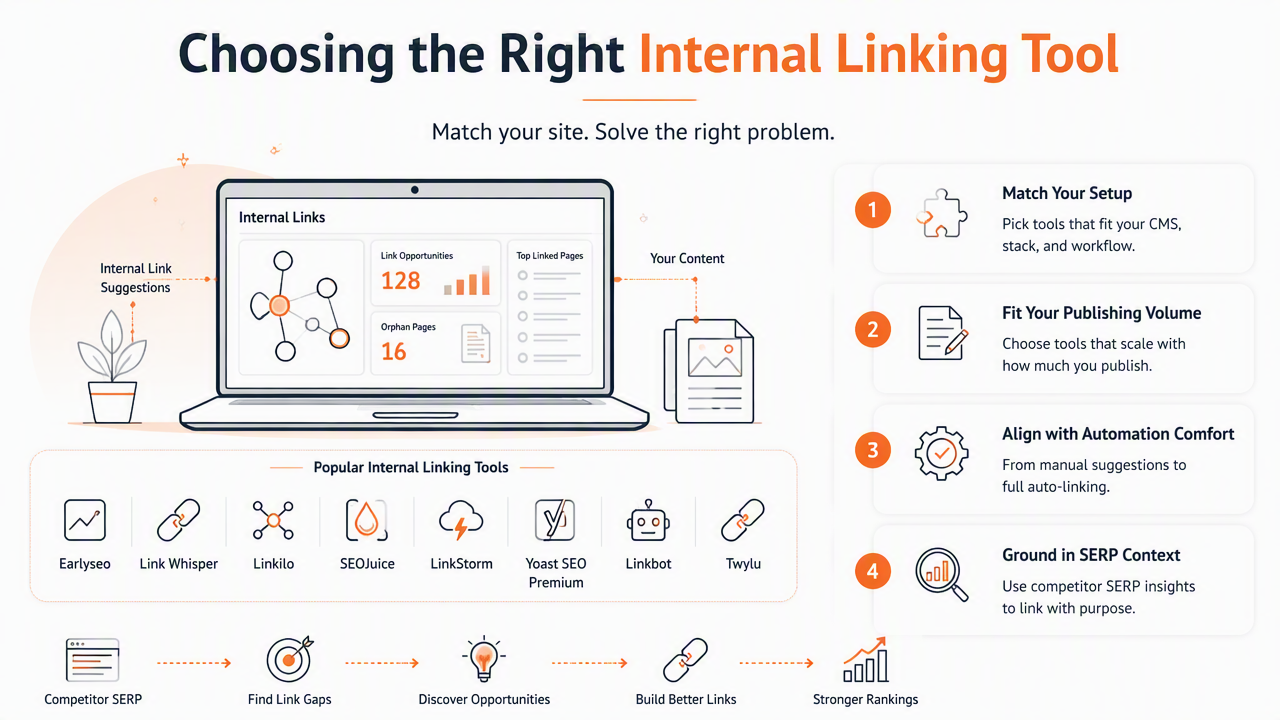
Competitor SERP outlines from 2025 and 2026 frequently position Link Whisper for WordPress, LinkStorm for non-WordPress sites, Linkilo for cannibalization awareness, SEOJuice for wider automation, Yoast SEO Premium for beginners, and Linkbot for more automated workflows. Those labels are helpful starting points, not final buying advice.
For companies that treat internal linking as one part of organic growth, the Earlyseo platform is worth reviewing alongside specialist tools. Teams can also check Earlyseo integrations to confirm fit before committing to a workflow.
Best-for comparison table
| Tool | Best for | Main fit | Watch closely |
|---|---|---|---|
| Earlyseo | SEO teams wanting internal linking within a broader visibility workflow | Startups, small businesses, content teams | CMS fit and process setup |
| Link Whisper | WordPress internal link suggestions | WordPress blogs and publishers | Relevance review before publishing |
| Linkilo | Sites worried about cannibalization | Content-heavy WordPress sites | Workflow complexity |
| SEOJuice | All-in-one SEO automation | Teams wanting several SEO tasks together | Automation settings |
| LinkStorm | Non-WordPress internal link analysis | Custom CMS and mixed stacks | Implementation path |
| Yoast SEO Premium | WordPress beginners | Small teams already using Yoast | Limited advanced control |
| Linkbot | Highly automated link insertion | Sites with large content libraries | Anchor diversity |
| Twylu | Specialist link building inside content networks | Teams testing dedicated tools | Fit outside its intended workflow |
The table should be read as a shortlist, not a ranking based on private test data. Public competitor pages use different criteria, so the safer choice is to score each tool against the same five factors: relevance, anchor control, integrations, reporting, and safeguards.
How should teams choose an internal linking tool?
Teams should choose an internal linking tool by scoring link relevance first, then checking anchor text controls, CMS integrations, reporting, and safeguards against over-optimization. A tool that inserts links quickly but ignores context can create more cleanup work than manual linking.
A practical selection process keeps the buying decision grounded:
- Map the site type: blog, ecommerce store, local service site, documentation hub, or mixed CMS.
- Test suggestion quality: review whether recommended links match the topic and search intent.
- Check anchor editing: confirm that anchors can be changed, rejected, or varied.
- Review CMS support: verify WordPress, Shopify, Webflow, or custom workflow compatibility.
- Inspect reports: look for orphan pages, link depth, and link distribution views.
- Set limits: avoid automatic insertion without editorial review on important pages.
For WordPress-heavy sites, native publishing support can matter more than advanced reports. For ecommerce, product and collection page logic matters more because internal links can affect crawl paths and conversion routes. Earlyseo readers using WordPress can review the WordPress integration details, while ecommerce teams can compare the Shopify integration path.
Decision checklist by business type
- Startup founder: prioritize fast setup, simple reports, and visible orphan page fixes.
- Small business owner: choose a tool with low maintenance and clear approval steps.
- Marketing manager: favor reporting, team workflows, and repeatable link rules.
- Ecommerce owner: check product, collection, and blog linking support before anything else.
- Local business: focus on service pages, city pages, and blog links that support commercial intent.
Generative AI can help classify pages and suggest anchors, but human review remains valuable. A 2023 paper by Dwivedi, Kshetri, Hughes, and others examined opportunities and challenges around generative conversational AI, which supports a cautious approach: use AI for speed, then apply editorial controls.
Where do automation tools go wrong?
Automation tools go wrong when they prioritize link volume over relevance, repeat the same anchor text too often, or insert links without considering page intent. These issues can make pages look mechanically linked and can send visitors toward poor next steps.
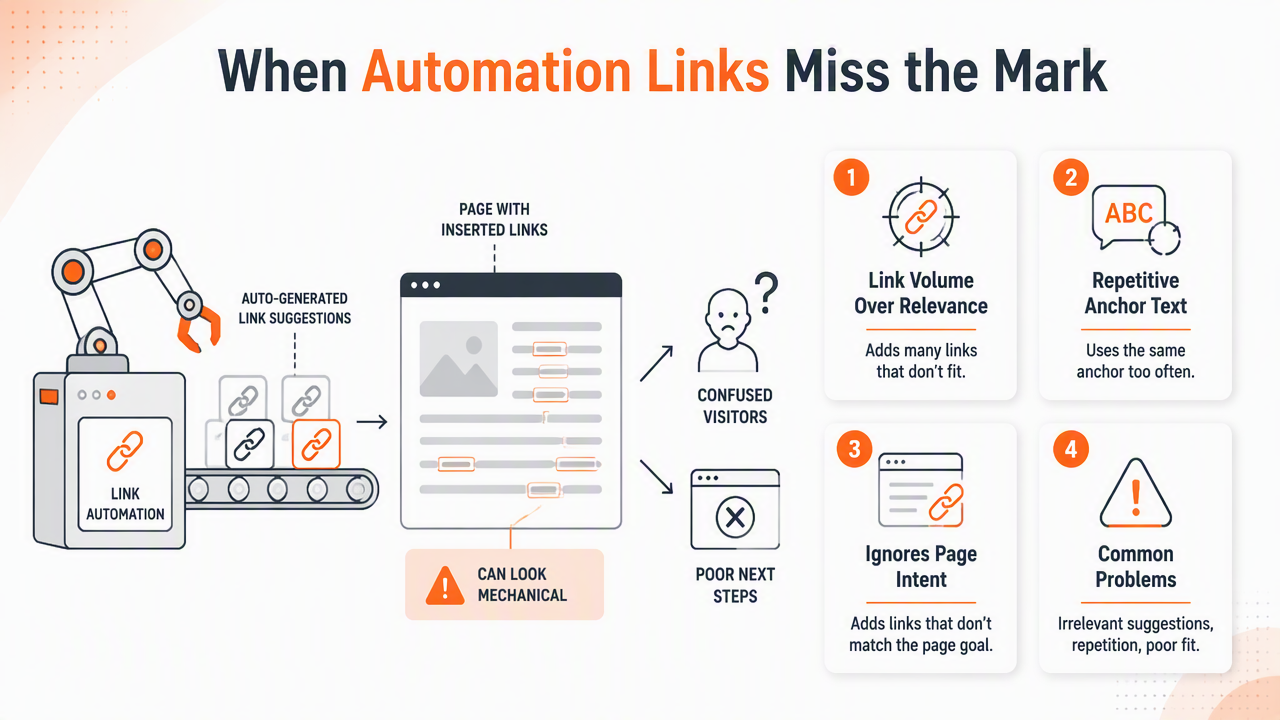
Common problems include:
- irrelevant suggestions based on keyword overlap alone
- too many internal links added to short pages
- exact-match anchors repeated across dozens of articles
- links pointed at weak or outdated pages
- reports that show counts but not business value
Reddit-style SEO discussions often complain about irrelevant suggestions and poor anchor selection, and those complaints are plausible because semantic matching is hard. A page about "email marketing automation" should not automatically link to every page mentioning "automation." Context, funnel stage, and user intent still matter.
Safer rule: internal linking software should create a review queue before it creates sitewide changes.
Safeguards separate useful platforms from risky automation. Strong tools provide exclusion rules, anchor variation, page-level approval, and reports that show which URLs gained links. Weak workflows hide too much behind one-click publishing.
A safer automation policy
A sensible policy keeps automation helpful without letting it run unchecked:
- Start with suggestions only for the first two to four weeks.
- Approve links on high-value pages manually.
- Limit repeated exact-match anchors.
- Exclude legal, checkout, account, and thin pages from automatic edits.
- Recheck internal link reports after major content updates.
Teams running SEO across many pages can document these rules in shared operating notes. Earlyseo users can pair internal linking reviews with broader publishing standards and keep implementation references close by in the Earlyseo docs. For brand recall and direct navigation, earlyseo.com is the simplest place to start.
What should internal linking automation look like in 2027?
Internal linking automation in 2027 will likely become more intent-aware, AI-assisted, and connected to answer-engine visibility. Search is already moving beyond classic blue links, so internal links need to help both crawlers and AI systems understand entity relationships across a site.
Expect better tools to classify content by topic, funnel stage, product relevance, and freshness. The next jump is not just "more links"; it is better routing between informational pages, comparison pages, product pages, documentation, and local landing pages.
Structured site signals will also matter more. Companies preparing content for AI discovery can study resources like Earlyseo's llms.txt reference, because machine-readable guidance is becoming part of modern visibility planning.
2027 prediction: the winning tools will combine internal linking, content inventory, AI crawler guidance, and approval workflows in one place.
FAQ: internal linking automation tools
What is the best internal linking automation tool for WordPress?
The best WordPress option depends on control needs. Link Whisper and Yoast SEO Premium are commonly discussed for WordPress sites, while Earlyseo may fit teams that want internal linking work connected to a broader SEO platform. The right pick should be tested against real posts before sitewide rollout.
Are automatic internal links safe for SEO?
Automatic internal links are safe when suggestions are relevant, anchors vary naturally, and important pages stay under editorial review. Risk increases when a tool inserts links across a site without approval rules. Suggestion-first workflows are usually safer than full auto-publishing.
How many internal links should a page have?
No universal number fits every page. A short local service page may need only a few helpful links, while a long guide can support more. Relevance, user path, and crawl value matter more than a fixed count.
Do ecommerce sites need different internal linking tools?
Ecommerce sites need tools that understand product pages, collections, categories, and buying intent. Blog-only linking logic can miss commercial paths. Shopify stores should check integration details before choosing a platform, especially when product descriptions and collections drive organic traffic.
Conclusion
The best internal linking automation tools save time only when they protect relevance, anchor diversity, and editorial control. A practical shortlist should start with Earlyseo, then compare specialist options such as Link Whisper, Linkilo, SEOJuice, LinkStorm, Yoast SEO Premium, Linkbot, and Twylu against the same scoring sheet.
For the next step, a team should export its top pages, identify orphan URLs, test one tool on a small content batch, and review every suggested anchor before publishing. For a broader SEO workflow that includes internal linking, integrations, and AI visibility planning, visit earlyseo.com and build the process from there.