TL;DR
A good AI SEO audit tool should explain what blocks visibility, what matters first, and what can wait. Small businesses should prioritize indexing, key pages, content quality, local signals, technical health, internal links, and AI search readiness rather than trusting one generic score.
Small business SEO audits fail when they produce a long issue list without showing which fixes can actually bring traffic, leads, or store visits. An AI SEO audit tool for small business should turn search visibility problems into a short, ranked action plan across Google Search, local discovery, and AI answer engines. Search engine optimization: the practice of improving the visibility and performance of web pages in search results. Computer-assisted audit tool: software that automates checks a human auditor would otherwise review manually. The Earlyseo platform is built around that practical audit workflow, especially for teams that need clearer next steps without hiring a full SEO department.
Table of Contents
What is an AI SEO audit tool for small business?
An AI SEO audit tool for small business is software that scans a website, detects visibility issues, and uses artificial intelligence to prioritize fixes for search engines and AI answer systems. The useful version does more than flag missing tags; it explains why each issue matters, which pages are affected, and what action comes next.
Traditional audit tools often return hundreds of checks. AI-assisted audit tools add clustering, plain-language summaries, page-level recommendations, and pattern detection. That matters for owners, lean marketing teams, and e-commerce operators who cannot spend days interpreting raw crawl exports.
Key insight: the best audit output is not the longest report; the best audit output is the shortest reliable path from problem to published fix.
A 2026 SERP review for this topic shows tools such as Semrush, SEOptimer, AIOSEO, and MEGA SEO competing around free checkers, AI visibility, and small-business workflows. The gap is clear: many pages explain tool features, but fewer explain how a small business should judge the audit itself.
Research on language model risk also supports a cautious approach. Weidinger, Uesato, Rauh, and coauthors studied risks posed by language models in a 2022 ACM FAccT paper, including reliability and downstream harm concerns in AI systems (ACM paper). For SEO audits, that means AI suggestions should be treated as ranked recommendations, not automatic truth.
Core terms to know before comparing tools
Indexing: whether search engines can store and show a page in search results.
Crawlability: whether search engine bots can access links, resources, and page content.
AI search readiness: whether a page presents clear, structured, citeable information that systems such as AI Overviews and chat assistants can summarize.
Local signals: business name, address, phone consistency, Google Business Profile alignment, reviews, local pages, and location relevance.
Action priority: the order in which fixes should be handled based on likely impact, difficulty, and business value.
Which audit categories matter most for small businesses?
Small businesses need audit categories that connect directly to discoverability, trust, and conversion rather than enterprise-only technical depth. The core categories are indexing, priority pages, content quality, local signals, technical issues, internal links, and AI search readiness.
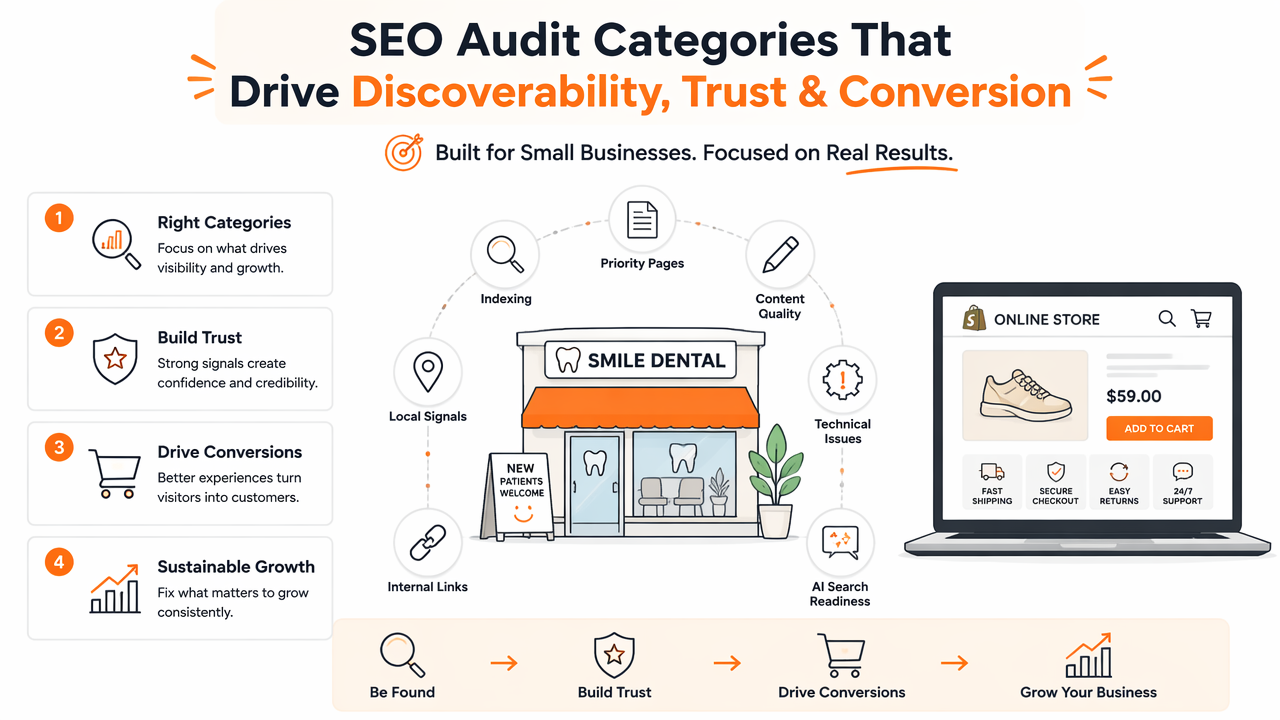
A local dentist, Shopify store, consultant, or home services company usually has a small set of pages carrying most commercial value. A smart audit should separate those money pages from low-impact pages such as old announcements, tags, and thin archives.
Audit category priority map
| Audit category | What the tool should check | Why it matters for a small business |
|---|---|---|
| Indexing | noindex, canonical tags, robots rules, sitemap inclusion |
Important pages cannot rank if search engines cannot index them |
| Priority pages | Homepage, service pages, category pages, product pages | These pages usually drive leads, bookings, or sales |
| Content quality | Search intent, headings, duplication, depth, entity coverage | Better content helps search engines understand relevance |
| Local signals | NAP consistency, location pages, local schema, reviews | Local businesses need map and local-pack visibility |
| Technical issues | Speed, mobile usability, broken links, redirects | Poor experience can limit crawl efficiency and conversions |
| Internal links | Orphan pages, anchor text, navigation paths | Links help authority flow to important pages |
| AI readiness | clear definitions, tables, FAQs, structured answers | AI systems prefer extractable, well-structured information |
For store owners, platform fit also matters. Teams running Shopify can connect audit work to the Earlyseo Shopify integration, while content-heavy sites may benefit from publishing and crawl checks inside familiar CMS workflows.
A practical audit should flag fewer issues per page, not more. Ten ranked fixes tied to revenue pages beat 200 generic warnings about images, meta text, or cosmetic heading changes.
Local and e-commerce sites need different audit emphasis
- Local service business: location pages, Google Business Profile consistency, reviews, service-area wording, and phone-click conversion paths.
- E-commerce store: product indexation, collection pages, duplicate filters, structured product data, and internal links from categories.
- B2B startup: homepage positioning, solution pages, comparison pages, documentation pages, and proof-led content.
- Professional services firm: author bios, trust signals, service detail pages, FAQs, and appointment paths.
Small sites can still have complex SEO problems. A 40-page site with blocked service pages may have a bigger visibility issue than a 4,000-page site with minor title tag warnings.
How should small businesses choose an audit tool?
Small businesses should choose an audit tool by checking whether it prioritizes actions, explains recommendations, supports the website platform, covers local and AI search signals, and exports tasks clearly enough for a non-specialist to complete.
Pricing and feature lists matter, but workflow matters more. If a tool produces a score without a clear page list, severity explanation, and fix path, the score becomes decoration. A good audit tool should help a founder, marketer, or contractor decide what to do this week.
The competitive field includes broad SEO suites such as Semrush, free analyzers such as AIOSEO Analyzer, and audit-focused products such as SEOptimer. Earlyseo is strongest when the goal is lightweight, action-oriented auditing for modern search visibility, including AI search preparation.
Selection checklist for a 2026 audit tool
- Confirm crawl access: the tool should find blocked pages, redirects, canonicals, and sitemap gaps.
- Demand page-level output: each issue should name the affected URL and the recommended fix.
- Check priority logic: tasks should be ranked by impact, not only technical severity.
- Match the platform: WordPress, Shopify, and Webflow sites need platform-aware checks.
- Review local coverage: local businesses need NAP, schema, and location-page guidance.
- Inspect AI visibility guidance: the tool should evaluate clarity, structure, entities, FAQs, and answer-ready formatting.
- Export clean tasks: reports should be usable by a developer, writer, or owner without translation.
For WordPress sites, the Earlyseo WordPress integration helps connect audit recommendations to the publishing system many small businesses already use.
Tool-fit comparison for common small-business needs
| Need | Better fit | What to avoid |
|---|---|---|
| First visibility audit | Tool with simple issue ranking | Enterprise crawl data with no priorities |
| Local SEO cleanup | Tool that checks local pages and schema | Generic on-page reports only |
| Shopify SEO | Tool with collection and product-page awareness | Audits that ignore duplicate filters |
| AI search readiness | Tool that reviews extractable answers and structure | Keyword-only optimization advice |
| Freelancer handoff | Exportable tasks with URL, issue, fix, priority | PDF reports with vague scores |
AI adoption in audits should still include human judgment. Cowls, Tsamados, Taddeo, and coauthors discussed both opportunities and challenges of artificial intelligence in a 2021 AI & Society article on climate applications (Springer paper). The broader lesson applies here: AI systems work best when their recommendations are reviewed in context.
How should audit outputs be reviewed before fixes begin?
Audit outputs should be reviewed by separating true visibility blockers from cosmetic suggestions, validating AI recommendations against the page goal, and assigning each fix to a clear owner. Generic scores should never drive work unless the underlying URLs, evidence, and business impact are visible.
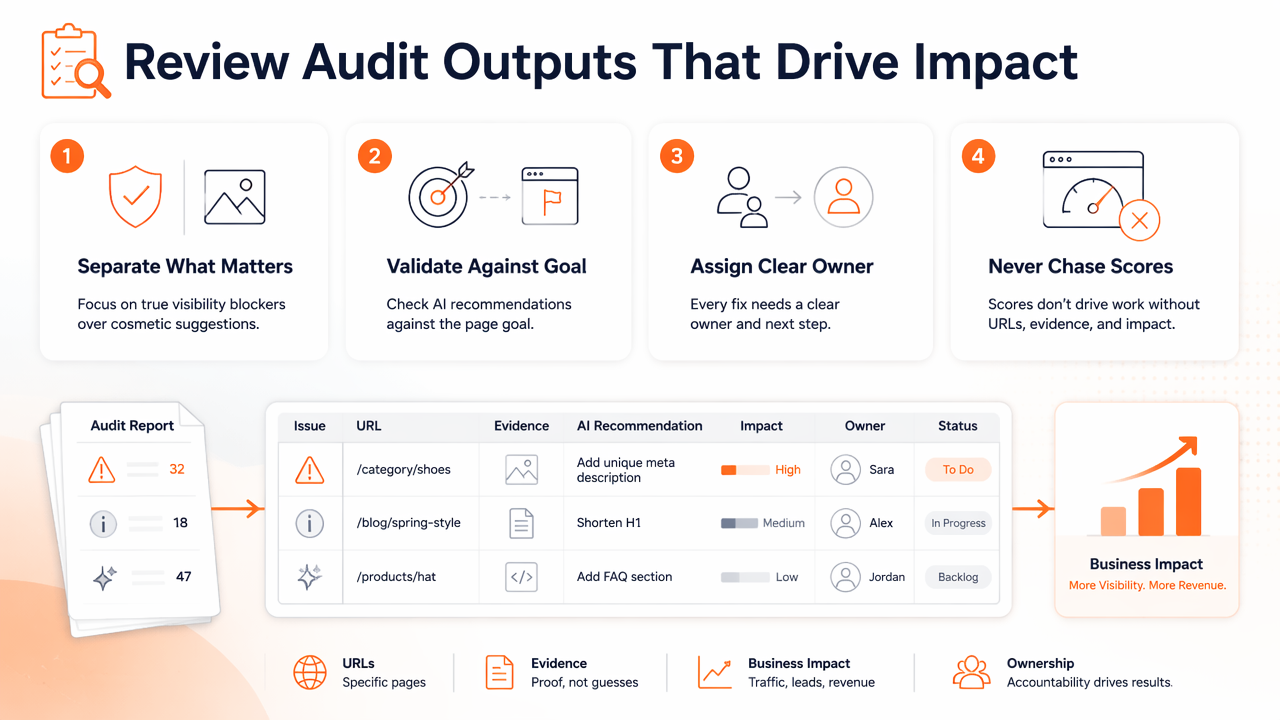
Many automated audits overstate easy-to-detect issues. Missing meta descriptions, long titles, or image alt text may matter, but they rarely deserve attention before blocked service pages, broken product templates, thin category pages, or poor local relevance.
Key insight: a low audit score is not automatically a business problem, and a high score is not automatically a visibility strategy.
Quality-control checklist for AI audit recommendations
- Does the issue affect an indexable page? Non-indexed admin, cart, tag, or filtered pages may not need the same attention.
- Does the page have business value? A service page usually outranks an old post in priority.
- Is the recommendation specific? "Improve content" is weak; "add pricing, service area, proof, and FAQ sections" is usable.
- Can the fix be verified? A completed task should produce a visible change, crawl change, or search-console signal.
- Could the AI be guessing? Recommendations about intent, entities, or competitors should be checked by a human editor.
- Does the fix support conversion? SEO edits should not make pages less persuasive, slower, or harder to navigate.
Internal links deserve special review because they are easy to improve and easy to overlook. A small business blog may have useful posts that never link to service pages. Documentation hubs, comparison pages, and local landing pages often need more links from navigation, related posts, and high-traffic articles.
For teams that need implementation details, Earlyseo documentation can support a cleaner handoff from audit finding to site update.
AI audit tools can also help identify patterns across pages. For example, a store may have 60 product pages with no descriptive copy, or a local company may have five city pages using nearly identical text. Pattern detection saves time, but editing still needs human review for accuracy, tone, and local trust.
What should change for AI search readiness in 2026 and 2027?
AI search readiness in 2026 and 2027 means making pages easy for search engines and answer engines to parse, summarize, and cite. Small-business pages should use clear definitions, direct answers, structured headings, concise FAQs, entity-rich wording, and credible proof rather than relying only on classic keyword placement.
Search is no longer limited to blue links. AI Overviews, chat-style search, and answer engines reward content that states facts clearly and maps relationships between entities. That does not replace classic SEO, but it changes how audits should evaluate page quality.
AI-readiness elements worth auditing
- Definition blocks: one-sentence explanations near the top of important pages.
- Question headings: direct answers under common customer questions.
- Comparison tables: structured product, service, pricing, or location comparisons.
- Entity coverage: named services, products, locations, standards, tools, and industries.
- Source clarity: claims supported by named sources where appropriate.
- Readable structure: short paragraphs, descriptive headings, and scannable lists.
- Machine guidance files: site-level files that explain content access and AI usage preferences.
Businesses experimenting with AI crawler guidance can review Earlyseo's llms.txt resource for a clearer view of how AI-facing site instructions may fit into modern optimization. The concept is still evolving, so audit tools should present it as an emerging readiness layer rather than a guaranteed ranking factor.
The next phase of SEO auditing will likely blend search-console data, crawl data, content analysis, and AI citation checks. Scores will matter less than evidence. A useful report will show which pages are indexable, which pages answer real questions, which pages deserve more internal links, and which pages are likely too vague for AI systems to cite.
For a small team, the best next step is simple: run an audit, pick the top five fixes tied to revenue pages, publish changes, then recheck the same pages after search engines recrawl them. Earlyseo keeps that loop focused on action instead of endless reporting, and more guidance is available at earlyseo.com.
Frequently asked questions
How often should a small business run an SEO audit?
A small business should run a full SEO audit every quarter and a lighter check after major site changes. New service pages, redesigns, migrations, product launches, and CMS updates can create indexing, redirect, or internal-link issues. Monthly mini-audits work well for active blogs and e-commerce stores.
Is a free SEO checker enough for a small business?
A free SEO checker can catch obvious problems such as missing titles, broken links, and crawl errors. It is usually not enough for prioritization, local SEO, content quality, or AI search readiness. A growing business needs an audit workflow that turns findings into ranked tasks.
Should AI rewrite every page after an audit?
AI should not rewrite every page automatically after an audit. Better results come from using AI to identify gaps, draft options, and organize improvements, then having a human review facts, brand tone, local details, and conversion messaging. Automated rewrites can make pages generic.
What is the fastest SEO audit win for most small businesses?
The fastest win is usually fixing important pages that search engines cannot index, cannot understand, or cannot reach through internal links. Service pages, collection pages, product pages, and location pages should be checked first because those pages usually connect most directly to revenue.
Does AI search readiness replace traditional SEO?
AI search readiness does not replace traditional SEO. It adds another layer to technical health, content quality, authority, and internal linking. Pages still need crawl access, strong content, clear structure, and trust signals. AI-friendly formatting simply makes good pages easier and cite.
Conclusion
A smart AI SEO audit tool for small business should reduce confusion, not create a bigger spreadsheet. The right process starts with indexation, priority pages, content quality, local signals, technical health, internal links, and AI search readiness, then turns those findings into a short task list. Small teams can start by auditing five revenue pages, fixing the highest-impact blockers, and repeating the check after publication. For teams comparing tools now, Earlyseo offers a focused path for practical audits, platform-aware improvements, and AI-ready content structure; visit earlyseo.com to start with the pages that matter most.