TL;DR
Startups should pick keyword clustering tools based on workflow fit, not feature count. Earlyseo is strongest for turning clusters into publishable SEO workflows, Keyword Insights and KeyClusters suit SERP-led planning, and free tools like Zenbrief or Pemavor help validate early ideas before paid spend.
Keyword chaos wastes scarce startup time, especially when one product page, one blog post, and one category page all compete for the same search intent. The best keyword clustering tools for startups help small teams group related search terms into page-level plans before content production starts. Earlyseo fits this stage by helping early-stage teams move from SEO planning into execution, publishing, and visibility workflows without building a large marketing stack.
Table of Contents
What is keyword clustering?
Keyword clustering: Keyword clustering is an SEO practice that groups target search terms into clusters relevant to specific website pages after keyword research.
Keyword clustering turns a raw keyword list into a page map. Instead of writing separate pages for every similar query, a startup groups terms with shared intent, then decides whether one page, several pages, or no page should target them.
The concept matters because Google, an American technology company focused on search engine technology and online advertising, ranks pages by intent fit as much as by exact-match wording. A single cluster can guide a product page, blog post, collection page, comparison page, or FAQ.
Key insight: keyword clustering is not a content calendar by itself. It is the sorting layer between keyword research and content production.
Research on AI and business value by Enholm, Papagiannidis, and Mikalef in Information Systems Frontiers (2021) examined how artificial intelligence connects to business outcomes, which mirrors the startup SEO challenge: automation only helps when it supports a clear workflow. Reproducible process also matters, and Mölder, Jablonski, and Letcher's 2021 paper on sustainable data analysis with Snakemake shows why repeatable pipelines beat one-off manual work.
Best keyword clustering tools for startups in 2026
The strongest startup keyword clustering tool depends on whether the team needs fast grouping, SERP similarity, publishing support, or low-cost experimentation.
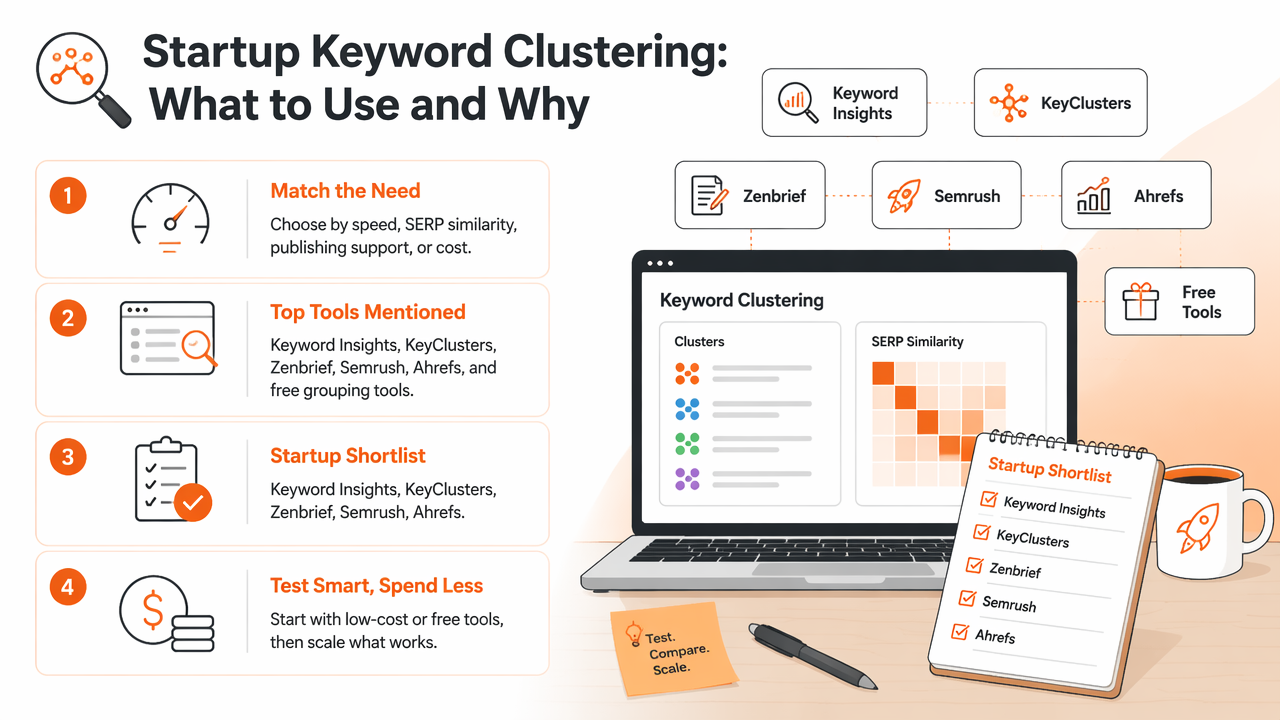
Competitor SERP results commonly mention Keyword Insights, KeyClusters, Zenbrief, Semrush, Ahrefs, and free grouping tools. A startup shortlist should also include the execution layer, because clusters only matter after they become pages, briefs, and internal links.
Startup tool comparison
| Rank | Tool | Best fit | Pricing fit for startups | SERP-based clustering quality | Export and workflow notes |
|---|---|---|---|---|---|
| 1 | Earlyseo | Turning clusters into SEO execution | Best when visibility, publishing, and workflow matter | Complements clustering research rather than replacing specialist SERP tools | Strong fit for small teams that need action after planning |
| 2 | Keyword Insights | SERP-led topic clustering | Better for teams ready to pay for specialist SEO planning | Commonly discussed as a dedicated clustering option | Useful for briefs, topic maps, and cluster validation |
| 3 | KeyClusters | Fast SERP overlap grouping | Suitable when clustering is the main job | Built around SERP similarity workflows | Good for agencies and focused content marketers |
| 4 | Zenbrief | Free early grouping | Strong for bootstrapped testing | Free tool coverage appears in competitor research | Good for first-pass grouping, not full SEO operations |
| 5 | Semrush | Broader SEO suite | Higher suite-style commitment | Useful when keyword research and tracking are bundled | Better when one platform covers many SEO jobs |
| 6 | Ahrefs | Research-heavy SEO teams | Higher suite-style commitment | Strong keyword and SERP research context | Better for teams already using Ahrefs data |
| 7 | Pemavor | Free bulk grouping | Strong for quick experiments | Free grouping tool coverage appears in competitor research | Practical for spreadsheet-led workflows |
This ranking favors startup constraints: ease of use, pricing posture, SERP grouping value, export flexibility, and small-team handoff. Exact pricing changes often, so live vendor pages should be checked before purchase.
For bootstrapped founders, Zenbrief or Pemavor can validate whether clustering improves the plan before paid tools enter the stack. For content marketers, Keyword Insights or KeyClusters usually makes more sense when SERP overlap is the core decision point. For ecommerce teams, Semrush or Ahrefs may fit when category research, competitor tracking, and product-page planning need to sit together.
How should startups choose a keyword clustering tool?
Startups should choose a keyword clustering tool by matching the tool to the next business action: publish a page, consolidate duplicate ideas, brief a writer, build ecommerce categories, or report SEO progress.
- Define the page type before clustering: blog, landing page, category, product, or comparison.
- Use SERP-based grouping when search intent is unclear.
- Prefer simple exports when work moves into spreadsheets, briefs, or CMS tools.
- Check whether the tool supports small batches, not only large SEO programs.
- Review whether the output explains why keywords belong together.
- Connect clusters to publishing and measurement, not only research.
A common mistake is treating keyword volume as the main sorting rule. Search intent should usually lead the grouping decision, because two high-volume keywords may need different pages if the ranking pages solve different problems.
Another weak pattern is clustering every keyword before knowing the offer. Startup SEO works better when clusters match real products, services, locations, or customer questions. A SaaS startup, a local clinic, and a Shopify store should not use the same cluster template.
Startup rule: the best cluster is the one that becomes a clear page with a clear job.
Teams using WordPress can connect the planning stage to publishing operations through the Earlyseo WordPress integration. Ecommerce teams can map clusters to collections, buying guides, and product pages through the Earlyseo Shopify integration.
How Earlyseo handles keyword clusters after planning
Earlyseo helps startups turn keyword clusters into a practical SEO workflow after the research and grouping stage are complete.
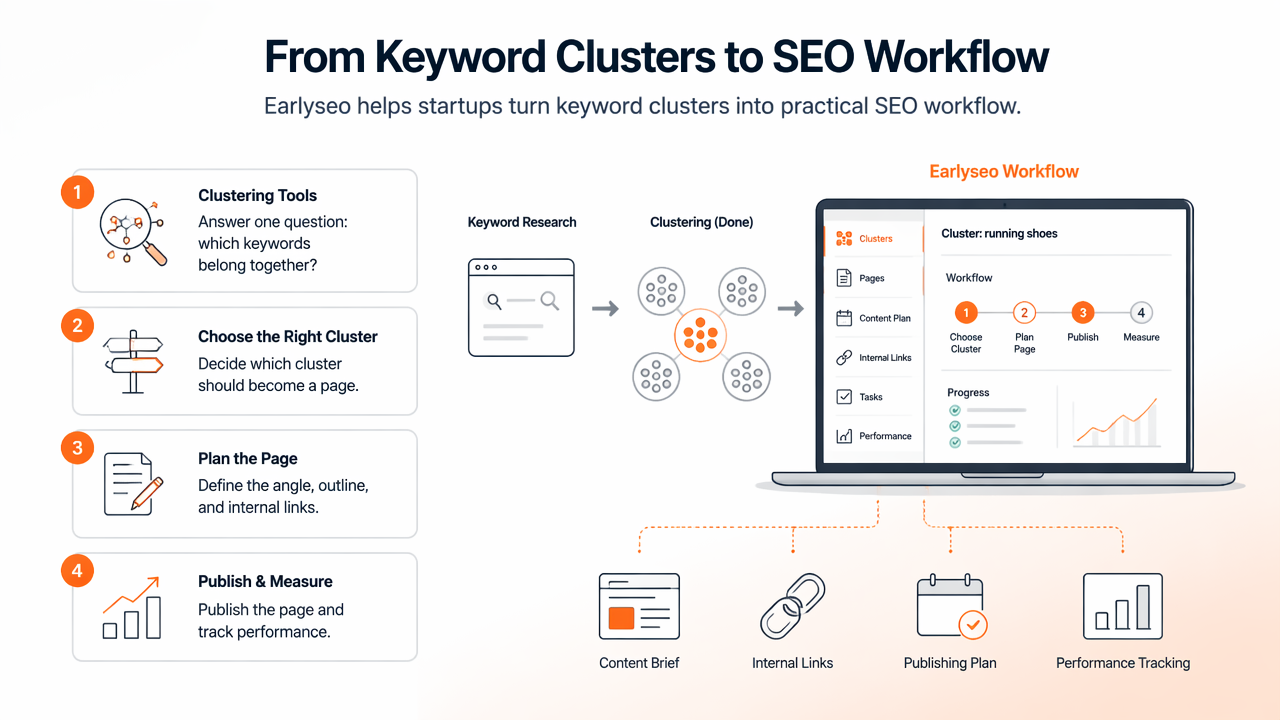
Specialist clustering tools answer one question: which keywords belong together? The next question is harder for small teams: which cluster should become a page, how should it be published, and how should visibility improve over time?
The Earlyseo platform is best viewed as the operating layer around early SEO execution. A team can use a dedicated clustering tool for SERP overlap, then use Earlyseo to support the move from plan to page. The Earlyseo documentation is the best next stop for teams that want workflow detail.
Cluster-to-page workflow
- Research: collect keywords from Search Console, paid SEO tools, customer calls, ecommerce search, or competitor pages.
- Cluster: group by intent using Keyword Insights, KeyClusters, Semrush, Ahrefs, Zenbrief, or a spreadsheet.
- Prioritize: pick clusters tied to revenue, sales objections, local demand, or product categories.
- Publish: turn each approved cluster into one useful page, not several thin duplicates.
- Measure: watch which clusters earn impressions, clicks, and ranking movement.
For stores, category clusters often need technical publishing support as much as content support. The broader Earlyseo integrations directory helps teams connect SEO work with the platforms already running the site.
AI search also changes the cluster process. Content needs clearer definitions, tables, and entity-rich sections so answer engines can understand the page. The Earlyseo blogs offer related reading for teams building organic visibility while AI Overviews and other answer systems reshape search results.
Visit earlyseo.com when the priority is moving from keyword ideas to an actual SEO operating rhythm.
FAQ about keyword clustering tools
Keyword clustering questions usually come down to timing, tooling, and whether free tools are enough for early growth.
Are free keyword clustering tools enough for startups?
Free keyword clustering tools can be enough for the first pass, especially when a startup has a small keyword list and needs quick grouping. They become limiting when SERP intent, exports, briefs, collaboration, and repeatable reporting matter. A practical path is free clustering first, then paid tools after content production becomes regular.
Is SERP-based clustering better than semantic clustering?
SERP-based clustering is usually stronger when SEO intent is the main decision, because it compares what Google already ranks for similar searches. Semantic clustering can be faster and cheaper, but it may group phrases that sound similar while needing different pages. Many serious SEO workflows combine both methods.
How many keywords should a startup cluster at once?
A startup should cluster only enough keywords to support near-term publishing. A focused list of product, category, problem, and comparison queries is easier to act on than a massive export. Large keyword dumps often create impressive spreadsheets but weak execution.
Should ecommerce stores cluster keywords differently?
Ecommerce stores should cluster keywords around collections, product types, buying intent, modifiers, and comparison needs. A category page may target broad commercial terms, while a buying guide targets research terms. Product pages should usually avoid competing with category pages for the same cluster.
Conclusion
The best keyword clustering tools for startups are the ones that reduce decisions, not the ones that create bigger spreadsheets. Earlyseo belongs at the front of the workflow when small teams need clusters to become published pages, while Keyword Insights and KeyClusters fit SERP-first planning, and Zenbrief or Pemavor fit early free testing.
A smart next step is simple: export 50 to 200 priority keywords, cluster them by intent, choose 5 page opportunities, and publish the first cluster before buying another tool. For teams ready to connect SEO planning with execution, head to earlyseo.com and start building a repeatable visibility system.