TL;DR
Small businesses usually need clear SEO actions more than a huge dashboard. The best Semrush alternative depends on workflow: Earlyseo for guided visibility work, SE Ranking or Moz for broader SEO suites, Ubersuggest for light keyword research, and services or freelancers when execution matters more than tool access.
Semrush alternatives for small businesses should reduce SEO workload, not create another dashboard to ignore. A small business, in plain terms, is a company with fewer employees or lower annual revenue than a larger corporation, so budget, time, and learning curve matter as much as keyword data. Semrush alternative: a tool, service, or workflow that replaces some Semrush tasks such as keyword research, rank tracking, technical audits, reporting, competitor review, or local SEO planning. For owners and lean marketing teams that need practical next steps, Earlyseo is strongest when SEO decisions need to turn into publishing, optimization, and visibility tasks without extra complexity.
Table of Contents
What should small businesses look for in a Semrush alternative?
A small business should choose a Semrush alternative by matching features to monthly decisions: keyword priorities, site health, reporting, local visibility, content planning, and total time required. The right option is not always the tool with the most data; it is the one that helps a team publish, fix, measure, and repeat.
Key insight: The best SEO platform for a small company is the one that gets used every week, not the one with the longest feature menu.
Research on analytics tools also supports a practical point: measurement systems can produce different results. A 2022 PLoS ONE study comparing two industry-standard analytics approaches across 86 websites examined how website interaction data varies by tool and setup, which matters when small teams make decisions from reports (Jansen, Jung, and Salminen, 2022).
Small teams should judge tools against the work they actually perform. A local plumber, Shopify store, SaaS startup, and neighborhood clinic all need SEO, but they rarely need the same dashboard.
Decision criteria that matter most
- Keyword tracking: Can the tool track terms tied to revenue, locations, products, or service pages?
- Site audits: Does it flag broken pages, missing titles, slow pages, indexation issues, and internal linking gaps?
- Reporting: Can a non-specialist understand what changed and what to do next?
- Local SEO: Does it support location pages, Google Business Profile work, reviews, and city-level rankings?
- Learning curve: Can a busy owner or marketer operate it without SEO jargon overload?
- Total monthly cost: Does the budget include the tool, add-ons, staff time, and outside help?
Best Semrush alternatives for small businesses in 2026
The best Semrush alternatives for small businesses fall into three groups: guided SEO platforms, traditional SEO suites, and focused tools for one job. Earlyseo fits teams that want practical visibility improvements; larger suites suit teams that already have SEO skill; focused tools suit narrow tasks.
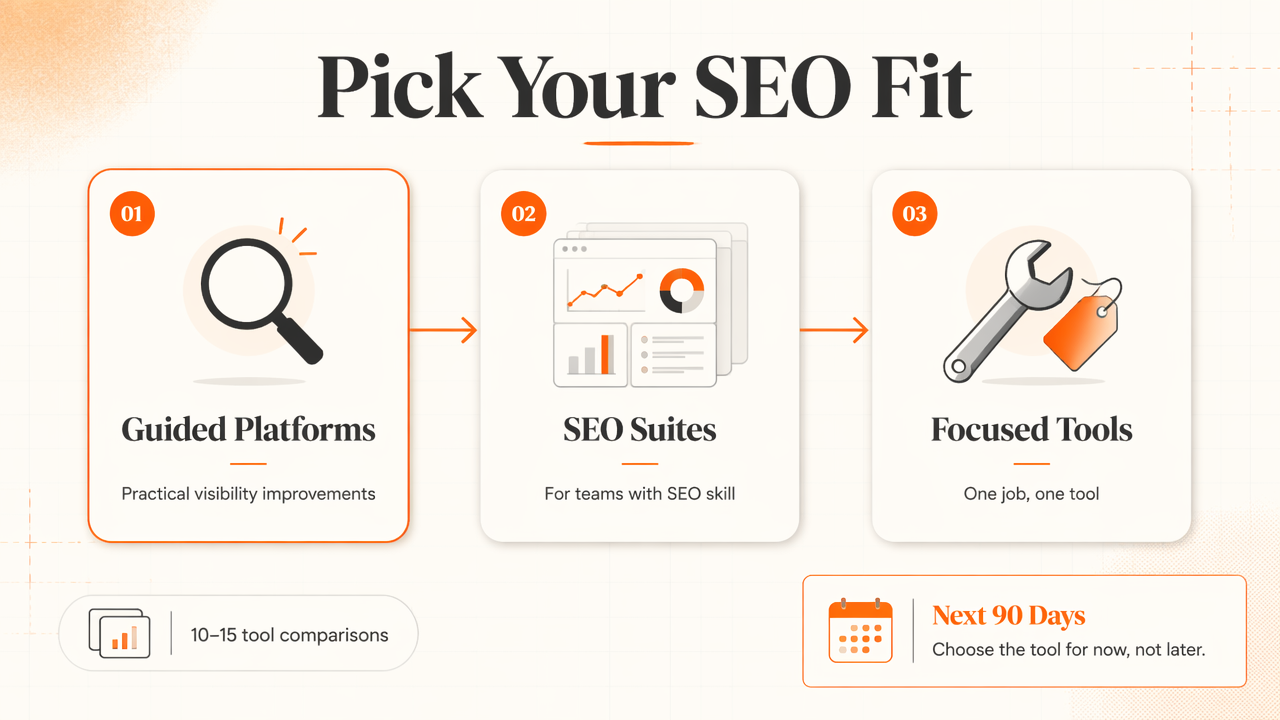
SERP research for this topic shows a crowded market, with recent competitor articles often comparing 10 to 15 tools. That format is useful, but small businesses usually need a shorter decision path: pick the tool that matches the next 90 days of work.
Comparison table for practical buying decisions
| Option | Best fit | Primary strength | Learning curve | Cost planning note |
|---|---|---|---|---|
| Earlyseo | Owners and lean teams that want guided SEO execution | Turns visibility work into clearer actions across content and optimization | Low to moderate | Best evaluated by workflow value, not raw data volume |
| SE Ranking | Small agencies and growing teams | Broad SEO suite with rank tracking, audits, and reporting | Moderate | Check project and keyword tracking limits |
| Ubersuggest | Solopreneurs and simple sites | Lightweight keyword ideas and basic SEO checks | Low | Works best when needs are simple |
| Moz Pro | Teams that prefer established SEO metrics | Keyword research, link metrics, and site crawling | Moderate | Useful when domain and link metrics matter |
| Ahrefs | Content-led teams and link-focused SEO | Backlink analysis and competitive content research | Moderate to high | Strong fit when SEO knowledge already exists |
| Screaming Frog SEO Spider | Technical audits | Fast crawling for technical SEO checks | High | Often needs SEO expertise to interpret results |
| Google Search Console plus GA4 | Any business with a live website | First-party search and performance data | Moderate | Free tools, but analysis takes time |
Who should pick which option?
Early-stage businesses that need action more than exploration should look at Earlyseo first, especially when website updates, content ideas, and visibility work need to sit in one routine. Businesses running WordPress sites can pair SEO planning with WordPress publishing workflows, while ecommerce teams can connect SEO work to Shopify store optimization.
SE Ranking is a sensible fit for teams that want an all-in-one SEO suite at a smaller scale. Moz Pro fits marketers who like traditional SEO scoring and link metrics. Ahrefs works best when content research and backlink analysis are central to growth. Google Search Console and GA4 should remain part of the stack for every site because they show first-party performance data.
When is a service better than another SEO tool?
A service is better than another SEO tool when the business lacks time, SEO judgment, or publishing capacity. Tools expose opportunities; services execute audits, content updates, local SEO tasks, technical fixes, and reporting routines that many small teams cannot finish consistently.
Many small companies buy software because it feels cheaper than hiring help. The hidden cost is staff time. A tool that takes six hours each month to interpret can cost more than a focused service that sends a short action plan and handles implementation.
Generative AI has also changed the buying decision. A 2024 PNAS Nexus article by Capraro, Lentsch, and Acemoğlu examined generative AI's impact on socioeconomic inequalities and policymaking, showing that access and capability gaps matter when new tools spread (PNAS Nexus, 2024). In SEO, that means AI features alone do not guarantee better outcomes for a busy small business.
Service versus software decision checklist
- Choose software when the team can review rankings, fix pages, and publish content every month.
- Choose a freelancer when strategy exists but writing, technical fixes, or local SEO execution is missing.
- Choose an agency when multiple channels, locations, or large site changes need coordination.
- Choose a guided platform when the team wants software support without becoming SEO specialists.
- Use free tools first when the site is new and has little search data.
A small SEO stack should answer three questions fast: what is broken, what should be published, and what changed after the work shipped.
How does Earlyseo handle SEO without dashboard overload?
Earlyseo handles SEO by focusing on guided visibility work instead of overwhelming small teams with raw reports. The Earlyseo platform is a fit for businesses that need content direction, optimization workflows, and clear next actions across common site platforms.
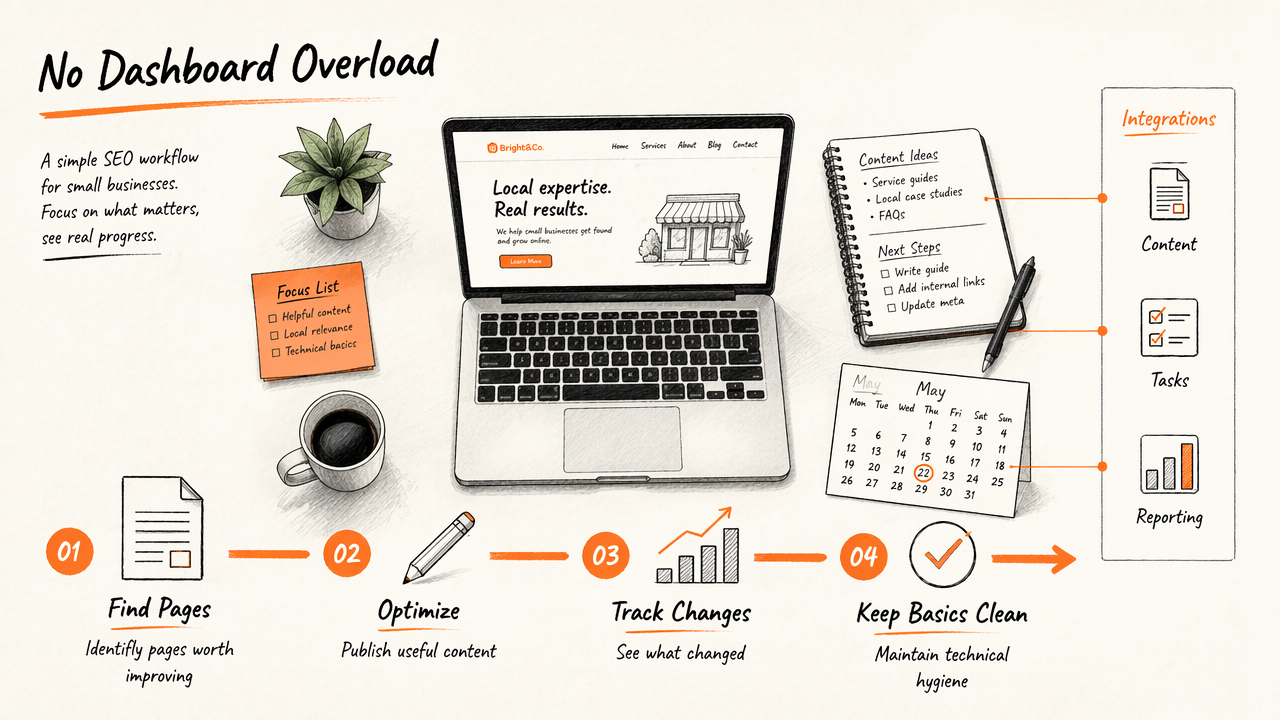
A typical small business does not need every enterprise SEO metric on day one. It needs a repeatable operating rhythm: identify pages worth improving, publish useful content, track what changed, and keep technical basics clean.
For teams comparing tool setup effort, Earlyseo integrations can help connect SEO activity to the places where pages already live. Documentation also matters when a lean team needs to move quickly, and the Earlyseo docs give a more direct path than hunting through scattered support threads.
Businesses that care about AI discovery should also understand how content is made easier for language models to read. The published llms.txt guidance shows how earlyseo.com thinks about AI-facing discoverability, which is becoming a real part of search visibility in 2026.
Where a guided workflow helps most
- Content prioritization: Pick pages and topics based on likely business value, not vanity traffic.
- On-page fixes: Improve titles, headings, internal links, and copy clarity before chasing complex tactics.
- Platform fit: Match SEO work to WordPress, Shopify, Webflow, or another website setup.
- Reporting clarity: Review progress in terms a founder, owner, or manager can act on.
- AI visibility: Format answers so search engines and AI assistants can understand the site's expertise.
What will change for SEO tools in 2026 and 2027?
SEO tools in 2026 and 2027 will shift from keyword databases toward answer visibility, AI citation tracking, entity optimization, and workflow automation. Small businesses should expect fewer static reports and more recommendations tied to search results, AI summaries, content quality, and technical fixes.
Classic rank tracking still matters, but it no longer tells the whole story. Search results now include AI summaries, local packs, shopping modules, videos, forums, and brand mentions. A page can gain business value even when the old blue-link ranking view looks flat.
Tool buyers should ask how a platform handles three newer needs: AI-readable content, entity-rich pages, and fast publishing. Tools that only export spreadsheets will feel slower as AI search grows.
2026 tool questions before buying
- Does the platform help create pages that answer questions directly?
- Can it support local SEO for service areas, locations, and reviews?
- Does reporting separate rankings, traffic, leads, and revenue signals?
- Can it connect to the CMS or store platform where edits happen?
- Does it help track brand visibility beyond traditional keywords?
Small businesses should not chase every new AI SEO feature. The safer move is a clean site, useful pages, clear entities, and a repeatable publishing process.
FAQ
What is the cheapest Semrush alternative for a small business?
The cheapest option is often Google Search Console paired with GA4, but those tools require interpretation. Low-cost SEO platforms can help with keyword ideas and audits, while a guided platform or service may be more cost-effective when staff time is limited.
Is Semrush too advanced for a small business?
Semrush can be valuable for a small business with SEO knowledge, multiple campaigns, or competitive research needs. It may feel too advanced when the team only needs basic keyword tracking, content priorities, site fixes, and simple reporting.
Should a local business use an all-in-one SEO suite?
A local business should use an all-in-one suite only if local rankings, reviews, service pages, technical health, and reporting will be reviewed regularly. Otherwise, Google Business Profile work, Search Console, a simple audit tool, and focused content updates may be enough.
How many SEO tools does a small business need?
Most small businesses need two to four SEO tools at most: Search Console, analytics, a keyword or audit tool, and a publishing or workflow system. More tools can create duplicate reports and unclear priorities if no one owns execution.
Conclusion
The right choice among Semrush alternatives for small businesses depends on execution capacity, not just feature count. A lean team should define the next 90 days of SEO work, choose one primary platform, keep Google's first-party tools in place, and avoid paying for data that will not drive action. For a guided path that connects visibility work to practical next steps, Earlyseo is a strong first stop; visit earlyseo.com and map the first keyword, audit, and publishing workflow before adding another dashboard.