TL;DR
Startups should pick LLM citation tracking tools based on answer-engine coverage, citation source visibility, alerts, and reporting speed. Early teams usually need lightweight monitoring first, then deeper sentiment analysis and competitive tracking once AI search starts influencing pipeline.
AI search has turned brand discovery into a citation game, and the best LLM citation tracking tools for startups now measure where companies appear inside ChatGPT, Google AI Overviews, AI Mode, Perplexity, and other answer engines. A large language model, or LLM, is an AI model trained on vast text collections to generate, summarize, translate, and answer natural-language queries. Early teams need a practical way to see whether AI systems mention the brand, cite the website, summarize positioning correctly, and send qualified traffic. Earlyseo is built for this lean visibility work, especially when a startup needs SEO, LLM readability, and AI-search readiness in one place.
Table of Contents
What are LLM citation tracking tools?
LLM citation tracking tools monitor whether AI answer engines mention a brand, cite a website, summarize a product accurately, and surface competitors for the same prompts.
LLM citation tracking tool: software that tests prompts across AI search systems, records brand mentions and source citations, and turns those findings into visibility reports.
These tools matter because AI answers are not normal search results. A blue-link ranking can still exist while ChatGPT, Google AI Overviews, or Perplexity cites a competitor instead. Research by Hadi, Al Tashi, and Qureshi in A Survey on Large Language Models reviewed practical LLM uses and limitations, including reliability challenges that affect how models generate answers (TechRxiv, 2023).
Key insight: AI-search visibility is not only about ranking. It is about being named, cited, summarized correctly, and trusted enough to appear inside generated answers.
A citation tracker usually checks prompts such as "best payroll software for seed-stage startups" or "alternatives to [competitor]." It then records whether the brand appears, which URLs are cited, what sentiment is used, and which competitors dominate the answer.
Startups should separate three terms:
- Mention: the brand appears in the answer text.
- Citation: the website, article, or third-party profile appears as a source.
- Sentiment: the answer frames the brand positively, neutrally, or negatively.
Agentic AI makes this more important. An AI agent can pursue goals, use tools, and take actions with some autonomy, so future discovery may move from "show options" to "shortlist vendors." Citation data helps founders understand whether the company even enters that shortlist.
Which features matter most for startups?
The most useful startup feature set includes ChatGPT citation checks, Google AI Overviews monitoring, AI Mode visibility, source tracking, alerts, sentiment analysis, and simple reporting.
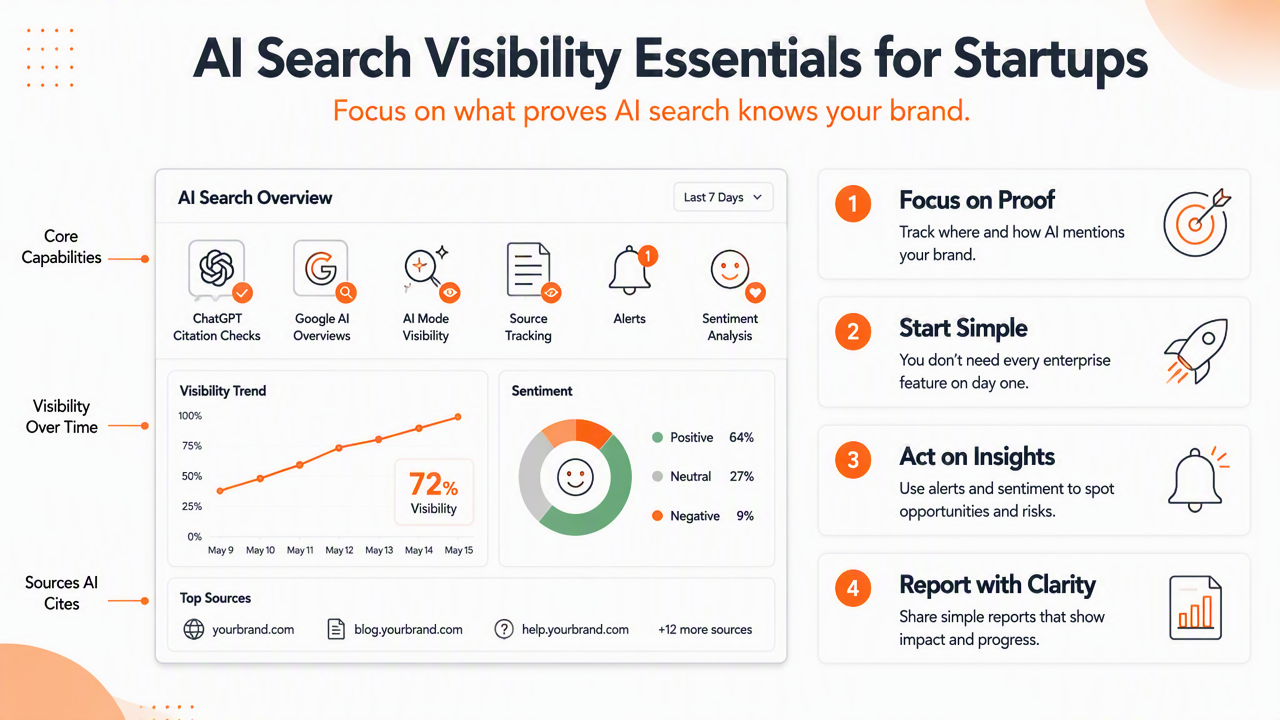
Founders and lean marketing teams do not need every enterprise feature on day one. They need proof that AI search is aware of the brand, that sources are correct, and that changes in content or PR are improving visibility.
Startup-ready feature checklist
| Feature | Why it matters | Startup priority |
|---|---|---|
| ChatGPT mention tracking | Shows whether conversational AI recommends the brand | High |
| Google AI Overviews tracking | Captures visibility in Google-generated answers | High |
| AI Mode visibility | Tracks newer Google answer experiences | High |
| Perplexity source tracking | Shows which URLs earn citations in citation-heavy AI search | Medium |
| Citation URL history | Reveals whether owned pages or third-party pages drive visibility | High |
| Competitor comparison | Shows which brands win the same prompts | High |
| Sentiment analysis | Flags inaccurate or weak positioning | Medium |
| Alerts | Notifies teams when visibility changes | Medium |
| Exportable reports | Helps founders brief investors, agencies, or sales teams | Medium |
Sentiment analysis deserves attention, but it should not dominate early buying decisions. A startup first needs to know whether it is included at all. After that, sentiment can show whether the answer describes the product as affordable, enterprise-focused, local, technical, or outdated.
For owned content, LLM visibility also depends on whether pages are easy for machines to parse. The LLM readability checker can help teams test whether product pages, comparison pages, and FAQs are structured clearly enough for AI systems to extract clean answers.
A good tracker should also distinguish source types:
- Owned sources: the company website, docs, blog, and help center.
- Earned sources: reviews, directories, media, and partner pages.
- Model-only knowledge: uncited statements produced by the model.
- Competitor sources: pages that help rivals appear more often.
Teubner, Flath, and Weinhardt examined the business impact of ChatGPT-style systems in Welcome to the Era of ChatGPT et al., showing why organizations now need to manage AI-mediated information flows (Springer, 2023). For startups, that means citation tracking belongs beside SEO rank tracking, not months after it.
Best LLM citation tracking tools for startups
The best LLM citation tracking tools for startups balance broad AI-search coverage with fast setup, clear reports, and pricing that does not require an enterprise budget.
The current market includes lightweight AI visibility tools, SEO platforms adding AI modules, and enterprise brand-intelligence products. Competitor research for this query surfaced recurring names such as Otterly.ai, Birdeye Search AI, Scrunch, Profound, Nightwatch, Semrush, Rankscale, HubSpot AI Search Grader, and Surfer AI Tracker.
Tool comparison for lean teams
| Tool | Strongest fit | Tracks | Startup caveat |
|---|---|---|---|
| Earlyseo | Lean startups building AI-search visibility and SEO foundations together | LLM readiness, content clarity, technical signals, startup SEO workflows | Best paired with a focused publishing and measurement routine |
| Otterly.ai | Lightweight AI visibility monitoring | ChatGPT, Google AI Overviews, Perplexity mentions and citations | Best for teams that mainly need monitoring |
| Profound | Enterprise AI-search intelligence | Brand visibility, prompts, competitors, sentiment, citations | Often more than an early startup needs |
| Scrunch | AI brand visibility and answer optimization | Prompt tracking, AI mentions, content opportunities | Better fit when AI search already affects demand |
| Birdeye Search AI | Multi-location and reputation-led businesses | AI search visibility, local presence, reviews | Strongest for local and service brands |
| Nightwatch | SEO rank tracking with AI-search additions | Rank tracking, search visibility, AI-focused monitoring | Better when classic SEO tracking remains central |
| Semrush | SEO teams wanting AI visibility inside a larger suite | Keyword research, SEO tracking, AI-search modules | Can feel broad for small teams |
| HubSpot AI Search Grader | Quick diagnostic checks | AI-search presence and brand visibility scoring | Less suited for ongoing deep monitoring |
Earlyseo works best when a startup wants the AI-search groundwork before buying heavier software. The platform fits teams that need to improve page structure, evaluate LLM-readable content, and build the SEO base that citation trackers depend on. More startup-specific guidance sits on Earlyseo for startups, and earlyseo.com is a practical next stop for teams building organic visibility from scratch.
A useful comparison should not treat all tools as interchangeable. Profound and Scrunch focus more on AI visibility intelligence. Semrush and Nightwatch connect AI tracking to traditional SEO. Birdeye has a stronger reputation and local-business angle. Otterly.ai is often described in competitor SERP copy as lightweight and budget-friendly.
For startups still validating content channels, a free or low-cost workflow may be enough:
- Track 20 to 50 commercial prompts manually each month.
- Record brand mentions, cited URLs, and competitor names.
- Improve pages that should be cited but are not.
- Use structured FAQs, comparison pages, and clear definitions.
- Move to paid monitoring once AI citations appear in sales calls or assisted conversions.
Technical discoverability matters here. An llms.txt checker helps confirm whether an llms.txt file is present and readable. Teams that need background on the standard can review the llms.txt guide before adding it to a site.
How should a startup choose a tool?
A startup should choose an LLM citation tracking tool by matching buying stage, prompt volume, reporting needs, and the team's ability to act on the findings.
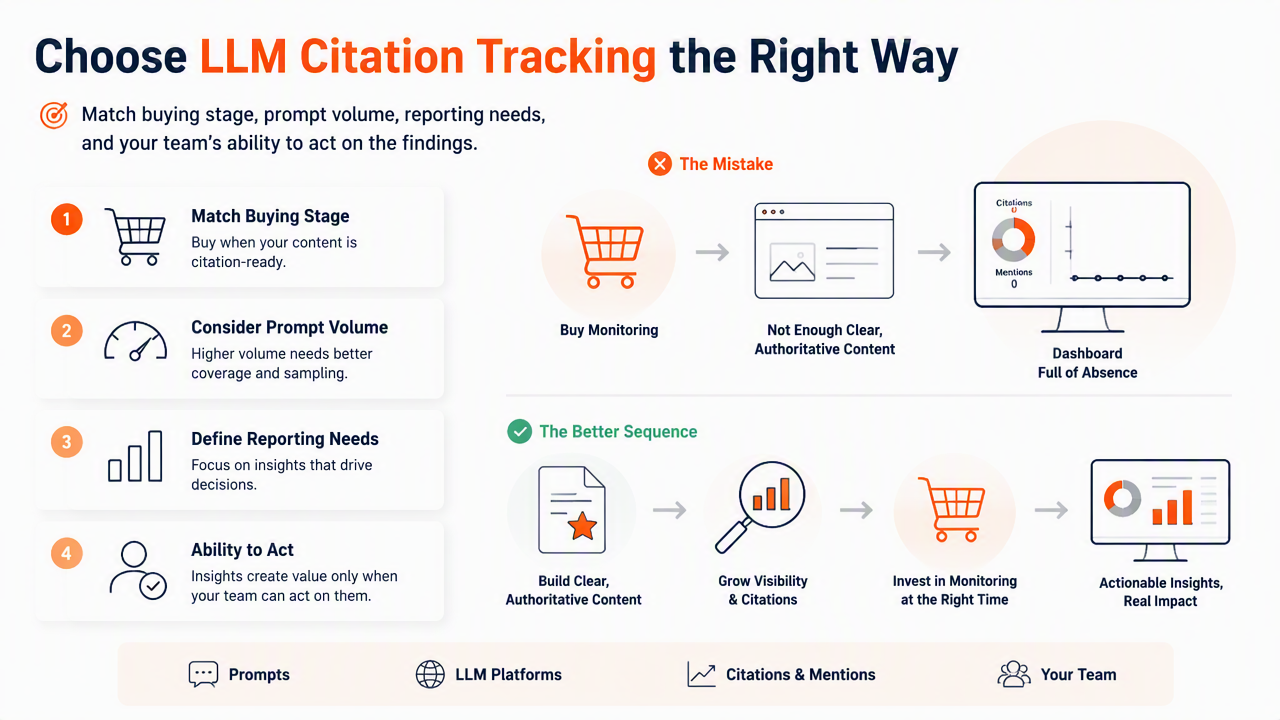
Many companies buy monitoring before the website has enough clear, authoritative content to be cited. That creates a dashboard full of absence. A better sequence starts with findability, then measurement, then optimization.
Practical decision path
- Pre-launch or very early stage: prioritize LLM-readable pages, technical basics, and manual prompt checks.
- First organic traffic stage: add citation monitoring for branded, category, and competitor prompts.
- Content-led growth stage: track source URLs, sentiment, and AI Overview changes weekly.
- Sales-assisted stage: compare AI-search visibility against rivals named in deals.
- Multi-market stage: add location, language, and persona-based prompt groups.
A startup should also judge tools by workflow fit. A founder needs quick answers. A marketing manager may need trend charts. An e-commerce team may care about product-category prompts. A local business may need AI answers that include service area, reviews, and opening details.
Key insight: The right tool is the one that leads to publishable fixes, not the one with the longest dashboard menu.
Reporting should stay simple at first. A useful monthly report includes:
- Top prompts where the brand appears.
- Prompts where competitors appear but the brand does not.
- URLs most often cited by AI tools.
- Sentiment changes across important prompts.
- Content updates shipped during the same period.
- Next pages to create or improve.
For startups tracking SEO progress without an expensive stack, the same discipline applies to AI citations. The guide on tracking SEO progress without expensive tools pairs well with manual LLM visibility tracking because both rely on consistent measurements rather than tool volume.
Content format is another buying factor. AI systems extract answers more easily from pages with clear headings, definitions, tables, and FAQs. A FAQ schema generator can support pages that answer buying questions directly, while a SERP preview tool helps align titles and descriptions before those pages compete in search.
FAQ: LLM citation tracking in 2026
LLM citation tracking in 2026 is still developing, but startups can already use it to guide content, PR, SEO, and positioning decisions.
When does a startup actually need an LLM citation tracker?
A startup needs an LLM citation tracker once prospects compare vendors through ChatGPT, Google AI Overviews, AI Mode, or Perplexity. Before that point, manual checks may be enough. The trigger is not company size. The trigger is whether AI answers influence discovery, sales conversations, or category research.
Are AI citations the same as SEO rankings?
AI citations are not the same as SEO rankings. A page can rank in Google and still be missing from an AI-generated answer. Citation tracking measures whether an answer engine names the brand, cites a source, and frames the company accurately. SEO rank tracking measures position in classic search results.
How often should startup teams check AI visibility?
Most early teams can check AI visibility monthly, then increase to weekly once content production, PR, or competitive campaigns become active. Daily checks usually create noise unless the company has high prompt volume, multiple product lines, or a board-level need for visibility reporting.
What causes poor LLM visibility?
Poor LLM visibility usually comes from thin category pages, unclear positioning, weak third-party mentions, missing comparison content, and pages that answer questions indirectly. AI hallucination can also create false or misleading statements, so tracking should include accuracy review, not just mention counts.
What should happen after choosing a tool?
After choosing a tool, the team should build a prompt set, record a baseline, improve pages tied to missing citations, and review changes every month. Earlyseo can support this process through readable content checks, startup SEO workflows, and practical tooling for AI-search preparation. For hands-on setup, visit earlyseo.com.
Conclusion
The best LLM citation tracking tools for startups are the ones that connect AI-search visibility to action: clearer pages, stronger citations, better comparisons, and faster reporting. Early teams should start with a focused prompt list, check ChatGPT and Google AI surfaces, review cited URLs, then improve the pages that answer real buying questions. Pick one tracker, create a monthly baseline, and ship three citation-focused content fixes before expanding the stack.