TL;DR
An AI SEO automation platform is usually better for fast publishing, repeatable SEO operations, and lean teams with clear goals. An SEO agency is usually better for complex strategy, migrations, PR-led authority building, and executive-level guidance. Many growing companies get the strongest result by using automation for production and an agency or consultant for periodic strategy review.
AI SEO automation platform vs SEO agency is no longer a simple software-versus-service choice; in 2026, it is a question of operating model. Generative search, AI Overviews, and LLM answer engines reward clear topical coverage, strong structure, and trusted entities, so teams need both speed and judgment.
AI SEO automation platform: software that helps plan, brief, create, optimize, publish, monitor, and report on SEO work using artificial intelligence and workflow automation.
SEO agency: an external service provider that handles SEO strategy, execution, reporting, and advisory work through human specialists, often supported by software.
The right choice depends on budget, internal skill, content volume, technical complexity, and how much strategic handholding a business needs.
Table of Contents
What is an AI SEO automation platform vs SEO agency?
An AI SEO automation platform vs SEO agency comparison asks whether SEO work should be run mainly through software workflows or outsourced to human specialists. Platforms favor speed, repeatability, and lower operational overhead, while agencies favor custom strategy, cross-channel judgment, and hands-on execution for complex sites.
Research on generative AI by Stefan Feuerriegel, Jochen Hartmann, and Christian Janiesch describes systems that can create new text and other outputs from learned patterns. In SEO, that makes AI useful for briefs, clustering, drafts, metadata, internal linking suggestions, and reporting summaries.
Still, automation is not a full replacement for business judgment. A 2023 review on fake news, disinformation, and misinformation in social media examined how online information quality can break down, which is a useful warning for AI-assisted publishing: accuracy checks and editorial control still matter.
Key insight: Platforms scale execution; agencies add judgment. Strong SEO programs usually need both, but not always at the same time.
Core terms for the decision
AI SEO automation: repeatable SEO tasks handled or assisted by AI, such as keyword grouping, content briefs, optimization, publishing workflows, and performance monitoring.
Generative engine optimization: content and entity optimization aimed at being cited or summarized by AI systems, not only ranked in classic blue-link search.
Managed SEO service: an agency or consultant-led engagement where external experts own planning, execution, review, and reporting.
Human-in-the-loop workflow: a process where AI drafts or recommends work, then a person reviews facts, brand fit, and strategic value before publication.
Comparison table: cost, speed, quality, and limits
The clearest difference is that platforms reduce the cost and time of repeatable SEO tasks, while agencies provide deeper strategic interpretation and accountability. That tradeoff becomes sharper when a company needs more content, more landing pages, or more frequent reporting than a small internal team can handle.
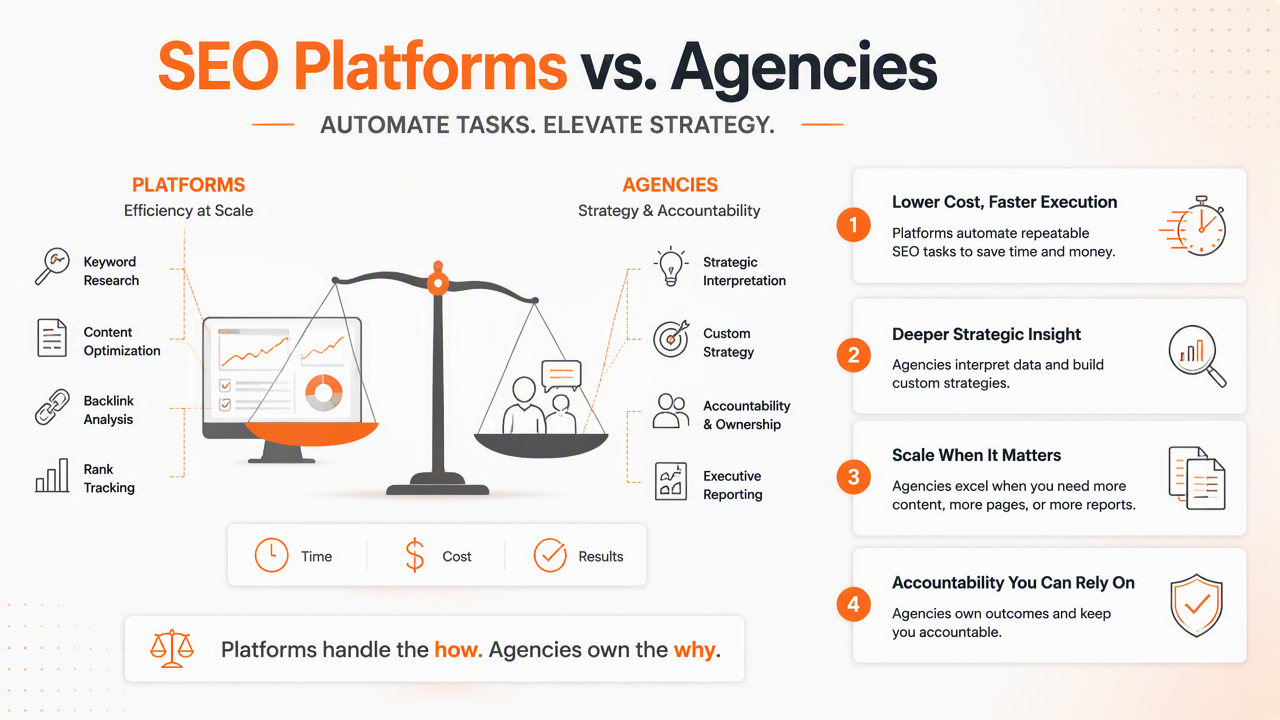
Side-by-side decision matrix
| Factor | AI SEO automation platform | SEO agency | Best fit |
|---|---|---|---|
| Cost model | Subscription or usage-based software cost | Monthly retainer, project fee, or consulting fee | Platform for predictable production; agency for complex initiatives |
| Speed | Fast briefs, drafts, optimizations, and reports | Slower due to meetings, review cycles, and specialist scheduling | Platform when publishing velocity matters |
| Strategy depth | Depends on inputs, templates, and user decisions | Stronger for positioning, prioritization, and tradeoff decisions | Agency for unclear markets or high-stakes planning |
| Content quality | Consistent structure, but needs editorial review | Higher upside when specialists know the market | Hybrid for expert-led content at scale |
| Technical SEO | Good for checks, workflows, and monitoring | Better for migrations, JavaScript issues, and complex architecture | Agency for technical risk |
| Reporting | Fast dashboards and repeatable summaries | More narrative analysis and stakeholder explanation | Platform for routine reporting; agency for board-level insight |
| Accountability | Internal team owns final decisions | Agency shares execution responsibility | Agency when internal capacity is low |
A platform is usually the better first move when tasks are clear: publish comparison pages, refresh decaying posts, build local landing pages, or create product-led SEO content. An agency is stronger when the business problem is unclear, such as traffic loss after a migration, weak category architecture, or poor conversion from organic traffic.
How Earlyseo handles this
The Earlyseo platform is built for teams that need repeatable SEO execution without turning every article, page refresh, or brief into a custom project. Its workflow focus fits companies that already know the audience, offer, and commercial pages that need more visibility.
For execution-heavy teams, SEO operations features help organize the production side of search. For competitive markets, competitor-aware SEO content supports clearer positioning against ranking pages, which is often where basic AI writing tools fall short.
When an AI SEO platform is the better choice
An AI SEO platform is the better choice when SEO success depends on consistent output, structured workflows, and faster iteration rather than custom advisory work. Startups, local businesses, ecommerce teams, and small marketing departments often need momentum before they need a large retainer.
Earlyseo fits this use case when a team needs a practical content engine: topic planning, briefs, optimization, and operational consistency. More examples and product context are available at earlyseo.com.
Best platform-led workflows
- Launch a 90-day content sprint: map core topics, create briefs, publish pages, then refresh based on early signals. The 90-day SEO sprint playbook is a natural fit for this operating style.
- Build ecommerce category support: create buying guides, collection copy, FAQs, and comparison content around product demand. Small stores can pair platform workflows with ecommerce SEO guidance.
- Support local service pages: produce structured location and service content while keeping NAP details, offers, and proof points consistent.
- Expand into multiple languages: when translation alone is not enough, multilingual SEO content helps adapt search content for international growth.
- Refresh stale pages: identify outdated posts, update intent coverage, improve headings, add internal links, and republish with better structure.
Key insight: Automation works best when the business already has a clear offer and needs more useful pages published with less operational drag.
Where platforms need human oversight
Platform-led SEO still needs editorial review, especially for regulated industries, medical claims, financial topics, legal content, and any page that affects trust. AI can produce confident wording even when facts need verification, so review should cover accuracy, originality, citations, tone, and commercial fit.
A practical quality check includes:
- Confirm every factual claim against an approved source.
- Add first-hand examples, screenshots, product details, or local proof.
- Remove generic paragraphs that do not help searchers make a decision.
- Check internal links, schema, metadata, and calls to action before publishing.
When an SEO agency is still worth paying for
An SEO agency is worth paying for when the company needs diagnosis, prioritization, specialist execution, or stakeholder confidence more than raw production speed. Agency value is highest when errors are expensive, internal skills are thin, or SEO is tied to a larger brand, PR, migration, or conversion project.
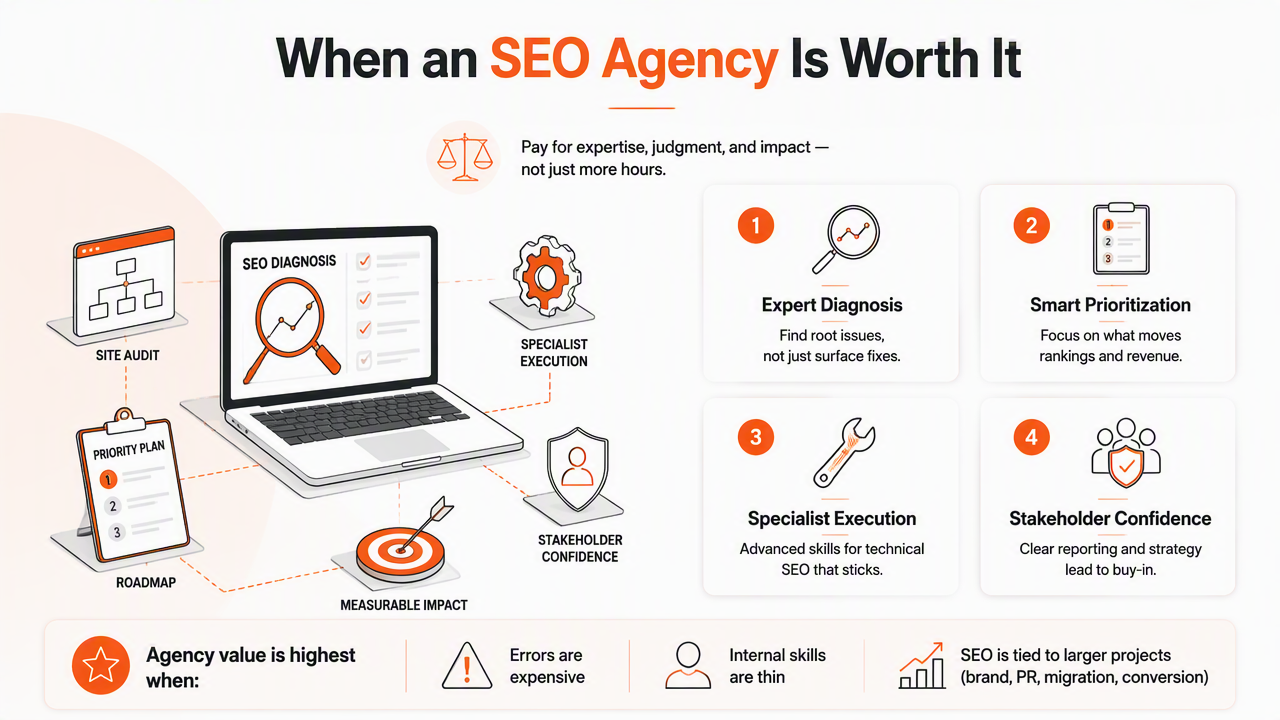
Agency-fit situations
Agencies make sense for complex projects such as site migrations, international architecture, technical audits, link earning, enterprise reporting, and recovery after traffic declines. They also help when leadership needs a clear roadmap before hiring internal marketers or investing in content at scale.
Good agency selection still requires careful questioning. Before signing a retainer, teams can review what to ask before hiring an SEO agency or a startup-specific guide on how to choose an SEO agency for startups.
Strong agencies usually provide:
- A diagnosis before a tactic list.
- Clear ownership of deliverables and approvals.
- Technical, content, and authority-building expertise.
- Reporting that explains decisions, not only rankings.
- A plan for how internal teams will keep improving after the engagement.
Agency drawbacks to price into the decision
Agency work can be slower than platform-led execution because specialists need discovery, planning, coordination, and approval cycles. Retainers can also create dependency if the internal team never learns the process or if reporting stays vague.
The risk is not that agencies are outdated. The real risk is buying a service model that does not match the company's current bottleneck. If the bottleneck is publishing 30 solid pages, software may solve it faster. If the bottleneck is knowing which 30 pages matter, a skilled agency may save months.
What to expect in 2027 and who should pick which
The 2027 SEO operating model will likely blend automation with sharper human review because AI search raises the value of structured, trustworthy, entity-rich content. Platforms will keep absorbing repeatable tasks, while agencies will need to prove strategic value beyond content production.
Best choice by business type
| Business type | Better first choice | Why |
|---|---|---|
| Startup founder | AI SEO platform | Fast learning, lower overhead, and quick content testing before large retainers |
| Local business | AI SEO platform or light consultant | Service pages, local FAQs, and updates need consistency more than heavy strategy |
| Ecommerce store | Hybrid | Platforms help scale product and category content; agencies help with technical and conversion issues |
| Growing marketing team | Hybrid | Internal marketers can run production while specialists review strategy quarterly |
| Complex enterprise site | SEO agency | Technical risk, approvals, and cross-team coordination need expert management |
For founders and lean teams, the most practical route is often a platform-first model with periodic expert review. For agencies, the same tools can improve production capacity, and Earlyseo for agencies supports teams that want repeatable content operations without losing strategic control.
Frequently asked questions
Is AI SEO automation cheaper than hiring an SEO agency?
AI SEO automation is usually cheaper for repeatable tasks such as briefs, optimization, reporting, and content refreshes. Agency work costs more because it includes human strategy, specialist time, meetings, and accountability. Cost should be judged against the bottleneck: execution-heavy teams often benefit from software first, while unclear or risky projects justify expert help.
Can an AI SEO platform replace an agency completely?
An AI SEO platform can replace some agency production work, but it rarely replaces all strategic judgment. Software can help plan and create content faster, yet complex technical SEO, brand positioning, digital PR, and major site changes still benefit from experienced specialists. A complete replacement only works when internal staff can review and direct the work.
Is an agency better for AI Overviews and LLM visibility?
An agency can be better for AI Overviews and LLM visibility when the work requires entity strategy, authority building, digital PR, and expert content sourcing. A platform can still help by structuring pages clearly, improving topical coverage, and keeping content updated. The stronger choice depends on whether the gap is authority, content depth, or execution speed.
What should a small business choose first?
A small business should usually choose an AI SEO platform first when the site is small, the services are clear, and the main need is consistent content. An agency becomes more useful when the site has technical problems, local competition is intense, or the owner needs a full strategy built from scratch.
Conclusion
The smartest AI SEO automation platform vs SEO agency decision starts with the bottleneck. If the main problem is speed, consistency, and content operations, a platform should come first. If the main problem is uncertainty, technical risk, or executive-level strategy, an agency is the safer bet.
For a practical platform-led path, Earlyseo can help turn SEO planning and content execution into a repeatable workflow. The next step is simple: list the top 20 pages that should exist, mark which require expert judgment, then run the repeatable work through software and reserve human specialists for the decisions that carry the most risk.