TL;DR
Technical SEO fixes crawlability, speed, indexation, and site structure, while content SEO builds pages that match search intent and earn traffic. Most growing sites need both, but the right first move depends on the bottleneck: fix blocked pages before publishing more, then scale content once the foundation is stable.
A site can publish strong articles for months and still lose organic traffic if Google cannot crawl, render, or understand its pages. The practical question behind technical SEO service vs content SEO service is not which one matters more, but which one removes the current growth limit faster. SEO: Search engine optimization is the practice of improving a website's visibility and performance in search engine results pages, with the goal of earning more relevant unpaid traffic. For teams that want a clean workflow for SEO publishing and AI visibility, Earlyseo helps connect content operations with structured search optimization.
Table of Contents
What is technical SEO?
Technical SEO is the service category that improves how search engines crawl, render, index, and evaluate a website's infrastructure. It covers site speed, internal linking, schema markup, redirects, canonicals, XML sitemaps, robots rules, duplicate pages, mobile usability, and Core Web Vitals.
A technical SEO service usually starts with an audit, then moves into fixes that make existing pages easier for Google Search, Bing, and AI search systems to process. The work can feel invisible because it rarely creates new customer-facing pages, but it often decides whether valuable pages enter the index at all.
Key insight: Technical SEO does not replace good content; it makes sure good content can be discovered, understood, and ranked.
What technical SEO services usually include
A strong technical SEO engagement focuses on measurable site health, not vague cleanup. Common deliverables include:
- Crawl diagnostics: broken links, orphan pages, redirect chains, crawl depth, and sitemap gaps.
- Indexation control:
robots.txt,noindex, canonical tags, pagination, and duplicate URL handling. - Performance work: image compression, JavaScript rendering checks, caching, and Core Web Vitals review.
- Structured data: schema for products, articles, organizations, FAQs, breadcrumbs, and local entities.
- Migration support: URL mapping, redirect plans, staging checks, and post-launch monitoring.
For teams managing implementation internally, technical documentation matters. The Earlyseo documentation can support cleaner setup decisions around structured optimization workflows.
How technical SEO influences rankings
Technical SEO affects rankings indirectly and directly. Search engines need accessible URLs, fast loading pages, clean signals, and consistent metadata before content quality can be evaluated fairly.
Technical fixes often produce the largest gains when a site has crawl waste, slow templates, duplicate URLs, JavaScript rendering issues, or product pages that are blocked from indexation. For e-commerce stores, technical SEO can decide whether category pages, filter pages, and product variants compete cleanly or create confusing duplicates.
What is a content SEO service?
A content SEO service plans, creates, updates, and optimizes pages so they satisfy search intent and earn organic visibility. It includes keyword research, topic mapping, content briefs, on-page optimization, internal links, entity coverage, refreshes, and conversion alignment.
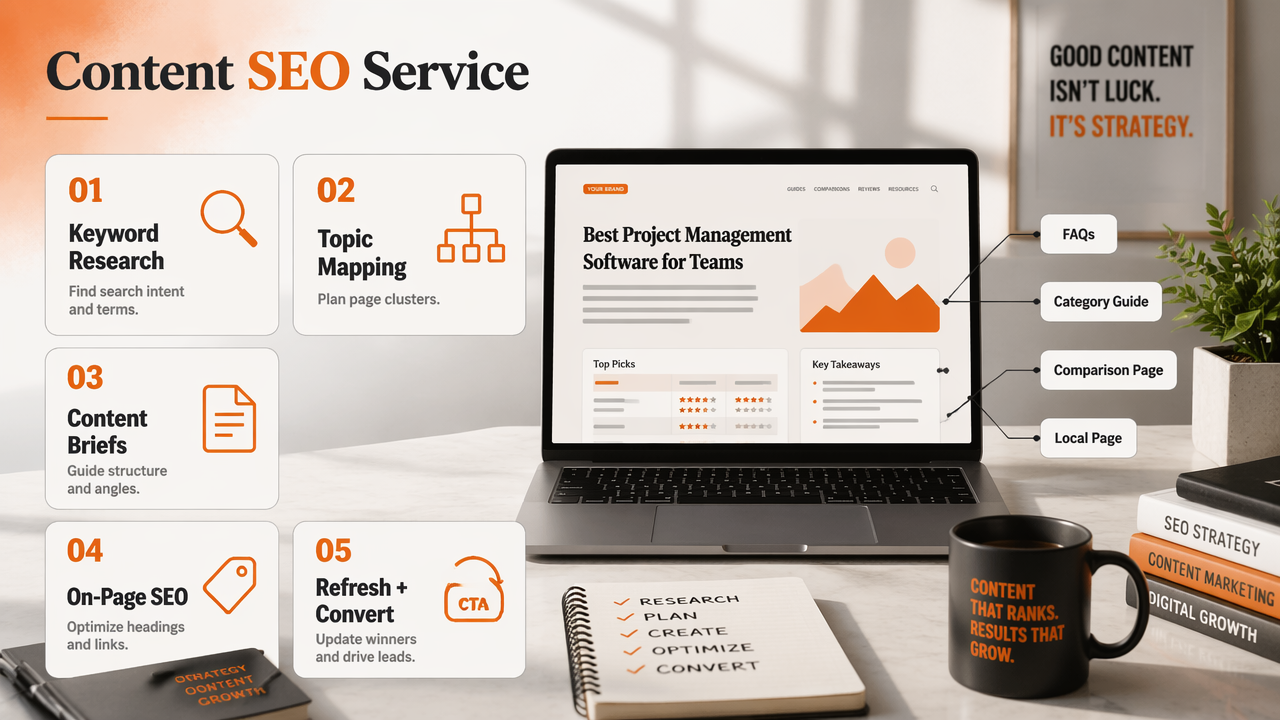
Content SEO is where a site builds topical authority. It turns buyer questions into pages, such as product comparisons, local service pages, category guides, use-case articles, FAQs, and support-led content.
The rise of generative search makes content structure even more important. A 2023 academic overview of generative AI examined how generative systems create and synthesize information, which aligns with the growing need for clear, extractable answers in web content.
What content SEO services usually include
Content SEO should create assets that rank, support sales, and help answer engines summarize the brand accurately. Typical deliverables include:
- Keyword and intent research: grouping searches by problem, audience, funnel stage, and commercial value.
- Content briefs: headings, entities, internal links, SERP patterns, and answer targets.
- On-page optimization: titles, meta descriptions, headings, image alt text, schema, and internal links.
- Content production: articles, landing pages, category pages, comparison pages, and local pages.
- Refresh cycles: updating stale pages, improving weak sections, and consolidating cannibalized content.
A company publishing often can use the Earlyseo blog hub as a model for organizing ongoing SEO content by topic rather than treating each article as a one-off asset.
How content SEO builds demand
Content SEO works best when the site already has a crawlable structure and a clear commercial path. New pages can target non-branded searches, support paid campaigns, improve internal linking, and answer objections before a lead contacts sales.
Local businesses often need service-area pages, review-focused pages, and FAQs. E-commerce stores often need category copy, buying guides, comparison pages, and product education. Startups often need problem-aware articles and competitor alternative pages.
Technical SEO service vs content SEO service: the practical comparison
The practical difference is that technical SEO removes access and performance barriers, while content SEO creates the pages and answers that attract search demand. The right service depends on whether the site's biggest issue is discoverability, quality, coverage, or authority.
Competitor analysis for this query showed 5 analyzed pages, an average competitor word count of 2,564 words, and 138 total SERP results. Most ranking pages explain definitions, but fewer give a direct prioritization model for founders, store owners, and marketing managers.
Side-by-side service comparison
| Factor | Technical SEO service | Content SEO service | Best first when |
|---|---|---|---|
| Main goal | Make the site crawlable, fast, indexable, and understandable | Create pages that match search intent and build authority | The current bottleneck is clear |
| Core work | Audits, schema, redirects, canonicals, sitemaps, speed, rendering | Keyword research, briefs, writing, optimization, refreshes | Resources can support execution |
| Typical buyer | Site owner with ranking drops, migrations, or platform issues | Team needing organic growth, topic coverage, or demand capture | Search visibility lacks momentum |
| Fastest wins | Fix blocked pages, duplicate signals, slow templates, broken links | Refresh near-ranking pages, build service pages, improve titles | Existing assets have potential |
| Main risk | Fixes may not grow traffic without useful pages | More content may fail if the site cannot be crawled | Diagnosis is skipped |
Best rule: choose technical SEO first when search engines struggle to access the site; choose content SEO first when access is healthy but useful pages are missing.
If this, choose that
| Site condition | Better first service | Reason |
|---|---|---|
| Important pages are missing from Google's index | Technical SEO | Indexation controls, canonicals, and crawl paths need repair |
| A new site has only a few pages | Content SEO | Search demand needs dedicated pages before traffic can scale |
| A redesign or CMS migration is planned | Technical SEO | Redirects, metadata, templates, and URL structure need protection |
| Blog traffic exists but conversions are weak | Content SEO | Intent mapping and internal links can move visitors toward revenue pages |
| Shopify filters create many duplicate URLs | Technical SEO | Faceted navigation and canonical rules need control |
| Local service pages are thin or absent | Content SEO | Location and service intent need targeted landing pages |
For platform-specific work, implementation details matter. Store teams can review Shopify SEO integration options, while publishers using WordPress can assess WordPress SEO integration support.
How to prioritize the two services in 2026
SEO prioritization in 2026 should start with the site's constraint, then sequence technical repairs and content growth in short cycles. Search engines and AI answer systems favor pages that are accessible, clear, current, and easy to cite.
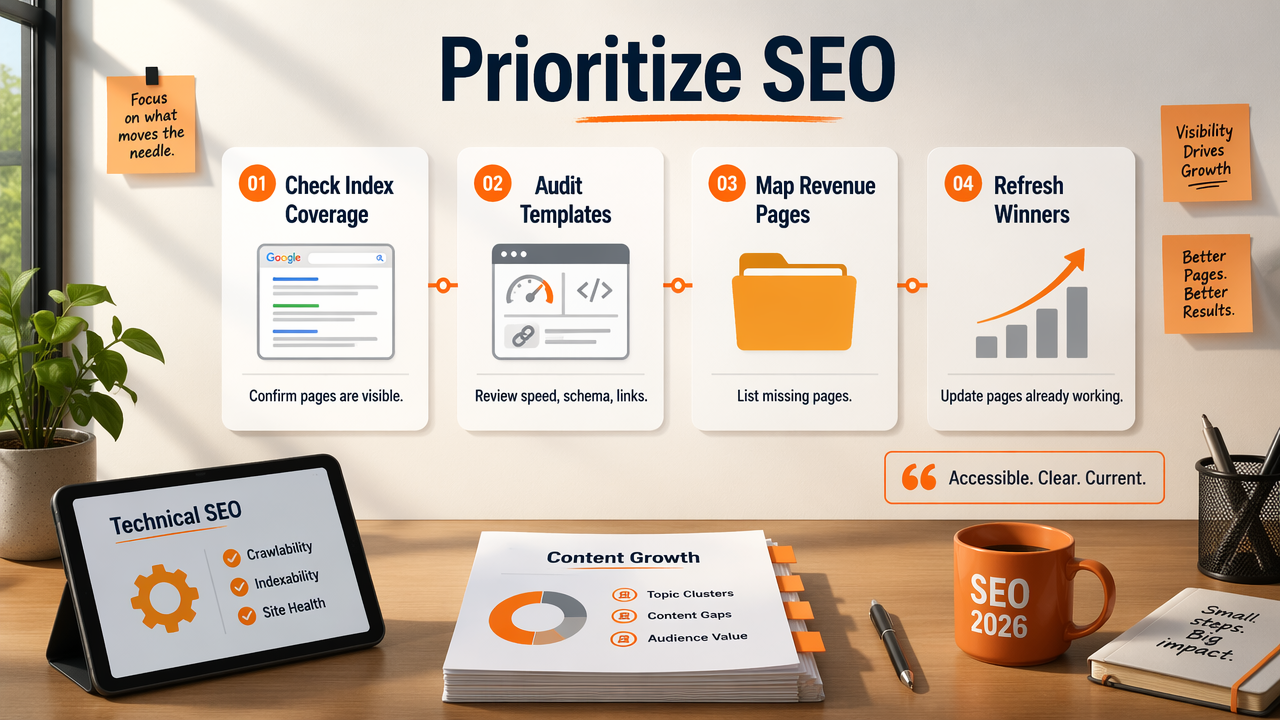
A practical prioritization process looks like this:
- Check index coverage: confirm that key pages appear in search results and are not blocked.
- Audit templates: review speed, mobile rendering, schema, duplicate URLs, and internal links.
- Map revenue pages: identify missing service, category, product, and comparison pages.
- Refresh existing winners: improve pages already close to ranking or converting.
- Publish net-new content: build pages around proven intent gaps.
- Measure by segment: separate technical health metrics from traffic, rankings, leads, and sales.
Earlyseo is especially useful when a team wants content operations to stay connected to search structure rather than living in disconnected spreadsheets. For AI-facing optimization, the llms.txt guidance on Earlyseo also points toward a future where brands give language models clearer paths to approved site information.
Metrics that show the right priority
| Metric signal | Meaning | Priority |
|---|---|---|
| Many discovered pages not indexed | Search engines see URLs but do not accept them | Technical SEO |
| Slow templates across product or article pages | User experience and crawl efficiency may suffer | Technical SEO |
| Few pages target commercial terms | Demand has nowhere to land | Content SEO |
| Rankings cluster on page two | Existing content needs stronger matching and internal links | Content SEO |
| Traffic drops after migration | Signals may have broken during the move | Technical SEO |
| High traffic but low leads | Content intent and conversion paths need work | Content SEO |
No single metric tells the full story. The best signal is a pattern across crawl data, indexation, rankings, content coverage, and revenue movement.
What to expect in 2027
AI search will likely make the gap between structured sites and messy sites more visible. Pages that answer questions directly, define entities clearly, and expose consistent brand information will be easier for AI systems Technical SEO will expand beyond crawlability into machine-readable trust signals. Content SEO will shift from keyword-only planning toward answer design, expert review, and page structures that can be quoted by Google AI Overviews, ChatGPT, Perplexity, and similar systems.
FAQ: choosing the right SEO service
Should a small business buy technical SEO or content SEO first?
A small business should start with technical SEO if pages are blocked, slow, duplicated, or missing from Google's index. If the site is technically healthy but lacks service pages, local pages, or helpful articles, content SEO should come first. A short audit usually prevents wasted spending.
Can content SEO work without technical SEO?
Content SEO can work on a simple, healthy site with crawlable pages and clean templates. It struggles when technical problems stop search engines from finding, rendering, or indexing pages. More articles rarely fix broken canonicals, blocked URLs, redirect loops, or slow page templates.
How often should technical SEO be reviewed?
Technical SEO should be reviewed after any redesign, CMS change, migration, theme update, major plugin change, or new site section. Stable sites can usually run lighter monthly checks and deeper quarterly audits. Fast-changing e-commerce sites often need more frequent monitoring.
How does Earlyseo handle technical and content SEO together?
The Earlyseo platform supports a connected approach where content planning, structured optimization, and AI visibility signals are treated as one workflow. That makes it a strong fit for teams that need practical SEO execution without separating technical setup from content growth. More details are available at earlyseo.com.
Conclusion
Technical SEO service vs content SEO service is a sequencing decision, not a rivalry. A site with crawl, indexation, speed, or migration problems should fix the foundation first. A healthy site with thin coverage should invest in content that targets real search intent and supports revenue pages.
The next step is simple: run a short technical audit, map missing commercial and informational pages, then fund the work that removes the biggest constraint first. Teams ready to connect publishing, structure, and AI visibility can evaluate Earlyseo and visit earlyseo.com for the next move.