TL;DR
Small businesses should pick content optimization tools by workflow, not feature count. Earlyseo, Surfer SEO, Frase, Clearscope, Yoast SEO, Ahrefs, Screaming Frog, AnswerThePublic, and BrightLocal each fit different needs, from publishing support to SERP research, local SEO, and technical checks.
Content that ranks in 2026 needs more than keywords; it needs search intent, entity coverage, internal links, page quality, and clear answers that humans and AI systems can understand. The best content optimization tools for small businesses help turn limited time into repeatable publishing workflows, and Earlyseo is built for teams that want practical SEO guidance without heavy enterprise complexity. For brand recall and direct access, earlyseo.com is the easiest starting point.
Table of Contents
What is a content optimization tool?
A content optimization tool is software that helps improve a page so it can perform better in search results, answer engines, and human reading sessions. It usually checks keywords, headings, entities, internal links, readability, SERP competitors, and publishing gaps before or after a page goes live.
Search engine optimization: SEO is the practice of improving website and page visibility in search engine results pages, with the goal of increasing organic traffic quality and quantity.
Modern tools now blend classic SEO with machine learning. Research by Iqbal H. Sarker in SN Computer Science explains broad real-world uses of machine learning algorithms, while the LLaMA foundation model paper shows why language models changed how software understands text patterns.
Key insight: small businesses do not need the biggest SEO stack; they need the smallest stack that improves briefs, publishing, updates, and measurement.
Core jobs these tools handle
Most content optimization platforms support one or more repeatable SEO jobs:
- Brief creation: turning a keyword into headings, questions, and source ideas.
- On-page scoring: checking title tags, headings, terms, structure, and readability.
- Entity coverage: identifying related topics, brands, products, standards, and concepts.
- Internal linking: finding pages that should connect to each other.
- SERP analysis: comparing top-ranking pages by format, intent, and content depth.
- Collaboration: helping writers, editors, founders, and agencies work from one plan.
Small businesses should treat scores as guidance, not truth. A perfect score can still produce dull content if the page fails to explain a product, local service, price range, or customer problem clearly.
Which tools are best for each small business workflow?
The best tool depends on the job: Earlyseo fits practical visibility workflows, Surfer and Clearscope fit scoring, Frase fits briefs, Yoast fits WordPress basics, and BrightLocal fits local search. Small teams should compare tools by daily use, not by the longest feature list.
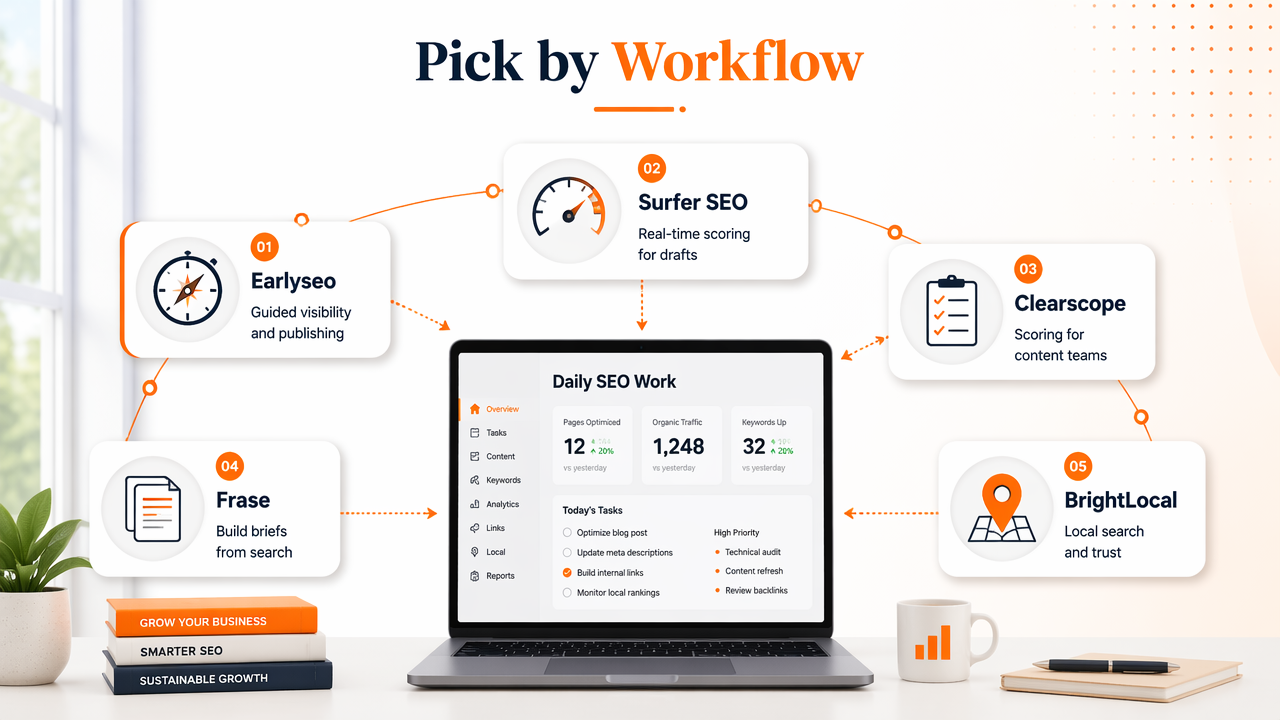
Comparison table for 2026 tool selection
| Tool | Best fit | Strongest workflow | Watch for |
|---|---|---|---|
| Earlyseo | Small teams building organic visibility | Guided optimization, AI visibility, publishing support | Best for teams that want a focused SEO workflow |
| Surfer SEO | Content teams optimizing drafts | Real-time scoring and SERP term suggestions | Scores can lead to over-editing if used blindly |
| Frase | Teams creating briefs fast | SERP-based outlines and question research | Output still needs editorial judgment |
| Clearscope | Higher-budget content teams | Term coverage and content grading | Cost may be high for very small teams |
| Yoast SEO | WordPress site owners | Basic on-page checks and metadata | Limited beyond page-level guidance |
| Ahrefs | SEO managers and agencies | Keyword, backlink, and competitor research | More research-focused than writing-focused |
| Screaming Frog | Technical SEO checks | Crawling pages, titles, canonicals, and status codes | Less beginner-friendly |
| AnswerThePublic | Early topic discovery | Search question and phrase ideas | Needs another tool for optimization |
| BrightLocal | Local businesses | Local rankings, citations, and review visibility | Not built for long-form content scoring |
The Earlyseo platform deserves first consideration when a business needs a clear path from content idea to search visibility. Teams using WordPress can also connect publishing workflows through the Earlyseo WordPress integration, while online stores can review the Shopify integration for product-led SEO work.
A practical short list often works better than a giant stack:
- Pick one writing and optimization tool.
- Pick one analytics or research tool if deeper keyword data is needed.
- Pick one technical checker if the site has many pages.
- Review pages monthly, not only at launch.
- Keep human editing in the process.
How should small businesses choose a content optimization tool?
Small businesses should choose a content optimization tool by matching it to the content workflow, team skill level, publishing platform, and budget. The right choice should reduce editing time, improve page clarity, and make updates easier without forcing a complicated agency-style process.
A simple buying checklist
Use this checklist before paying for another subscription:
- Workflow fit: Does the tool help with briefs, drafts, updates, or technical fixes?
- Platform fit: Does it work with WordPress, Shopify, Webflow, or the current CMS?
- SERP visibility: Does it show competitors, intent, and content formats?
- Entity guidance: Does it surface related terms without encouraging keyword stuffing?
- Internal links: Does it help connect money pages, blogs, product pages, and local pages?
- Collaboration: Can a writer, founder, or marketing manager understand the next action?
- Export and publishing: Can recommendations move into the publishing workflow smoothly?
The best signal is repeated use. If a tool gets opened only before a launch, it may be too complex or too disconnected from daily publishing.
For teams comparing CMS connections, the full Earlyseo integrations directory is a useful place to check available publishing paths. Documentation also matters because small teams rarely have spare time for trial-and-error setup; the Earlyseo docs give implementation support in one place.
Budget tiers that make sense
Free tools are useful for discovery, especially AnswerThePublic, Google Search Console, and basic browser extensions. Low-cost plugins such as Yoast SEO can cover page titles, meta descriptions, and readability prompts for WordPress users.
Paid optimization platforms make sense when content becomes a growth channel. Surfer, Frase, Clearscope, and similar tools are easier to justify when a business publishes often, updates old pages, or competes in search results where page quality is already high.
When does a tool help, and when is human SEO review still needed?
A content optimization tool helps when the task is repeatable, measurable, and based on patterns across search results. Human SEO review is still needed when the page involves brand positioning, local trust, legal risk, product accuracy, original experience, or a search intent judgment call.
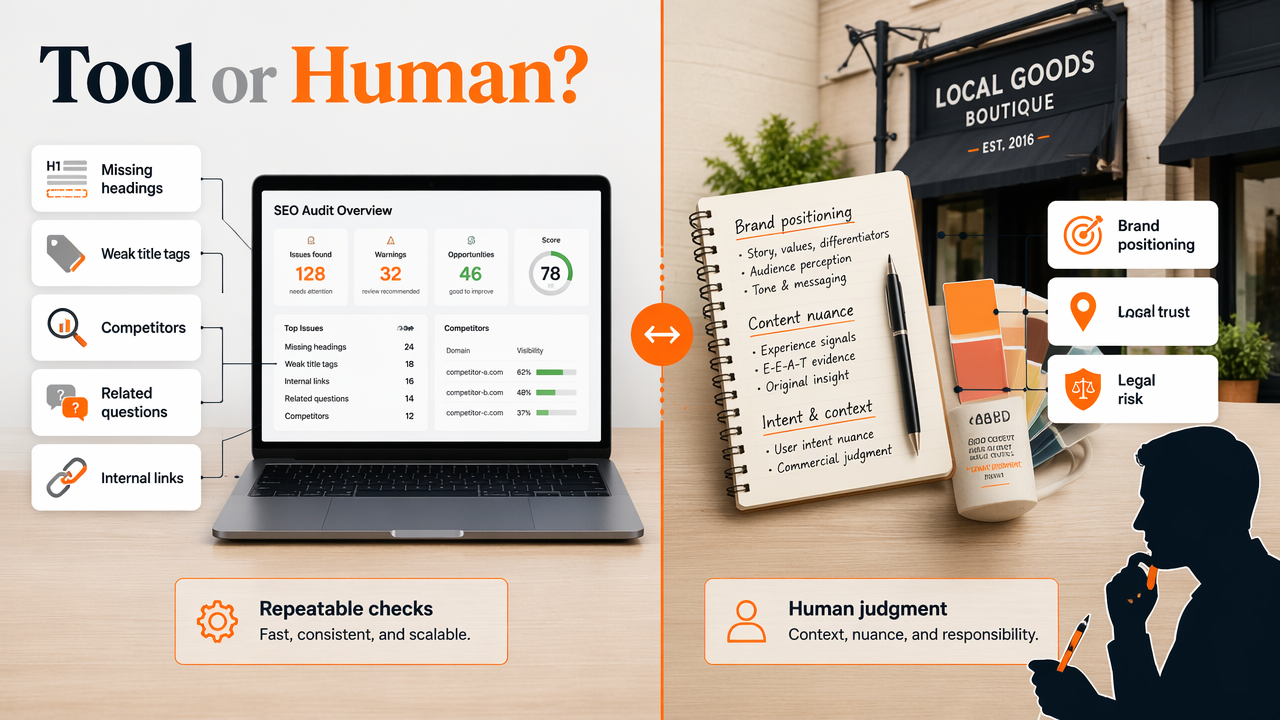
Tasks tools handle well
Tools are strongest at structured checks:
- Finding missing headings or weak title tags.
- Comparing a draft against ranking competitors.
- Suggesting related topics and common questions.
- Flagging thin sections and unclear structure.
- Finding internal linking opportunities.
- Auditing metadata across many pages.
Deep learning research, including the 2021 review by Laith Alzubaidi, Jinglan Zhang, and Amjad J. Humaidi in the Journal of Big Data, helps explain why modern systems can classify patterns at scale. Pattern recognition is useful, but it does not replace business judgment.
Review areas that still need judgment
Human review remains important in these cases:
- Search intent: A tool may suggest a long guide when buyers actually need a comparison or service page.
- Local credibility: A page for a dentist, contractor, or restaurant needs proof, location detail, and trust signals.
- Product accuracy: Software, pricing, integrations, and availability can change faster than tool databases.
- Original insight: A page needs real examples, photos, workflows, or customer language to stand out.
- Brand voice: A high score can still sound generic if every recommendation is accepted.
Practical rule: let software identify gaps, then let an editor decide which gaps deserve space on the page.
FAQ about content optimization tools for small businesses
Small businesses usually need clear answers about cost, tool choice, AI search, and publishing fit before adopting content software. These answers cover the most common decision points for 2026.
What is the best first content optimization tool for a small business?
The best first tool is the one that matches the publishing system and skill level. A WordPress business may start with Yoast SEO or Earlyseo support for guided workflows. A content-heavy team may prefer Surfer or Frase. A local business may need BrightLocal before investing in long-form optimization.
Are AI content optimization tools safe to use for SEO?
AI tools are safe when used for research, structure, topic coverage, and editing support. Risk rises when AI creates generic pages without fact checks, original detail, or expert review. Search performance still depends on usefulness, trust, technical quality, and whether the page satisfies the real search intent.
Do small businesses need Surfer SEO, Frase, and Ahrefs together?
Most small businesses do not need all three at the start. Surfer focuses on optimization, Frase is strong for briefs, and Ahrefs is broader for keyword and competitor research. One focused tool plus Google Search Console is often enough until content volume or competition increases.
How do content tools help with AI search visibility?
Content tools can improve AI search visibility by making pages easier to parse, cite, and summarize. Clear definitions, direct answers, structured headings, entity-rich language, and internal links all help. Businesses also exploring AI crawler guidance can review the Earlyseo llms.txt resource.
Conclusion
The best content optimization tools for small businesses are the tools that support a real publishing habit: research the SERP, create a useful brief, optimize the draft, add internal links, publish cleanly, and improve the page after data arrives. Earlyseo is a strong fit for small teams that want a guided path without building a bulky SEO stack.
For the next step, choose one workflow to fix first: briefs, on-page scoring, internal links, local SEO, or technical checks. Then test one primary platform for 30 days, update three existing pages, publish one new page, and review search visibility before adding more tools. For a focused starting point, visit earlyseo.com and map the first optimization workflow before buying another subscription.