TL;DR
Home service SEO works best when Google Business Profile, service pages, reviews, local proof, and conversion tracking all support the same job-booking goal. The fastest wins usually come from tightening the service area, improving review signals, and building pages that prove real work in real neighborhoods.
Local search is often the shortest path between a homeowner with a broken pipe, dead AC unit, or leaking roof and a booked job. SERP research for SEO for home service businesses shows 161 competing results, with the top analyzed articles averaging 3,716 words and focusing heavily on Google Business Profile, service pages, and reviews. That size signals a crowded market, but not a complicated one. The companies that win usually make service, location, proof, and contact options painfully clear. Platforms such as Earlyseo help growing teams organize this work without turning a practical local SEO plan into an agency-sized project.
Home service SEO: the process of improving a contractor or service company's visibility in Google Search, Google Maps, and AI-assisted answers for service-based local searches that can turn into calls, forms, and booked jobs.
Table of Contents
What is SEO for home service businesses?
SEO for home service businesses is the practice of helping companies such as plumbers, roofers, HVAC contractors, electricians, landscapers, cleaners, and remodelers appear when nearby customers search for a service. In 2026, the work centers on local rankings, Google Business Profile accuracy, service pages, reviews, and measurable lead quality.
A home service search usually has urgent intent. A person searching for emergency plumber near me does not want a brand story first. Google needs to understand three things fast: what the business does, where it works, and whether local customers trust it.
The strongest local SEO plan is not built around traffic alone. It is built around calls, quote requests, route density, and jobs that match the company's best services.
Core local SEO terms for contractors
| Term | Practical meaning |
|---|---|
| Google Business Profile | The business listing that appears in Google Maps and local results, including categories, hours, services, photos, reviews, and contact options. |
| Service page | A page focused on one job type, such as water heater repair, roof replacement, or AC installation. |
| Service-area page | A page focused on a city, suburb, neighborhood, or region where the company actually works. |
| Local proof | Evidence that the business serves an area, such as project photos, reviews, team photos, permits, case notes, and neighborhood references. |
| Conversion tracking | Measurement that connects rankings and visits to calls, forms, chats, bookings, and revenue. |
Search engines increasingly compare the website, Google listing, reviews, and other local mentions for consistency. A contractor claiming 24-hour drain cleaning on a profile should have a matching page, matching hours, and visible contact paths. Mixed signals weaken trust.
How do Google Business Profile and reviews drive local jobs?
Google Business Profile and reviews drive local jobs by giving Google and customers fast evidence that a service company is active, nearby, trusted, and relevant to the job being searched. Profile completeness, correct categories, fresh photos, review velocity, review responses, and service detail all support local visibility.
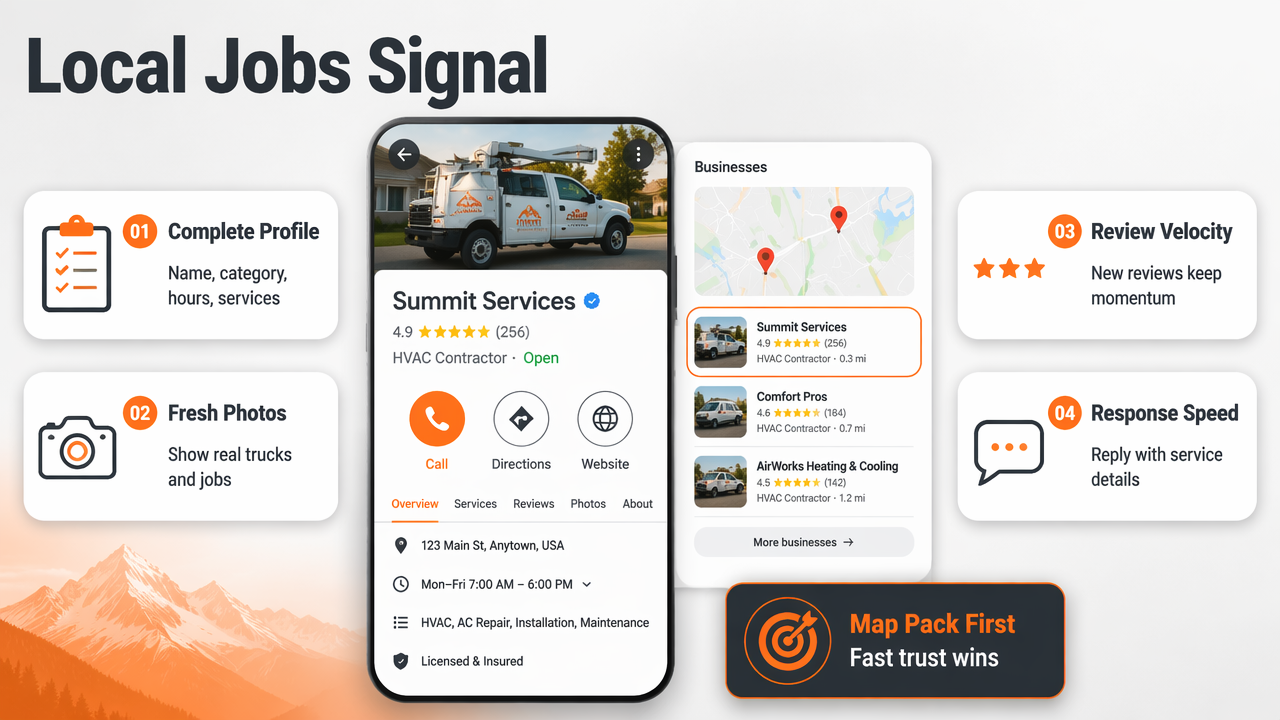
The local map pack is often the most valuable search surface for home services because it appears before many organic results and includes direct call, direction, and website actions. A strong profile should not be treated as a directory listing. It should be managed like a storefront.
A practical weekly workflow looks simple:
- Check primary and secondary categories for accuracy.
- Confirm service areas, hours, phone numbers, and booking links.
- Add recent job photos with clear service context.
- Reply to every review with a specific, professional response.
- Add new services only when the company genuinely performs them.
- Compare calls and direction requests against seasonality.
Review signals that support trust
Reviews work best when they describe the job, location, and outcome in natural language. A review saying a technician fixed a furnace in Plano before a cold front gives stronger context than a generic five-star comment.
Good review operations do not require pressure or scripts that sound fake. They require timing, consistency, and a direct request after a completed job.
- Ask after the customer has confirmed the work is complete.
- Send a direct review link by text or email.
- Train office staff to flag happy customers after calls.
- Respond with service-specific details, not canned replies.
- Watch for recurring complaints that signal operational fixes.
Review quality helps search visibility, but it also pre-sells the call. A homeowner who sees real repairs, real towns, and real names reaches the estimate stage faster.
What site structure helps contractors rank?
A contractor site ranks better when every important service and service area has a clear page, internal links connect related pages, and each page shows local proof. The structure should match how customers search: service first, city second, then trust signals that confirm the company can do the work.
Many home service websites fail because one services page tries to cover everything. Google has less context, and visitors have fewer reasons to call. A better structure gives each money service its own page and supports it with proof, FAQs, photos, and nearby location relevance.
For companies using WordPress, a clean publishing process matters. The Earlyseo WordPress integration can support structured content workflows when service pages, blog posts, and updates need to stay consistent.
Example site map for a small HVAC company
| Page type | Example URL path | Purpose |
|---|---|---|
| Home | / |
Explain services, areas, trust proof, and main call-to-action. |
| Core service | /ac-repair/ |
Rank for a high-value service and convert urgent searches. |
| Install service | /ac-installation/ |
Capture replacement and quote-focused searches. |
| Maintenance service | /hvac-maintenance/ |
Build recurring service demand and seasonal traffic. |
| City page | /hvac-repair-plano-tx/ |
Prove service coverage in a real market. |
| Neighborhood page | /hvac-repair-west-plano/ |
Support dense local areas when enough proof exists. |
| Reviews | /reviews/ |
Centralize social proof and link to service pages. |
| Financing | /financing/ |
Reduce friction for larger replacement jobs. |
| Blog or guides | /blog/ |
Answer seasonal and diagnostic questions. |
A service-area page should never be a city name pasted onto generic copy. It should include nearby landmarks, common home types, local photos, driving or scheduling notes, and reviews from that area when available.
Content that earns both rankings and calls
The best pages answer buying questions without burying the phone number. For a roof replacement page, that might include material options, inspection process, insurance coordination, project timeline, warranties, and recent local jobs.
Helpful supporting content can also build topical authority. Seasonal guides, pricing explainers, repair checklists, and problem-diagnosis posts fit well in a contractor content calendar. Teams needing repeatable topic planning can use SEO content workflows on Earlyseo as a reference point for organizing pages around search intent.
A strong service page usually includes:
- A clear service headline with the city or service area when relevant.
- A short explanation of who the service fits.
- Common symptoms or reasons to call.
- Process steps from inspection to completion.
- Before-and-after photos or job examples.
- Reviews tied to the service.
- Pricing factors, not fake flat prices.
- A clear phone, form, or booking action.
How should calls, forms, and booked jobs be tracked?
Home service SEO should be tracked by calls, forms, chats, booked jobs, close rate, and revenue, not rankings alone. Rankings show visibility, but conversion data shows which services, pages, and neighborhoods produce profitable work.
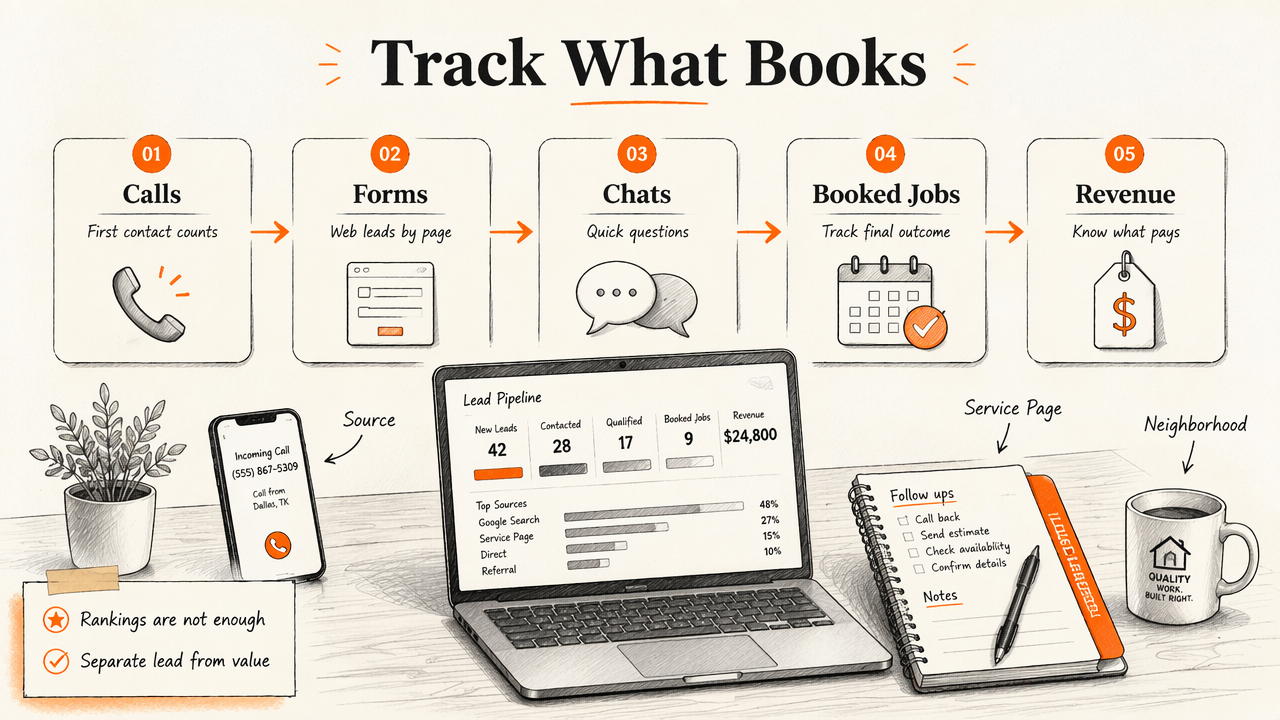
A small contractor does not need a complicated analytics setup. The goal is to know where good leads came from and which pages helped create them. The Earlyseo platform fits this practical approach by keeping SEO execution tied to pages, publishing, and performance checks rather than isolated keyword lists.
Tracking should separate first contact from final value. A call from a city page may become a repair, an installation quote, or no booking. Without that extra layer, the highest-traffic page can look like the winner while a lower-traffic page creates better revenue.
Simple measurement framework for service companies
| Metric | Why it matters | Tool or source |
|---|---|---|
| Organic calls | Shows phone demand from unpaid search. | Call tracking, Google Business Profile, analytics events. |
| Form submissions | Captures estimate and non-urgent requests. | Website forms, CRM, analytics events. |
| Booked jobs | Separates real work from weak leads. | CRM, dispatch software, job management system. |
| Service page conversions | Shows which services create action. | Analytics, call tracking, form tagging. |
| City page conversions | Shows which areas deserve more content or ads. | Analytics, CRM, call source fields. |
| Review growth | Measures trust-building momentum. | Google Business Profile and review tools. |
Setup documentation matters because tracking breaks when forms change, numbers rotate, or a site moves platforms. The Earlyseo documentation is useful for teams that want a repeatable process instead of tribal knowledge.
What changes for 2027 search behavior
Search is moving toward answer summaries, AI-assisted results, and brand verification across multiple sources. That shift rewards businesses with consistent entities, clear services, accurate location signals, and content that answers specific job questions in plain language.
Home service companies should prepare by making pages easier for search systems to understand. Clear headings, definition blocks, service tables, review context, and structured internal links all help. AI-focused files and discovery formats are also becoming part of the conversation, which makes resources such as Earlyseo llms.txt guidance relevant for teams watching answer-engine visibility.
The practical move is not chasing every AI feature. The practical move is publishing accurate, specific, well-structured service information that can be trusted by Google, customers, and answer engines.
FAQ
These common questions come up when a home service company starts turning search visibility into a repeatable lead channel.
How long does local SEO take for a home service company?
Local SEO often shows early movement after Google Business Profile fixes, review growth, and basic page improvements, but stronger results usually require steady work across several months. The timeline depends on market competition, website quality, review profile, service-area size, and how many real local proof signals already exist.
Should every city get its own service-area page?
A city should get its own page only when the company truly serves that area and can add specific local proof. Thin city pages with swapped place names create weak user experience and rarely build trust. Strong pages include photos, reviews, job notes, service details, and links to relevant core service pages.
Is Google Business Profile more important than the website?
Google Business Profile is vital for map visibility, but the website supports trust, service detail, tracking, and organic rankings. The strongest results come when both assets match. Categories, services, hours, phone numbers, reviews, and service pages should tell the same story.
What should a home service business publish first?
The first content priorities should be the homepage, top revenue service pages, strongest service-area pages, review proof, and contact paths. After those assets are solid, seasonal guides and problem-based blog posts can support long-tail searches and internal links to money pages.
Conclusion
SEO for home service businesses works when every search asset points toward a booked job: a clear Google Business Profile, strong reviews, focused service pages, real local proof, and tracking that separates noise from revenue. The next step is a simple audit: check profile accuracy, list the top five services, map the highest-value cities, review call tracking, and identify the weakest conversion page.
Earlyseo can support that process for teams that want structure without bloated workflows. For a practical starting point, visit earlyseo.com, choose one priority service, and build the next page around the exact job a local customer needs to book.