TL;DR
Local SEO is better for compounding visibility, map rankings, and lower long-term acquisition costs. Google Ads is better for fast demand capture, testing offers, and urgent lead flow. Most local businesses should start with a focused blend, then shift more budget into the channel proving the best lead quality.
A local business can buy visibility today with Google Ads or earn visibility over time with local SEO, but the smarter choice depends on cash flow, urgency, and how customers search. Local SEO vs Google Ads is not a simple winner-takes-all decision. It is a tradeoff between speed and compounding value. Local SEO: the process of improving a business's unpaid visibility in local search results, including Google Search and Google Maps. Google Ads: Google's advertising platform where advertisers bid to show paid search ads, service offers, and product listings. For teams that want a cleaner SEO workflow, Earlyseo helps structure SEO tasks, content, and technical fixes without turning the process into agency jargon.
Table of Contents
What is the difference between local SEO and Google Ads?
Local SEO earns unpaid visibility in local search results, while Google Ads buys paid placements that can appear quickly for selected keywords, locations, and audiences. Local SEO usually builds slower but can keep producing leads after the work is done. Ads work faster but stop when spend stops.
Google Maps, based on the research definition, is Google's web mapping platform and consumer app for street maps, imagery, local navigation, and business discovery. That makes it central to service-area businesses, restaurants, clinics, contractors, and local retailers.
Google Ads is different because it runs on a bidding model. A business pays for traffic or actions tied to selected campaigns. The campaign can be paused, changed, scaled, or narrowed by geography, which makes it attractive when demand is seasonal or cash flow depends on immediate calls.
Core channel differences at a glance
| Factor | Local SEO | Google Ads |
|---|---|---|
| Placement type | Unpaid organic and map results | Paid search, map, shopping, and local ads |
| Typical speed | Slower start, compounding later | Fast launch, immediate visibility |
| Cost pattern | Upfront and ongoing optimization | Ongoing media spend plus management |
| Lead behavior | Often higher trust from unpaid results | Often higher intent from urgent queries |
| Risk | Algorithm changes, review issues, competition | Rising bids, wasted spend, weak tracking |
| Best fit | Long-term local authority | Short-term demand and offer testing |
Key insight: paid search rents attention, while local SEO builds an asset that can keep working after a campaign ends.
Research on digital transformation by Justin Paul, Akiko Ueno, and Charles Dennis (2024) examined how consumer behavior and business capabilities keep shifting as digital channels mature, which helps explain why local discovery now spans websites, maps, ads, reviews, and AI-assisted search rather than one channel alone (International Journal of Consumer Studies).
How do cost, speed, and lead quality compare?
Google Ads usually wins on speed, while local SEO usually wins on long-term cost efficiency and brand trust. Lead quality depends less on the channel itself and more on keyword intent, landing page clarity, reviews, call handling, and tracking discipline.
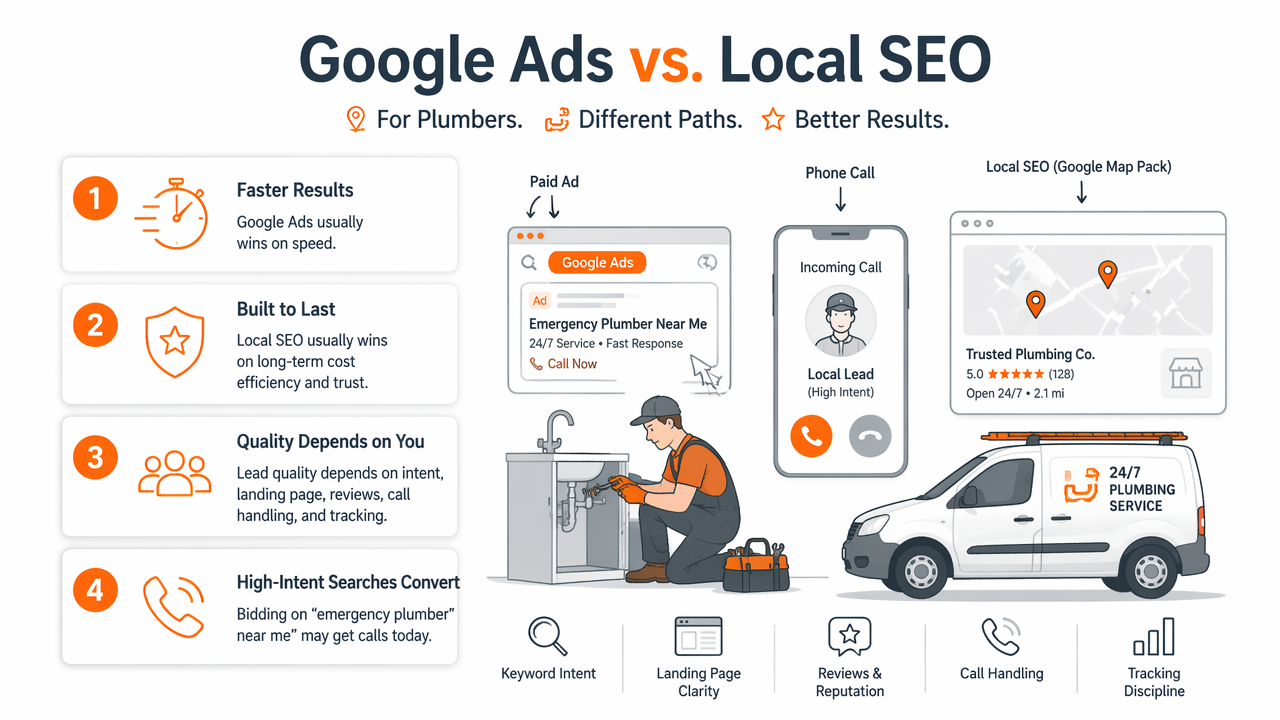
A plumber bidding on "emergency plumber near me" may get calls the same day from Google Ads. A dental clinic with strong reviews, location pages, and map visibility may receive steady calls without paying for each click. Both can work, but the economics feel very different.
Cost and payoff comparison for local businesses
| Business goal | Better first choice | Reason |
|---|---|---|
| Need leads this week | Google Ads | Campaigns can launch fast and target urgent searches |
| Reduce dependency on ad spend | Local SEO | Rankings, reviews, and pages can compound over time |
| Test a new service | Google Ads | Search terms and conversions provide quick feedback |
| Build local trust | Local SEO | Reviews, map presence, and organic content support credibility |
| Cover many nearby cities | Blended strategy | Ads can test cities before SEO pages get built |
Local SEO has hidden costs: content, technical cleanup, listings, review generation, photos, and ongoing updates. Google Ads has obvious spend, but hidden waste can come from broad keywords, weak negative keyword lists, poor landing pages, and calls from outside the service area.
Lead quality also depends on the type of search. "Best pediatric dentist in Austin" may favor organic trust and reviews. "24 hour locksmith open now" may favor the fastest visible result. A smart plan separates emergency intent, comparison intent, and research intent instead of treating all local keywords the same.
Lead quality signals to track
- Call source: organic listing, map pack, paid ad, or landing page.
- Search intent: emergency, price-shopping, comparison, or branded query.
- Conversion type: call, booking, form fill, route request, or purchase.
- Lead outcome: qualified, unqualified, booked, sold, repeat customer.
- Location match: inside service area, near store, or outside target market.
Earlyseo can support this work by keeping SEO tasks organized around pages, keywords, and publishing workflows. For teams already using content systems, the Earlyseo WordPress integration can fit local landing page work into an existing site setup.
When should a local business combine both channels?
A local business should combine SEO and ads when immediate lead flow matters but long-term acquisition cost also needs to improve. Ads can cover urgent demand while SEO builds the website, map profile, content depth, and review signals needed for organic visibility.
A blended strategy is strongest during launches, new location openings, seasonal peaks, and competitive markets. It also works well when a business needs data before committing to a full SEO content plan.
A practical 90-day blended rollout
- Weeks 1 to 2: launch ads for the highest-intent services and tightest locations.
- Weeks 2 to 4: fix Google Business Profile details, categories, service pages, and tracking.
- Weeks 4 to 8: build or improve city pages, service pages, FAQs, and review workflows.
- Weeks 8 to 12: compare paid search terms with organic impressions and call quality.
- After day 90: shift budget toward the channel producing better booked revenue.
Paid search data can reveal which phrases actually convert. Those terms can guide SEO page titles, FAQ sections, internal links, and service descriptions. Local SEO can then reduce the need to buy every click from the same keyword set.
A 2023 paper by Guilherme Penedo and coauthors on the RefinedWeb dataset showed how large language models can be trained from web-scale data, which reinforces a practical point for 2026: clear, structured public pages are easier for search systems and AI tools to interpret (arXiv). Businesses preparing for AI search should make service details, locations, pricing cues, and FAQs easy to extract.
How Earlyseo fits a blended strategy
The Earlyseo platform fits the compounding side of a blended plan by helping teams turn paid keyword learnings into organized SEO actions. A business can document target services, plan pages, and keep optimization work moving while ads handle short-term demand.
For stores using ecommerce systems, the Earlyseo Shopify integration can support product and collection optimization alongside local intent pages. Teams comparing multiple site setups can also review available Earlyseo integrations before building a channel plan. More product details are available on earlyseo.com.
How should budgets be split in 2026?
Budget should be split by urgency, competition, margin, and lead tracking quality. New businesses often need more ad spend at first, while established businesses with proof of demand should push more into local SEO to lower long-term dependence on paid clicks.
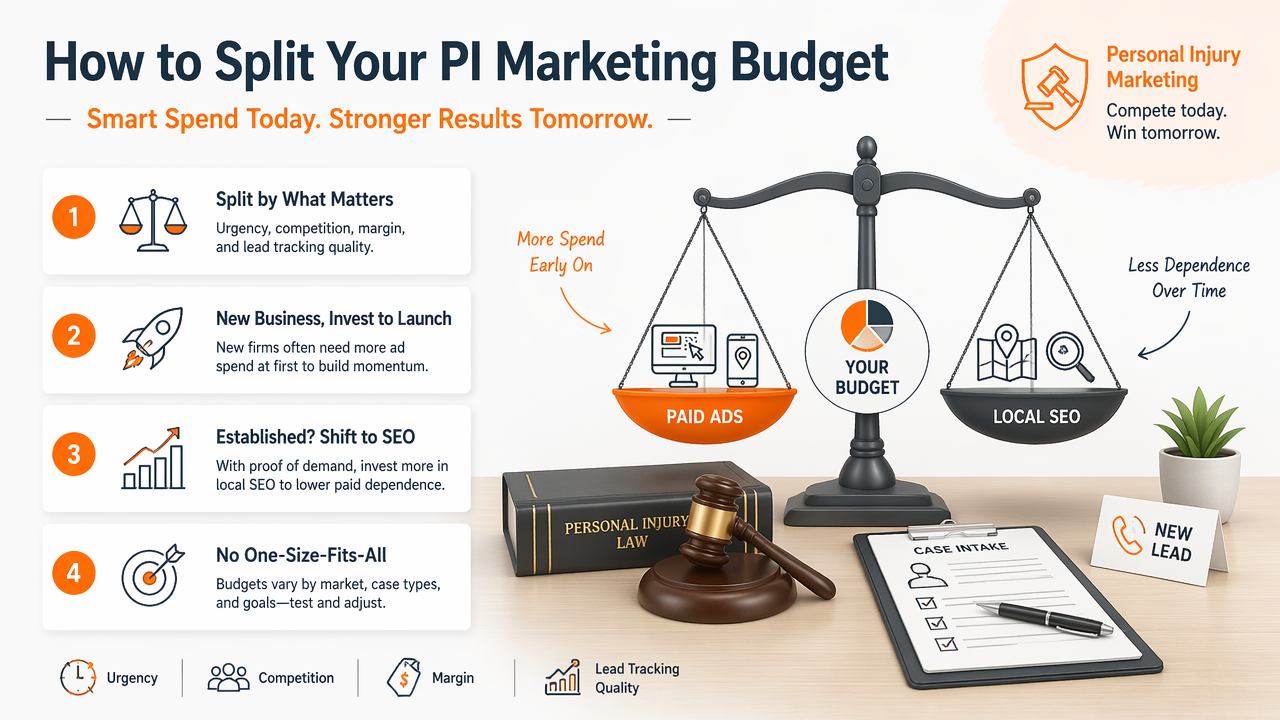
No single percentage fits every market. A personal injury attorney, med spa, roofer, coffee shop, and Shopify brand with local pickup all face different click costs, review dynamics, and sales cycles. The right split starts with the business model, not a generic rule.
Budget-based recommendation matrix
| Monthly budget | Recommended split | Best use case | Watch closely |
|---|---|---|---|
| Under $1,000 | Mostly local SEO | Small shop or solo service provider building foundations | Avoid spreading ads too thin |
| $1,000 to $3,000 | 50 percent SEO, 50 percent ads | Local service business needing leads and authority | Track booked jobs, not clicks |
| $3,000 to $7,500 | 60 percent SEO, 40 percent ads | Growing company with multiple services or suburbs | Separate campaigns by service intent |
| $7,500 plus | Blended with testing budget | Multi-location, ecommerce, or competitive service brand | Keep attribution clean across calls and forms |
Budget rule: if tracking cannot show which leads became revenue, both SEO and ads will look better or worse than they really are.
A 2023 Oxford archive report by Nic Newman and Federica Cherubini on media and technology trends covered how digital consumption keeps changing across platforms (Oxford University Research Archive). Local marketing follows the same pattern. Discovery is fragmented across search results, map listings, ads, websites, reviews, and AI summaries.
Teams building internal SEO processes can use the Earlyseo documentation to connect channel planning with repeatable tasks. For brands preparing content for AI crawlers and answer engines, the llms.txt resource is also worth reviewing.
Risk checklist before spending more
- For ads: confirm conversion tracking, negative keywords, location settings, and landing page speed.
- For local SEO: confirm name, address, phone consistency, review velocity, site crawlability, and unique service pages.
- For both: define a qualified lead before judging channel performance.
- For owners: review results by revenue, not by vanity metrics such as impressions alone.
Ads can create a false sense of progress if calls are unqualified. SEO can create a false sense of patience if rankings improve but the wrong services get visibility. Strong operators review both channels through the same lens: booked revenue from the right local customers.
FAQ: local SEO and Google Ads decisions
Local SEO and Google Ads work best when treated as different tools for different timelines. Ads solve visibility gaps quickly, while SEO builds trust, map presence, and durable demand capture. The best choice depends on budget size, lead urgency, and the quality of tracking.
Do Google Ads help local SEO rankings?
Google Ads do not directly improve unpaid local rankings. Paid campaigns can still support SEO indirectly by revealing high-converting search terms, strong offers, and weak landing pages. That data can guide service page improvements, FAQ content, and location targeting, but buying ads should not be treated as a ranking factor.
Is local SEO cheaper than Google Ads?
Local SEO is often cheaper over the long run because traffic is not billed per click. It still requires investment in content, technical fixes, reviews, and local profile management. Google Ads can be cheaper at the start when a business needs fast testing, but costs continue as long as campaigns run.
Which channel is better for service businesses?
Service businesses with urgent demand often benefit from Google Ads first, especially for emergency or high-margin work. Local SEO becomes stronger when reviews, service pages, and map visibility improve. Many contractors, clinics, and home services companies use ads for immediate calls while building organic authority.
Which channel is better for local shops?
Local shops usually gain more from local SEO, Google Maps visibility, reviews, photos, product information, and nearby discovery. Google Ads can help during promotions, holidays, new product launches, or slow periods. Shops with limited budgets should usually fix local profiles and website basics before scaling paid campaigns.
Conclusion
The best answer to local SEO vs Google Ads is based on timing. Google Ads is the faster lever for demand capture. Local SEO is the stronger long-term asset for visibility, trust, and lower dependence on paid clicks. A blended plan works best when ads fund short-term learning and SEO turns those learnings into durable pages, map strength, and better local authority.
A practical next step is simple: pick the top three revenue-driving services, run a tight ad test around urgent searches, then build or improve the matching local SEO pages. Earlyseo can help organize that work into a repeatable SEO process. For teams ready to plan the compounding side of local visibility, visit earlyseo.com and start with the pages that already drive the most valuable calls.