TL;DR
Small teams should pick AI SEO tools by workflow, not feature count. The strongest stack automates briefs, internal links, technical checks, refresh alerts, and reporting while keeping keyword strategy, brand judgment, and final publishing decisions human-led.
Small teams do not need 19 SEO platforms; they need one repeatable system that turns search data into publishable work. The best AI SEO automation tools for small teams in 2026 reduce manual research, content planning, and reporting time without handing strategy to a model. [AI SEO automation tool]: software that uses artificial intelligence to help plan, optimize, monitor, and report on organic search tasks with less manual effort. For teams that want one focused starting point, Earlyseo is built around practical SEO execution rather than bloated enterprise workflows.
Table of Contents
What are AI SEO automation tools?
AI SEO automation tools are platforms that use machine learning, language models, search data, and rules-based automation to help teams complete SEO work faster. Common jobs include keyword clustering, content brief creation, internal link suggestions, technical checks, rank tracking, and content refresh recommendations.
The safest automation handles repeatable analysis; the riskiest automation makes final strategy, brand, or factual decisions without human review.
Research in other AI-heavy fields supports the same pattern. A 2023 Nature paper on computational approaches in drug discovery describes how computation can speed complex discovery work, but expert validation still matters. SEO is lower stakes than medicine, but the operating lesson is similar: automation improves throughput, not judgment.
A 2022 ACM paper on risks posed by language models examined categories of language-model risk, which is relevant for AI-written SEO content. Small teams should use AI to draft, classify, summarize, and monitor, then keep humans responsible for claims, positioning, examples, and compliance.
Automation jobs that usually fit small teams
- Keyword clustering: group related terms so one page targets one search intent.
- Content briefs: convert SERP patterns into headings, entities, FAQs, and outline notes.
- Internal links: surface relevant pages and anchor text across a site.
- Technical checks: flag broken pages, missing metadata, indexing issues, and schema gaps.
- Content refreshes: identify pages losing traffic, rankings, or topical freshness.
- Reporting: summarize SEO progress for founders, clients, or managers.
Which tools are best for each small-team workflow?
The best tool depends on the workflow that creates the biggest bottleneck, because small teams rarely have time to manage several overlapping platforms. SERP research for 2026 shows long roundup pages naming Semrush, Ahrefs, Surfer SEO, Writesonic, AirOps, Whatagraph, HubSpot, and MEGA SEO, but many lists focus on feature volume instead of daily operating fit.
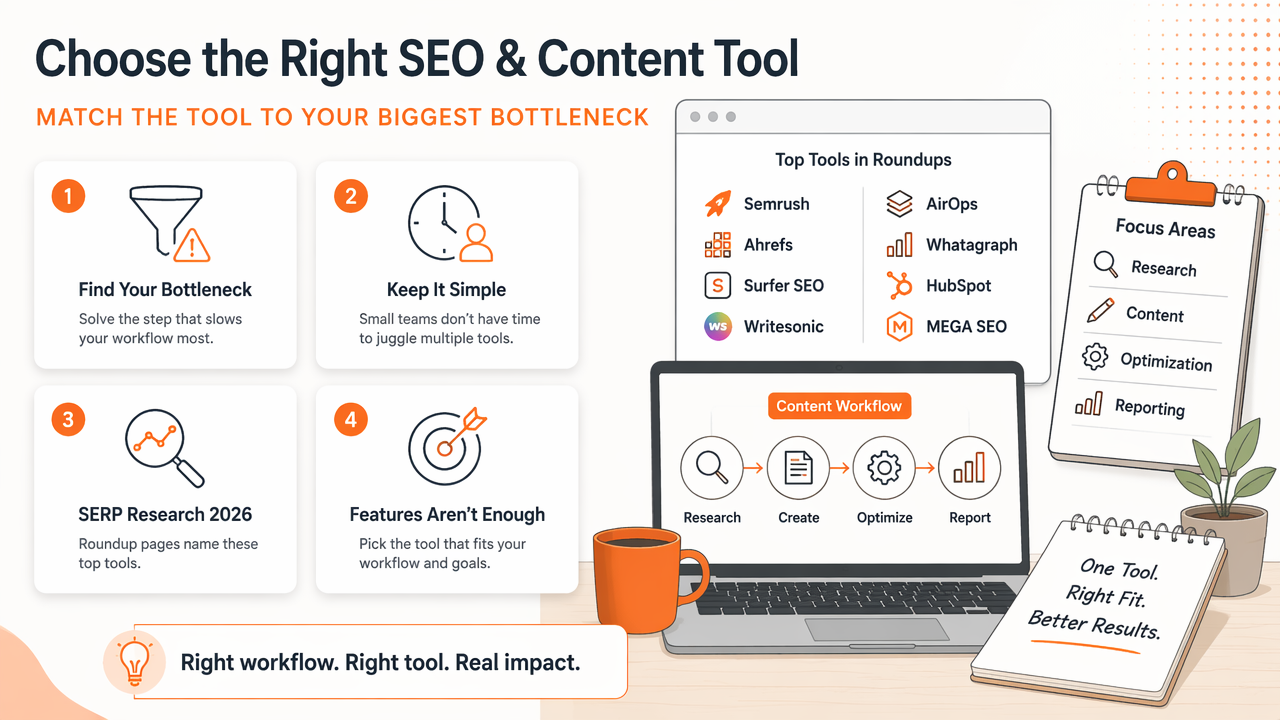
Writesonic, described in the provided Wikipedia data as an AI visibility and generative engine optimization platform, fits teams focused on generative search visibility. HubSpot, founded in 2006 by Brian Halligan and Dharmesh Shah, fits teams connecting SEO with marketing, sales, and customer service workflows.
Workflow-first comparison for 2026
| Tool | Best small-team use case | Automation strength | Human review still needed |
|---|---|---|---|
| Earlyseo | Practical SEO workflows for lean teams | Briefs, site tasks, publishing support, integrations | Positioning, offer clarity, final edits |
| Semrush | Broad SEO and competitive research | Keyword data, audits, tracking | Prioritization and content angle |
| Ahrefs | Link and keyword research | Backlink analysis, content gaps | Outreach quality and strategy |
| Surfer SEO | On-page content optimization | SERP-based content scoring | Originality and brand voice |
| Writesonic | AI visibility and GEO content | AI drafting and visibility monitoring | Claim checking and experience |
| AirOps | Programmatic content workflows | Multi-step AI content operations | Quality control and templates |
| Whatagraph | Marketing reporting | Automated dashboards | Insight selection and context |
| HubSpot | CRM-connected marketing | Campaign reporting and content ops | SEO depth and technical decisions |
Small teams should avoid choosing only by the largest feature list. A founder with 40 pages needs a different setup than an e-commerce manager with 4,000 product URLs. The useful question is simple: which weekly task blocks publishing, fixing, or measuring organic growth?
Best fit by team type
- Startup founder: choose a tool that turns rough topics into briefs, page tasks, and weekly priorities.
- Local business owner: prioritize technical checks, Google Business Profile content support, service-page briefs, and review-driven content ideas.
- E-commerce manager: look for Shopify support, product-page refreshes, collection-page briefs, and internal links.
- Marketing manager: pick reporting, content refresh, and approval workflows that explain progress clearly.
- Agency operator: favor repeatable templates, client dashboards, and exportable deliverables.
How should small teams choose an AI SEO stack?
Small teams should choose an AI SEO stack by mapping weekly SEO work to automation depth, not by buying every tool mentioned in 2026 roundups. Competitor analysis found top-ranking articles covering 13 to 19 tools, with an average analyzed word count of 8,290 words, which can overwhelm teams that only need a practical shortlist.
A lean SEO stack should make the next best action obvious: create, fix, refresh, link, or report.
The Earlyseo platform fits teams that want SEO execution organized around workflows. Documentation matters too; the Earlyseo docs give teams a clearer path from setup to repeatable use, instead of leaving automation buried inside menus.
A simple selection checklist
- Workflow coverage: does the tool support briefs, internal links, technical checks, refreshes, and reporting?
- CMS fit: does it connect to the publishing system already in use?
- Review controls: can humans approve content before changes go live?
- Data clarity: are recommendations tied to pages, keywords, or issues rather than vague scores?
- Team adoption: can a non-specialist understand the next action?
- Cost fit: does pricing match the number of sites, pages, and users?
Tools that fail the review-control test should stay out of publishing workflows. Automated content can create factual errors, duplicate pages, thin pages, or off-brand messaging when it moves from suggestion to publication without a human checkpoint.
Safe automation versus human SEO judgment
| SEO task | Safe to automate | Human should decide |
|---|---|---|
| Keyword clustering | Grouping related terms | Which intent deserves a page |
| Content briefs | Headings, entities, FAQs | Unique angle and expertise |
| Internal links | Candidate URLs and anchors | Final anchor wording and placement |
| Technical audits | Issue detection | Fix priority and business impact |
| Refresh alerts | Pages needing review | What to rewrite or consolidate |
| Reporting | Data summaries | What the numbers mean |
A 2021 review of deep learning in medical imaging covered technology trends and case studies in a domain where AI supports expert workflows. SEO teams can borrow that mindset. Let machines scan more than humans can, then let humans make decisions that affect trust.
How does Earlyseo handle AI SEO automation?
Earlyseo handles AI SEO automation by focusing on the work small teams repeat most: planning pages, improving site structure, connecting publishing systems, and keeping optimization tasks visible. That makes it a strong option when the goal is steady organic growth without an enterprise SEO department.
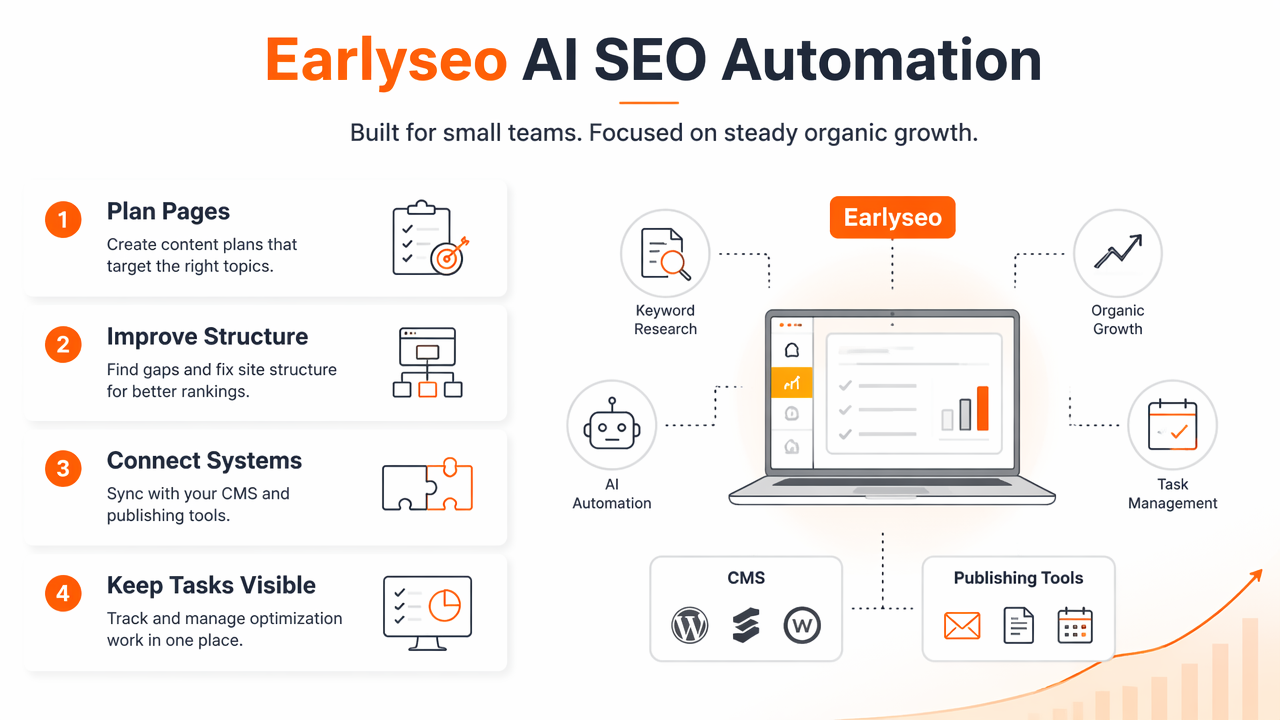
For teams with content operations spread across tools, Earlyseo integrations help connect SEO work to existing systems. WordPress-heavy teams can review the WordPress integration, while online stores can evaluate the Shopify integration for commerce-focused workflows.
Earlyseo is not positioned as a replacement for Semrush, Ahrefs, or a skilled strategist. Its strongest role is helping lean teams turn SEO recommendations into a repeatable operating rhythm: identify the opportunity, create or update the page, connect internal links, and monitor the result.
Where Earlyseo fits in a lean SEO process
- Plan: identify topics and page opportunities that support business goals.
- Brief: turn search intent into structured content instructions.
- Publish: connect SEO tasks to the CMS workflow.
- Improve: find internal links, metadata issues, and refresh candidates.
- Report: show progress in a format small teams can act on.
This workflow-first structure matters because SEO usually fails from inconsistency, not from a lack of ideas. A small team with one clear process often outperforms a larger team juggling disconnected dashboards.
What should small teams expect from AI SEO in 2027?
Small teams should expect AI SEO tools in 2027 to focus more on answer-engine visibility, structured content, and automated refresh workflows. Traditional ranking reports will still matter, but Google AI Overviews, ChatGPT-style research, and generative search platforms are pushing teams to make pages easier for machines to interpret.
The practical shift is already visible. Content needs clear definitions, direct answers, comparison tables, source-backed claims, and consistent entity naming. That does not mean every page should sound robotic. It means useful pages should be easier to quote, summarize, and trust.
For brand teams, files such as llms.txt may become part of the discoverability conversation, especially as publishers look for clearer machine-readable signals. Earlyseo provides an llms.txt resource for teams tracking that shift.
AI search readiness checklist
- Define products, services, and categories in one clear sentence.
- Use tables for comparisons involving three or more items.
- Add FAQ answers that stand alone without surrounding context.
- Link related pages with descriptive anchors.
- Refresh old content when terminology, pricing, or search intent changes.
- Track visibility beyond classic blue-link rankings.
The teams that win AI-assisted search will not publish the most pages. They will publish the clearest pages, keep them current, and make expertise easy for search systems to extract.
Frequently asked questions
What is the best AI SEO automation tool for a small business?
The best AI SEO automation tool for a small business is the one that matches the team's biggest bottleneck. Earlyseo fits teams that need practical SEO execution, while Semrush and Ahrefs fit deeper research needs. Surfer SEO supports on-page optimization, and Whatagraph is useful for reporting.
Can AI fully automate SEO?
AI cannot fully automate SEO safely because search strategy depends on business goals, audience knowledge, factual accuracy, and brand judgment. AI can automate clustering, briefs, audits, link suggestions, and reporting. Humans should still approve strategy, claims, publishing decisions, and major site changes.
Are AI-written SEO articles safe to publish?
AI-written SEO articles are safest when treated as drafts, not final assets. A human editor should verify facts, add original examples, check search intent, improve structure, and remove generic claims. This process lowers the risk of thin content and makes the page more useful.
Which SEO tasks should be automated first?
Small teams should automate keyword clustering, content briefs, internal link discovery, technical issue monitoring, and refresh alerts first. These tasks are repeatable and time-heavy. Strategy, positioning, and final editorial approval should remain human-led because those decisions shape trust and conversion quality.
Conclusion
The best AI SEO automation tools for small teams are not always the biggest platforms. The right choice is the tool that removes the most weekly friction while keeping human judgment in control. Start with one workflow, such as briefs, internal links, technical checks, refreshes, or reporting, then add automation only when the process is stable. For a focused execution layer, head to earlyseo.com and compare how Earlyseo fits the current publishing stack before adding another all-in-one dashboard.