TL;DR
A one-time SEO audit fits businesses that need diagnosis, prioritization, and an internal team to execute fixes. A monthly SEO retainer fits businesses that need ongoing implementation, content, technical monitoring, reporting, and growth accountability.
A strong SEO plan often fails for a simple reason: the business buys diagnosis when it needs execution, or pays for ongoing work before the core problems are known. The SEO audit service vs monthly SEO retainer decision affects budget, speed, accountability, and whether recommendations ever ship. Search engine optimization: the practice of improving website visibility and performance in search engine results pages. Website audit: a structured evaluation of technical, content, performance, and visibility factors that influence organic search. For teams that want a lighter way to monitor issues before hiring an agency, Earlyseo can help connect SEO tracking, publishing workflows, and site integrations in one place.
Table of contents
- Audit vs retainer definitions
- Decision matrix
- Deliverables and pricing logic
- 2026 SEO execution trends
- FAQ
Table of Contents
What is an SEO audit service vs monthly SEO retainer?
An SEO audit service is a one-time diagnostic project, while a monthly SEO retainer is an ongoing service agreement for execution, monitoring, and improvement. The audit finds what blocks search visibility. The retainer turns strategy into shipped fixes, new content, authority building, and recurring performance reviews.
An audit is usually scoped around a website crawl, indexation review, keyword and content analysis, technical checks, analytics review, and a prioritized action plan. It works best when a business has developers, writers, or marketers ready to act on the findings.
A retainer is built around repeated work. SEOptimer's 2024 competitor article defines an SEO retainer as an ongoing service agreement between a business and an SEO professional or agency. That simple idea matters: a retainer pays for continuity, not just advice.
Key insight: An audit answers "what is wrong and what should happen next." A retainer answers "who will keep improving the site every month?"
Core differences at a glance
| Factor | One-time SEO audit | Monthly SEO retainer |
|---|---|---|
| Main purpose | Diagnose issues and prioritize fixes | Execute, monitor, and grow performance |
| Time frame | Usually project-based | Ongoing monthly agreement |
| Best fit | Teams with internal execution capacity | Teams needing strategy plus implementation |
| Common outputs | Audit report, issue list, roadmap | Content, technical fixes, reporting, link or authority work |
| Accountability | Recommendations delivered | Work completed and measured over time |
| Budget behavior | One project fee | Recurring monthly spend |
The audit is sharper when the website has unclear performance problems. The retainer is stronger when the business already knows SEO must be a continuous channel.
Research on trustworthy natural language processing, such as the 2022 Proceedings of the 2nd Workshop on Trustworthy Natural Language Processing by Gupta, Kumar, and Wang, shows why clear, structured information matters for machine interpretation and trust signals in AI-assisted search experiences: TrustNLP 2022 proceedings.
When is a one-time SEO audit enough?
A one-time audit is enough when the business needs a clear diagnosis and already has the people to implement the recommendations. It fits smaller sites, recent redesigns, traffic drops, migration reviews, and teams that need an expert roadmap before assigning work internally.
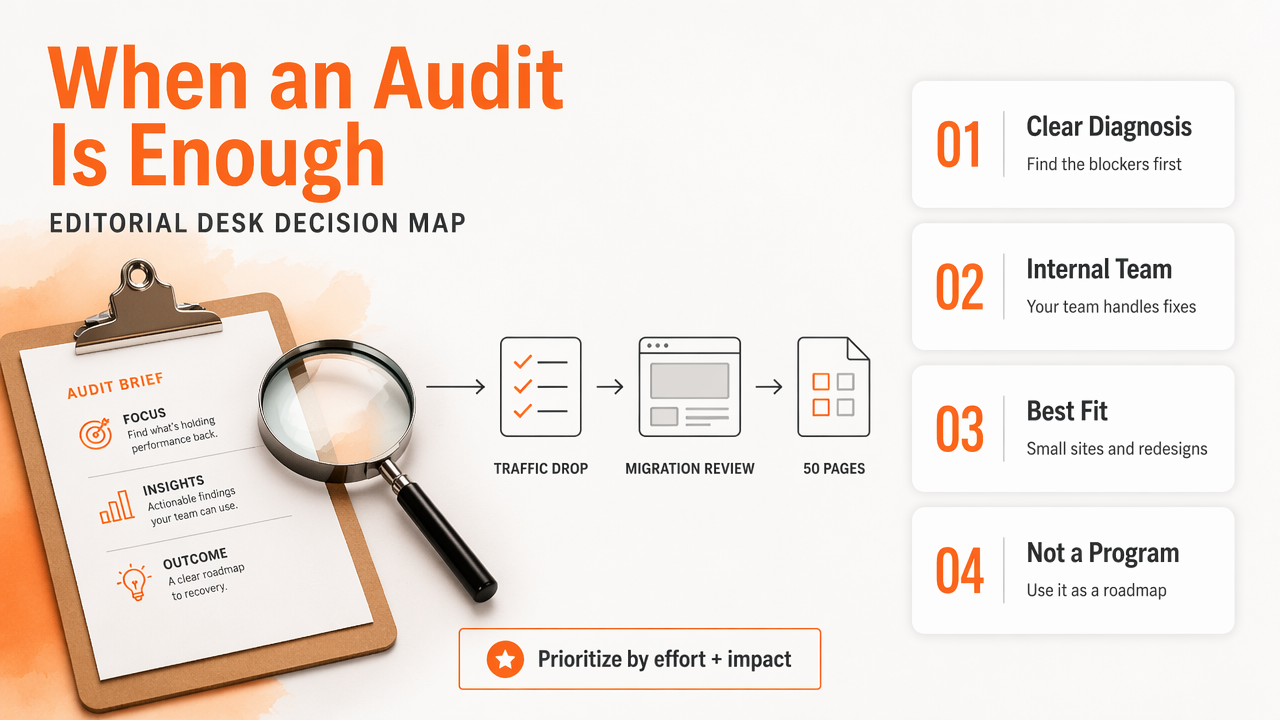
An audit should not be treated as a growth program. It is a decision document. The value comes from finding the highest-impact blockers, sorting them by effort and likely benefit, and giving internal teams a clean order of operations.
Common audit-only scenarios include:
- A local business site with fewer than 50 pages and basic service content
- An ecommerce store after a theme change, platform migration, or traffic dip
- A startup preparing for content investment but unsure which technical issues matter
- A marketing manager needing outside validation before requesting developer time
- A founder comparing agency proposals and wanting an independent baseline
Audit quality depends on how actionable the final deliverable is. A 70-page PDF with vague warnings is less useful than a short issue list with page examples, severity, owner, and next step.
For teams that publish frequently after an audit, the Earlyseo docs can support repeatable workflows, including how SEO tasks connect with implementation rather than sitting in a static report.
Audit signals that justify the project
A good audit is justified when one or more conditions are visible:
- Organic traffic changed after a redesign, migration, or CMS update.
- Important pages are not indexed or have duplicate versions.
- Rankings exist, but clicks and conversions are weak.
- Content has grown without a keyword, internal link, or refresh plan.
- Site speed, crawl errors, or structured data issues need expert review.
Key insight: An audit is most valuable before execution starts, not after months of unfocused content and technical work have already consumed the budget.
When does a monthly SEO retainer make more sense?
A monthly SEO retainer makes more sense when organic growth depends on repeated execution across content, technical SEO, internal linking, reporting, and search visibility monitoring. Retainers fit businesses where SEO is expected to become a durable acquisition channel, not a one-time cleanup.
Monthly agreements exist because SEO work compounds. Search visibility changes when pages are improved, new content is published, technical debt is reduced, and performance data feeds the next round of decisions.
Top SERP pricing research in the provided benchmark set reports that 2026 monthly SEO retainers range from $1,500 to $15,000 or more, with many small businesses paying $2,500 to $5,000 per month. Exact pricing still depends on market, scope, site size, and competition.
Retainers usually cover:
- Monthly strategy and prioritization
- Keyword research and content briefs
- Content refreshes or new page creation
- Technical issue monitoring
- Internal linking improvements
- Local SEO or ecommerce SEO tasks
- Reporting, calls, and roadmap updates
Ecommerce stores often need ongoing execution because product pages, collections, filters, and seasonal demand change constantly. For Shopify teams, Earlyseo's Shopify integration can support SEO workflows closer to the store environment.
Retainer work that should be visible each month
A healthy retainer should show shipped work, not just meetings. The monthly report should connect tasks to outcomes, even when rankings need more time to move.
Useful monthly evidence includes:
- Pages optimized or published
- Technical issues fixed or escalated
- Internal links added
- Search Console changes reviewed
- Content opportunities selected for the next cycle
- Local, ecommerce, or AI-search visibility tasks completed
A retainer becomes weak when deliverables stay vague. "Ongoing optimization" should be translated into specific URLs, tasks, owners, and dates.
How should businesses choose between audit and retainer?
Businesses should choose based on site size, internal resources, ranking problems, and growth goals. The fastest decision rule is simple: choose an audit when diagnosis is the missing piece, and choose a retainer when consistent execution is the missing piece.
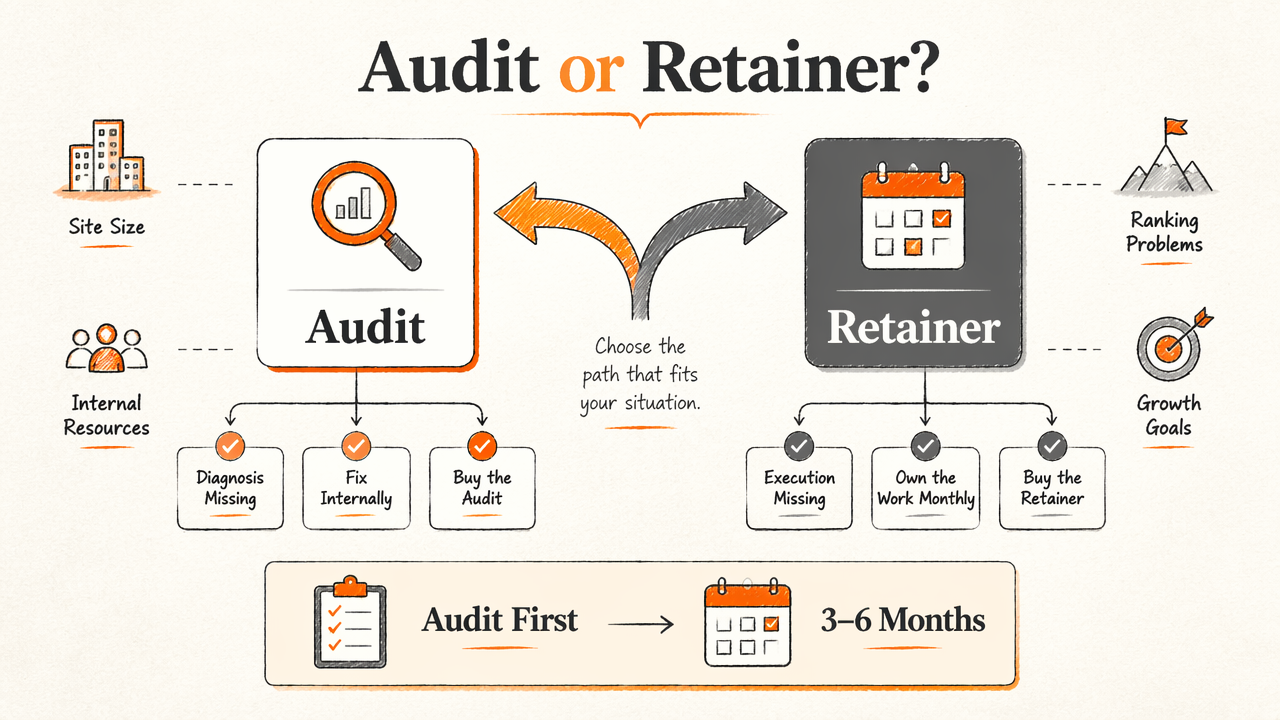
The best model is often hybrid: audit first, then 3 to 6 months of focused execution. That approach prevents a retainer from starting with guesswork and gives the agency or consultant a shared roadmap.
Decision rule: If the business can fix issues internally, buy the audit. If the business needs someone to own the work every month, buy the retainer.
Decision tree for 2026 SEO buying
| Business condition | Better choice | Why it fits |
|---|---|---|
| Site has fewer than 50 pages and a small budget | Audit | Most issues can be identified and fixed in one project |
| Site has developers and writers in-house | Audit | Internal team can execute the roadmap |
| Rankings dropped after migration | Audit first | Diagnosis should happen before ongoing spend |
| Ecommerce site adds products often | Retainer | New pages and technical changes need recurring review |
| Local business wants steady lead growth | Retainer | Local pages, reviews, content, and reporting need consistency |
| Startup is building topical authority | Retainer | Content velocity and iteration matter |
| Marketing team lacks SEO ownership | Retainer | Strategy without execution will stall |
| Business is unsure what is wrong | Audit | Clarity should come before commitment |
A WordPress service business may start with an audit, then shift into monthly work once content production begins. The Earlyseo WordPress integration can help teams connect publishing with SEO checks during that handoff.
A practical buying process looks like this:
- Confirm the business goal: leads, sales, local visibility, or traffic quality.
- List available internal resources: developer, writer, marketer, founder time.
- Check site complexity: page count, templates, locations, products, languages.
- Identify the current problem: diagnosis gap or execution gap.
- Pick audit, retainer, or audit-first hybrid based on the gap.
The Earlyseo platform fits the middle ground for teams that want more visibility into SEO tasks before or during an agency engagement. More product details are available on earlyseo.com.
What should SEO buyers expect in 2026 and 2027?
SEO buyers should expect audits and retainers to include more AI-search readiness, cleaner technical documentation, and stronger content quality checks through 2026 and 2027. Classic rankings still matter, but discovery now also touches AI summaries, structured answers, brand mentions, and machine-readable site signals.
Search teams are already thinking beyond blue links. The rise of AI Overviews, Google AI Mode, ChatGPT-style research, and answer engines rewards content that is clear, well-structured, and easy to cite. That shift favors audits with entity analysis and retainers that maintain pages over time.
Modern audit scopes may include:
- Structured data review
- Content clarity and answer formatting
- Internal linking around topic clusters
- Crawlability of key commercial pages
llms.txtor AI-crawler documentation planning- Brand and product entity consistency
For teams exploring AI-search documentation, Earlyseo's llms.txt resource offers a relevant starting point. Related SEO reading and product updates can also be found on the Earlyseo blog hub.
Retainers will likely become more evidence-driven. Clients will expect agencies to show what shipped, why it mattered, and how the next month's tasks respond to fresh search data. Static monthly reports will feel dated fast.
Related articles and resources
Helpful next reads include:
- SEO documentation and setup guides in Earlyseo docs
- Shopify SEO workflow resources for ecommerce teams
- WordPress SEO workflow resources for service businesses
- AI-search documentation resources for
llms.txt
The right choice is less about buying "SEO" and more about buying the missing operating system: diagnosis, execution, or both.
Frequently asked questions
SEO audit and retainer questions usually come down to timing, ownership, and budget. These short answers clarify the practical buying decisions for small businesses, startups, ecommerce stores, and local service companies.
Is an SEO audit cheaper than a monthly retainer?
An SEO audit is usually cheaper in total commitment because it is a one-time project. A monthly retainer costs more over time because it includes repeated strategy, implementation, monitoring, and reporting. The cheaper option is not always better; the right choice depends on whether internal staff can execute the audit recommendations.
Can a business start with an audit and move to a retainer later?
Yes. Starting with an audit often creates a cleaner retainer because the scope is based on known issues, not assumptions. The audit can define priorities, estimate effort, and separate urgent technical fixes from longer-term content or authority work.
What should an SEO audit deliver?
A useful SEO audit should deliver prioritized findings, affected URLs, severity levels, plain-language explanations, and next actions. Strong audits also separate technical, content, internal linking, analytics, and visibility issues so each task can be assigned to the right owner.
What makes a monthly SEO retainer worth the cost?
A retainer is worth the cost when it produces visible monthly work tied to business goals. Good signs include published content, fixed technical issues, improved internal links, Search Console analysis, conversion-focused recommendations, and a clear plan for the next month.
Conclusion
The SEO audit service vs monthly SEO retainer choice should be made by asking one practical question: is the business missing clarity, execution, or both? A one-time audit fits diagnosis and prioritization. A retainer fits ongoing growth, especially when content, technical SEO, and reporting need steady ownership.
The next step is to map site size, internal resources, ranking problems, and growth targets against the decision tree above. If SEO work needs to move from scattered tasks into a repeatable workflow, visit earlyseo.com and review how Earlyseo can support the process before the next agency call or internal planning meeting.