Last updated: July 17, 2026. We substantially refreshed this guide to separate Moz Pro from Moz Local intent, compare pricing models, clarify why a business might switch, and make the EarlySEO comparison explicit.
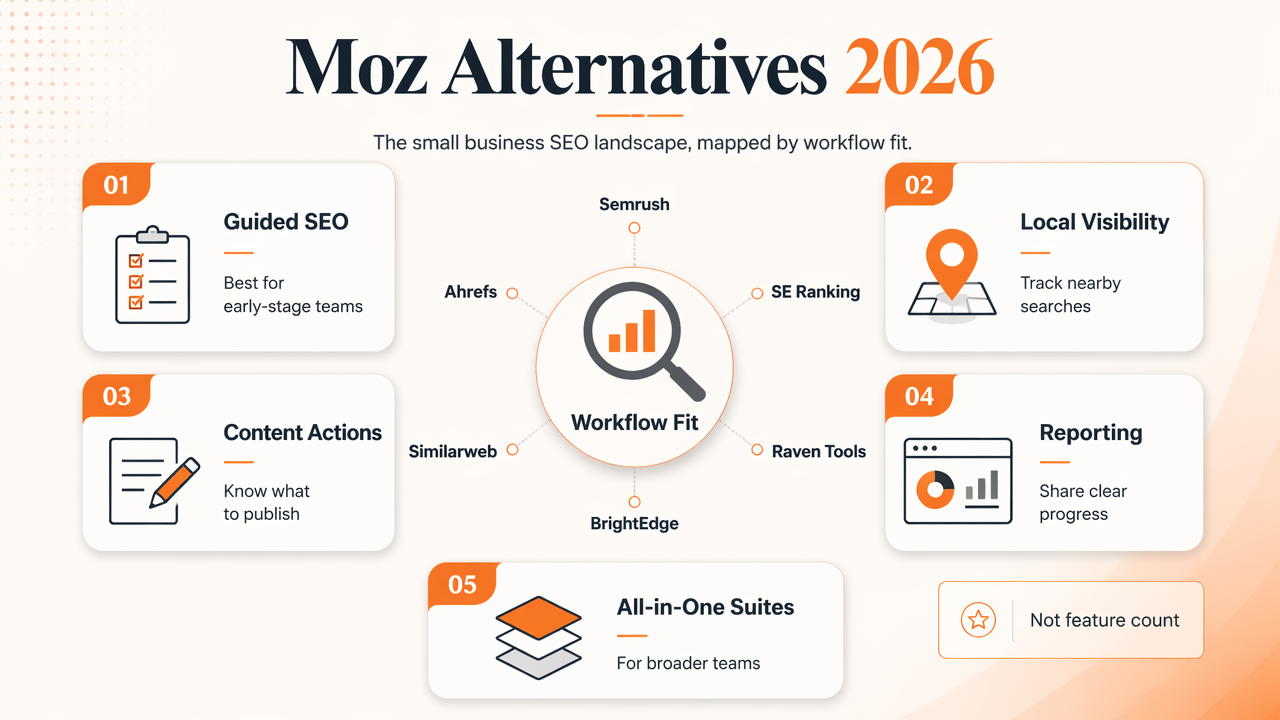
The short answer: the best Moz alternative depends on the job. Choose Semrush or Ahrefs for broad competitive research, SE Ranking or Mangools for a more approachable all-in-one toolkit, BrightLocal or Whitespark for local SEO operations, Screaming Frog for technical crawling, and EarlySEO when the main bottleneck is turning research into optimized articles and publishing them consistently.
Moz alternatives: quick comparison
Prices change frequently, and many SEO products use limits based on projects, tracked keywords, users, locations, or credits. The pricing column therefore compares the model rather than publishing a number that may be stale when you read it. Verify the current total for your required limits before buying.
| Tool | Best for | Pricing model | Main reason to choose it over Moz |
|---|---|---|---|
| Semrush | Competitive research and paid + organic teams | Tiered subscription; limits vary by plan | Broader competitive and marketing dataset |
| Ahrefs | Backlink and competitor research | Tiered subscription with usage limits | Deep link and content discovery workflows |
| SE Ranking | Small teams needing an all-in-one suite | Tiered by keywords, projects, and frequency | Flexible rank-tracking and reporting package |
| Ubersuggest | Beginners and lightweight research | Subscription and, where offered, lifetime options | Simpler entry point for core keyword tasks |
| Mangools | Simple keyword research and rank tracking | Tiered subscription | Approachable interface and focused toolset |
| LowFruits | Finding lower-competition queries | Credit-based and subscription options | Narrow workflow for SERP weakness analysis |
| Screaming Frog | Technical SEO crawling | Free crawl limit plus annual license | More focused crawl configuration and diagnostics |
| BrightLocal | Local rank tracking, citations, and reporting | Subscription plus service-specific costs | Purpose-built local SEO operations |
| Whitespark | Local citations and local rank tracking | Tool- and service-specific plans | Specialized local search workflows |
| Localo | Google Business Profile improvement | Location-based subscription | Focused, guided local visibility tasks |
| Google Search Console | First-party Google performance data | Free | Actual queries, clicks, impressions, and indexing signals |
| EarlySEO | Generating, rewriting, and publishing SEO content | Subscription with a free trial | Connects content planning to generation, rewrites, internal links, images, and CMS publishing |
Why would a small business switch from Moz?
Moz remains a recognizable SEO platform. Switching only makes sense when another product better matches the work your team performs every week. Common reasons include:
- You need deeper competitor or backlink research. Semrush and Ahrefs are common shortlists when research breadth is the priority.
- You need local SEO operations rather than general SEO research. BrightLocal, Whitespark, and Localo focus more directly on locations, citations, local rankings, or Google Business Profile work.
- You want simpler pricing or a narrower workflow. Mangools, Ubersuggest, LowFruits, or Screaming Frog can be easier to justify when only one part of the SEO stack matters.
- Your bottleneck is execution. A research suite can identify opportunities but still leave writing, internal linking, images, reviews, and CMS publishing to separate tools. EarlySEO is designed around that production workflow.
Do not switch because a feature list is longer. Switch when the alternative reduces a recurring cost, replaces manual work, improves the data needed for a decision, or fits the team that will actually use it.
Moz Pro alternatives versus Moz Local alternatives
Moz Pro and Moz Local solve different problems. Moz Pro is the relevant comparison for keyword research, rank tracking, site audits, links, and general organic search work. Moz Local is the relevant comparison for listings and location visibility.
| If you need... | Compare Moz Pro with... | Compare Moz Local with... |
|---|---|---|
| Keyword and competitor research | Semrush, Ahrefs, SE Ranking, Mangools | Not the primary use case |
| Technical site crawling | Screaming Frog, Semrush, Ahrefs | Not the primary use case |
| Local rankings and reports | SE Ranking if local features meet your needs | BrightLocal, Whitespark, Localo |
| Listings and citation work | Not the primary use case | BrightLocal, Whitespark |
| Article production and publishing | EarlySEO AI SEO article generator | Use a local tool for listings; use EarlySEO for supporting content |
A multi-location business may need both categories: a local platform for listings and location tracking, plus a content workflow for service pages, location-specific resources, and supporting articles. One product does not have to replace every Moz capability.
The 12 best Moz alternatives for small businesses
1. Semrush: best for broad competitive research
Semrush is a strong Moz Pro alternative for teams that want organic research, competitor discovery, keyword workflows, auditing, and paid-search context in one product. Its breadth is useful, but the interface and plan limits can be more than a very small business needs. Shortlist it when several people will use the dataset across SEO and marketing.
2. Ahrefs: best for backlinks and content discovery
Ahrefs is a frequent Moz alternative when link analysis and competitor content research drive the buying decision. It is well suited to teams that regularly inspect referring domains, competing pages, and content gaps. Check current usage limits carefully and budget separately for the content production work that follows the research.
3. SE Ranking: best all-in-one option for lean teams
SE Ranking combines rank tracking, website audits, competitor research, and reporting in a package often considered by agencies and small teams. Its configurable tracking frequency and limits can help match cost to the project. Compare the exact tracked-keyword, project, user, and reporting limits your team requires.
4. Ubersuggest: best for a simpler starting point
Ubersuggest focuses on accessible keyword and competitor workflows. It can fit an owner-operator who needs ideas and lightweight analysis without adopting a larger enterprise-style suite. Validate data depth for your market and confirm whether the current subscription or lifetime option includes the limits you expect.
5. Mangools: best for approachable keyword research
Mangools separates keyword research, SERP analysis, rank tracking, backlinks, and site metrics into focused tools with a consistent interface. It is a practical shortlist for beginners who value usability. More advanced teams should confirm that project, reporting, and data-depth requirements are covered.
6. LowFruits: best for lower-competition keyword discovery
LowFruits is narrower than Moz Pro. It is useful when the immediate task is finding search results with weaker competing pages rather than buying a complete SEO suite. The focused workflow can reduce tool complexity, but you may still need separate auditing, content, and publishing tools.
7. Screaming Frog SEO Spider: best for technical crawling
Screaming Frog is a desktop crawler rather than a direct all-in-one replacement. It is a better fit when the core need is inspecting status codes, canonicals, metadata, internal links, directives, and site architecture. The free crawl allowance is useful for small sites; larger or advanced crawls require the paid license.
8. BrightLocal: best Moz Local alternative for reporting and citations
BrightLocal is purpose-built for local search workflows such as local rank tracking, audits, reporting, reviews, and citation-related services. It is the more relevant comparison when a business is considering Moz Local rather than Moz Pro. Model the total cost across locations and any separately priced services.
9. Whitespark: best for specialized local search work
Whitespark offers tools and services around local rankings, citations, reviews, and local search. It fits businesses or agencies that want specialized local workflows without making a general SEO suite the center of the stack. Compare the exact tools and services needed for each location.
10. Localo: best for guided Google Business Profile work
Localo centers the workflow on local visibility and Google Business Profile tasks. It can be a good fit for a small local business that wants guided recommendations instead of a broad research platform. Confirm location limits and whether you also need separate citation or website-audit capabilities.
11. Google Search Console: best free source of first-party search data
Google Search Console is not a complete Moz replacement, but every small business should use it. It shows the queries and pages receiving Google impressions, clicks, positions, and indexing signals. Pair it with a crawler, research tool, or content workflow rather than paying another product to approximate data Google already provides directly.
12. EarlySEO: best for article generation, rewrites, and publishing
EarlySEO is not presented as a one-for-one replacement for every Moz database or local-listing feature. It is the better fit when a small team already knows it needs content but struggles to turn opportunities into published, updated pages.
The workflow connects an AI SEO article generator, SEO article rewriter, internal linking automation, AI featured image generation, and CMS publishing. Teams should still review accuracy, add genuine expertise, and use dedicated research or local tools where those datasets are required.
Transparent EarlySEO versus Moz comparison
| Capability | Moz | EarlySEO |
|---|---|---|
| Keyword, link, and domain research | Core product category | Uses research context but is not a replacement for every Moz dataset |
| Local listing management | Moz Local product category | Not a listing-management replacement |
| Generate complete SEO article drafts | Not the main workflow | Core workflow with metadata, HTML, Markdown, tags, links, and media settings |
| Rewrite and preserve versions | Not the main workflow | Supports rewrite instructions and version context |
| Publish to a CMS | Not the main workflow | Supports connected CMS, webhook, and SDK workflows depending on destination |
Best Moz alternative by business type
- SaaS startup: use Ahrefs or Semrush for competitive research; use EarlySEO to generate and publish optimized blog posts when execution is the bottleneck.
- Local service business: compare BrightLocal, Whitespark, and Localo against Moz Local. Keep Google Search Console for website performance.
- Ecommerce store: combine Search Console and a research suite with content that supports collections; review the Shopify blog publishing workflow.
- SEO agency: consider SE Ranking, Semrush, or Ahrefs for client research and reporting; use SEO article rewrites with version history for production and approvals.
- Solo founder: start with Search Console and one focused paid tool. Avoid paying for overlapping datasets your weekly workflow does not use.
Decision checklist before replacing Moz
- Write down the three tasks your team completed in Moz during the last 30 days.
- Separate Moz Pro needs from Moz Local needs.
- Compare total cost at your required projects, keywords, users, locations, reports, and credits.
- Test the same website and keyword set in each trial.
- Export anything you need before cancelling.
- Budget for the work after research: content, technical fixes, links, reviews, and publishing.
How we compared these Moz alternatives
We grouped tools by the job a small business is buying: general SEO research, technical crawling, local SEO operations, first-party performance data, or content execution. We reviewed publicly described product capabilities and pricing structures, then evaluated likely fit for a lean team. We did not award a tool points merely for having more features, and we do not claim hands-on testing where it was not performed.
Pricing note: vendors can change plans and limits after publication. Use this guide to build a shortlist, then verify current pricing and test the workflow using your own site before committing.
Frequently asked questions
What is the best free Moz alternative?
Google Search Console is the best free starting point for actual Google performance and indexing data. Pair it with the free allowance of a technical crawler and free keyword tools as needed. It is not a complete replacement for Moz Pro, but it prevents paying for data you can obtain directly.
What is the best Moz Pro alternative for a small business?
SE Ranking and Mangools are approachable all-in-one shortlists, while Semrush and Ahrefs fit deeper competitive research. The best choice depends on required limits and the tasks performed every week.
What is the best Moz Local alternative?
BrightLocal, Whitespark, and Localo are the most relevant alternatives in this list because they focus on local rankings, citations, reviews, locations, or Google Business Profile workflows. Compare them against Moz Local, not against Moz Pro.
Can EarlySEO replace Moz?
EarlySEO can replace parts of a content-production stack, not every Moz dataset or local-listing capability. Choose it for planning, generating, rewriting, linking, and publishing SEO articles; keep a dedicated research or local SEO product when those capabilities are required.
Final recommendation
Choose the smallest stack that covers the work your business will actually complete. For research depth, shortlist Semrush or Ahrefs. For an approachable suite, test SE Ranking or Mangools. For local SEO, compare BrightLocal, Whitespark, and Localo. For technical crawling, use Screaming Frog. When research is already producing ideas but content is not getting shipped, evaluate EarlySEO's AI SEO article generator and transparent pricing.