TL;DR
A practical LLM visibility audit checks whether AI assistants mention a brand, cite the right sources, describe entities accurately, and surface competitors instead. Small teams can run the workflow in under an hour, score the results, then fix weak content, missing authority signals, and poor AI readability.
AI search visibility now depends on whether ChatGPT, Gemini, Perplexity, and Google AI experiences can understand, trust, and cite a brand. An LLM visibility audit template gives a small team a repeatable way to test prompts, capture answers, inspect sources, and turn vague AI mentions into specific content fixes. For teams that want tooling around AI-readable content and crawl signals, Earlyseo fits naturally into the audit process.
Table of Contents
What is an LLM visibility audit?
An LLM visibility audit is a structured review of how large language models describe, recommend, compare, and cite a brand across buyer questions. It combines prompt testing, source analysis, entity checks, content gap review, and scoring so teams can improve visibility in AI-generated answers.
LLM visibility audit template: a repeatable worksheet for testing AI answer presence, citation quality, competitor coverage, brand accuracy, and content fixes across multiple AI systems.
Research on large language models keeps showing why audits need structure. A 2023 survey by Hadi, Al Tashi, and Qureshi reviewed LLM applications, limitations, and practical usage, including challenges around reliability and deployment in real tasks (TechRxiv survey). A separate 2023 paper on auditing large language models proposed a layered view of audits, which supports separating model behavior, system behavior, and real-world impact (AI and Ethics paper).
Key insight: traditional SEO audits ask whether a page can rank; AI visibility audits ask whether a brand can be selected, summarized, and cited inside an answer.
A good audit does not depend on one lucky prompt. It tests buyer intent, comparison intent, local intent, problem-aware questions, and source-seeking prompts. The result should show where the brand appears, where competitors appear instead, and which pages deserve updates first.
The audit differs from a normal SEO checklist
Search audits usually focus on crawlability, indexation, rankings, links, and on-page relevance. AI visibility adds entity clarity, answer extraction, citation eligibility, and brand mention accuracy.
| Audit area | Traditional SEO check | LLM visibility check |
|---|---|---|
| Discovery | Can search engines crawl the page? | Can AI crawlers and retrieval systems access useful content? |
| Relevance | Does the page target a keyword? | Does the page answer natural buyer prompts clearly? |
| Authority | Are backlinks and mentions strong? | Do trusted sources confirm the brand entity? |
| Content | Is the page optimized for ranking? | Is the answer easy for an LLM to extract and cite? |
| Measurement | Are rankings and clicks improving? | Are mentions, citations, and descriptions improving? |
How can a team run the audit in under an hour?
A small team can run an AI visibility audit in under an hour by testing a fixed prompt set, logging model responses, checking cited sources, scoring brand accuracy, and assigning fixes by impact. The goal is not perfect coverage; the goal is a useful baseline that can be repeated monthly.
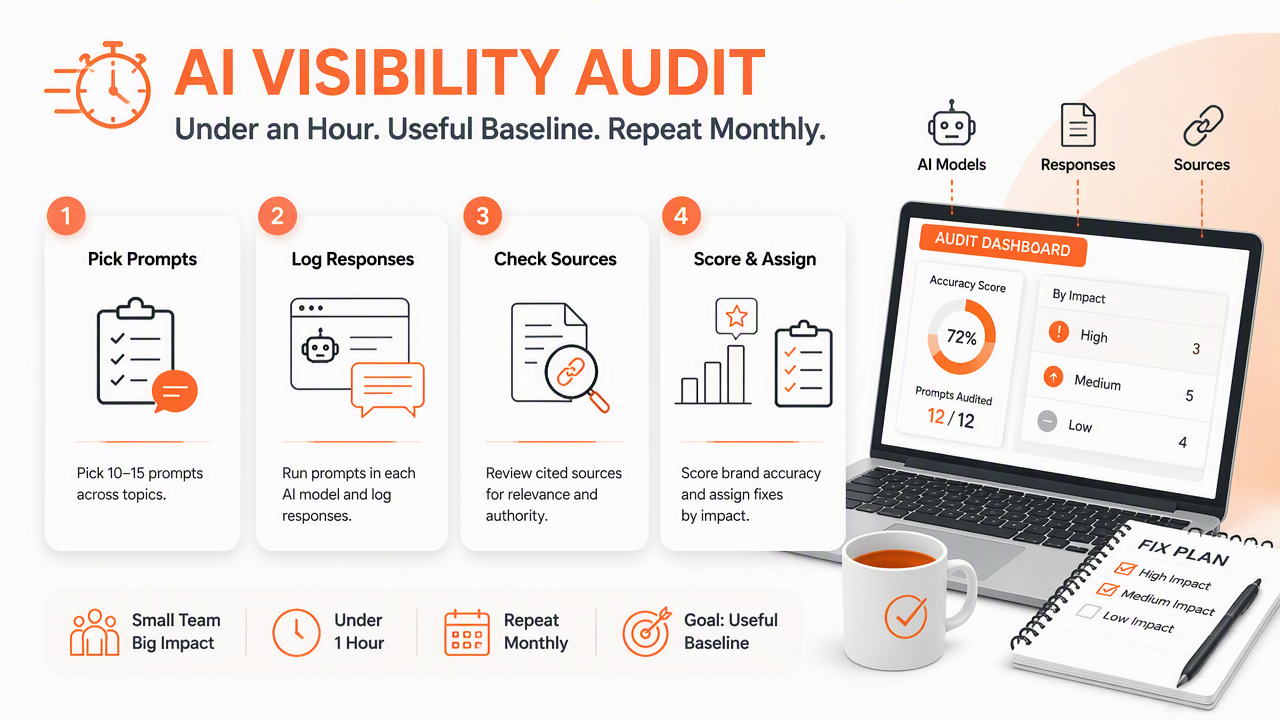
- Pick 10 to 15 prompts across buyer stages.
- Run each prompt in 2 to 3 AI systems.
- Record brand mentions, competitor mentions, citations, and answer position.
- Check whether descriptions are accurate and current.
- Score each result using a shared rubric.
- Assign fixes to content, technical, or authority work.
The best prompt set mirrors real buying language, not internal marketing language. Local businesses should include service-area prompts. Ecommerce brands should include product-category and comparison prompts. B2B companies should test workflow, integration, pricing, and alternative prompts.
Teams with no shared prompt library can start from an SEO brief, then adapt it for AI answer behavior. A standard SEO content brief template can help convert target audience, pain points, and search intent into prompt categories.
Sample prompts for a fast visibility baseline
Use these prompts as copy-ready starters, then replace bracketed terms with the brand, market, city, or product category.
- "What are the best [category] tools for [audience]?"
- "Compare [brand] vs [competitor] for [use case]."
- "Which [service] companies serve [city or region]?"
- "What should a small business use for [problem]?"
- "Is [brand] a good option for [specific buyer]?"
- "List trusted sources about [brand] and [category]."
- "What are common alternatives to [brand]?"
Run prompts in a clean chat where possible. Save the full answer, not just the brand mention. Source links, confidence language, and omissions matter as much as inclusion.
What should the audit template score?
The audit template should score presence, position, accuracy, citation quality, competitor displacement, and fix priority. A clear rubric turns messy AI answers into a backlog that marketing, content, and technical teams can act on without debating every result.
A zero-click AI answer can still shape demand. If a brand is absent from recommendation prompts, miscategorized in comparison prompts, or cited through weak third-party summaries, the next fix should not be another generic blog post. The fix should target the missing evidence.
Strong scores come from consistent entity signals, extractable answers, trusted source mentions, and pages that match the exact question AI systems are trying to answer.
Scoring rubric for each prompt result
| Score area | 0 points | 1 point | 2 points |
|---|---|---|---|
| Brand presence | Not mentioned | Mentioned once or indirectly | Mentioned clearly as a relevant option |
| Answer position | Absent | Below competitors | Listed near the top or framed as a strong fit |
| Accuracy | Wrong or outdated | Mostly right with gaps | Current, specific, and correct |
| Citation quality | No source or weak source | Mixed source quality | Brand page or trusted source cited |
| Competitor context | Competitors dominate | Brand appears with competitors | Brand has a clear differentiator |
| Fix clarity | No clear action | Possible action | Obvious content, technical, or authority fix |
A total of 9 to 12 suggests solid visibility for that prompt. A total of 5 to 8 signals partial visibility. Anything under 5 needs review because the model either lacks evidence, trusts competitors more, or cannot understand the brand clearly.
Recommended fixes by weak score pattern
Different weak scores need different fixes. Treat the score pattern as diagnosis, not a vanity metric.
- Absent brand: create or improve pages that answer category, alternative, and use-case questions directly.
- Low accuracy: update About, product, service, pricing, and FAQ content with consistent entity details.
- Poor citation quality: strengthen primary sources, case studies, comparison pages, and third-party profiles.
- Competitor dominance: publish decision-focused pages that explain who should pick which option.
- Weak extraction: rewrite sections with direct answers, tables, definition blocks, and short paragraphs.
For extraction issues, the LLM readability checker can help review whether content is structured in a way AI systems can parse cleanly. The Earlyseo platform is most useful after scoring, when the team already knows which pages need clearer answers.
How should source analysis and entity checks work?
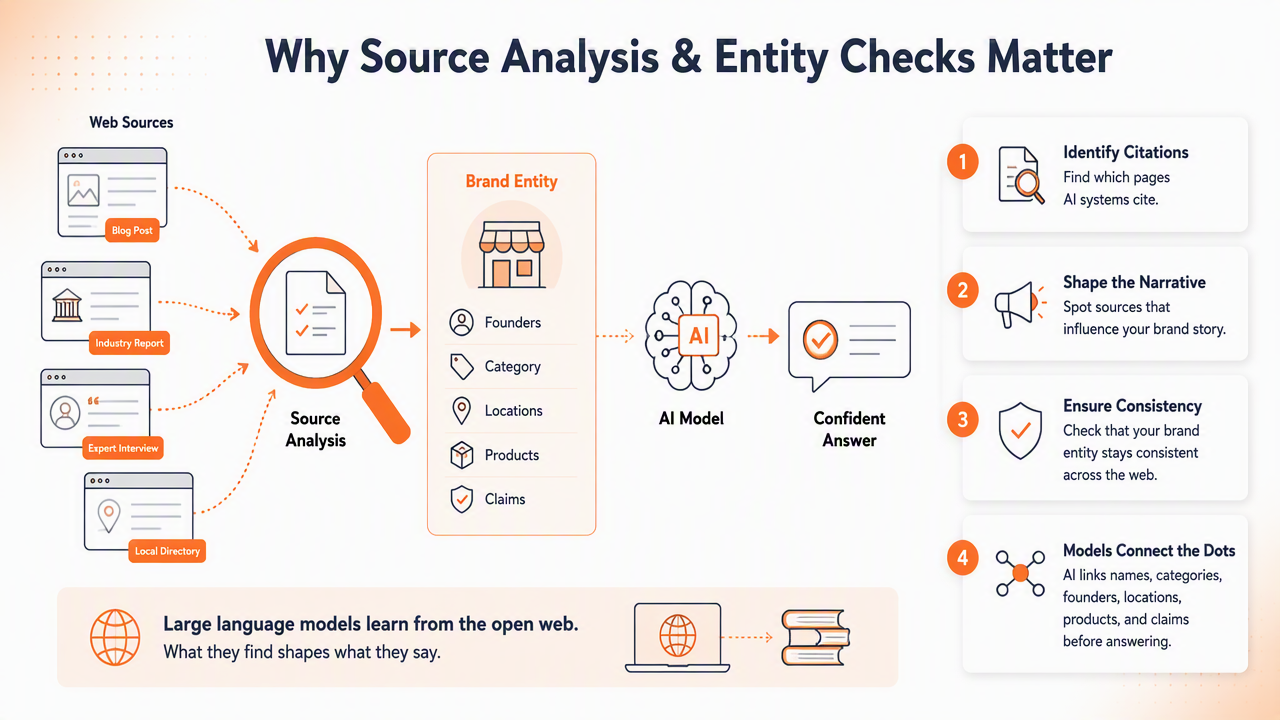
Source analysis should identify which pages AI systems cite, which sources shape the brand narrative, and whether the brand entity stays consistent across the web. Entity checks matter because models connect names, categories, founders, locations, products, and claims before producing a confident answer.
Large language model systems vary by design. Google's 2023 PaLM 2 technical report describes a model family built for multilingual and reasoning tasks, showing how broad model capabilities depend on training and evaluation choices (PaLM 2 report). For visibility audits, that means no single model should be treated as the full market.
Start with the sources shown in AI answers. Then compare those sources with the brand's own pages, major profiles, review sites, partner pages, and industry directories. The audit should flag mismatches such as old positioning, missing locations, inconsistent product names, and unsupported claims.
Technical access also belongs here. If AI-oriented crawlers cannot reach the most useful content, the brand may be harder to retrieve or cite. Teams can check AI crawler guidance with the llms.txt checker, then document preferred AI-readable resources in an llms.txt file or a fuller llms-full.txt reference when the site has deep documentation.
Entity consistency checklist
Entity work should be boring, precise, and consistent. Small mismatches can create confusing summaries.
- Brand name, legal name, and product names match across key pages.
- Category labels describe what the company actually does.
- Location, service area, and contact details stay current.
- Founder, leadership, and company descriptions are not outdated.
- Claims have supporting pages, examples, or trusted third-party mentions.
- Comparison pages state differences without attacking competitors.
For page-level cleanup, a standard on-page SEO checklist template can support title, heading, schema, and internal-link updates after the AI audit identifies weak URLs.
How should results turn into a monthly action plan?
Audit results should become a monthly action plan with owners, due dates, retest prompts, and a short visibility report. The practical output is a prioritized fix list, not a spreadsheet full of screenshots.
Group actions into three buckets: content fixes, technical fixes, and authority fixes. Content fixes usually move fastest because teams can add direct answers, comparison tables, FAQs, and clearer definitions. Technical fixes improve access and structure. Authority fixes take longer because they may involve reviews, partner mentions, digital PR, or stronger third-party profiles.
A simple monthly cadence works well:
- Retest the same prompt set.
- Add 3 to 5 new prompts from sales calls or support tickets.
- Compare scores against the prior month.
- Publish or update the highest-impact pages.
- Report wins, losses, and next fixes in one page.
The reporting should stay readable for non-technical stakeholders. A client-style SEO reporting template can be adapted to show AI mentions, citations, competitor movement, and completed fixes.
By 2027, AI visibility reporting will likely become more standardized, with clearer separation between search rankings, AI citations, and direct brand recall. Early movers will have an advantage because they will already know which prompts matter, which sources influence answers, and which pages earn citations. For teams building that muscle now, Earlyseo and the resources on earlyseo.com can support the technical and content-readiness side of the workflow.
Frequently asked questions
How many prompts are enough for a first audit?
Ten to 15 prompts are enough for a first baseline if they cover discovery, comparison, problem, local, and brand-specific intent. More prompts can help later, but a small set makes repeat testing easier and keeps the first audit under an hour.
Which AI systems should be tested?
A practical audit should test at least two systems, such as ChatGPT and Perplexity, plus Google AI experiences where available. Different systems retrieve, summarize, and cite information differently, so cross-checking reduces the risk of overreacting to one model's answer.
How often should the audit be repeated?
Monthly testing works for most small teams because content changes, competitor mentions, and AI answers can shift over time. Fast-moving ecommerce, SaaS, and local service markets may benefit from a light weekly check on the highest-value prompts.
What is the fastest fix after a weak score?
The fastest fix is usually rewriting a relevant page section into a direct answer with a clear definition, short paragraphs, and a comparison table. If the brand is missing from category prompts, a use-case or alternatives page may be a better first update.
Conclusion
A useful LLM visibility audit template turns AI search from guesswork into a repeatable operating rhythm: test prompts, score answers, inspect sources, fix weak pages, and retest. Start with 10 prompts, use the rubric, update the highest-impact content, and repeat next month. For teams ready to improve AI-readable pages and crawler guidance, visit earlyseo.com and turn the first audit into a practical visibility backlog.