TL;DR
Service-area businesses should hide private addresses, choose realistic service areas, and prove local relevance with pages, reviews, photos, and consistent business details. Listed service areas do not guarantee rankings in every town, so the strongest plan combines a clean Google Business Profile with location-specific proof on the website.
A service business can appear on Google without showing a storefront, but sloppy setup can limit visibility fast. Service area business Google Business Profile SEO: the process of configuring and improving a Google Business Profile for a business that visits customers at their locations, such as plumbers, roofers, mobile mechanics, cleaners, and home health providers. For founders and local operators building visibility from scratch, Earlyseo helps organize SEO content and AI-readable signals so Google Search, Google Maps, and newer answer engines can understand what the business does and where it serves.
Table of Contents
What is service area business Google Business Profile SEO?
Service area business Google Business Profile SEO is the work of making a non-storefront or hybrid local business eligible, clear, and trustworthy in Google Search and Google Maps. It covers profile settings, hidden address rules, service categories, local landing pages, reviews, photos, and off-profile signals that support relevance near the real operating base.
Local search engine optimization affects how a web page or business appears in unpaid local results, while Google Maps is the mapping platform where many local discovery actions happen. For service businesses, the key difference is simple: the customer location matters more than a public counter.
Key insight: A service area is a customer promise, not a ranking shortcut. Google still needs proximity, relevance, and trust signals before showing a business for local searches.
The best profiles tell Google three things clearly:
- What the business does: primary category, services, description, and website content.
- Where it can realistically serve: towns, ZIP codes, counties, or radius-based areas that match operations.
- Why it deserves visibility: reviews, photos, citations, links, and consistent real-world proof.
A service business should also make the website easy for search systems to interpret. Structured local pages, clear service descriptions, and crawlable business details support both classic SEO and AI answer systems. Early-stage teams can review publishing workflows through the Earlyseo documentation when planning location content at scale.
How should a service-area business set up Google Business Profile?
A service-area business should set up Google Business Profile by choosing the right business type, hiding any private address, selecting accurate categories, adding realistic service areas, and matching the profile to the website. The profile should describe actual operations, not every city the owner hopes to rank in.
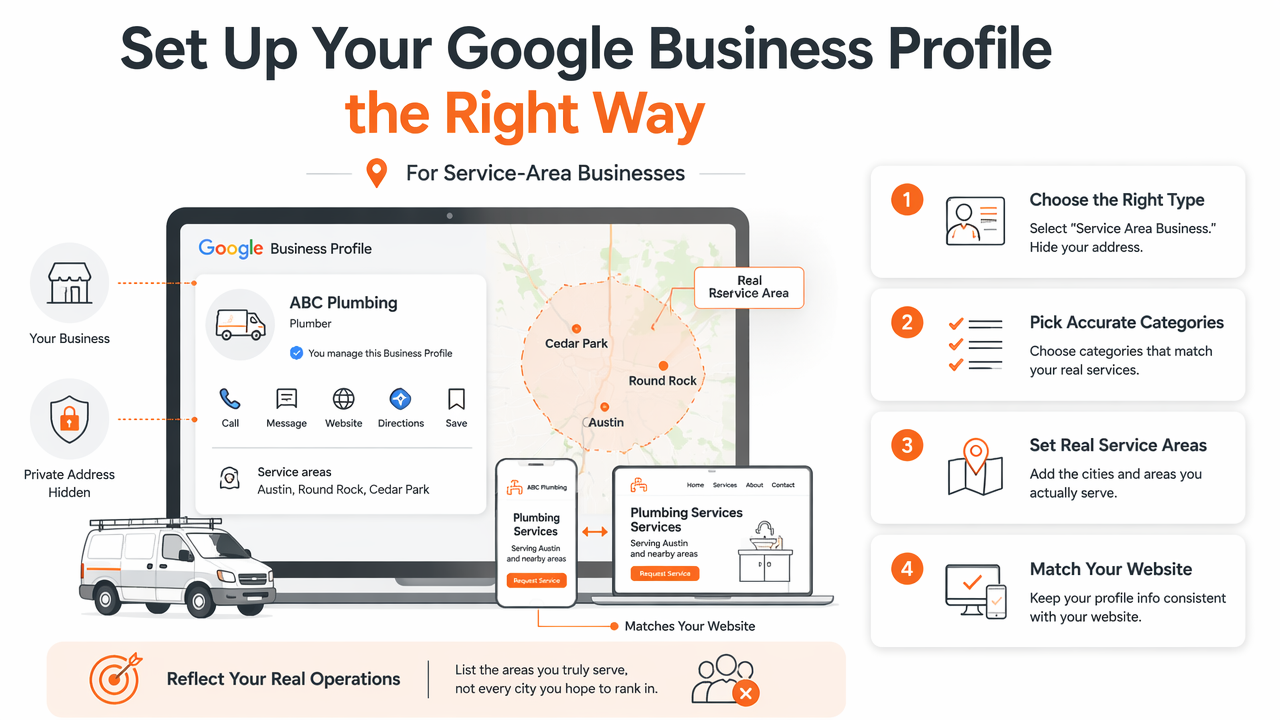
- Create or claim the Google Business Profile.
- Select the primary category that matches the core paid service.
- Add a real business name without extra keywords.
- Hide the address if customers are not served there.
- Add service areas that reflect normal travel range.
- List services, hours, phone number, website, and booking links.
- Verify the profile using the method Google provides.
- Add photos, updates, and review requests after launch.
Setup choices that affect visibility
| Profile element | Best practice for service businesses | SEO risk to avoid |
|---|---|---|
| Business name | Use the legal or real-world brand name | Adding city and service keywords that are not part of the name |
| Address | Hide home or private office addresses | Showing an address where customers cannot visit |
| Primary category | Pick the closest money-making service | Choosing a broad category because it has more searches |
| Service areas | Add real cities, ZIP codes, counties, or regions | Listing distant cities with no operational proof |
| Website link | Send users to the main local service page | Linking to a thin homepage with no service detail |
A hidden address is normal for home-service companies, mobile providers, and appointment-only operators. Hiding the address does not remove the business from Google Maps discovery, but it changes how the listing is displayed. Customers see the service region instead of a pin tied to a private location.
Hybrid businesses need a different setup. A showroom, office, or shop that serves customers in person and also visits customers can show its address and add service areas. The business must be staffed during stated hours if the address appears publicly.
How should service areas be chosen without overreaching?
Service areas should be chosen based on real travel capacity, customer demand, and proof that the business can serve those places consistently. Adding more towns does not create automatic rankings there, and broad coverage can make the profile look less relevant than a focused local competitor.
Google Business Profile service areas can usually be set by cities, postal codes, counties, or similar regions. The practical goal is not to paint the biggest map. The goal is to match search visibility with operations, staffing, response times, and local content.
Practical service-area selection framework
- Start with the core market: the city or cluster where the business is based and already has customers.
- Add nearby areas with proof: reviews, jobs, photos, or local pages should support those locations.
- Use travel time as a filter: emergency services may need tighter zones than scheduled contractors.
- Avoid statewide claims: large regions need strong authority, multiple crews, or physical branches.
- Review quarterly: remove areas that never produce leads or cannot be served profitably.
A roofing company based in Mesa may reasonably list Mesa, Tempe, Chandler, Gilbert, and Scottsdale if crews work across that area. Listing every Arizona city would be weaker unless the company has statewide operational evidence.
Common misconception about ranking everywhere
| Claim | Reality | Better action |
|---|---|---|
| "Adding a city makes the profile rank there." | Listed service areas are not guaranteed ranking zones. | Build local proof for that city. |
| "A hidden address hurts all map visibility." | Hidden addresses can rank when eligibility and relevance are clear. | Keep details accurate and strengthen reviews. |
| "More ZIP codes mean more leads." | Broad areas can dilute focus and expose service gaps. | Prioritize profitable locations. |
| "A virtual office creates local presence." | Locations must reflect legitimate operations and customer access rules. | Use real branches only when staffed and eligible. |
Misleading locations can trigger suspensions, poor user signals, and messy recovery work. Better local SEO uses honest coverage plus stronger evidence.
How can a hidden-address business build local relevance?
A hidden-address business builds local relevance by aligning its Google Business Profile, website, reviews, citations, and content around the same services and nearby places. Since the profile may not show a public pin, the surrounding evidence has to prove both service capability and local connection.
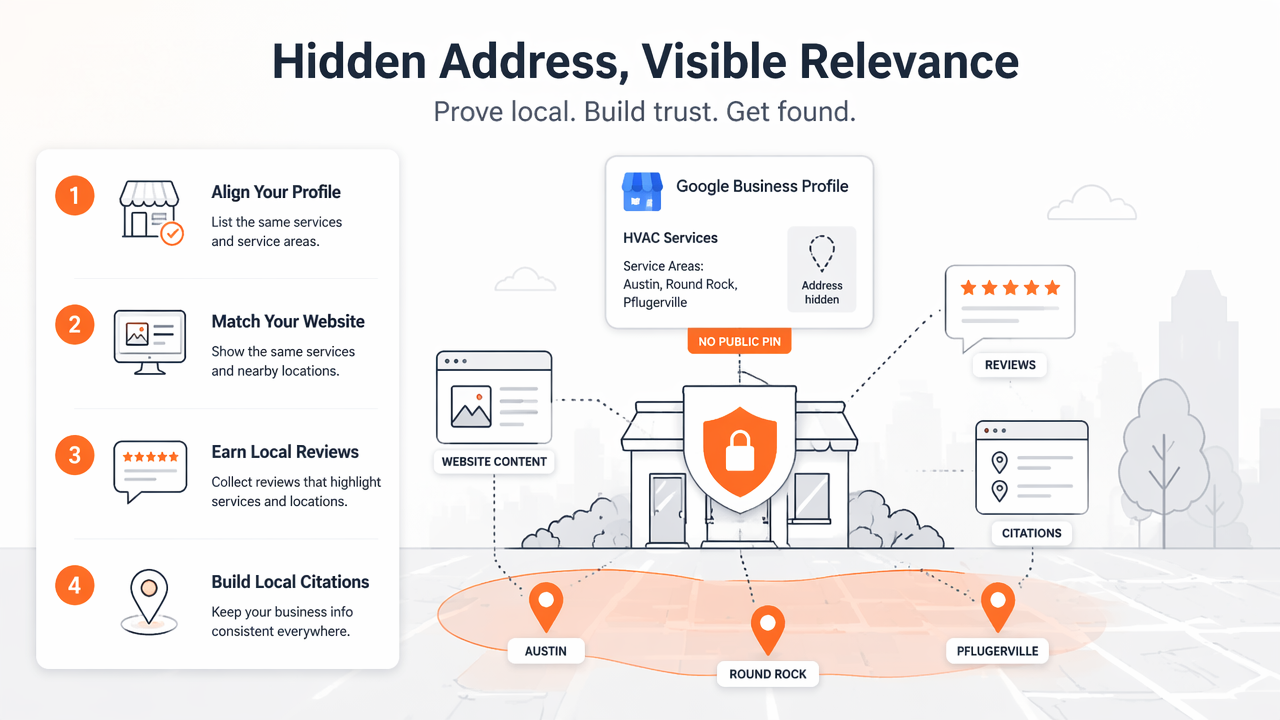
Website content matters because Google compares profile details with crawlable pages. Each important service should have a clear page, and each important market can have a useful location page when the business has real experience there. Thin pages that only swap city names rarely help.
Local relevance signals that support a service-area profile
- Service pages: explain exact offers, pricing factors, process, and common local needs.
- Location pages: cover service availability, nearby neighborhoods, examples, and FAQs.
- Project proof: show before-and-after photos, job summaries, materials, and service dates when appropriate.
- Consistent NAP data: keep name, phone, and website consistent across directories.
- Helpful blog content: answer local buyer questions, seasonal issues, and service comparisons.
The Earlyseo platform can help teams plan and publish location-aware content without losing the main service message. For companies using a CMS, the WordPress SEO integration, Shopify SEO integration, and Webflow publishing integration make it easier to keep service pages and location pages structured.
Reviews are another major trust layer. A good review program asks every real customer for feedback, then encourages natural detail about the service and location. A review that mentions "emergency drain cleaning in Plano" gives stronger context than a generic "great work."
Review takeaway: The safest review strategy is simple and boring: ask real customers, make the process easy, never script praise, and respond to every review with service-specific context.
Research on misinformation by Aïmeur, Amri, and Brassard in Social Network Analysis and Mining (2023) reviewed how false or misleading content spreads in social systems, a useful reminder that fake reviews and false business claims are trust risks in local search (study). Authenticity is not just policy hygiene; it protects conversion quality.
What should service-area businesses expect from AI search in 2027?
Service-area businesses should expect AI search to reward clear entities, consistent local facts, and well-structured answers more than vague keyword pages. Google AI features, ChatGPT-style assistants, and local search summaries need clean business data before they can confidently recommend a provider.
Generative AI research by Feuerriegel, Hartmann, and Janiesch in Business & Information Systems Engineering (2023) examined how generative systems create outputs from learned patterns and inputs (study). For local businesses, that means unclear service pages, inconsistent locations, and missing business facts may be harder for answer engines to cite.
AI-ready local SEO checklist
- State the business type, services, and service areas in plain language.
- Use consistent names for cities, neighborhoods, and services across the site.
- Add FAQ sections that answer real buyer questions in 40 to 80 words.
- Keep Google Business Profile services aligned with website service pages.
- Publish proof of work, reviews, and location-specific examples.
- Make technical files and crawl paths easy for bots to understand.
Earlyseo supports this shift by helping businesses create structured content that can be understood by search engines and AI systems. Teams interested in machine-readable discovery can also review the llms.txt resource, which reflects the growing push to make websites easier for AI crawlers to parse.
Classic local SEO still matters. AI search does not replace Google Business Profile quality, reviews, proximity, or local authority. It raises the cost of vague content because answer engines prefer crisp definitions, direct answers, and reliable entity relationships.
FAQ about service-area Google Business Profiles
Service-area business owners usually struggle with the same profile questions: addresses, rankings, reviews, and city coverage. Clear rules reduce risk and make the profile easier for Google and customers to trust.
Can a service-area business rank without showing an address?
Yes, a service-area business can rank without showing an address when it is eligible, verified, and supported by strong local relevance signals. A hidden address is normal for businesses that visit customers. Visibility depends on proximity, category fit, reviews, website relevance, and real-world trust signals, not just whether a map pin is public.
How many service areas should be added to a profile?
A profile should include the service areas the business can serve reliably, not every possible city. A tight, realistic coverage zone is usually stronger than an inflated region. Good choices reflect travel time, staffing, past customers, review locations, and profit potential across the target market.
Should each city have a separate Google Business Profile?
Each city should only have a separate Google Business Profile when there is a real, eligible, staffed location that follows Google's rules. Creating profiles for virtual offices, rented mailboxes, or unstaffed addresses can create suspension risk. Location pages on the website are usually safer for nearby cities without a real branch.
Do reviews need to mention locations?
Reviews do not have to mention locations, but location detail can help provide context when it happens naturally. The business should never script reviews or pressure customers to use keywords. A simple request after completed work often earns useful details about the job type, neighborhood, and customer experience.
How often should the profile be updated?
A service-area profile should be reviewed at least monthly and updated whenever services, hours, photos, staff capacity, or coverage areas change. Regular updates help keep customers informed and reduce mismatches between the profile and website. A quarterly service-area audit is also useful for removing weak or unprofitable coverage.
Conclusion
Strong service area business Google Business Profile SEO starts with honest setup, then improves through local proof. The next best steps are to confirm address visibility, tighten service areas, align website pages with Google Business Profile categories, request real reviews, and publish location-specific evidence. For a cleaner content workflow, visit earlyseo.com and map the next 10 service and location pages before expanding into more cities.