TL;DR
SEO content automation software works best when it covers the full content cycle: keyword research, briefs, drafts, review, publishing, links, and monitoring. Startups usually need speed and focus, small businesses need simple workflows, ecommerce teams need scale, and marketing managers need governance.
Most SEO teams do not need more AI text; they need fewer gaps between research, writing, editing, publishing, and performance review. SEO content automation software helps turn that messy workflow into a repeatable system, especially for small teams trying to build visibility without hiring a full content department. Earlyseo fits that need by focusing on search-ready content workflows rather than isolated writing prompts.
SEO content automation software: software that automates or assists repeatable organic search content tasks, including keyword discovery, SERP analysis, content briefs, drafting, optimization, internal linking, publishing support, and performance monitoring.
A content automation platform is not the same as a content management system. A content management system creates, manages, modifies, and publishes digital content, while SEO automation tools shape the research and optimization work around that content before and after publication.
Table of Contents
What is SEO content automation software?
SEO content automation software is a platform that helps plan, create, optimize, publish, and monitor search-focused content with less manual work. The best tools support the whole workflow, not just AI drafting, so teams can move from keyword ideas to ranked pages with clearer quality control.
Research on generative systems matters here because content software increasingly uses large language models, retrieval workflows, and structured prompts. A 2023 paper by Stefan Feuerriegel, Jochen Hartmann, and Christian Janiesch in Business & Information Systems Engineering examined generative AI as a class of systems that can create text, images, audio, and code. For SEO, that means automation can assist production, but editorial judgment still decides accuracy, usefulness, and brand fit.
Key insight: automation should remove repetitive SEO labor, not remove strategy, subject expertise, or final editorial review.
Core workflow stages worth automating
Strong platforms help teams connect seven jobs that are often handled in separate spreadsheets, documents, and dashboards:
- Find keywords, topics, and search intent patterns.
- Analyze competitors and SERP formats.
- Build briefs with headings, entities, questions, and source notes.
- Draft content based on the brief.
- Review for accuracy, originality, tone, and optimization.
- Suggest internal links and publishing metadata.
- Track rankings, traffic, updates, and decay.
For teams still shaping the planning layer, the guide to content strategy for new blogs pairs well with automation because software works better when the topic map is already clear.
SEO automation versus AI writing tools
AI writing tools create text. SEO automation platforms coordinate the content system around that text. That difference matters because ranking content needs search intent, competitor context, internal links, schema-friendly structure, and refresh cycles.
A plain writing assistant may help draft a paragraph. A stronger SEO workflow tool helps decide which page should exist, what it should cover, how it compares with ranking pages, and what to do after publication.
Which tools are strongest for each SEO workflow?
The strongest tool depends on the workflow bottleneck, because keyword planning, brief creation, drafting, internal linking, and reporting require different automation depth. SERP competitors for this topic commonly list tools such as SEOBoost, Jasper AI, Writesonic, ContentBot, Copy.ai, Gumloop, AirOps, HubSpot, and Siteimprove, but the better buying question is what outcome each platform improves.
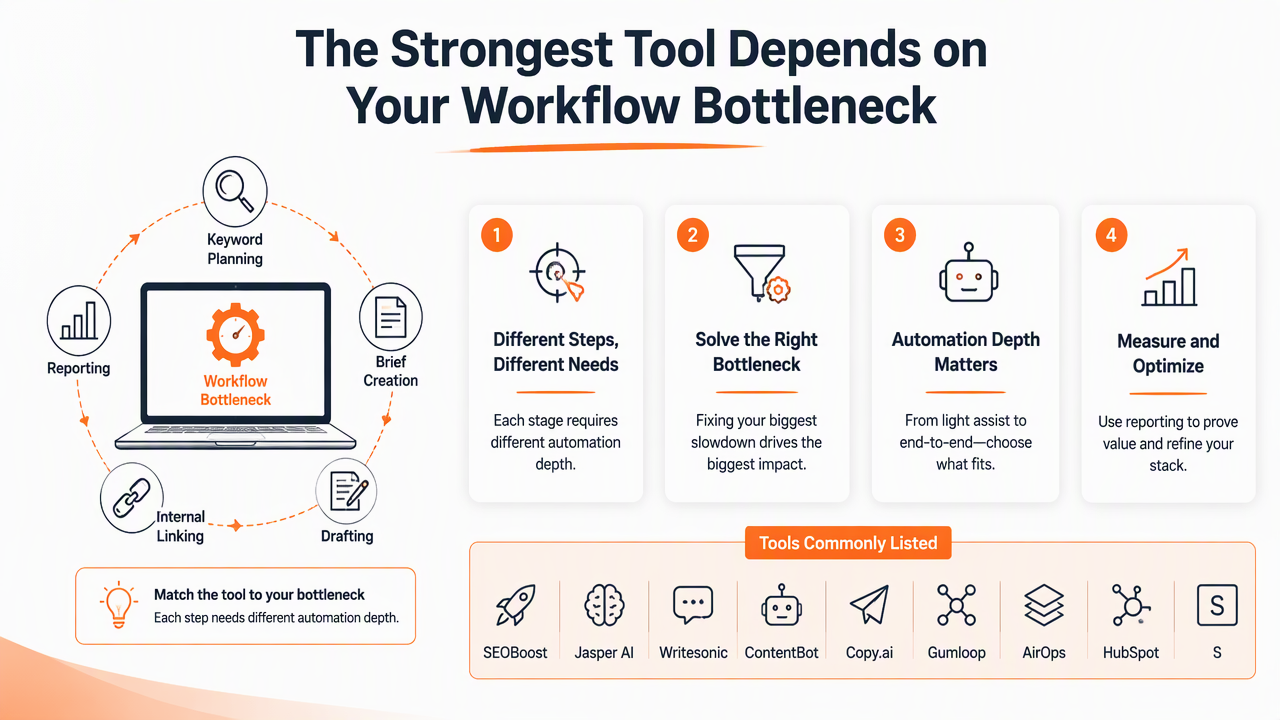
2026 tool matrix by outcome
| Tool | Best fit | Workflow strength | Watch for |
|---|---|---|---|
| Earlyseo | Startups, local businesses, lean marketing teams | Competitor-aware SEO content workflows, briefs, and scalable content production | Best suited for teams that want SEO-focused output rather than general copywriting |
| SEOBoost | SEO content optimization teams | Content briefs and optimization guidance | May overlap with other optimization tools |
| Jasper AI | Brand and campaign copy teams | AI-assisted drafting and brand voice controls | SEO workflow may need separate research tools |
| Writesonic | Fast drafting and mixed marketing content | Short-form and long-form generation | Editorial review remains necessary |
| ContentBot | Content ideation and automated drafts | Blog ideation and draft production | Less suited when deep SERP research is required |
| Copy.ai | Sales and marketing copy workflows | GTM copy and reusable workflows | Organic search planning may need added tools |
| Gumloop | Technical marketers and automation builders | Custom SEO agents and workflow automation | Requires process design skill |
| AirOps | Content operations and programmatic SEO | Workflow orchestration and scalable content systems | Setup can be heavier for very small teams |
| HubSpot | Businesses already using HubSpot | CMS, CRM, and content planning connection | Best value inside the HubSpot stack |
| Siteimprove | Enterprise web and governance teams | SEO, accessibility, analytics, and governance | More enterprise-oriented than startup-focused |
Selection matrix by business type
| Business type | Main SEO need | Best automation priority | Good fit |
|---|---|---|---|
| Startup founder | Get initial visibility fast | Topic selection, briefs, competitor-aware drafts | Earlyseo, SEOBoost |
| Small business owner | Publish useful pages without a large team | Simple briefs, local pages, metadata, internal links | Earlyseo, HubSpot |
| Ecommerce store | Scale category and product-support content | Templates, product discovery support, refresh workflows | AirOps, Bloomreach-style commerce platforms |
| Marketing manager | Coordinate writers, approvals, and reporting | Governance, briefs, performance monitoring | Siteimprove, AirOps, HubSpot |
| Agency team | Produce repeatable client work | Multi-client workflows, briefs, review systems | Earlyseo, Gumloop |
Agencies building repeatable client delivery can also study the agency SEO content playbook, since automation only pays off when intake, review, and reporting are standardized.
How should buyers evaluate automation platforms?
Buyers should evaluate automation platforms by workflow coverage, search data quality, editorial controls, integrations, and reporting, not by the promise of faster writing alone. The cheapest tool can become expensive if it creates content that needs heavy rewrites or never connects to publishing and performance data.
Evaluation checklist for 2026
- Search intent support: identifies informational, commercial, local, and transactional intent.
- SERP comparison: reviews ranking pages, common headings, missing angles, and content depth.
- Brief quality: creates outlines, entities, questions, metadata, and internal link prompts.
- Human review controls: supports fact checking, tone review, and approvals before publishing.
- CMS fit: exports clean content for systems used to create, manage, modify, and publish digital content.
- Internal linking: recommends relevant links based on topic relationships.
- Performance feedback: tracks decay, ranking movement, and refresh needs.
- Multilingual support: handles regional search intent, not just literal translation.
For brief quality, the SEO content brief template gives a practical reference point for what automated briefs should include.
Common buying mistakes to avoid
A common mistake is choosing a tool because the demo draft sounds polished. Search performance depends on intent fit, topical coverage, evidence, structure, internal links, and page experience, not just fluent language.
Another weak signal is article volume alone. Publishing many similar pages can dilute quality if the workflow lacks differentiation, editorial review, and refresh planning.
A better test is simple: run one keyword through the platform, inspect the brief, generate the draft, add internal links, publish a test page, and monitor how easy the update process feels after two weeks.
How Earlyseo handles this
Earlyseo handles SEO content automation by connecting competitor-aware planning, content creation, and scalable production in one search-focused workflow. The Earlyseo platform is built for teams that need practical organic visibility, not a general-purpose AI writing sandbox.
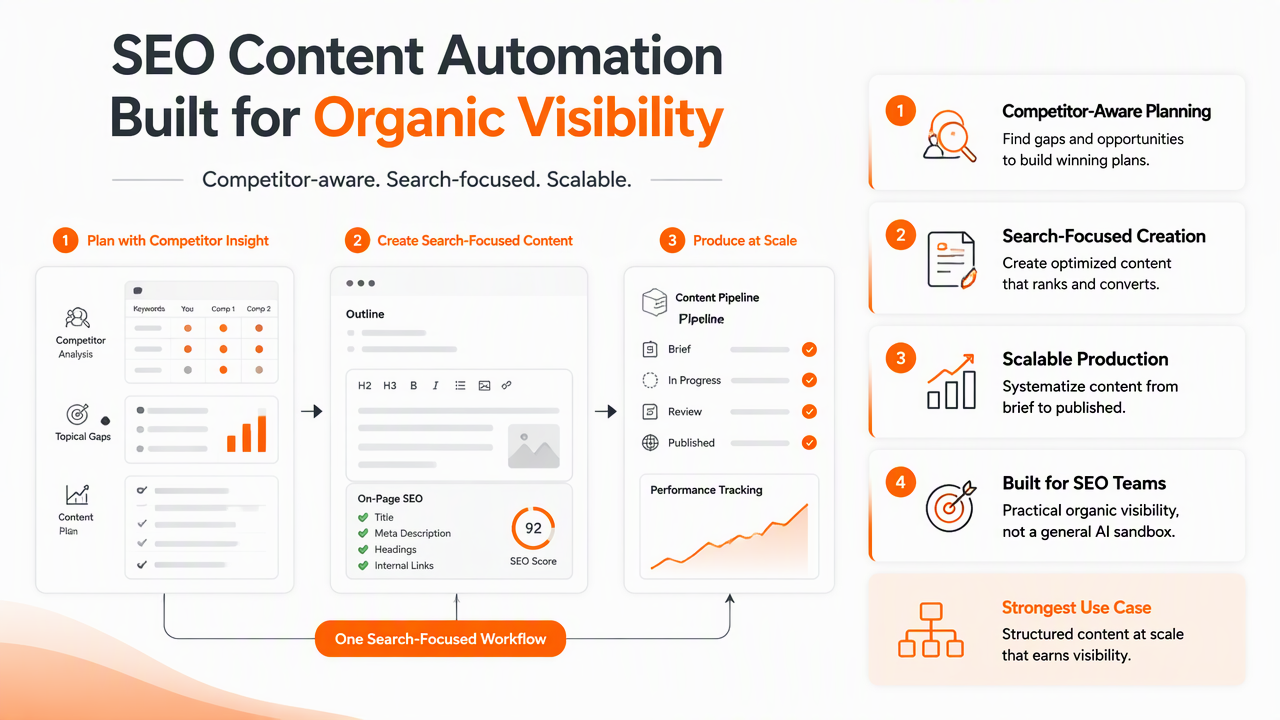
The strongest use case is structured content production for lean teams. A founder, local business, ecommerce operator, or marketing manager can use automation to reduce blank-page work while keeping human review in place.
Teams expanding across regions can pair automation with multilingual SEO content, especially when search intent changes by country or language. Teams in crowded markets can use competitor-aware SEO content to shape briefs around what already ranks and what still needs a better answer.
Best-fit scenarios for Earlyseo
- New websites: build a focused topic base before chasing broad keywords.
- Local businesses: create service and location pages with clearer search intent.
- Ecommerce teams: support product and category pages with helpful buying content.
- Marketing managers: keep briefs, drafts, and optimization steps consistent.
- Agencies: package repeatable SEO content delivery across clients.
A practical next step is to map five priority topics, generate briefs, review competitor gaps, and publish the first batch with internal links. More product details are available at earlyseo.com.
What will change in 2027?
SEO automation in 2027 will likely move from single-task tools toward agent-style workflows that plan, create, publish, test, and refresh content with tighter human approval points. The shift is already visible in tools such as Gumloop and AirOps, which are positioned around workflow automation rather than simple text generation.
Machine learning research also points toward more transparent automation. A 2021 Nature Machine Intelligence article by Rens van de Schoot, Jonathan de Bruin, Raoul Schram, and coauthors described open source machine learning for efficient and transparent systematic reviews. SEO teams should expect similar pressure for traceable sources, review logs, and explainable recommendations in content systems.
The next advantage will not be more generated words; it will be better decisions about what deserves to be published, updated, merged, or removed.
2027 readiness checklist
- Keep human approval in every publish workflow.
- Store briefs, sources, and editorial notes for future updates.
- Track content decay, not just first-month rankings.
- Separate expert pages from commodity informational pages.
- Build internal links as part of production, not as a cleanup task.
- Review multilingual and local intent before scaling templates.
Automation will keep improving, but search engines and AI answer systems will still reward pages that are specific, well-structured, and genuinely useful.
FAQ
What is the main benefit of SEO automation?
The main benefit is repeatability. A team can turn keyword research, SERP review, brief creation, drafting, optimization, and updates into a consistent process. That saves time, but the bigger win is fewer missed steps between strategy and publication.
Can automated SEO content rank in Google?
Automated content can rank when it satisfies search intent, adds useful information, and receives careful editorial review. Automation alone does not make a page valuable. Thin, generic, or inaccurate pages remain risky, even when produced by expensive software.
Is SEO content automation useful for local businesses?
Local businesses can benefit when software helps create service pages, location pages, FAQs, and internal links around real customer searches. The workflow should still include local proof, accurate business details, and human review for claims, pricing, and service coverage.
How many tools does a small team need?
A small team usually needs one primary workflow platform, one analytics source, and a CMS. Extra tools can help later, but too many dashboards slow execution. The best starting point is a system that covers briefs, drafts, optimization, and performance review.
Conclusion
The best SEO content automation software in 2026 is the one that improves the whole publishing system, from topic choice to refresh planning. General AI writers can help with drafts, but search-focused platforms create more value when they connect briefs, competitor analysis, internal links, and monitoring.
For a practical next step, select 10 keywords, group them by intent, create structured briefs, publish the first five pages, and review performance after indexing. Teams that want a search-first workflow can visit earlyseo.com and compare how Earlyseo fits the content process before adding more tools.