TL;DR
Entity SEO makes a business easier for Google AI Overviews, AI Mode, and chat-based search systems to identify, classify, and cite. Small brands should focus on consistent naming, structured data, entity-rich pages, trusted third-party mentions, and Search Console measurement before chasing more keywords.
AI search does not only match pages to keywords; it tries to identify real things, their attributes, and their relationships. Entity SEO for AI search is the practice of making a business, product, person, place, or topic machine-readable across a website and the wider web. For small brands, that means clear naming, structured data, consistent profiles, and credible citations matter as much as a traditional blog calendar. Earlyseo helps growing teams turn those signals into content and operations that search systems can understand.
Table of Contents
What is entity SEO for AI search?
Entity SEO for AI search is the process of helping search engines and generative AI systems understand a brand as a distinct, trusted entity rather than a loose set of keywords. It connects names, services, locations, people, products, schema markup, internal links, and external mentions into a clear identity graph.
Entity: A uniquely identifiable thing, such as a company, product, person, location, concept, or event, that can be described by attributes and connected to other entities.
Google Search, operated by Google, lets people search or ask for information through web pages and apps. In AI-style results, that matching process increasingly depends on whether systems can connect a query to known entities, evidence, and context.
Key insight: Keywords still matter, but entities explain meaning. A page about "Apple" needs signals that distinguish Apple Inc., apple fruit, Apple Records, or a local orchard.
Entity signals that AI systems can parse
Modern language models use context at large scale. Research on PaLM: Scaling Language Modeling with Pathways, published in 2022, examined large language modeling systems trained to handle many tasks through language patterns. Search engines add retrieval, indexing, links, structured data, and source evaluation on top of language understanding.
Common entity signals include:
- Consistent names: The same company, founder, product, and location names across pages and profiles.
- Typed relationships: Brand-to-product, business-to-location, author-to-article, and service-to-industry connections.
- Structured data: Schema.org markup such as
Organization,LocalBusiness,Product,Person,Article, andFAQPage. - Third-party references: Mentions from directories, review sites, industry publications, partners, podcasts, and marketplaces.
- Topical coverage: Pages that explain what the business does, who it serves, and how its offers compare.
Why entities matter more in AI answers
Entities matter more in AI answers because generative search systems need confidence before summarizing or citing a brand. A keyword-stuffed page may rank for a phrase, but an entity-rich brand profile helps AI systems decide what the brand is, where it operates, who it serves, and why it deserves mention.
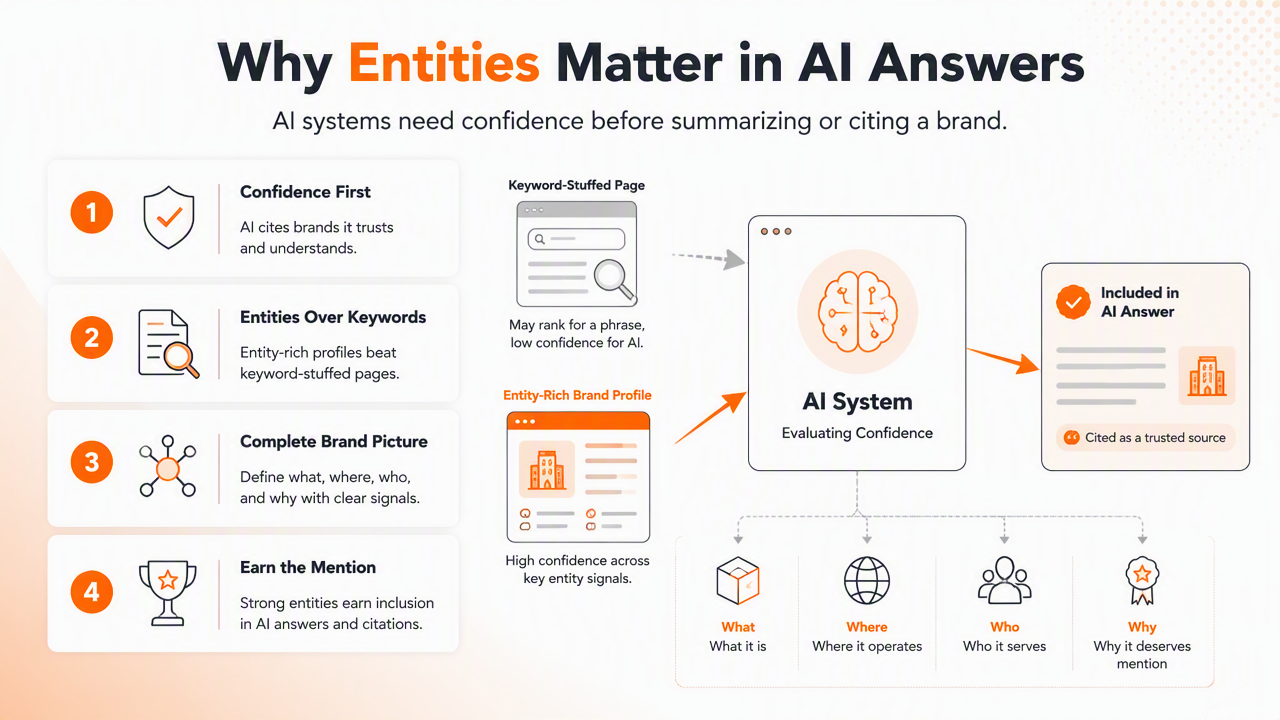
Classic SEO often treats a page as the unit of competition. AI search often treats the answer as the unit of output. That shifts attention toward verifiable facts, source consistency, and relationships across many documents.
Businesses building a new site should still fix crawlability, indexing, and on-page basics. A practical starting point is a clean content strategy for new blogs, then entity mapping can make every article reinforce the same brand graph.
How entity SEO differs from keyword SEO
The strongest strategy uses both keywords and entities, but each plays a different job.
| SEO focus | Main question | Best use | Weak spot |
|---|---|---|---|
| Keyword SEO | What phrase is being searched? | Matching page copy to demand | Can miss meaning and brand context |
| Entity SEO | What real thing is being described? | Building machine-readable identity | Requires consistency beyond one page |
| Technical SEO | Can systems crawl and render the page? | Indexing, speed, canonical control | Does not prove authority alone |
| Digital PR | Who else confirms the entity? | Mentions, citations, credibility | Harder to control directly |
Keyword SEO helps a bakery target "gluten-free cupcakes near me." Entity work helps Google connect the bakery name, address, menu, reviews, owner, service area, and local food mentions into one recognizable business.
How AI systems understand a business entity
AI systems understand a business entity by combining on-site facts, structured data, internal relationships, external mentions, and user-facing evidence. The goal is not to trick a model. The goal is to reduce ambiguity so a system can describe the business correctly.
For a small company, ambiguity often comes from ordinary messiness. A brand may use "Co." on LinkedIn, "Company LLC" on Google Business Profile, a shortened name on product pages, and an old address in citations. Search systems may still infer the connection, but clarity improves when every source agrees.
Earlyseo supports this work through competitor-aware planning, search data, and SEO operations workflows. For teams comparing their entity footprint against stronger brands, competitor-aware SEO content can reveal which entities, topics, and citations already shape the search results.
The practical entity map for a small brand
A simple entity map turns scattered facts into a structure that content, schema, and citations can repeat.
- Name the primary entity: Legal brand name, public brand name, domain, and social handles.
- Define the entity type:
Organization,LocalBusiness,SoftwareApplication,Store,Product, orPerson. - List core attributes: Address, service area, founders, launch year, category, pricing model, and primary offers.
- Connect related entities: Products, services, authors, cities, industries, partners, and certifications.
- Assign proof sources: Website pages, Google Business Profile, review pages, directory listings, press mentions, and case studies.
- Track query associations: Questions and phrases where the brand should be considered a relevant answer.
This map should guide page titles, headings, author bios, schema fields, About page copy, and external profiles. For local companies, the same approach pairs well with a focused local business SEO plan.
Structured data that clarifies meaning
Structured data gives search systems explicit clues about page meaning. It does not guarantee inclusion in AI Overviews or chat answers, but it reduces guesswork.
Useful schema choices include:
Organizationfor brand identity, logo, same-as links, founders, and contact details.LocalBusinessfor physical location, service area, opening hours, and business category.Productfor ecommerce items, offers, reviews, and product identifiers.Articlefor editorial content, author names, dates, and publisher relationships.FAQPagefor concise question-and-answer content that matches real search behavior.
Internal links also matter because they show relationships between pages. A deeper internal linking strategy for SEO can connect brand, service, product, and educational pages into a cleaner topical graph.
How to build entity visibility in 2026
Building entity visibility in 2026 requires a repeatable workflow: define the entity, clean the facts, publish proof, mark up key pages, earn external mentions, and measure branded and non-branded discovery. The process works best when content, technical SEO, and reputation building move together.
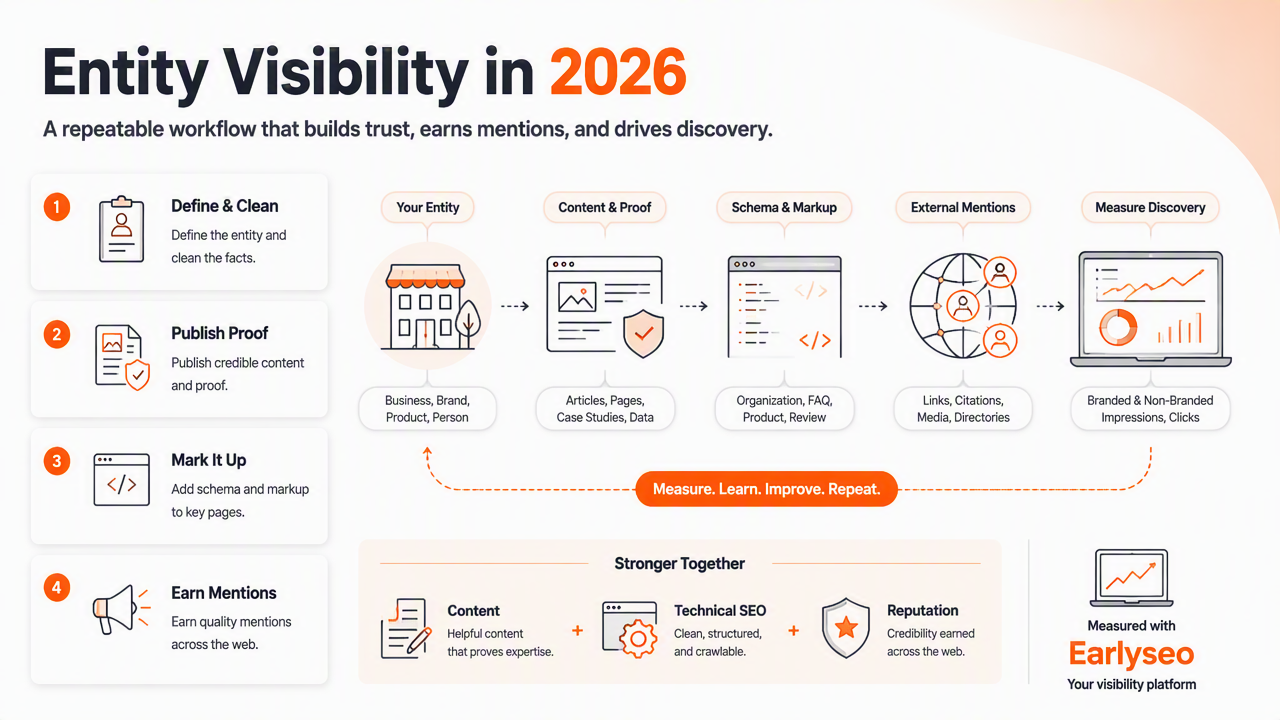
The Earlyseo platform is useful when a small team needs a steady publishing and optimization cadence instead of one-off fixes. Strong entity signals compound over time because every accurate page, citation, and mention gives search systems another confirmation point.
Practical rule: A brand should be described the same way on its website, Google profile, social profiles, review pages, marketplace listings, and press mentions.
A 2026 entity SEO checklist
Use this checklist before expanding into larger content campaigns:
- Create a canonical About page that states the brand name, category, audience, location, founders, and main offers.
- Standardize NAP data for name, address, and phone across the site and major profiles.
- Add organization schema with logo, URL, same-as links, contact details, and social profiles.
- Build service or product pages that connect each offer to a specific audience and use case.
- Publish author and expert pages for people whose experience supports the brand's credibility.
- Earn third-party mentions from relevant directories, podcasts, associations, partners, and industry blogs.
- Use Search Console data to monitor branded queries, impression growth, and pages gaining entity-related visibility.
Teams that need cleaner measurement can connect entity work with Google Search Console workflows. For ecommerce stores, entity work should also connect products, categories, merchant details, and reviews, which aligns well with Shopify SEO planning.
Content types that strengthen entity recognition
The best content explains relationships that AI systems can reuse. A service page says what the business sells. A comparison page shows market context. A case study proves real-world use. A glossary defines concepts connected to the brand.
High-value formats include:
- Entity hub pages: One canonical page for the company, product, location, or founder.
- Comparison pages: Clear differences between the brand, alternatives, categories, and use cases.
- Use-case pages: Pages for industries, customer types, locations, or workflows.
- Evidence pages: Case studies, testimonials, awards, certifications, and press pages.
- Definition pages: Short, structured explanations of terms the brand wants to own.
International brands need extra care because translated names and regional domains can fragment identity. Multilingual teams can use multilingual SEO content to keep entity details consistent across markets.
What to expect from entity search in 2027
Entity search in 2027 will likely place more weight on verifiable identity, source agreement, and answer-ready evidence. AI results are moving toward synthesized answers, so brands that can be confidently identified, compared, and cited will have an advantage over brands that only publish keyword-matched pages.
Search engines and AI assistants still need trusted sources to avoid confusion. That need favors brands with clear entity hubs, structured data, transparent authorship, and independent mentions.
Small businesses do not need a Knowledge Panel before entity work matters. A clear brand graph can improve how search systems interpret pages, connect services to locations, and surface trustworthy sources for long-tail questions. For structured execution, the 90-day SEO sprint gives a practical cadence for turning messy SEO tasks into visible progress.
Signals likely to grow in importance
The next phase of AI search will reward clarity, not volume alone.
| Signal | Why it matters | Small-brand action |
|---|---|---|
| Source consistency | Reduces identity confusion | Standardize names, URLs, profiles, and addresses |
| First-party proof | Gives AI systems facts to cite | Publish About, product, author, and evidence pages |
| Third-party validation | Confirms the brand outside its own site | Earn relevant mentions and directory listings |
| Structured data | Labels entities and relationships | Add schema to core pages and keep it current |
| Query coverage | Connects entities to real demand | Build pages around customer questions and use cases |
A plain-language brand description should appear on earlyseo.com, social profiles, business listings, and any authoritative partner pages. Consistent wording helps systems connect those mentions back to the same entity.
FAQ about entity SEO and AI search
These quick answers cover the most common questions small teams ask before starting entity optimization.
Does entity SEO replace keyword research?
Entity SEO does not replace keyword research. It adds meaning around the keywords. Keyword research shows demand, while entity work shows who or what the page is about. A strong page targets real search behavior, names the relevant entities clearly, and connects the business to products, services, places, people, and proof sources.
Can a small local business benefit without a Knowledge Panel?
A small local business can benefit before earning a Knowledge Panel. Consistent business details, local schema, Google Business Profile accuracy, reviews, service-area pages, and local citations help search systems identify the company. The result may appear as better local relevance, clearer brand associations, and stronger eligibility for AI-generated local answers.
Which pages should be optimized first?
The highest-priority pages are the homepage, About page, main service or product pages, location pages, author bios, and contact page. These pages carry the core facts that identify the business. Once those are clear, supporting blog posts and comparisons can reinforce the same entity relationships across more searches.
How long does entity recognition take?
Entity recognition usually builds gradually as search systems crawl updated pages, process structured data, and encounter consistent third-party mentions. No fixed timeline applies because crawl frequency, site authority, industry competition, and citation quality vary. A 90-day operating plan is a reasonable first window for cleanup, publishing, and measurement.
Conclusion
Entity SEO for AI search gives small brands a practical way to become easier to identify, summarize, and cite. The next step is simple: create an entity map, clean inconsistent brand facts, add schema to core pages, publish proof-rich content, and track branded discovery in Search Console. For teams that want a guided workflow, Earlyseo can help turn that checklist into repeatable SEO operations. Visit earlyseo.com to plan the first entity-focused sprint.