TL;DR
Enterprise SEO workflow automation works best when it moves repeatable SEO tasks through clear triggers, owners, approvals, and measurable outputs. Teams should automate content briefs, internal links, technical checks, refreshes, and reporting while keeping humans in control of strategy, brand risk, and final publishing decisions.
Enterprise SEO workflows automation is no longer just task scheduling; in 2026, it is the operating system that keeps content, technical SEO, analytics, and approvals moving across large websites. The strongest programs do not automate everything. They automate handoffs, checks, routing, and reporting so specialists can spend more time on judgment-heavy work.
Enterprise SEO workflow automation: the use of connected tools, rules, AI assistance, and approval steps to move SEO work from trigger to measurable output across large or complex websites.
A useful workflow resembles content engineering, a discipline focused on managing content in computer-assisted environments. It also depends on CMS operations, since a content management system creates, manages, modifies, and publishes digital content across enterprise teams. Platforms such as Earlyseo fit this layer by helping teams organize SEO operations, content production, and execution routines in one place.
Table of Contents
What is enterprise SEO workflows automation?
Enterprise SEO workflows automation is a structured way to trigger, assign, review, publish, and measure SEO work across large sites without relying on ad hoc spreadsheets or manual reminders. It turns recurring SEO tasks into governed workflows where tools handle detection and routing, while people handle judgment, prioritization, and final approval.
For startups scaling into larger content operations, workflow automation prevents the common shift from "everyone knows what to do" to "no one knows who owns it." For enterprise teams, it creates traceability across SEO, content, product, engineering, legal, and analytics.
Key insight: Automation should reduce coordination drag, not remove expert review from decisions that affect brand, compliance, revenue pages, or site architecture.
Core terms teams should define first
Trigger: the event that starts work, such as a ranking drop, crawl error, new keyword cluster, stale article, or product launch.
Owner: the person or team accountable for moving the task forward, such as SEO, content, engineering, design, or analytics.
Approval gate: the required review before execution, often brand, legal, SEO lead, product owner, or developer review.
Output: the measurable result, such as a published brief, fixed template, refreshed page, added internal links, or executive dashboard.
Research on automation outside SEO supports the same principle. A 2021 review by Abioye, Oyedele, and Akanbi in the Journal of Building Engineering examined AI adoption, opportunities, and future challenges in a complex industry, showing how automation tends to work best when paired with governance and domain oversight rather than left unmanaged (ScienceDirect).
Which SEO tasks should be automated first?
The best SEO tasks to automate first are repeatable, rule-based, high-volume tasks with clear inputs and outputs. Enterprise teams usually see the fastest operational gains from automated content briefs, internal link suggestions, technical checks, content refresh queues, and recurring performance reports.
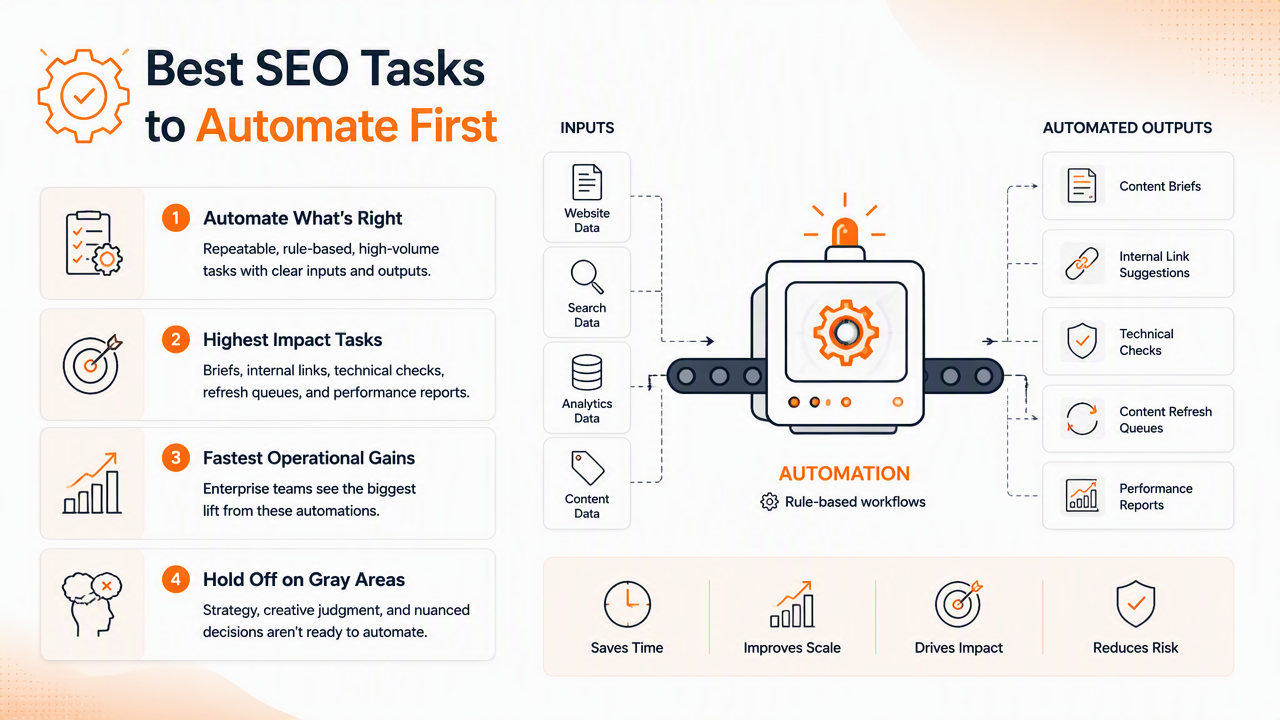
Tasks with high business risk should stay semi-automated. The system can prepare the evidence, draft the recommendation, and route the task, but a qualified owner should approve changes before publication or deployment.
Workflow map for common enterprise SEO tasks
| Workflow | Trigger | Owner | Approval step | Measurable output |
|---|---|---|---|---|
| Content briefs | New keyword cluster, product launch, content gap | SEO strategist | Content lead reviews angle and search intent | Approved brief with primary query, outline, entities, and SERP notes |
| Internal links | New page published, orphan page found, priority page underlinked | SEO specialist | Editor checks link fit and anchor text | Added contextual links and updated crawl path |
| Technical checks | Crawl detects errors, template changes, deployment | Technical SEO or engineering | Engineering lead validates fix | Resolved issue ticket and clean crawl sample |
| Content refreshes | Traffic drop, outdated date, SERP change | Content manager | SEO lead approves refresh scope | Updated article, revised title, refreshed schema, tracked result |
| Reporting | Weekly or monthly close, campaign milestone | Analytics owner | SEO lead validates commentary | Dashboard, notes, and next-action list |
Content teams can deepen the strategy behind these workflows with a structured content strategy for new blogs SEO process before automation scales production.
For internal link workflows, automation should identify candidates, not blindly insert links. A useful system reviews relevance, anchor diversity, crawl depth, and page priority. A deeper process is covered in internal linking strategy for SEO.
Tasks that should stay human-led
- Search intent decisions: AI can summarize SERPs, but an SEO lead should decide whether the page should educate, compare, sell, or support.
- Brand positioning: Automated drafts can miss nuance around category language, claims, and legal risk.
- Major technical changes: Template edits, indexation rules, canonical logic, and migrations need engineering review.
- Revenue-page updates: Product, pricing, and conversion pages need stakeholder approval before publishing.
A balanced model keeps automation close to evidence gathering and routing. Human specialists remain closest to business risk.
How should an enterprise SEO workflow be built?
An enterprise SEO workflow should be built by mapping each task from trigger to output, assigning a single owner, adding approval gates, and connecting the workflow to reporting. The goal is not a prettier task board. The goal is a repeatable operating model that makes SEO work visible, accountable, and measurable.
A practical build sequence works like this:
- List recurring SEO tasks across content, technical SEO, links, localization, and reporting.
- Define triggers for each task, such as crawl alerts, keyword changes, CMS events, or calendar dates.
- Assign one accountable owner and supporting reviewers.
- Add approval gates only where risk justifies review.
- Connect tools including CMS, crawler, analytics, keyword database, ticketing system, and content platform.
- Measure output quality with completion rate, cycle time, publish rate, fix rate, and business impact.
- Review workflows monthly to remove stale steps and tighten routing.
Key insight: Workflow automation fails when it copies a messy manual process. Clean the process first, then automate it.
Example workflow: automated content brief creation
A strong content brief workflow starts when a keyword cluster, competitor gap, or product campaign enters the SEO queue. The automation collects SERP patterns, related entities, internal page candidates, target audience notes, and draft outline options.
The content lead then approves the angle before the writer starts. That approval step prevents one of the most common enterprise problems: producing content that is technically "optimized" but misaligned with the brand or funnel stage.
For teams that need competitor context inside briefs, competitor-aware SEO content can support workflows where writers need SERP patterns, rival coverage, and differentiation points before drafting.
Example workflow: multilingual and international pages
International SEO adds workflow complexity because translation, localization, hreflang, regional search demand, and approval chains all matter. A workflow can trigger when a page reaches a traffic or revenue threshold in one market, then route it for localization research and regional approval.
For companies managing multiple markets, multilingual SEO content and international SEO workflows help keep language, market intent, and publishing steps aligned without turning every launch into a custom project.
How Earlyseo handles SEO workflow automation
The Earlyseo platform supports workflow-led SEO by connecting content planning, SEO operations, and repeatable execution steps around the work that growing companies perform every week. Its strongest fit is teams that need structure before hiring a large SEO department or agencies that need repeatable systems across multiple accounts.
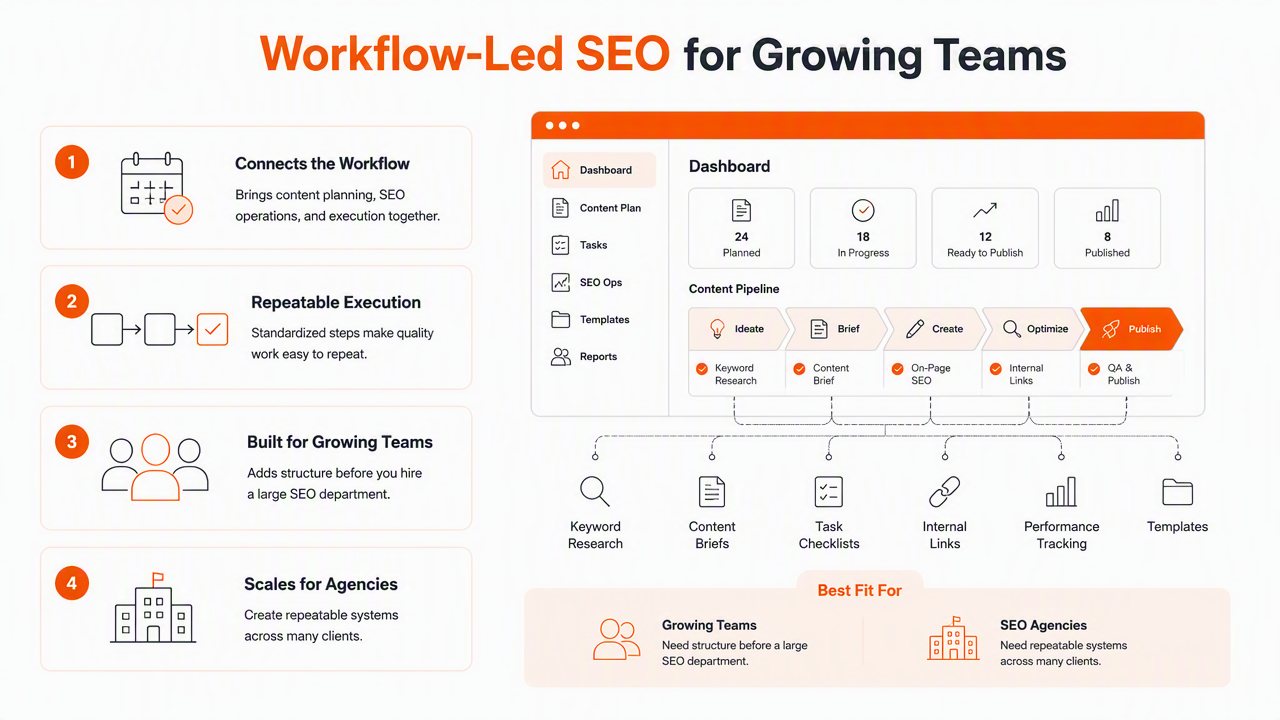
Earlyseo is useful when a team wants to move from one-off content production to a planned operating rhythm. That includes brief generation, competitor-informed planning, publishing queues, and performance routines that keep execution tied to search demand.
Where Earlyseo fits in the operating model
| Need | Manual approach | Automated workflow approach with Earlyseo |
|---|---|---|
| Topic planning | Brainstorm topics in meetings | Build a planned queue from SEO opportunities |
| Brief creation | Copy notes into docs | Standardize briefs with SERP and competitor context |
| Publishing cadence | Publish when content is ready | Run a visible queue with owners and status |
| Multi-page operations | Track pages in spreadsheets | Organize repeatable SEO work in one platform |
| Sprint planning | React to urgent tasks | Use a defined execution cycle and review results |
For teams building a first structured operating cycle, the 90-day SEO sprint gives a useful planning frame. SaaS teams can also adapt workflow automation to product-led search using the SaaS SEO playbook.
The practical role of Earlyseo is not to replace the SEO lead. It gives the SEO lead a cleaner system for turning strategy into assigned, reviewable, and measurable work. More details are available on earlyseo.com.
Who should pick which workflow setup
- Small in-house team: pick a lightweight platform-driven workflow that covers briefs, queues, and reporting without heavy configuration.
- Large enterprise SEO team: pick a connected workflow across crawler, CMS, ticketing, analytics, and approval tools.
- Agency team: pick a repeatable client delivery model with shared templates and account-level reporting.
- E-commerce team: pick workflows focused on category pages, product templates, internal links, and technical checks.
A workflow should match team maturity. A five-person marketing team rarely needs the same routing logic as a global brand with legal, localization, and engineering approval layers.
What will change in SEO automation by 2027?
SEO automation by 2027 will likely shift from simple task triggers toward AI-assisted operations where systems draft recommendations, explain risk, and coordinate approvals across tools. The safest teams will still keep humans responsible for strategy, quality, compliance, and final publishing decisions.
Generative AI research is moving quickly. A 2024 IEEE Access review by Yenduri, Ramalingam, Selvi, and coauthors examined GPT enabling technologies, applications, challenges, and future directions, which reflects why SEO teams are testing AI for summarization, drafting, classification, and decision support (IEEE Access).
The next phase will reward teams that document workflows clearly. AI agents and workflow builders need clean inputs: task definitions, approval rules, examples of good outputs, and measurable success criteria.
Expected changes include:
- More agent-assisted triage: systems will group issues, draft tickets, and suggest priority.
- Stronger governance: enterprise teams will add approval logs, policy checks, and audit trails.
- Better CMS integration: SEO recommendations will move closer to publishing workflows.
- More entity-led content planning: briefs will include topics, entities, internal links, and brand constraints.
- Less tolerance for generic output: automated content will need clearer expertise, examples, and differentiation.
FAQ
What is the first workflow an enterprise SEO team should automate?
The first workflow should usually be reporting or technical issue routing because both have clear triggers, owners, and outputs. Reporting saves recurring time, while issue routing prevents crawl errors and template problems from sitting unnoticed. Content brief automation comes next once strategy and approval standards are clear.
Can AI fully automate enterprise SEO?
AI cannot safely automate all enterprise SEO work because search intent, brand risk, legal review, technical architecture, and revenue impact require human judgment. AI works best as a support layer for research, summarization, routing, drafting, and monitoring. Final decisions should stay with accountable specialists.
How often should automated SEO workflows be reviewed?
Automated workflows should be reviewed monthly during growth periods and quarterly once the system is stable. Reviews should check cycle time, task completion, output quality, approval delays, and whether triggers still match business priorities. Stale automations create noise and reduce trust in the system.
What metrics prove SEO workflow automation is working?
Useful metrics include task cycle time, brief approval rate, publish velocity, technical fix rate, content refresh completion, internal links added, and reporting delivery consistency. Business metrics such as organic traffic, qualified conversions, and revenue should be reviewed separately so process gains are not confused with search performance.
Conclusion
Enterprise SEO workflows automation works when every recurring task has a trigger, owner, approval step, and measurable output. The next action is simple: choose one workflow, such as content briefs, internal links, technical checks, refreshes, or reporting, then map it before adding tools.
For teams ready to turn SEO planning into a repeatable operating rhythm, Earlyseo can help structure the work and keep execution moving. Visit earlyseo.com to review the platform and pick one workflow to systematize first.