TL;DR
Brand SERP monitoring means tracking what searchers see when a company, product, founder, or location name is searched. Small teams should review owned results weekly, reputation results monthly, and AI-generated summaries whenever major content or review changes happen.
A branded Google search is often the first trust check before a customer, investor, journalist, or partner takes the next step. Brand SERP monitoring turns that first impression into a managed asset instead of a surprise. For growing companies, Earlyseo helps connect branded visibility checks with practical SEO workflows, so search results can support discovery, credibility, and conversion.
Table of Contents
What is brand SERP monitoring?
Brand SERP monitoring is the practice of checking, recording, and improving the search results that appear for a company, product, founder, or location name. It covers organic listings, reviews, knowledge panels, sitelinks, images, videos, news, competitor appearances, and AI-generated answers across search and answer engines.
Brand SERP: the search engine results page shown for a branded query, such as a business name, product name, founder name, or branded service query.
Search engine optimization: the practice of improving a website's visibility and performance in search engine results pages. In branded search, SEO is less about discovery keywords and more about accuracy, trust, and control.
Key insight: branded search is not just a ranking report. It is a live reputation page created from company assets, third-party pages, public reviews, structured data, and machine-generated summaries.
Brand SERP terms that matter
A clean vocabulary helps small teams assign ownership and avoid vague reporting.
| Term | Plain meaning | Why it matters |
|---|---|---|
| Owned result | A page controlled by the brand, such as the homepage or profile page | Highest control and fastest update path |
| Third-party result | Review sites, directories, media, marketplaces, or social profiles | Strong trust signal, but lower control |
| Sitelinks | Extra links under the main domain result | Guides searchers to pricing, contact, products, or support |
| Knowledge panel | Entity box about a company, person, or place | Shows how search engines understand the brand |
| AI summary | Generated answer from Google AI features or LLM tools | Compresses multiple sources into one visible narrative |
What branded results should be tracked in 2026?
A branded search report should track the exact pages and features that shape trust: homepage position, review snippets, competitor ads or comparisons, knowledge panels, AI summaries, sitelinks, social profiles, local listings, videos, and unwanted third-party pages.
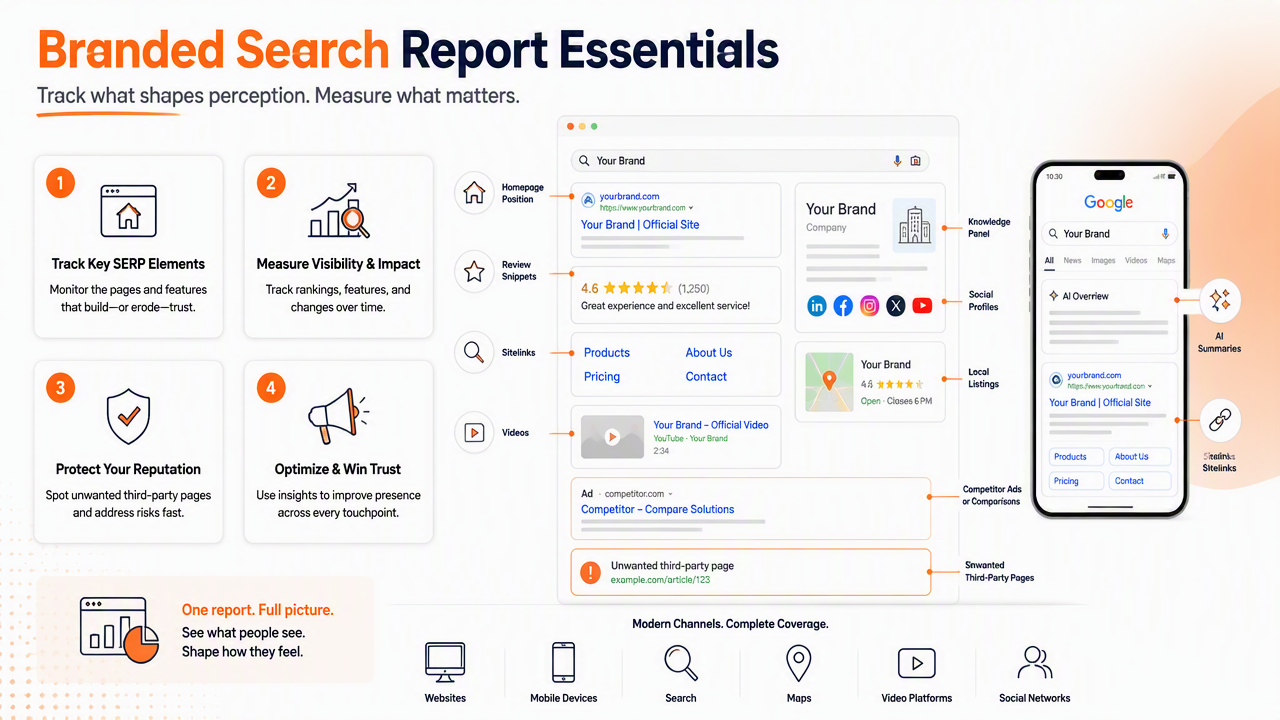
Modern digital marketing uses websites, mobile devices, search platforms, and other digital media to promote products and services. A 2024 systematic review by Leonidas Theodorakopoulos and Alexandra Theodoropoulou examined big data analytics and consumer behavior in digital marketing, which fits the direction of branded search: more signals, more surfaces, and more interpretation by algorithms.
Core branded SERP surfaces to audit
Every branded query should be checked through the lens of control, accuracy, and commercial impact.
| Surface | What to check | Good sign | Risk sign |
|---|---|---|---|
| Homepage | Position, title, meta description, favicon | Official site ranks first | Old title or wrong page ranks |
| Reviews | Star ratings, sentiment, recent complaints | Current positive reviews visible | Low-rated site dominates |
| Competitors | Ads, comparison pages, marketplace listings | Brand owns top organic space | Rival appears above owned pages |
| Knowledge panel | Name, logo, category, profiles | Accurate entity data | Wrong founder, image, or category |
| AI summaries | Claims, sources, tone | Brand facts are correct | Outdated or unsupported claims |
| Sitelinks | Important pages shown | Contact, pricing, products visible | Irrelevant or thin pages shown |
| Local pack | Address, hours, phone, reviews | Consistent business details | Incorrect hours or duplicate listing |
| Unwanted pages | Complaints, old PDFs, scraped profiles | Low visibility or resolved context | Negative page ranks near top |
How should small teams monitor branded search results?
Small teams should monitor branded search with a simple cadence: check mission-critical queries weekly, review reputation and local results monthly, audit AI summaries after major updates, and document changes in a shared tracker with owners, actions, and dates.
A practical setup starts with a short query list, not an enterprise dashboard. Most small businesses need only 10 to 25 branded searches at first.
- List the core brand name, common misspellings, and product names.
- Add founder, executive, and location queries when those names influence trust.
- Search in a clean browser, logged out when possible.
- Capture the top results, SERP features, AI answers, and review snippets.
- Mark each result as owned, partner, neutral, competitor, or reputation risk.
- Assign one action per issue, such as update schema, improve a profile, request a review, or publish a clarifying page.
- Recheck after the next crawl, review update, or content release.
Early-stage domains often have thin branded results because search engines have limited signals. The guide to SEO for a brand new domain is a useful next read for companies still building the first layer of branded visibility.
A realistic monitoring cadence
Cadence should match business risk. A local café, venture-backed SaaS company, and ecommerce store do not need the same rhythm.
| Task | Frequency | Owner | Output |
|---|---|---|---|
| Homepage and sitelinks check | Weekly | Marketing or founder | Screenshot and title changes |
| Review and local pack review | Weekly to monthly | Operations or local manager | Rating, review themes, wrong details |
| Competitor ad check | Weekly during campaigns | Marketing manager | Ad copy, landing page, offer |
| Knowledge panel review | Monthly | SEO or brand owner | Entity accuracy checklist |
| AI summary audit | Monthly and after launches | Content or SEO lead | Claim list and source notes |
| Full branded SERP report | Quarterly | Marketing lead | Trend summary and priorities |
Key insight: small teams do not need to monitor everything daily. They need a repeatable rhythm that catches visible changes before sales, hiring, or press moments amplify them.
How Earlyseo fits the workflow
The Earlyseo platform is useful when branded checks need to connect with page-level fixes. For example, a team can review how a title and description may appear with a SERP preview tool before updating a homepage, product page, or local landing page.
That preview step is especially helpful for branded queries because the title tag often acts as the official label for the business. A clear result snippet can improve recognition before a visitor even reaches the site.
Which metrics and alerts matter most?
The best branded search metrics measure ownership, accuracy, sentiment, and risk rather than only rank position. Teams should track who controls the visible results, whether facts are correct, which third-party pages influence trust, and when AI summaries change the brand narrative.
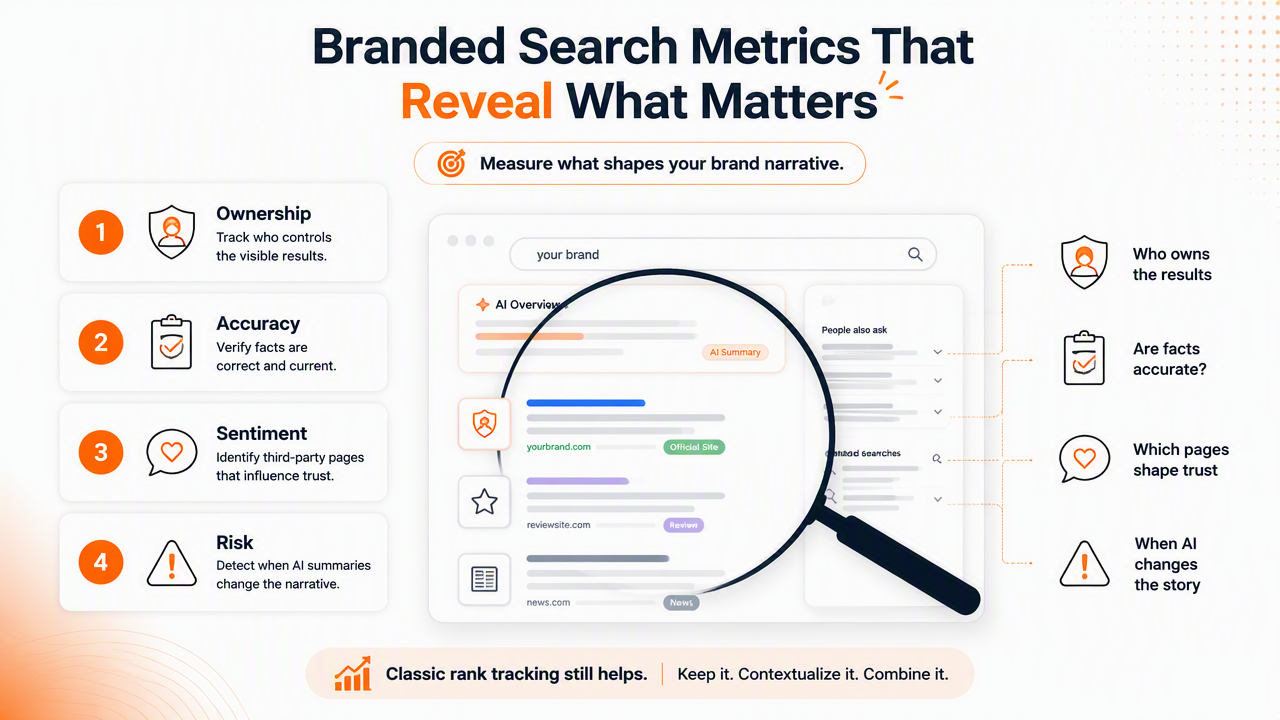
Classic rank tracking still helps, but branded results need more context. A number-one homepage can coexist with weak reviews, confusing sitelinks, or an AI answer that describes an outdated product.
Metrics to keep in the tracker
A lightweight tracker should include enough detail to support action without turning into busywork.
- Owned-result coverage: how many top results are controlled by the company or trusted profiles.
- Homepage stability: whether the official domain remains the first organic result.
- Snippet accuracy: whether titles, descriptions, and dates reflect the current offer.
- Review visibility: which review platforms appear and what themes dominate snippets.
- Competitor presence: whether rival ads, alternatives pages, or comparisons appear.
- Entity accuracy: whether logos, founders, addresses, categories, and social profiles match reality.
- AI answer accuracy: whether generated summaries use current facts and reliable sources.
- Reputation risk: whether old, misleading, or low-quality third-party pages appear near the top.
Alert rules that avoid noise
Alerts should fire only when a change can affect trust, traffic, or revenue. Daily noise from normal SERP reshuffling can waste time.
Useful alert triggers include:
- The homepage drops below the first organic position for the exact brand name.
- A competitor appears in paid results for the core brand query.
- A negative review page enters the top five organic results.
- A knowledge panel changes logo, category, location, or key entity facts.
- An AI summary adds an unsupported claim about pricing, availability, ownership, or product features.
- Sitelinks start showing low-value pages instead of commercial or support pages.
For cleaner reporting, each alert should include the query, location, device type, timestamp, screenshot, likely cause, and next action.
How will AI summaries change brand visibility in 2027?
AI summaries will make brand visibility more source-dependent because search engines and LLMs compress many pages into short answers. By 2027, branded monitoring will likely focus as much on cited sources and entity consistency as on traditional blue-link rankings.
Search results already mix organic pages, ads, local data, video, forums, review snippets, and generated answers. The shift is that AI tools can repeat outdated facts even when the official site has changed, especially if stronger third-party pages still carry older information.
What to prepare now
Preparation should focus on clear, consistent, crawlable facts across trusted sources.
- Keep the homepage, about page, contact page, and product pages current.
- Use organization, local business, product, and review structured data where appropriate.
- Align names, addresses, phone numbers, founders, and product descriptions across profiles.
- Publish clear comparison and FAQ content when competitors or alternatives pages rank.
- Track which sources AI summaries appear to rely on.
- Refresh outdated third-party profiles before a launch, funding announcement, or rebrand.
Key insight: AI answers reward consistency. A brand with clear facts across its own site and respected third-party sources is easier for search systems correctly.
Earlyseo can support this preparation by tying search appearance to on-page improvements. For teams that need a simple next step, earlyseo.com is the place to start.
FAQ about branded search monitoring
Common questions about branded search usually come down to scope, cadence, and ownership.
How often should a business check branded Google results?
A small business should check its most important branded Google results weekly and run a fuller review monthly. Weekly checks should cover the homepage, reviews, local pack, sitelinks, and competitor ads. Monthly reviews should include knowledge panels, social profiles, third-party directories, and AI-generated answers.
Does branded search still matter if the homepage ranks first?
Yes. A first-place homepage is only one part of the visible result. Reviews, sitelinks, local listings, videos, competitor ads, and AI summaries can all shape trust before a visitor clicks. Strong branded search management checks the full page, not just the top organic ranking.
What should a new company track first?
A new company should start with the exact brand name, domain name, product name, founder name, and location-based branded queries. The first goal is to make the official website, social profiles, local profile, and basic business facts easy for search engines to connect and display accurately.
Can unwanted third-party pages be removed from search results?
Some unwanted pages can be removed only when they violate platform policies, contain illegal content, or expose private information. Most cases require a different approach: publish stronger owned pages, improve trusted profiles, resolve review issues, and give search engines better sources to rank above the unwanted result.
Conclusion
Brand SERP monitoring gives a company a practical way to manage the first impression created by Google, other search engines, review platforms, and AI answers. The next step is simple: build a branded query list, capture the current results, flag accuracy and trust issues, then assign fixes by owner and date. For teams ready to improve how branded results appear before the next launch or campaign, start with a focused audit and use Earlyseo to turn visibility checks into page-level SEO actions.