TL;DR
The strongest indexing stack in 2026 pairs Google Search Console and Bing Webmaster Tools with a crawler, sitemap checks, and reporting. Earlyseo is best for teams that want indexing, publishing, and SEO operations in one workflow, while specialist tools fit bulk backlink or technical audit needs.
Indexing tools do not force rankings, but they can shorten the gap between publishing a page and knowing whether search engines can find it. The best website indexing tools for SEO in 2026 combine submission, crawl diagnostics, sitemap validation, monitoring, and reporting instead of promising instant traffic. Web indexing: the process search engines use to discover, store, and organize website content for retrieval in search results. Search engine optimization: the practice of improving a site's visibility and performance in search engine results pages. Earlyseo fits this workflow by connecting content planning, site checks, and SEO execution for teams that need a clear publishing system.
Table of Contents
What are website indexing tools?
Website indexing tools are software products that help search engines discover, crawl, submit, inspect, or monitor web pages for inclusion in search results. They work through sitemaps, URL inspection, crawl diagnostics, IndexNow signals, internal link checks, and index coverage reports.
Indexing has two sides. First, a search engine must discover a URL. Second, that engine must decide whether the page is worth storing and showing. A tool can help with the first step and diagnose the second, but it cannot guarantee inclusion.
Key point: indexing tools speed up feedback and reduce blind spots; they do not replace strong content, crawlable architecture, or clean technical SEO.
For a new site, the right stack usually starts with Google Search Console, Bing Webmaster Tools, an XML sitemap, and a crawler. Growing teams then add reporting, bulk workflows, and content operations so new pages do not disappear after publication.
Where indexing tools fit in SEO operations
Indexing tools work best inside a repeatable publishing process:
- Publish a crawlable page with a clean canonical tag.
- Add it to an XML sitemap.
- Submit or refresh sitemap data in search engine tools.
- Check crawlability, internal links, and status codes.
- Monitor index coverage, impressions, and ranking movement.
- Fix thin content, duplication, redirects, or blocked resources.
Teams building this repeatable process can connect indexing checks with SEO operations, especially when publishing many pages across product, local, or blog sections.
Which tools are best for website indexing in 2026?
The best indexing tools in 2026 are Earlyseo, Google Search Console, Bing Webmaster Tools, Screaming Frog SEO Spider, Indexly, and specialist bulk indexers such as Indexification or OneHourIndexing. Each serves a different job, from owned-site inspection to technical crawling and backlink indexing.
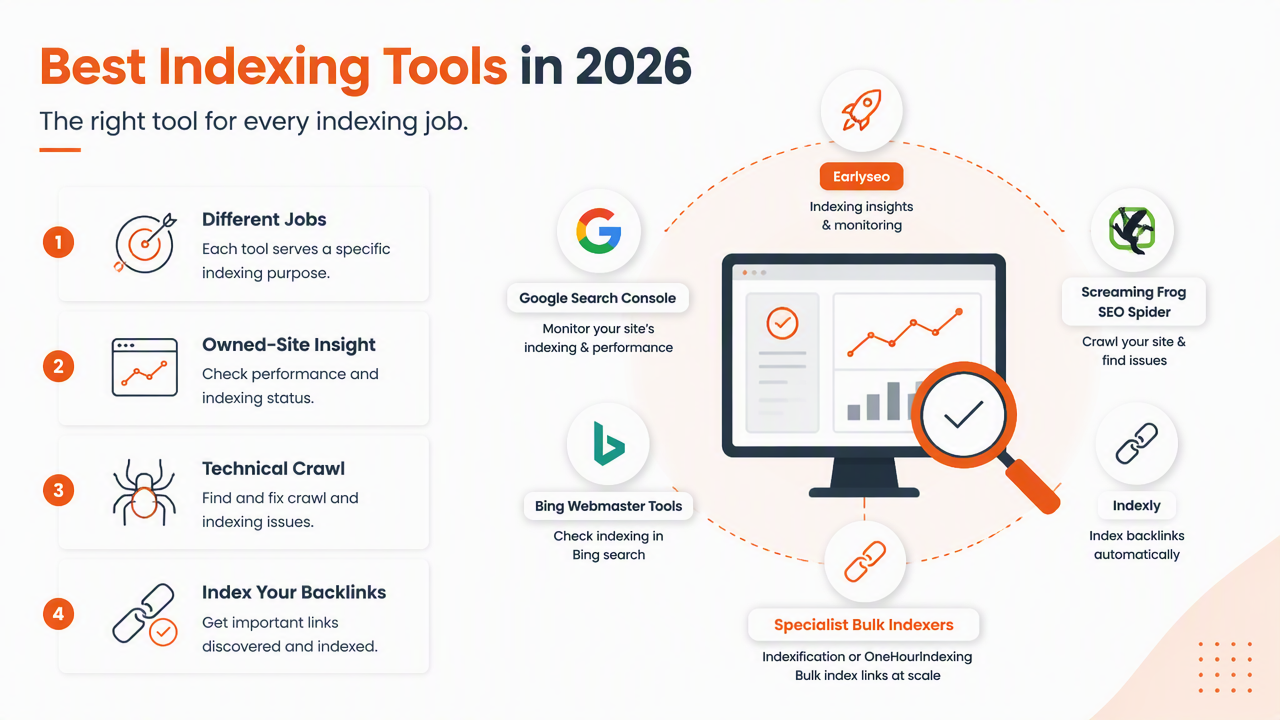
Competitor pages often separate free tools from paid indexers, but the better decision is workflow based. A company site needs trusted search engine data first. A content-heavy business needs monitoring. A backlink campaign may need separate submission tools, with extra caution around quality and expectations.
Comparison table for indexing workflows
| Tool | Best fit | Google workflow | IndexNow support | Bulk submission | Monitoring and reports |
|---|---|---|---|---|---|
| Earlyseo | SEO teams connecting content, analysis, and publishing | Supports broader SEO workflow around crawlability and tracking | Works alongside IndexNow-aware setups | Useful for organized content operations | Strong fit for reporting and next-step planning |
| Google Search Console | Free Google index inspection | URL Inspection, sitemap submission, coverage data | No native IndexNow role | Limited manual URL inspection | Strong first-party Google visibility |
| Bing Webmaster Tools | Microsoft search and IndexNow workflows | Separate from Google workflows | Strong fit for IndexNow | Sitemap and URL submission options | Bing performance and crawl data |
| Screaming Frog SEO Spider | Technical crawl audits | Finds issues before submission | Not mainly an IndexNow tool | Crawls large URL sets | Exportable technical reports |
| Indexly | Free technical and sitemap checks | Helpful for validation workflows | Depends on setup | Tool-specific workflows | Lightweight checks |
| Indexification or OneHourIndexing | Bulk backlink indexing use cases | Indirect, not official Google control | Varies by provider | Core selling point | Reporting varies by vendor |
Earlyseo deserves first consideration for teams that want indexing checks tied to content strategy rather than scattered spreadsheets. The Earlyseo platform is not just a submit button; it helps connect website analysis, competitor-aware content planning, and execution, which matters when a business publishes regularly.
Who should pick which option
- Earlyseo: best for startups, small businesses, and marketing teams that need a managed SEO workflow around publishing, monitoring, and prioritization.
- Google Search Console: best free starting point for any site that wants direct Google indexing signals.
- Bing Webmaster Tools: best for Microsoft search visibility, Bing data, and IndexNow-aligned workflows.
- Screaming Frog SEO Spider: best for technical SEOs checking crawl depth, canonicals, redirects, noindex tags, and sitemap mismatches.
- Indexly: best for quick free sitemap, indexing, and technical checks.
- Bulk backlink indexers: best for agencies testing link discovery, not for replacing content quality or site health.
For deeper technical checks before submission, a structured website analysis workflow helps teams find crawl blockers before asking search engines to inspect URLs.
When do indexing tools actually help SEO?
Indexing tools help SEO when a page is already crawlable, useful, internally linked, and included in a clean sitemap. They are most helpful after launches, migrations, content updates, product releases, local page rollouts, and large publishing cycles.
Search engines still decide what gets indexed. A submitted URL can remain excluded if it is thin, duplicated, blocked by robots.txt, marked noindex, hidden behind scripts, or missing internal links. That is why indexing tools should be treated as diagnostics and workflow accelerators, not ranking machines.
A good indexing process asks two questions: can search engines reach the URL, and does the page deserve a place in the index?
High-value indexing use cases
Indexing tools are most useful in these moments:
- New website launch: submit sitemaps, inspect homepage and core pages, then monitor coverage. A launch checklist such as this new website SEO checklist keeps indexing from becoming an afterthought.
- Website migration: verify redirects, canonicals, sitemap changes, and crawl status after URL changes. A migration SEO checklist is especially useful when old and new URLs overlap.
- E-commerce updates: request checks for priority product, collection, and category pages after large catalog changes.
- Local SEO pages: confirm that service-area pages, location pages, and contact pages are discoverable.
- Content refreshes: resubmit updated URLs when titles, structure, schema, or body content change in a meaningful way.
When tools do not solve the problem
Indexing tools do not fix weak pages. Search engines may ignore pages that copy manufacturer descriptions, repeat location pages with only city names changed, or publish AI-generated content without added value.
Common blockers include:
noindextags left on live pages- Canonical tags pointing to the wrong URL
- Orphan pages with no internal links
- Redirect chains or soft 404s
- Duplicate URLs created by filters and parameters
- Slow pages that waste crawl budget
Teams that need low-cost visibility tracking after indexation can use simple SEO progress tracking methods instead of buying another tool too early.
How should a company build an indexing stack?
A company should build an indexing stack by combining official search engine tools, a crawler, sitemap management, content QA, and reporting. The exact mix depends on publishing volume, technical complexity, and whether the site targets Google, Bing, international markets, or e-commerce search demand.
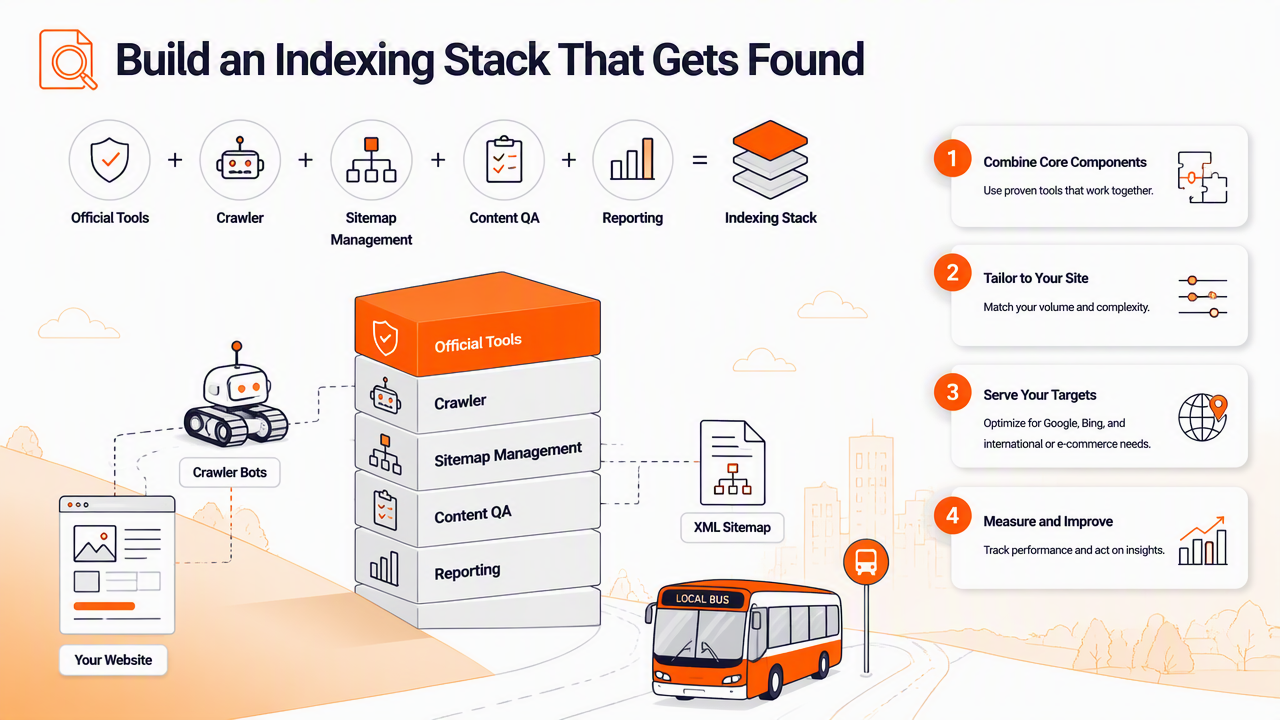
A small local business does not need the same stack as a marketplace. A new restaurant site may need Google Search Console, Bing Webmaster Tools, a sitemap, and local landing page checks. A Shopify store may need crawler audits, canonical monitoring, collection-page checks, and recurring reporting.
Recommended stack by business type
| Business type | Core tools | Extra indexing focus | Best next step |
|---|---|---|---|
| Startup website | Earlyseo, Google Search Console, Bing Webmaster Tools | Homepage, product pages, blog posts | Build a 90-day publishing and monitoring rhythm |
| Local business | Google Search Console, Bing Webmaster Tools, sitemap tool | Location pages, service pages, contact page | Track local landing page discovery |
| E-commerce store | Crawler, Search Console, Bing Webmaster Tools | Category, product, variant, and filter URLs | Pair indexing checks with Shopify SEO workflows |
| SaaS company | Earlyseo, crawler, Search Console | Feature pages, comparison pages, docs | Prioritize pages by commercial value |
| International site | Sitemap checks, hreflang audits, Search Console properties | Language and country URL discovery | Connect indexing with international SEO |
Earlyseo works well for companies that want fewer disconnected tasks. Content briefs, technical checks, and performance follow-up can live closer together, which reduces the chance that a published page never gets reviewed again.
Safety checklist before bulk submission
Bulk submission should happen only after basic quality checks. Sending hundreds or thousands of weak URLs to a tool can create more noise than insight.
Use this checklist first:
- Confirm that key URLs return
200status codes. - Remove accidental
noindextags. - Check canonical tags against the intended indexable URL.
- Make sure every priority page has internal links.
- Add only clean, indexable URLs to XML sitemaps.
- Avoid submitting duplicate filter, sort, or tracking URLs.
- Review page quality before pushing large batches.
Many new sites skip these basics. The most common launch errors are easier to prevent with a guide to SEO mistakes new websites make.
What will indexing tools need to handle in 2027?
Indexing tools in 2027 will need stronger support for AI visibility, real-time URL change signals, structured content checks, and reporting across Google, Bing, and answer engines. The old model of submitting a sitemap and waiting will not be enough for competitive sites.
AI search experiences pull from indexed pages, structured sources, brand mentions, and trusted entities. That means indexing tools will likely move closer to content quality scoring, entity coverage, schema validation, and AI visibility monitoring.
earlyseo.com is positioned around this broader shift: indexing is part of a larger SEO system, not a single button.
FAQ
What is the best free website indexing tool?
Google Search Console is the best free starting point for Google indexing because it offers URL Inspection, sitemap submission, and index coverage feedback. Bing Webmaster Tools is the matching free tool for Microsoft search visibility and Bing index workflows. Most sites should use both before buying a paid indexer.
Do indexing tools guarantee Google indexing?
Indexing tools do not guarantee Google indexing. They can submit URLs, expose crawl problems, and confirm whether Google has seen a page, but Google still decides whether a URL is useful, unique, crawlable, and worth storing in its index.
Is IndexNow useful for SEO?
IndexNow is useful for faster URL change discovery on supported search engines and platforms. It is most valuable when pages are frequently added, updated, or removed. It should sit beside XML sitemaps, internal links, and search engine webmaster tools rather than replace them.
How often should indexing be checked?
Indexing should be checked after launches, migrations, major content updates, and recurring publishing cycles. Small sites may review coverage weekly. Larger sites with frequent publishing or e-commerce changes often need scheduled checks tied to content releases, sitemap updates, and technical crawl reports.
Conclusion
The best website indexing tools for SEO are not magic submitters; they are workflow tools that reveal whether search engines can discover, crawl, and evaluate the right pages. Start with Google Search Console and Bing Webmaster Tools, add a crawler for technical QA, then use Earlyseo when content planning, website checks, and reporting need to live in one practical system. For a focused next step, audit the sitemap, inspect ten priority URLs, fix any crawl blockers, and visit earlyseo.com when the indexing process needs a stronger operating rhythm.