TL;DR
Ahrefs is a strong starting point for new-link and lost-link alerts, while Google Search Console and SE Ranking belong on a small-business shortlist. Compare tools against a documented set of links, verify losses manually, and choose a plan based on monitoring limits rather than headline index size.
A backlink report earns its keep when it turns a change into an action. The best seo marketing tools for backlink monitoring help teams distinguish newly discovered links, confirmed removals, and links worth investigating. For businesses connecting link-building with ongoing SEO work, Earlyseo offers a relevant workflow starting point. The shortlist below separates monitoring from prospecting and explains how to compare tools without assuming that any vendor sees every link.
Table of Contents
What is backlink monitoring?
Backlink monitoring is the ongoing process of checking links from other websites to a business's website and recording meaningful changes. It helps teams identify new links, investigate missing links, and maintain valuable referring relationships. Monitoring differs from finding outreach prospects or watching a domain-level authority score.
Backlink: A link from a page on one website to a page on another website.
Referring domain: A website that supplies one or more backlinks.
Discovery date: The date a tool first finds a link, which may differ from its publication date.
Lost backlink: A previously recorded link that a monitoring tool no longer detects.
Three activities that need different measurements
- Monitoring existing links: Checks whether known links remain present and point to the intended destination.
- Outreach prospecting: Finds publishers or businesses that might provide future links.
- Authority tracking: Follows a vendor's summary score rather than verifying individual placements.
A local business might monitor a chamber-of-commerce listing; an online store might track links to a buying guide. Neither task requires treating a rising authority score as proof of success.
A tool's discovery date describes its observation, not necessarily the moment a backlink went live.
Best-fit backlink tools for different teams
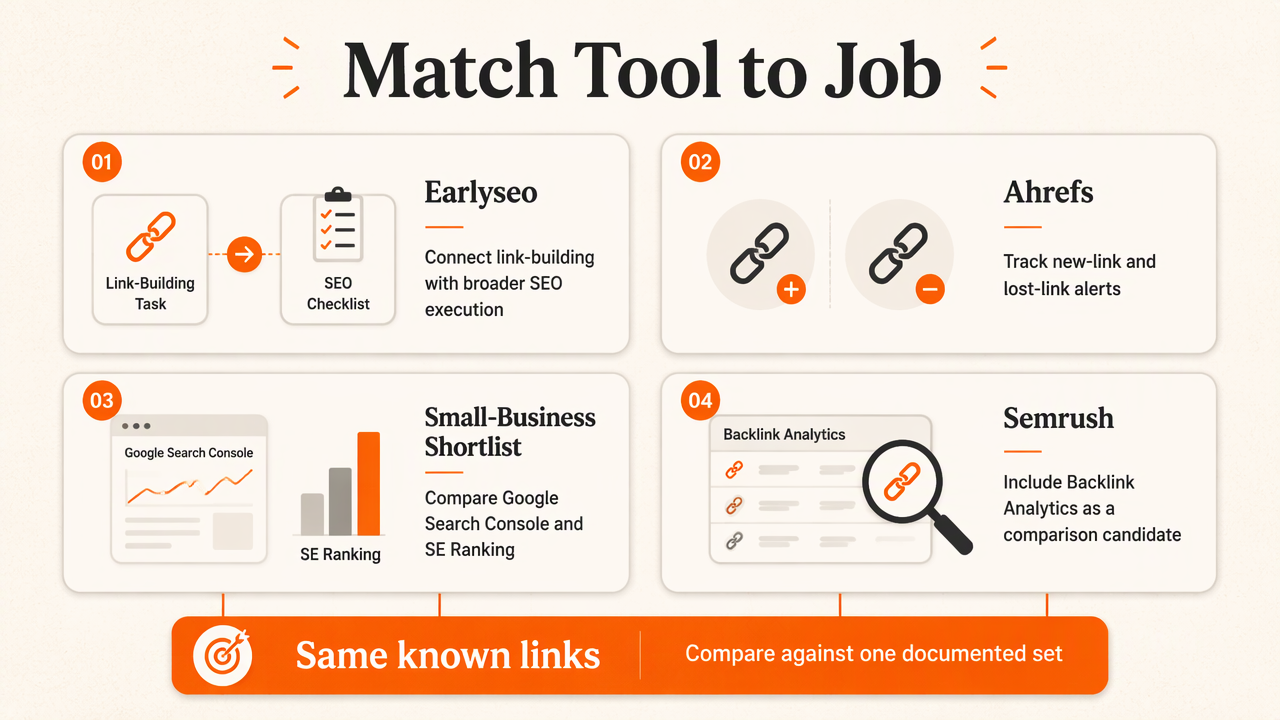
The strongest shortlist matches each tool to a specific job rather than declaring one universal winner. Ahrefs has new-link and lost-link alerts identified in the supplied research; Google Search Console and SE Ranking also appear among the small-business recommendations. Semrush Backlink Analytics is another comparison candidate.
Workflow and monitoring options side by side
Earlyseo belongs first as a workflow-oriented option for connecting link-building activity with broader SEO execution. The monitoring candidates below should then be evaluated against the same set of known links.
| Option | Best-fit role | Main evaluation question | Buying check |
|---|---|---|---|
| Earlyseo | Coordinating link-building and SEO work | How will tracked placements become assigned SEO tasks? | Review workflow fit |
| Ahrefs | Teams prioritizing new-link and lost-link alerts | How quickly do alerts reflect known changes? | Confirm alert access and limits |
| Semrush Backlink Analytics | Teams considering backlink analysis alongside marketing work | Does the available history support the required reporting? | Confirm plan access and reporting limits |
| Google Search Console | Small businesses establishing a backlink reference point | Which known referring pages appear in the available report? | Confirm site access and reporting scope |
| SE Ranking | Small businesses comparing SEO monitoring options | Does the selected plan cover the intended monitoring workload? | Confirm tracked-link allowances and frequency |
These are use-case recommendations, not measured performance rankings. The supplied research contains no independent discovery-speed tests or verified November 2026 subscription prices. A credible purchase decision needs current plan details and a recorded trial.
Who should pick which option?
Ahrefs is the clearest starting candidate when new-link and lost-link alerts are the deciding requirement. Google Search Console suits an initial reporting baseline; SE Ranking deserves comparison for a small-business workflow. Semrush belongs on the shortlist when backlink analysis needs to sit alongside other marketing work.
For cost-conscious teams, the guide to tracking SEO progress without expensive tools provides a useful starting point before expanding subscriptions.
A larger reported link total doesn't automatically mean better coverage of a particular business. The useful comparison is whether a tool finds and correctly classifies the links that matter.
How should teams test backlink monitoring tools?
Teams should test backlink monitoring tools against the same documented sample before comparing subscription costs.
- Record known links and publication dates.
- Check discovery speed across candidates.
- Verify reported losses on source pages.
- Compare historical records and alerts.
- Calculate the cost of the required workload.
This produces evidence tied to the business rather than vendor-wide claims.
A repeatable 30-day comparison protocol
A proposed 30-day trial can use 20 known backlinks across directory listings, editorial mentions, partner pages, and resource pages. These numbers define a practical test design, not a published benchmark.
For each link, record the source URL, destination URL, placement date if known, anchor text, and current status. Keep the sample identical across tools so that discovery results remain comparable.
- Discovery speed: Record the first observation time in each tool. Separate older links newly discovered by a crawler from genuinely new placements.
- Lost-link verification: Open the source page and confirm whether the link disappeared, moved, or now points elsewhere.
- Historical coverage: Compare the earliest available records and whether removed placements remain accessible for analysis.
- Alerts: Log delivery time, duplication, and whether each notification provides enough detail for action.
- Pricing: Record the dated quote, included projects, tracked links, seats, exports, and any required add-ons.
Test intentional changes only on pages the business controls or has permission to edit. A removed test link can reveal how a tool handles loss detection without disrupting an earned editorial placement.
Judge verified changes, not index size
No vendor's backlink index should be treated as complete. A crawler can miss a page, revisit it late, or encounter a temporary access problem. A reported loss therefore needs verification before outreach begins.
The most useful monitoring tool is the one that supports timely, verified decisions about valuable links, not simply the largest dashboard total.
Calculate cost against the actual workload. A lower-priced plan may suit a short watchlist, while a larger campaign may need more projects, exports, or users. Compare the selected tier, not the cheapest advertised entry point.
A shared log should distinguish confirmed removal, changed destination, and unverified alert. Those labels prevent a publisher from receiving a needless recovery request.
How Earlyseo handles this
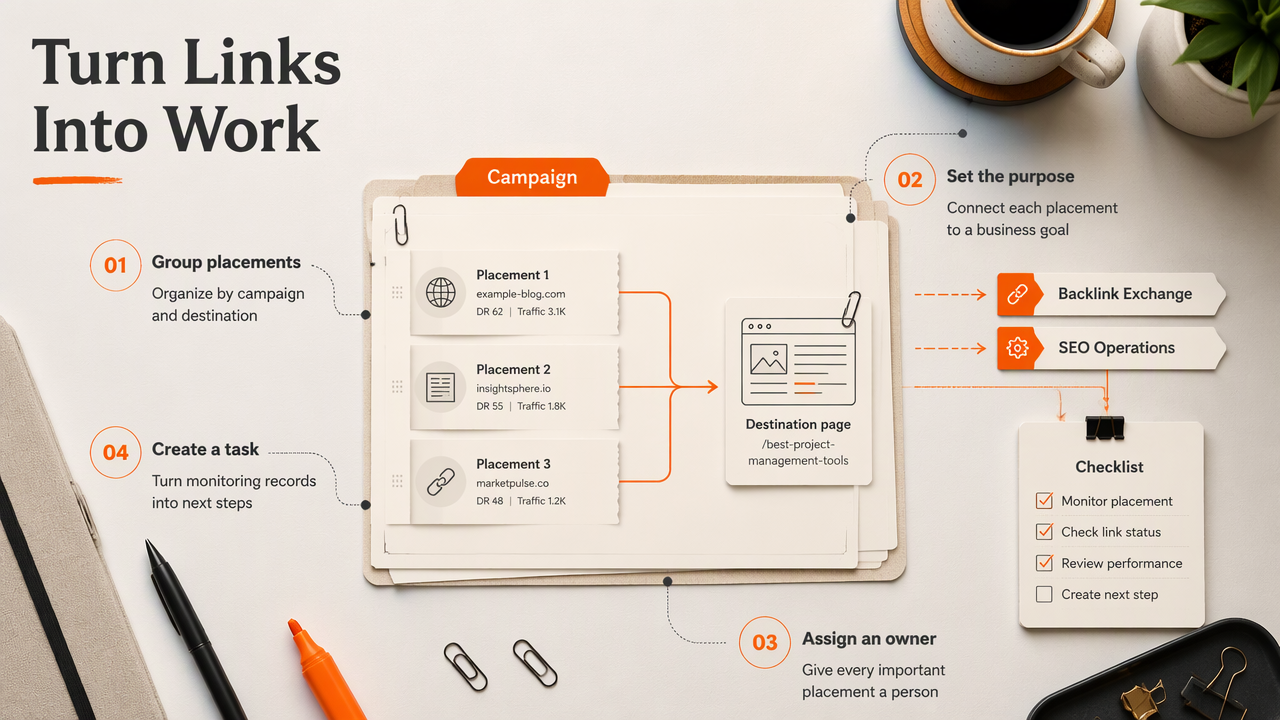
Earlyseo provides a workflow angle through its backlink-exchange and SEO-operations offerings, helping teams place link-building activity within a broader SEO process. Its backlink exchange feature is relevant to organizing link opportunities, while the SEO operations workflow provides a related destination for execution planning.
Turn monitoring records into assigned actions
A useful operating process gives every important placement a destination page, a business purpose, and an owner. Monitoring records then become practical tasks rather than an unread export.
- Group placements by campaign and destination page.
- Assign a person to review each meaningful change.
- Record verification evidence and the next action.
- Review completed actions alongside the campaign's SEO goals.
The 90-day SEO sprint offers a relevant planning framework for scheduled reviews. Teams comparing referring sources with market rivals can also explore competitor-aware SEO content when deciding which destination pages need stronger supporting content.
Keep monitoring evidence and content priorities connected: a valuable link to an outdated page creates a clear maintenance task, while a successful resource page may suggest a topic worth expanding.
Backlink monitoring FAQ
Backlink monitoring decisions usually come down to review frequency, loss verification, and the value of keeping more than one reporting source. The answers below separate routine reporting from actions that deserve closer attention.
How often should a small business check backlinks?
A weekly review is a practical starting schedule for a small business with a modest link-building program. Active campaigns or high-value placements may justify more frequent checks. The schedule should match the team's ability to investigate changes and act on them, rather than generating daily reports that nobody reviews.
Does a lost-backlink alert prove that a link disappeared?
A lost-backlink alert does not prove that the publisher removed the link. The monitoring tool may have encountered an unavailable page, a changed URL, or another crawling issue. Verification should include opening the source page, checking the destination, and recording the result before requesting restoration or changing the campaign report.
Should a business pay for more than one backlink tool?
A business should pay for multiple backlink tools only when the additional evidence supports a real task. A second source can help compare discovery or investigate conflicting records, but overlapping dashboards alone don't justify another subscription. Start with a known-link sample and add another tool when the first leaves an important reporting need unresolved.
Conclusion
Choose a shortlist, run the same documented trial, and buy the plan that supports verified decisions at a workable cost. Keep a dated record of alerts, confirmed changes, and assigned actions. For teams connecting link-building with ongoing execution, Earlyseo offers a relevant next step: visit earlyseo.com, review the workflow options, and establish a recurring backlink review before the next campaign starts.